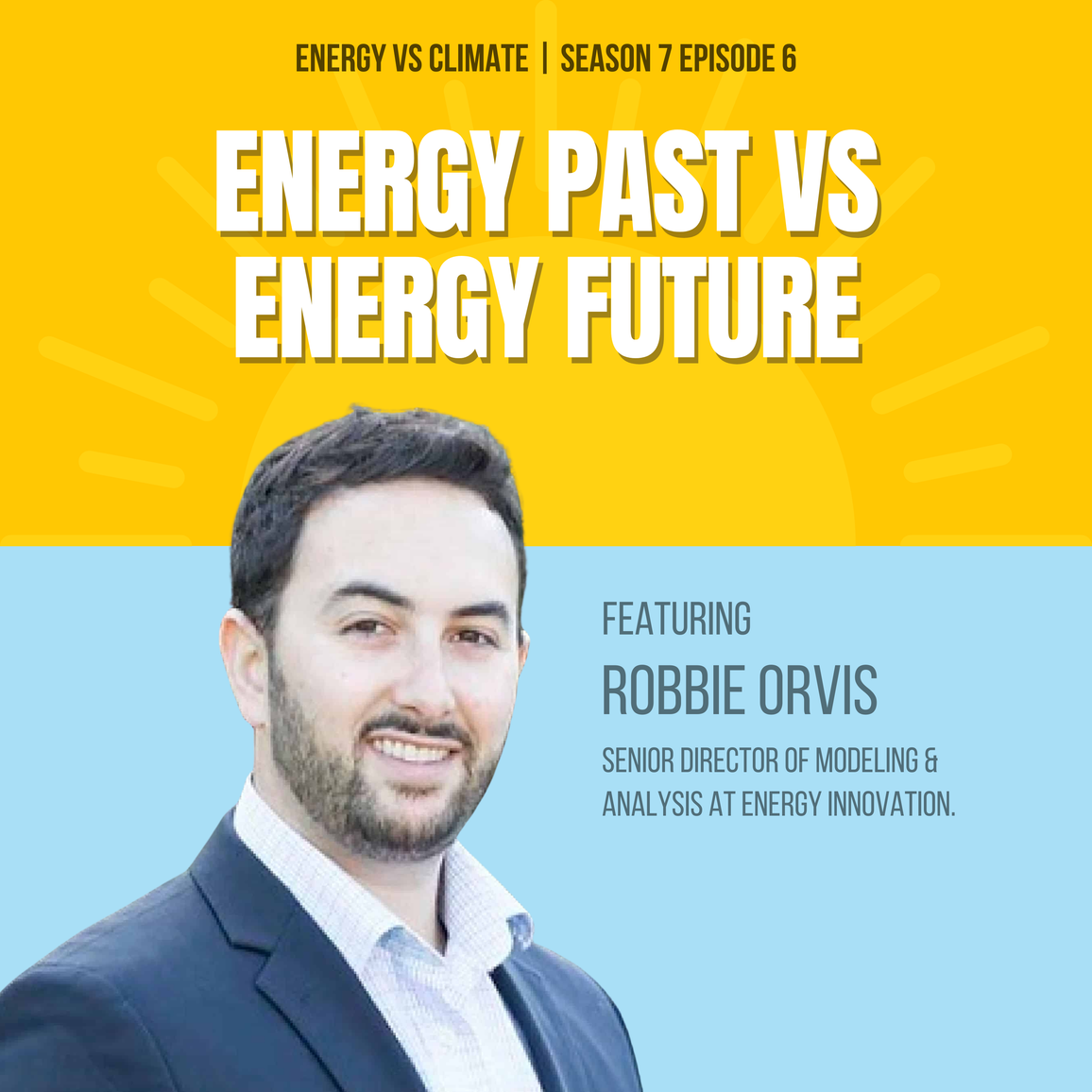
Energy Past vs Energy Future with Robbie Orvis

A look back at the biggest energy stories of 2025 and some crystal ball gazing about what to watch for in 2026.
David, Sara and Ed chat with Robbie Orvis, Senior Director of Modeling & Analysis at Energy Innovation, an American Think Tank.
The show was set up to do two things: First, to sort out what genuinely shifted in 2025 and what didn't. Second, to build a 2026 energy and climate watch list that helps separate real transition signals from the noise and the hype.
It's a lively conversation with great audience questions - a sign that people are trying to make sense of a confusing year.
References & Show Notes
(4:45) Global spending on the clean energy economy continues to grow and now exceeds spending on fossil fuel development.
Scientific American, “Clean Energy Spending Will Surpass $2 Trillion This Year” (June 2024).
(6:20) EV sales have increased from zero to almost 18 million units annually over the last decade.
IEA, global EV outlook 2025, trends in electric car markets
(12:00) Clean energy prices are consistently trending downwards, often making them more competitive than fossil fuel generation.
Canary Media, Chart: Renewables are on track to keep getting cheaper and cheaper (September 2023)
(12:00) Manufacturing constraints on gas powered generation equipment could lead to challenges meeting near-term electricity demand.
(13:00) The role of LNG in the South Korean energy market is expected to decrease due to increasingly unfavourable economics.
(17:15) Alberta’s carbon system allows a large oversupply of credits, letting companies meet most of their obligations with cheap credits instead of paying the full carbon price.
(21:00) Exports of Chinese-manufactured solar panels in markets other than the U.S. have increased sharply over the last few years.
Ember, Global Electricity Review 2025 (see chart on China's solar PV exports) (April 2025)
(23:40) There is decreasing momentum behind national and international efforts to reduce emissions.
IEA, World Energy Outlook (November 2025)
(29:00) Oil and gas demand does not peak in the IEA’s Current Policies Scenario
IEA, World Energy Outlook Current Policies Scenario (November 2025)
(30:50) Global oil demand is not expected to peak until 2032. Reuters, Global oil demand won't peak until 2032, Wood Mackenzie report says (October 2025)
(33:10) Global emissions policy has reduced projected long-term warming by roughly one degree Celsius compared to 10 years ago.
Climate Action Tracker, Global Temperature Update COP Brazil (November 2025)
(37:27) Nuclear energy development has plateaued in the U.S. for decades, but countries like India and China are rapidly increasing their installed capacity.
(48:50) EU policymakers reached a deal to cut emissions by 90 percent by 2040. Reuters, EU strikes deal on climate target to cut emissions by 90% by 2040 (December 2025)
(56:00) A DOE proposal on large-load interconnection has raised concerns about federal-state jurisdiction. Utility Dive, DOE large load interconnection proposal sparks federal-state jurisdiction concerns (November 2025)
Episode Transcript
Robbie Orvis: I think there is so much momentum now, like we're not going back. Right. The, we're, we're headed towards the low carbon future. It's just how quickly we get there.
Ed Whittingham: Hi, I'm Ed Whittingham and you're listening to Energy Versus Climate, the show where my co-host David Keith, Sara Hastings-Simon and I debate today's climate and energy challenges.
On December 8th, the three of us recorded a live webinar with special guests, Robbie Orvis of the Think Tank Energy Innovation. We set the show up to do two things. First to sort out what genuinely shifted in 2025 and what didn't second to build a 2026 energy and climate watch list that helps separate real transition signals and the noise and the hype.
It was a lively conversation with great audience questions, which is a good sign that people are trying to make sense of a confusing year. So without any further ado, here's the show. Welcome, Robbie.
Robbie Orvis: Hi, Ed. Thanks for having me on.
Ed Whittingham: Hey, it's our pleasure. So we're gonna start with just a short scene setter with me and you.
Then we're gonna open up the conversation amongst the four of us, and then we'll finish up with audience questions. And please, uh, don't use the raise hand function. Send them in through the q and a box. So Robbie, though, before we dive into substance, we, we had Hal Harvey, the founder of Energy Innovation on EVC back like a few years ago now, August, 2022.
And he's talking about, uh, the book that, uh, he co-wrote called The Big Fix. And I'm pretty sure we only skimmed over energy innovation as a think tank at the time. Maybe you could give us the A, B, C 1, 2, 3 on energy innovation so people know where you're coming from.
Robbie Orvis: Energy innovation is a climate and energy policy think tank.
So we work on helping policy makers, uh, understand and design the most effective policies for an equitable and affordable future. Uh, and so we do that primarily through. Research using tools like the energy policy simulator and policy design advice based on our expertise. We do that all over the world, frequently working directly with policymakers and their staffs.
Ed Whittingham: Great. Okay. That's useful context. Now let's dive into substance and a very sort of high level question. When you look back, you and your colleagues look back at 2025. I know we're not done. We still have three weeks to go. We're mostly done. What were the big climate and energy things that changed in this year?
Robbie Orvis: I hope we're, we're almost done. I'm looking forward to turning the page on this year. Uh, it's been a, been a tough one for climate and energy, especially in the us. Uh, so obviously. Uh, you know, in the US the Trump administration took office and, um, the administration kind of quickly set to work on doing a lot of the progress that the prior administration had made.
Um, whether that's changing the tax incentives to deploy and onshore manufacturing in the US or the rules and standards that help ensure. That significant levels of clean energy technologies are being deployed. Um, or, you know, you look at the outcome of the latest cop and um, you know, the fact that we kind of fail to secure the next set of commitments that, that are in line with, you know, global ambition on climate.
Um, so it's been a tough year policy-wise. I think the kind of interesting counterpoint to that is that in spite of all that technology, we still see investment in technology deployment. You know, growing significantly. Uh, and, uh, that's happening all over the world. It's happening in the us, it's happening in China, it's happening in Europe.
So it's been, um, a tumultuous year for policy. And yet all that progress we've made on bringing down technology costs and, and scaling markets for new technologies is keeping a lot of the momentum, um, that we, that we had coming into this year.
Ed Whittingham: Yeah, and so that's a great summary. I, I think we saw some pretty significant policy moves this year, and most of them.
As you noted off the top kind of signaling a, like a retreat on climate action in the US but also here in Canada, which we'll get into. And in terms of cop and tumult, uh, I was involved in some of the discussions leading up to the G seven energy environment, ministerial, and it was interesting to see the way that politics played out.
The US was not just MIA as it was with cop, it was outright obstructionist. It was like sand in the gears, like behavior. And uh, without question, it limited the ambition coming outta the G seven. But I want you to expand upon that. Do these shifts that, like what's happened short term. Expand upon your part around, uh, technology deployment.
Do they really matter over the long term? If the world is still spending like 2 trillion a year on the clean energy economy, you know, close to 2% of global GDP? Or am I just seeing everything through rose tinted glasses and it's worse than, than that bottom line figure, uh, would suggest?
Robbie Orvis: Well, I think it's a bit of both.
I mean, um, right, so. Every ton matters and every incremental ton is worse than the last. So, um, in terms of losing. Uh, momentum and progress. It, it matters. Um, it ma it makes it harder. Uh, you know, one thing I like to talk about a lot is that the, um, you know, you kind of have your power plants and your more supply side technologies and policies, but, um, for a lot of things we are limited by how quickly the stock turns over.
So whether that's equipment in buildings, or. Um, you know, equipment and industry, um, you're kind of relying on the natural rate at which equipment breaks down and needs to be replaced. And so every year that we fail to grow the amount of clean stuff that's being deployed and replacing fossils, fossil equipment, we're locking in.
More emissions, right? So, you know, the loss of momentum is, uh, is a little bit damaging for achieving, uh, you know, deep decarbonization in line with the safe climate future. That said, you know, to your point, um. There's been so much progress made on, uh, on bringing down the costs and making available all these clean energy technologies.
I was looking at a graph from the IEA and the inter, uh, international Energy Agency, for example. Um, and like 10 years ago there were no EV sales at all, right? None. And now you look at, you know, China's gonna be more than half electric vehicles for new passenger cars. A lot of the rest of the world is on that trajectory.
You just have that across the board. You have it for EVs, you have it for batteries, you have it for solar and wind, which are by far dominating new builds globally. Uh, and so, uh, I think there is so much momentum now, like we're not going back, right? The, we're, we're headed towards the low carbon future.
It's just how quickly we get there. And then because, you know, climate change is a, is a problem of the total carbon in the atmosphere. It does matter for. You know, where we ultimately land in terms of how much warming we get, but these, I think in hindsight, will be looked at as more like blips on the road rather than, you know, a fundamental shift.
And, and that's largely due to just the economics of clean energy are. Spectacular now compared to where they were five or 10 years ago. And so increasingly you have just an economic argument, uh, for, for deploying these clean energy technologies and policy helps. But, um, at the end of the day, there's still a lot of countries and, you know, private sector actors who are still gonna choose what's cheapest.
And that's been clean energy, uh, now for a few years and it will continue to be that way.
Ed Whittingham: Hmm. Yeah. And I, I'll be curious to see when we get the data in, if 2025, we'll set another new record for solar and wind installations and, yeah. Yeah. The, the, the numbers on EV sales coming out of China are just absolutely staggering.
You, you're in Arlington, Virginia, you're close to dc so I'd love to talk just a little bit about US affordability politics. Then we're gonna pivot and, and talk about how they play out. In Canada, so I, I recall in the the, the New York gubernatorial race last month, the governor elect Mickey Sherrill campaigned on like freezing utility rates.
And trying to lower electricity bills, uh, for, for many residents. And normally that doesn't pop up as a key election issue. It did. That framing actually helped her defeat her Republican opponent. You know, so affordability is back in politics and you have progressive politicians running on doing things to keep.
Cost down. And that often means pivoting back to fossil generation, or at least they assume it means pivoting back to fossil generation. Uh, you know, what, what knock on effects do, sort of things like that at the, at the, um, state level in New Jersey have on federal politics. And then David and Sara, I'd love to chat about what, what knock on effect that has in Canada.
Robbie Orvis: Yeah, it's, um, it is interesting to see energy prices and affordability having, like being front and center. President Trump was on the air last week talking about how affordability is a democratic, uh, hoax. Um, but uh, you look around at, uh, energy prices and the direction they're going and household energy costs and.
It's clear that prices are going up and that a lot of the increase in prices in the US anyway is tied to, uh, growing natural gas prices. Uh, and so there is this interesting moment right now where, um, I think traditionally there's been, to your point, like, uh, there might have been a discussion around how, you know, increased fossil fuel production and demand can mitigate some of that.
You know, building off of what we were just talking about with how far we've come down the cost curve for renewables. I think the, the narrative that's kind of taking hold and is, you know, grounded in the empirical data is actually that our way out of this affordability crisis is through clean energy, right?
We're not, um, we're not dependent on, you know, the oscillation of fossil fuel prices in the us. If we can deploy more clean. And you know, one of the biggest factors here, and be curious to hear how it's happening in Canada as well, is this data center boom that's happening in the US or underway here.
There's so much demand for data center growth, and so you're seeing some of the forward markets where these price changes are being incorporated, reflecting the fact that the grid is, is expected to be highly constrained. And so those higher costs are being passed through already to rate payers. Um, and so in the US given our permitting system.
Uh, and the challenge in building new stuff and how long it can take. When you couple that with the fact that there's this global shortage for new gas power equipment, it really means that the only thing that can be built to address this affordability crisis and this growing demand is. Things like solar, wind, and battery storage for the next, you know, at least five years, maybe the next decade.
And so, you know, there's been just one study after another, a couple from us included, that are just highlighting the fact that there is no availability really to Dr. Drastically grow the amount of gas turbines in the pipeline. Um, but rather, you know. Deploying that clean energy that's already cost effective is, is the way out.
And you have utility executives saying the same thing, like the head of NextEra at John Ketchum is on record talking about this, uh, repeatedly, you know, that is at odds with what the administration is, is trying to do fundamentally and what they're talking about doing. Um, but if you just look at the, the economics and the cost of stuff, right?
Coal is so expensive to operate in the us. No one's building a new coal power plant. Um, gas, uh. The prices right now, the futures prices for gas are the highest they've been, um, in like five years. So gas is expensive in the us, um, or getting more expensive in the us and you just have this constraint on what can be built and the, the cheap stuff, the solar and the wind, and the storage is what can be built and will help bring down prices.
Um, it's, it's kind of amazing actually that we've gotten to the point where we can talk about clean energy as the solution to affordability instead of kind of the inverse of that. And that's due to all the policy and technology progress that's been made. But, um, that is really kind of at the heart of the affordability crisis in the US right now.
And, and at least, at least to us, the, the kind of clear way out of it.
David Keith: I can't help picking up on the loss of momentum question. I mean, it's clear there's a loss of momentum if you measure momentum by tweets or whatever you do on blue sky, but it's not so clear that there's a loss of momentum. I mean, obviously the capital flow into the ground, nuclear energy is accelerating.
I guess you could argue that the second derivative is slowing down, but I don't know if we know that. So I think it really is important to kinda distinguish this loss of momentum in the talk space than the real space. I mean, I got two questions. First, kind of specific one. What do you think about this kind of LNG glut that may come in the next couple years in East Asia?
I think there's a huge number of LNG plants coming. Of course that may make prices in the US higher 'cause they've got export markets, but it will tend to, I think, really change the, the, the, maybe change the way Indonesia gets off coal, for example. I'd like your thoughts on that.
Robbie Orvis: That's, uh, a really good question.
Um, and I'll note today I just saw that one of the main coal plants that's supposed to be shut down early in Indonesia, they just, uh, announced they're not gonna do that, which is kind of interesting just in the context of everything else. So, I. It's, it's hard to know exactly if you look for example, like in Korea where they've been tethered to LNG imports and they're, um, some of the, the power plant operators are, have been running at enormous losses because they're basically running on fixed contracts for the power and the LNG prices are exceeding what they're, they're getting there.
So you're seeing some of the early indications that, you know, tethering. If you're, you know, Indonesia or another Southeast Asian country and you want to tether your power grid to, uh, LNG, there are some serious risks to doing that. You know, it is increasingly as it becomes an internationally traded commodity, um, that's, you know, you're just locking in that.
You know, the price swings that, that, that opens up. I don't know what that means for, for, you know, Indonesia and other countries that are kind of figuring out all the different ways to try and to wean off coal. Obviously Indonesia also has this target that's been announced by the president about, uh, you know, getting to a hundred percent renewables.
But, um. Something's gonna have to be there to balance it. And the question is, do you build out the whole infrastructure to support that? Or you know, what exactly does that look like
David Keith: and what does it and, and how does it change if it's right that LNG prices are a lot lower there in the next few years. I wanna just push you on one thing you talked about, like cutting emissions for a safe climate future.
What does that mean to you? What's a safe climate future?
Robbie Orvis: Well, I'm, I'm thinking of it in the framing of the U-N-F-C-C. So, so one and a half degrees is the, is is kind of what has collectively been targeted. Right. But I guess the, the bigger picture is just, um, you know, like I said, every ton matters and obviously we're all coming to grips with the fact of where we are and, and yeah.
And where's where we can get, so we just,
David Keith: just to say it, you know it, but I mean, there's no scientific rationale between 1.5. It was a. Political target, which I think was very effective in actually motivating action. But there's nothing that makes it particularly safe or unsafe. Um, and it's every time that makes it worse.
And then of course, it, it's not just about emissions cuts, it also is about removing carbon or reflecting sunlight, if that's what we end up doing.
Robbie Orvis: That's right. Even in the 1.5 scenarios, you, especially this day and age, you have an enormous amount of overshoot and removal that you still need to do anyway.
So Right,
David Keith: which, just to be polite is, is that's what it looks like in scenario land. In reality land, it means like. Pretending like reality is you're not hitting 1.5 and then you're pretending you're gonna do something in the future that you're not actually doing, and then not talking about the thing that would actually manage climate.
It's this. Wait,
Robbie Orvis: David, you're telling me that, uh, our modeled scenarios aren't exactly what's gonna happen in the future.
David Keith: I mean, obviously not that, but more than that, that they're, they've been sort of politically constructed in this weird. Role that's kind of disconnected. Yes. So you get these very strong statements that decide to say, 10 gigatons of removal by 2050 or something, which I just think is laughable.
And, and it, it, it, it is. I just, I can't help poking you because you're sort of using that phrase and yet we all know it doesn't really mean much. And I think part of our duty to the public in this time of change, a really exciting change when we really are seeing this clean energy revolution, it is a time to, to start.
Talking more directly about what the trade offs are, and I think that that's why I am poking you. I know you know all this stuff underneath, but it's, it's the stuff that hangs under those phrases. Anyway, over to Sara.
Sara Hastings-Simon: Yeah, I just wanted to jump in on the, the rollback piece and maybe look at the Canadian story.
You know, I don't think we need to rehash the whole hot take that we had. If you didn't hear it. Go, go listen to some, uh, pretty. A pretty sharp criticism, I think it's fair to say of of some of the policies that came out of the Canadian, uh, federal Alberta, uh, MOU. And, and actually since we've recorded that, of course the Alberta government has now, um, put into regulation there, uh, change to the carbon pricing that in effect creates double.
Counting credits that will flood the market and lock in the price at, uh, something like $20 or below. So I think, you know, if there was any question about Alberta planning to negotiate towards a one 30, uh, effective price anytime soon, I think that sends a pretty, pretty strong signal. Um, so, you know, I think it's, I think it's pretty similar in some sense.
To, you know, actually Robbie, as you were saying, the administration coming in and rolling back climate policies of the previous administration, that does a pretty good description, unfortunately, of what's going on here in, in Canada, uh, with the, with the Carney government, despite the lack of change in, um, in party behind that.
But I think, like you say, I think there's, and, and like David was saying on the. Momentum. There's, there's some big steps backwards. And I think actually in the case of Canada and Alberta, we are gonna see, unfortunately, slower progress on the industrial side than, than we wouldn't have otherwise. But at the same time, there is, uh, still, you know, momentum moving forwards.
And I think there's still this, you know, you mentioned this idea of. Certainly in Canada and the US a lot of what has to get done is replace existing infrastructure with things that are clean. That's, of course very different from what has to happen in a lot of other parts of the world. Um, and so there's a, there's a little bit of a different story as well there too when you zoom out and say, well, okay, so there's, you know, Canada and the US maybe not going as, as fast as they might have otherwise.
Um, but there's some bigger changes that are un. Affected by the policies that I think are still gonna continue on the global scale. Right? And so in I, a's recent report, um, they talk about the fact that there, there's some of these underlying drivers, like previously population growth was a huge driver of demand increases when it comes to energy demand.
And that's really looking forward. Kind of no longer the case anymore, right? There isn't really a, a significant growing population. Similarly, you have certain sectors, um, they flagged cement, uh, along with iron and steel as you know, previously being, making up about 20% of global energy demand, uh, in the early two thousands, kind of looking back.
Um, and they are now, you know, below 10% and, and continuing to fall. Um, and, and. I think most interesting of all is, is that the growth, you know, over the last, since the 2000 say, was, was largely China. We've talked about where that's going forwards, but the new growth is really gonna come from places where the sun is shining and that new growth, it's not about replacing.
The existing high carbon infrastructure, but it's really about what you're building new. And there, I think those arguments around the, the costs, especially when you don't have to build out all this, say, underlying infrastructure for a, for a fossil grid in the same way. I think the mo, the momentum there I would argue is not necessarily.
You know, slowed down really by the US or, or China. I mean, certainly these are countries that are going to suffer more as a result of the, um, failure of US and China to cut their emissions, you know, as, as fast as they could be otherwise. And I mean, that, that is unconscionable, of course. Um, but at the same time, you know, from an emissions perspective in those places, perversely, some of these things we see popping up.
Uh, accelerating growth, you know, with the, with the solar story, right? I think it was maybe a graph from Ember that was going around showing that once, uh, the US kind of cut off Chinese imports of solar panels, you had quite a number of African countries, you could see, um, that the installations of solar in those places were spiking, sort of as those panels were basically being diverted and finding a new, a new market.
So, um, you know, I think it's, it's definitely. If not a step backwards. I agree. I think it's a slowdown in, in Canada and, and the us but that doesn't mean a similar slowdown elsewhere.
Robbie Orvis: Pakistan is such an interesting story to your point where it's like nobody had had thought that solar was gonna boom in Pakistan, but to your point that there's all this rooftop solar, um, that's, it's really helping to decarbonize the grid there.
Um, and that's largely this. You know, offloading of super cheap solar, um, from China, and you've seen, uh, similarly in a lot of the countries and regions around China, you're seeing this surge in ev sales that was also totally unexpected. And that too is from this, you know, supply of, of super cheap EVs. And it's not just there.
You know, I, on, on another show, um, um, ed Crooks was talking about, uh. His experience going to Jordan and seeing all the cab drivers there, they're all buying Chinese made EVs, right? Because they want cheap, reliable cars. They don't care where they're coming from. Um, so we do get, like, I think us, Canada, Europe, we get a little bit of that kind of like western, um, blinders on sometimes.
Uh, but it's totally, uh, you know. The amount, the growth in manufacturing of this stuff and, and where it's ending up is like a, a reason for optimism. Um, with, you know, I think probably have a whole show on the need to, like diversify supply chains generally, but I think it's a good thing we have a growing manufacturing base for clean tech.
Um, and that it's going, if it's not going here, it's going somewhere else.
Sara Hastings-Simon: Yeah, that's a, that's a great point. And I think that those, those are some of those dynamics that are missing from energy system models, right? When we're looking at costs and they really just don't capture those, those other pieces that, you know, drives, uh, drives decisions.
Ed Whittingham: Yeah. And just to comment, we have a growing manufacturing base, but it's still by any measure, if you look at what's happening in China versus. What used to be, you know, the, the heartland of clean energy manufacturing in the world, the US appears to have doubled down on, on fossil fuels and ai, and that's not a bad strategic decision, seeing the latter.
Whereas China is really doubling down on clean energy and playing catch up on ai. But I do, I do want to sort of. Pivot to a bit. Uh, we promised that we would look ahead and, you know, we've talked about sort of the good things that are happening. Sara mentioned, uh, the IA report. You know, we had the IA energy economist, Tim Gould.
Uh, on the show a couple years running when the IA came out with its World Energy outlook. And I know that the IA itself has pivoted a bit and it's trying to walk back a bit. Its prediction on, um, uh, emissions peak and, uh, you know, uh, global peak of, of oil demand. And partly that's because they don't see the world moving forward with their stated policies the way that they did before.
But I'd like to look just strictly at emissions. So what do the best now energy economic models, where do they converge on global emissions? Peaking, you know, what range are, are we looking at the plateau starting this year? And moreover, based on where that plateau, where that peak and plateau starts to happen, what does the decline look like?
Because my sense is, you know, current policy suggests once we peak, we're gonna decline sort of on a one to 2% annual basis. Whereas to your point, uh, Robbie and your description of avoiding dangerous climate change, you'd really need like a six to 7% annual decrease to stay within that, within that threshold.
And uh, David, I know that you'll have some comments on this as well, but Robbie, first,
Robbie Orvis: that's a hard question to answer in part because the models, uh, you have similar models doing similar things, producing wildly different outcomes. Um, and what you assume about the. The growth of the economy in different regions and population are also big drivers of that.
I might tackle that by actually breaking it into some like constituent pieces. Well, let's start with the largest in China, right? We expect emissions to level off this year or next year. Um, you know, the and, and greenhouse gases generally within the next few years. And then. Um, they're not gonna go down at six to 7% a year based on what's currently, you know, in law.
But even though, you know, the government has the goal of doing that, but we do expect to see a leveling off and then as, and then a decrease going forward. And that's, you know, as the power sector continues to decarbonize. I think the electrification of vehicles has moved much faster in China than anyone really expected.
And increasingly, you're seeing some of heavy industries start to be targeted now by the government, you know, moving off of, um, trying to move off of blast furnaces, for example, in the iron and steel sector. So, you know, that's China. Um. The US also, even though we have this rollback of policy to the earlier points, we still expect to see US emissions decrease going forward.
Um, and that again is from, you know, there will be definitely a slowdown in uptake of EVs. Um. Buildings and heat pumps are slowly being decarbonized in the US and we still expect to see the power sector, uh, decarbonize as well. And a lot of the existing coal fleet be retired regardless of what the current administration wants to do or tries to do.
And looking to a few others. Obviously Europe, um, there's a lot going on in Europe right now, but, uh, on the, on the brink of enshrining, um, arguably already have the 90 by 85 by 2040 reductions, plus 5% offsets. So. Um, fully expect the eu, even if they retreat a little on that, we should expect a pretty rapid decline.
In, uh, emissions in the eu. And the last one I'll, I mean, is India, right? And India is, we do not expect to see Indian emissions decrease in the near term. But again, uh, I think there's rapid growth in the EV market in India. Uh, and there's been really rapid growth in the deployment of solar and storage, especially the cheapest solar in the world.
Cheapest energy in the world is in India, Indian solar. You look at all those, you know, indicators, right? We haven't talked about, and to Sara's point, like so much of the growth is expected in, in, you know, parts of Africa and in some of south, some southeast Asian countries. Right? And I think that's a little bit, um, you know, to the earlier point about what happens with coal, what happens with LNG, uh, that's a little bit more up in the air.
But I think that generally, you know, we're starting to expect to see a leveling off. And then depending on policies countries have put into place and whether or not they follow through on them. Uh, we could see, you know, a, a steady decrease, but I think we have a little bit of a, of a ways to go before we can kind of say that that's, that's locked in.
Um, some of the, you know, momentum conversation notwithstanding.
Sara Hastings-Simon: I'll just throw in one, one other data point on the, um, kind of potential for a peaks of this also I think comes from ember. Uh, looking at the first half of 2025, the growth in solar and wind generation, um, was faster than the rise in electricity demand globally.
So I mean, that is, you know, of course that's just electricity. That's not the rest of the emissions. But given the, the increase in electrification as well, alongside that, that means, you know, a, a real decline in fossil fuels in the electricity sector globally. And, you know, potentially reaching then into other sectors that weren't previously electrified.
So I think that is an interesting sort of, you know, the, the challenge of like, when exactly is the peak coming and do we keep saying, it's just feels a little, like we keep saying it's just around the corner, but, but. That's one, um, more sort of concrete, uh, piece to, to throw in there on the IEAI do wanna clarify one thing.
So they, they didn't so much walk back the, the peak in oil. What they did was add back in, uh, sort of fro, I'll call it a frozen world scenario. There was a lot of, uh, Twitter and et. Uh, blue sky debate about that, um, in previous years where they, they took out this frozen world scenario, basically the one where you go forward with only the current policies.
Um, I think that there, you know, there's, there's good reasons to look at it from a, um, from a modeling standpoint. On the flip side, it's a, I think it's the most often abused. Scenario because people point to it to claim that, uh, you know, things aren't gonna change. And of course, what's inherent in that scenario, uh, or what underlies that scenario in terms of assumptions is the idea that there will be no new policies beyond what exists in the world.
And of course, never in certainly the history that I know of. Of climate policy, but probably I would, I would dare to say in the history of government overall, have you ever had the case where you had no new policies from, from one year to the next? And so, yeah, indeed, if you, you know, if we basically don't do anything more, we just throw up our hands and give up, you know, we're gonna, we're, we're not gonna see oil peaking for a long time.
Um, but in that same steps scenario that stated policies, um, you do still see, uh, that, that peak in oil.
Ed Whittingham: List these. This one didn't gen generate a sharp rebuke from the government of Alberta? When it came out. So it must have been at least a bit more palatable.
Sara Hastings-Simon: Uh, I think the politics is a big part of it, right?
Because, I mean, the IEA of course is the political, you know, it, it, it is, uh, subjects to political wins and it's funded by countries including the US and others. And so, you know, it's a, it's, it's a fine line. They have to walk.
David Keith: Yeah, I was looking at some of the other, uh, ones that aren't influenced in quite the same way, like the Wood McKenzie forecast has peaking in the next couple years.
Obviously Stead has a peak basically this year, or I mean this coming year. Uh, I think, I think the truth is we don't know very much and in some ways it doesn't matters rhetorically, but what's clear is it's gonna plateau and bounce around a little bit. The big question, of course, is what happens afterwards and you know, we've heard, I think Ed say, uh, 2% a year versus six seven.
I think the answer is. We really have no idea. I think that's the honest answer. I mean, we don't know how strong political efforts on climate will be 20 years from now. I'm actually kind of optimistic, but I think the truth is we don't know and we really don't know, uh, how the technologies are going to change.
I mean, it's, I think certain and emissions will go down, but, um, how quickly they go down, there's just. Huge set of branching uncertainties. I guess I'd like to hear from Robbie kind of thoughts on the kind of leading indicators of stuff that might happen outside the stuff we've been talking about. So, electricity system, decarbonization with solar and wind and batteries are clear.
EVs are clear. I mean, it's not clear how fast it will keep going, but it's clear that it's got this big momentum. I think what's less clear are questions like, you know, for the first time there actually has been more nuclear power generation. I wouldn't really call it a renaissance, but it's the first time it's turned around and China really is building reactors for it.
You know, reasonable prices in reasonable times. Is that gonna spread and what do we think about? Say cement plants with CCS cements are still, whatever they are, 5% or so of global emissions, is clearly a doable thing, what might happen. So I'd like to hear your thoughts about some of those things outside the, the, the stuff we talked about so far.
Robbie Orvis: Yeah, I'm happy to talk about that. I, one, one thing to add, just before jumping in on that, on to Sara's point and kind of like a note of optimism for folks who are familiar with Climate Action Tracker, they put out this thermometer, the cat thermometer every year. That is kind of a projection of where warming is headed with stated policies, frozen policies.
Pledges and commitments, and then we know the, the targets. But the main thing is, I was just in Europe and met with some folks there and kind of was saying, you know, it'd be really interesting to see what were you projecting a decade ago where we were headed with existing policy? And they're like, as it turns out, we just today put out, uh, a, a report, uh, infographic showing that.
And so the, the upshot is, to your point, Sara, on like not knowing what policies will be in place according to Climate Action Tracker. With, um, existing policies, we've cut a degree of warming, um, right over the ne through 2100 relative to where they saw things with policies in place a decade ago. So, um, that is a mix of, you know, technology progress that's induced to some degree by policy.
Um, but point being that, um. And this, you know, dovetails with you said David, like, we don't really know, we don't know what the policies are gonna look like. Um, but it's, it's great news that we've, according to, you know, their projections, been able to cut a degree off warming in, in a decade or so.
David Keith: To, to be clear, that's a degree off the expected median value.
Don't forget. We don't have a link between admissions and warming. It's one to one. There's an uncertainty effect of two or three there. It's so easy for policy people to keep not saying this thing. And yet, if you were a like regular Joe or Sally six pack and somebody was a bridge engineer and they said, oh, the bridge is definitely going to work for this truck, and then they later found out there was an uncertainty of a factor of three.
You you'd feel like they didn't know what they were talking about?
Robbie Orvis: Absolutely, yes. Central, central cases, of course. On the other tech. You know, I think, uh, and again, this kind of dovetails with you what you said, David, like we don't, I, there's been a lot of progress made. So if we think about, um, you know, a lot of people will still call the industrial sector hard to abate well.
Some of this stuff is hard to abate, but as it turns out, uh, we use a ton of low temperature and medium temperature heat for industrial processes. A lot of that can be tar, uh, decarbonized with the existing industrial heat pumps today, right? We don't need a technology breakthrough. We've got it for, for a lot of the low temperature stuff.
Um. The, the, the harder ones. You know, we thinking about cement and you mentioned CCS or iron and steel, I think the jury's still out. Um, I just, uh, heard about a company that has a novel process for separating iron from iron ore, um, with very little energy input and, and below today's cost, right? That's not.
No model is capturing that. I can guarantee you that that's, that's projecting into the future. So I think the one constant is generally that like technology innovation has outpa anything that our integrated assessment models or our climate models, um, are able to include. And so that provides some, some reasons for optimism.
I think, um, relatedly, like there are some of these sectors where the technology's actually there, it just hasn't been like the focus, all that said. Uh, a lot of it comes down to cost, right? And so, um, if you're trying to decarbonize your iron and steel sector and you're looking at, you know, should I do a blast furnace using really cheap coal, or do I wanna do a direct reduce iron with natural gas and electricity?
At the end of the day, it's gonna be the costs that matters and the fuel cost, right? And so that, um, that is gonna be highly geographically differentiated. Um, in the US for example, where we've had pretty cheap gas and pretty cheap electricity, we have a, we have heavily decarbonized our iron and steel.
But if you look at other countries that have really cheap coal and don't have much access to gas, that's where you see a lot of these blast furnaces that are still producing some of the highest emission steel. The world, you know, a lot of these industries, the technologies exist. Um, obviously if we wanna get like fully decarbonized seal, then we need to find another feed stock that's not coal or gas.
A lot of people talk about hydrogen or biomass based feed stocks, which we kind of know how to do. It just comes down to cost. And so the question is how quickly. How quickly can we scale the technologies to bring down the costs? Can we pivot them to being produced electro politically using cleaned energy?
Um, you know, and, and what's the willingness to pay or willingness to accept for that stuff? Um, you know, the Bill Gates likes to talk about the green premium and getting the green premium down to zero. Um, and you know, certainly there's a, there's a big kernel of truth in that. Um, and, and also that a lot of the technologies are being developed or have been developed.
Last point is just on nuclear. I always say like, I would love for there to be a nuclear renaissance. I would love to see small modular reactors, you know, be something that we can deploy and address those. I just always hear it's five or 10 years away and it's been that way for 25 years, so, um, well,
David Keith: but no, no, no, but something actually changed.
So, so first of all, small modular records may or may not be relevant at all, but I think it is important to say that it actually. Difference on the ground. Now I'm, I'm not a giant nuclear advocate, but it does feel different Objectively, we have seen the bottom turnaround.
Robbie Orvis: I think so. Um, and I, I mean, China, South Korea is really interesting.
Can you doubt the data
David Keith: or,
Robbie Orvis: well, I don't know. I think that there's a question around safety, I think, and what safety measures are being put into place and what the costs are. I think the US might be on the. One end of the spectrum of that where there's typically been very high and expense, you know, expensive safety measures.
I don't. And uh, um, from what I've seen, I don't know that China's building to the same specs. And so maybe there's something in between. Uh, I think it depends on countries and costs and willingness to tolerate risk. And I'm not someone I think the, uh. I think there is a public perception issue with the risk of nuclear that is maybe a little bit independent from the actual risk.
So I'm not saying that, uh. That there's necessarily strong logic to that, but, uh, I do, I I would like to see more data on the safety measures comparatively around the world. I will say that, um, we're working on some, some data and modeling for South Korea, and I did double, triple check. The costs that our partners were putting in there, because they were much lower than I expected.
And it does, it, it's based on real world achieve costs. So I think there are, to your point, some real cost breakthroughs that are starting to be achieved, um, in kind of the more traditional nuclear plants that I, um, it was, it was surprising to me to see it in China, kind of have an asterisk on, but South Korea, uh, I was, I was quite surprised to see the costs that are coming in for those new reactors.
David Keith: Yeah, I mean, China is mostly building basically now Westinghouse, AP 1000 variants. So I think those, I think are safer than the median US fleet. I'd be happy to live by one, but anyway, enough for now.
Sara Hastings-Simon: So before we move on to the, the future, I just wanted to throw one point in there, sort of philosophical in a way on the peak, because, you know, the, the analytical part of me says, well, you know, the, the peak is sort of nice to talk about, but when it comes to actually climate impacts, it's only half the story and therefore it doesn't really matter in that, you know, if we reach a peak somewhat further out, but we're getting a faster decline versus peaking sooner, but we have this long tail.
Of course that might be worse. You know, that, that. The sum of the admissions is what matters. But then there's part of me that, you know, reflects on, on things like the payers agreement and, and the way that I think having these targets does motivate action. And so I, I do kind of, I guess, and then on the side of really being able to demonstrate a peak in the decline, even if it's small, I think could actually sort of provide a bit of a.
Momentum in and of itself, right? Like a proof of concept that we can actually do this a real departure from the way that, you know, things have worked historically, globally in terms of emissions increases. Um, I'm curious, Robbie, or, or anyone else about, uh, where, you know, which side of that debate do you fall on?
Robbie Orvis: I think having, you know, to the earlier discussion on 1.5 too, you know, having, um. Having something to to aim for, like that is a helpful motivator in what we've seen with solar and wind to some degree. And storage and EVs is like, once you have that, um, point to aim for and you get the policies in place to scale the industries, some of the industries to meet that point, like that creates this somewhat like inexorable march towards.
Those technologies becoming available, right? Like we're not gonna, they're not gonna shut down ev a plants and en mass now because the target shifted, right? We're gonna, that they're gonna continue to innovate, they're gonna continue to drive down costs. So having those things to aim for can help, uh, put the steel in the ground to get the, uh, hopefully it's low carbon steel, put the low carbon steel on the ground to, uh, to get those, those techs, you know, invested in it and deployed.
Ed Whittingham: I, I've got actually one question. What is the single biggest metric that matters to you, Robbie, that tells us it's gonna tell us fast. Whether to, uh, 2026 is a turning point or not? You know, it's not, let's say it's not aggregate emission statistics, it's not policy declarations. It could be David's Westinghouse, AP a thousand installations.
It could be, uh, global year over year change in fossil fuel consumption. That's measured in Exajoules. It could be grid investments, ev market share trajectory, global battery storage installations. It could be all of the above. I'm just throwing them out. But I'm curious, what, what one, or, you know, two to three indicators are you gonna be most paying attention to?
Robbie Orvis: I do look and follow, uh, like coal consumption in China. Um, that can vary, uh, quarterly, monthly, and annually. But it is a good indicator since China's the largest emitter in the world, uh, of where things are headed. It's can be hard to separate the signal from the noise. You know, one down year for hydro, for example, can cause an increase in coal, but that's a little bit more noise than signal.
Um, if you're looking at long-term trends. So for near term, right, we always have, all the emissions data is on, like, usually on a multi-year delay. Um, there's some groups, you know, rhodium puts out their, kind of, their latest. Um, but I, I do look at kind of the, a lot of sales. So you have kind of energy consumption, whether that's coal, I mean primarily coal, um, but then also looking at sales figures, sales figures for EVs, sales figures for.
Heat pumps, if you can find it, it's pretty hard to find that stuff. Um, but those are the best kind of like near term indicators, right? Knowing too that they vary seasonally, you know, in the US for example, is the EV tax credit was expiring this year. You had this enormous surge in EVs and unsurprisingly, all of the media was like, oh my God, we have this huge surge in EVs.
Well, what do you think happened the month after that? Right. Sales dropped off 'cause the tax incentive went away and the next media cycle was, oh, EVs hit, you know, multi-year low. Well, it's 'cause you're looking month to month and there's noise in there, right? So it's a little hard to do that. And you have to be careful not to try and draw conclusions from, from that noise and look for the signal.
So I think that, you know, annual fuel demand accounting for changes to the system, but really like annual deployments. And to Sara's point, like seeing that the deployment of renewables outpace the growth in electricity demand, I mean, that tells us that, you know. That tells us that we're on a path towards decarbonizing power, if that holds, um, right.
And when, and we know there's gonna be growth and power there. But, um, you know, long answer to your question. If I had to point to a few, it would probably be coal consumption in China, EV production and exports from China. Um, and, uh, and sales of EVs in, you know, some of the leading markets, India, us, EU, and China are, are some of the, the big ones looking at sectors that are gonna be able to move enough to flatten or drive down in the near term.
Ed Whittingham: Got you. And to your question about, or to your point about EV drivers and which country was it Robbie? Was it, uh, Indonesia. Jordan, you mentioned. Oh, Jordan. Yeah, sorry. Um, if only here in North America, we opened up our market to BYD sales. Imagine what EV sales would be at a significantly reduced price point, but in the infinite wisdom of our governments, they see fit to keep it closed, to prop up the incumbents and the incumbent EV producers.
Wouldn't that be wonderful to change? Listen, I'm gonna take us well. I mean, okay. Okay. David Counterpoint, who
David Keith: knows who I, I don't. I mean, this is on the day where China just passed a trillion dollar, uh, uh, net, uh, uh, import surplus or export surplus. I think I want things to decarbonize faster, but I think there are true political problems with all manufacturing going to China, and I wouldn't sweep 'em under the rug.
Robbie Orvis: With, I agree with that. I agree with that. And you know,
David Keith: we have, we have friends in our extended family who work in those auto plants. I don't want them all to be wiped out right away. I want change, but
Ed Whittingham: I, I don't know if it's just a matter of time, like how much do you prop up market to make the change more gradual?
Because it's just a matter of time before Chinese EVs are dominating. Maybe you need to rip off that bandaid. A
David Keith: hundred percent agreement that if we're just propping it up to make it die more slowly, that's bad public policy. But we need to do something. We can't just have all manufactured go to China.
Robbie Orvis: This is the problem, right? We, we've, we've insulated the markets and we're not seeing the change from, from the big automakers. It's like kinda the worst of both worlds at the moment. Here, here.
Ed Whittingham: Okay. Uh, I'm gonna move us to questions. Liz Addison asks, Venezuela claims to have the world's largest reserve of oil and gas.
If their political situation stabilizes and their fossil industry comes back, will there be a reduction in price with an attendant increase in demand? I'm opening the floor to, however, wants to weigh in on Venezuela.
Sara Hastings-Simon: I'll jump in and say, you know, I think this is actually another example of the sort of up and down that Robbie was saying that, you know, you can't look at one data point and sort of make a conclusion and probably not even two.
So I think there is going to be this bumpy transition as. We hopefully, you know, are scaling down our use of fossil fuels where you sometimes have supply, outpacing demand and prices falling, and, you know, maybe then you do get some feedback on adoption. Um, but I don't, I, I think that we're out of the woods in terms of.
Really cheap oil, just completely flooding the market and stopping the transition because all of a sudden people decide, wait, like I'd rather have that. I, I think that kinda risk is more, uh, more meaningful at towards the very beginning of a transition of trying to get a totally new technology off the ground, where if you can just crush it on a price basis, you might be okay.
Ed Whittingham: Okay. Um, I'm gonna keep us going on to the next question, uh, friend of EVC that you've heard many, many times before. Rob Trombley. Okay. Um, as
Robert Tremblay: so, as long as I've been thinking about climate policy, which to be fair is not that long, all, all things considered, um. I thought there would be a, a, a virtuous cycle between kind of cost of clean tech and implementing policies that accelerate their adoption.
So, and I think that's kind of informed an idea that the most important policies right now are the ones that are likeliest to reduce the cost of clean technology. Um, does the moment we're in right now where it does seem we've achieved a lot of the cost declines that we've needed for kind of economic deployment of clean technology kind of show that that theory is wrong?
Or are we just in sort of a bit of a blip right now and. We might kind of get closer back to that, uh, world in the future.
Robbie Orvis: Uh, I'll, I'll, I'll take a first crack at that. Um, I think it's more of a, of a blip, I think. Uh, uh, and, and I think there's a lot of, um, substance that theory, if you look, uh. You know, you can look around the world.
I mean, EU is another example, right? Just mentioned there. They're just put in place, a 90 by 20, 45% of that's offsets, but that's, that's evidence of that you have what's happening in China with the growth of EVs also being part of that. If you look at the sub-national level in the us. You have a bunch of states in the past few years that have put into place clean electricity standards.
You have, you know, California had in place a standard to basically get close to a hundred percent electric fuels by 2035 that, uh, a handful of other states adopted is about 40% of the market. The current administration, um. Did, uh, basically block them from doing that. But I think it actually kind of ties into what we were just talking about, right?
The, the road to decarbonization is not straight, it's not linear, it's bumpy. Um, but if you have technology kind of marching along, um, you're gonna, you're gonna trend towards that, you know? That long-term deployment of clean electricity, clean technologies that drive, that drive down emissions and policy that kind of under underlies and supports that, even if you have periods where you're kind of going back on it.
So I think the long-term trend is, you know, aligned with your thinking on it, even though there. You know, administrations change and priorities change, but I do think you'll continue to see policy that is aimed towards growing the share of clean technology for no other reason than it's increasingly the cheapest thing you can do.
Sara Hastings-Simon: And I'll, I'll just add onto that. I, I totally agree that I think it's, it's sort of a pushback and a, a bit of a dynamic that goes in both ways. I think, um, certainly the lower costs, as we talked about without the policies, makes it ke easier for these things to be adopted. And then I agree, Ravi, that I think we see those policies come back.
I would characterize this pushback both on the policies and also, you know, if you look at sort of cop over the last few years. Um, in something that I've, uh, learned from Leah Stokes, professor Stokes, um, who I think we had on the podcast a while back. Now she's a political scientist at, uh, uc, Santa Barbara.
Um, and she and others have written about this idea that incumbents, they don't have the bandwidth and it doesn't make sense for them to go around fighting, you know, every single possible new technology. It's only when these technologies become sufficiently large and sufficiently threatening to their incumbent position that they actually stop.
Pushing back. And so, you know, there's sort of like a perverse good news way in a sense to read this, like fossil industry pushback, whether it's a, you know, showing up in at, in huge numbers un unlike they used to do at COP or this like pushback on climate policies as a sign that we're actually moving the needle when it comes to, you know, the ultimate goal of reducing emissions, which means reducing fossil fuel use.
And so I think that. Sort of both are true. There is a virtuous cycle and certainly also you start to have more of a clean tech incumbency that can also exert political power. Um, but there is also, I think, very normal that you start to get this pushback from the fossil fuel incumbents and policy rollbacks because it becomes a real threat and in, in the sense it becomes worth paying attention to and worth devoting, you know, more time efforts and, and money to.
Um, so I think that's another read our. Maybe not another, but an additional read to, to what's going on in this situation.
Ed Whittingham: You know, I feel like we can't have a genuine podcast unless we build in some question about ai and we really have only skimmed over it so far. So, uh, Robbie, uh, up here we're getting so much media on the increase in demand of electricity coming from data centers, including in the area where you live, which is a real hub.
In the area where we live in Alberta, uh, now these are, I would say, overinflated estimates, just projects that have been announced, but our electricity system operator here suggests that if all these centers were to go ahead, you're actually going to need to double, uh, generation of electricity on top of what we currently have, which is pretty astounding.
What do you think in, in 2026? What do you think? In terms of AI reshaping the electricity value proposition, is it gonna be very consequential? And, you know, some of the buzz and, and we had this with, we had this with Bitcoin as well in that, well the tech companies in this case, if they follow through to on their commitments to power data centers, to a 24 7 clean energy.
It's gonna be this great driver of noon clean electricity demand, and it's actually going to even more, it's gonna deliver everything. It's gonna deliver permitting reform because they need that electricity. Now. What are your thoughts?
Robbie Orvis: A nice small question, uh, at the end of the show here. Um, I, it's very interesting, you know, looking ahead in the US we have midterms this year, um, and you're already seeing, uh, fissures in this, in the base that supports AI because of the.
Impact, anticipated impact that it is going to have on affordability. Governor DeSantis in Florida today, right, who's almost as conservative as they get. He came out and said he thinks AI data center should be restricted in Florida. Um, and so there is a, um, there is a lot of uncertainty right now about how, uh, different, uh, state policy makers, federal policy makers.
Are or aren't going to intervene. I think we're, um, to your point, we're seeing exactly the same thing. Just I think we have a hundred and a hundred gigawatts expected of data center peak power load that's expected to come on in the next five to 10 years, uh, which is enormous and it's heavily concentrated in a few areas.
Virginia being one of them. Um, Ohio's another. Um, and so I mean that is untenable with the ability or inability, I should say, to build, um, here. So I. If I had to look for, I, I think there's a few things. I do think some states and, and utility commissions will probably start putting into place restrictions.
Um, those could be either flat out bans or they could be requirements, which is probably more likely that data centers have to bring their own supply. Um, and. Data centers, the energy portion of their costs relative to their, their fixed costs from all the equipment are pretty small. So they're basically willing to pay anything for power.
Uh, and so I, I think that is a likely path. The other thing is a lot of the data centers have said. We're not gonna be inflexible. We can't, we're not gonna be flexible. We can't be flexible. We have to pay off all of our investment. Now the utilities and the grid operators are saying, well, then you can get in line with everyone else and you can wait seven to 10 years to connect.
And so all of a sudden you're starting to see some data centers, you know, Google leading the way saying, well, wait a minute, maybe we can be flexible. You know, if it means, if it's the difference between being built or not being built. So I think we're gonna see. Um, a handful of rules and, uh, here in the states, ferc uh, federal Energy Regulatory Commission is looking into this.
Right now we see a handful of rules about interconnecting data centers. And we're gonna see, uh, I think a lot of the midterm, uh, runup is gonna, is gonna be focused on affordability and data centers could be a pretty, pretty central part of that. Uh, so I don't think that, I don't think it's going anywhere.
I think it's gonna be a topic of conversation. And I think the question is ultimately like. To your point, how much of what's been announced actually gets built, and how much of that comes with its own supply? If it's coming with its own supply, is it gonna be clean? Are they gonna do a bunch of, um, onsite diesel generators, which is what the Secretary of Energy in the US is now saying, since we can't really build anything else.
And if that happens, it's an environmental nightmare, not to mention horribly inefficient, inexpensive. So I think the jury's out. Um, but it's not go, the topic isn't going anywhere, uh, anytime soon in the us.
David Keith: It certainly isn't, but I just, you know, newsflash that we all know. But answering Ed, there's no chance all the things that are proposed will built in the last six months.
The increase of ity demand in the US has actually slowed a bunch from this earlier, kind of 4.8% to a 2.3% annual basis. And about 80% of that was in fact made up by the growth of renewables. So I think. We don't know what's gonna happen, but I think that I, I predict that there's gonna be a bit of a bubble here.
Not that AI won't transform things a long way, but I would guess that the data center thing will turn out to be less important to electricity demand than we thought. But who knows? We might be wrong. That's what next year will bring.
Robbie Orvis: I th I mean, I think, yeah, to your point, uh, I don't, I, the current projections are not what's gonna be built.
Um, right there. There's definitely a bubble. And, and then, you know, where does it land?
Ed Whittingham: Alright, listen, I think I'm gonna wrap us up. We're at time. Robbie, uh, you've been a wonderful guest. This has been very insightful. And now I think we're all waiting even more with what, uh, is what 2026. 2026 is to bring with bated breath.
So, uh, thanks so much and we're really grateful to have had you on.
Robbie Orvis: Thanks. Great. Great being here to talk with you all.
Ed Whittingham: Thanks for listening to Energy Versus Climate. The show is created by David Keith, Sara Hastings Simon, and me Ed Whittingham, and produced by Amit Tandon. Our show and title music is The Windup by Brian Lips.
This season of Energy vs Climate is produced with support from the North Family Foundation, the Consecon Foundation, Trottier Family Foundation. And you are generous listeners. Special thanks to all monthly donors and all those who generously gave during our annual listener appeal. We reached our 5K Target and for that we're all grateful.
Sign up for updates and exclusive webinar access@energyversusclimate.com and review and rate us on your favorite podcast platform. If you enjoyed this episode, check out our two shows with International Energy Agency Chief Economist, Tim Gould. On the IEA's annual World Energy Outlook. One is from season four, episode four, and the other Season five episode six.
We'll be back with an ask us anything show in time for holiday listening, followed by shows on China and aviation in January. In the meantime, send in your questions for the Ask Us Anything show to info@energyvsclimate.com. See you later this month.
About Our Guest:
Robbie Orvis is Senior Director, Modeling & Analysis at Energy Innovation. As a specialist in energy and climate policy, Robbie routinely works with federal and state policymakers in the U.S. as well as international policymakers to analyze legislation and regulation and to provide insights on how to achieve climate goals. He has helped develop and deploy Energy Policy Simulator models in more than a dozen countries, including Canada, China, India, Indonesia, Mexico, Saudi Arabia, and the United States, and to analyze decarbonization pathways in each region.
Robbie is the lead author of Designing Climate Solutions: A Policy Guide for Low-Carbon Energy and frequently provides insights to decision-makers on how to design policies to achieve deep decarbonization. His research is regularly cited in the nation’s top news outlets, including the New York Times, the Washington Post, Politico, Bloomberg, and the Los Angeles Times, and he is a regular contributor to Forbes.
About Your Co-Hosts:
David Keith is Professor and Founding Faculty Director, Climate Systems Engineering Initiative at the University of Chicago. He is the founder of Carbon Engineering and was formerly a professor at Harvard University and the University of Calgary. He splits his time between Canmore and Chicago.
Sara Hastings-Simon studies energy transitions at the intersection of policy, business, and technology. She’s a policy wonk, a physicist turned management consultant, and a professor at the University of Calgary where she teaches in the Energy Science program, and co-leads the Net Zero Electricity Research Initiative. She has a particular interest in the mid-transition.
Ed Whittingham isn’t a physicist but is a passionate environmental professional. He is the founder of Advance Carbon Removal, a coalition advancing demand side solutions for carbon removal in Canada. He is also the former CEO of the Pembina Institute, Canada’s widely respected energy/environment NGO. His op-eds have been published in newspapers and magazines across Canada and internationally.
Produced by Amit Tandon & Bespoke Podcasts
Energy vs Climate: How climate is changing our energy systems
www.energyvsclimate.com