HOT TAKE: Canada-Alberta Memorandum of Understanding (MOU)

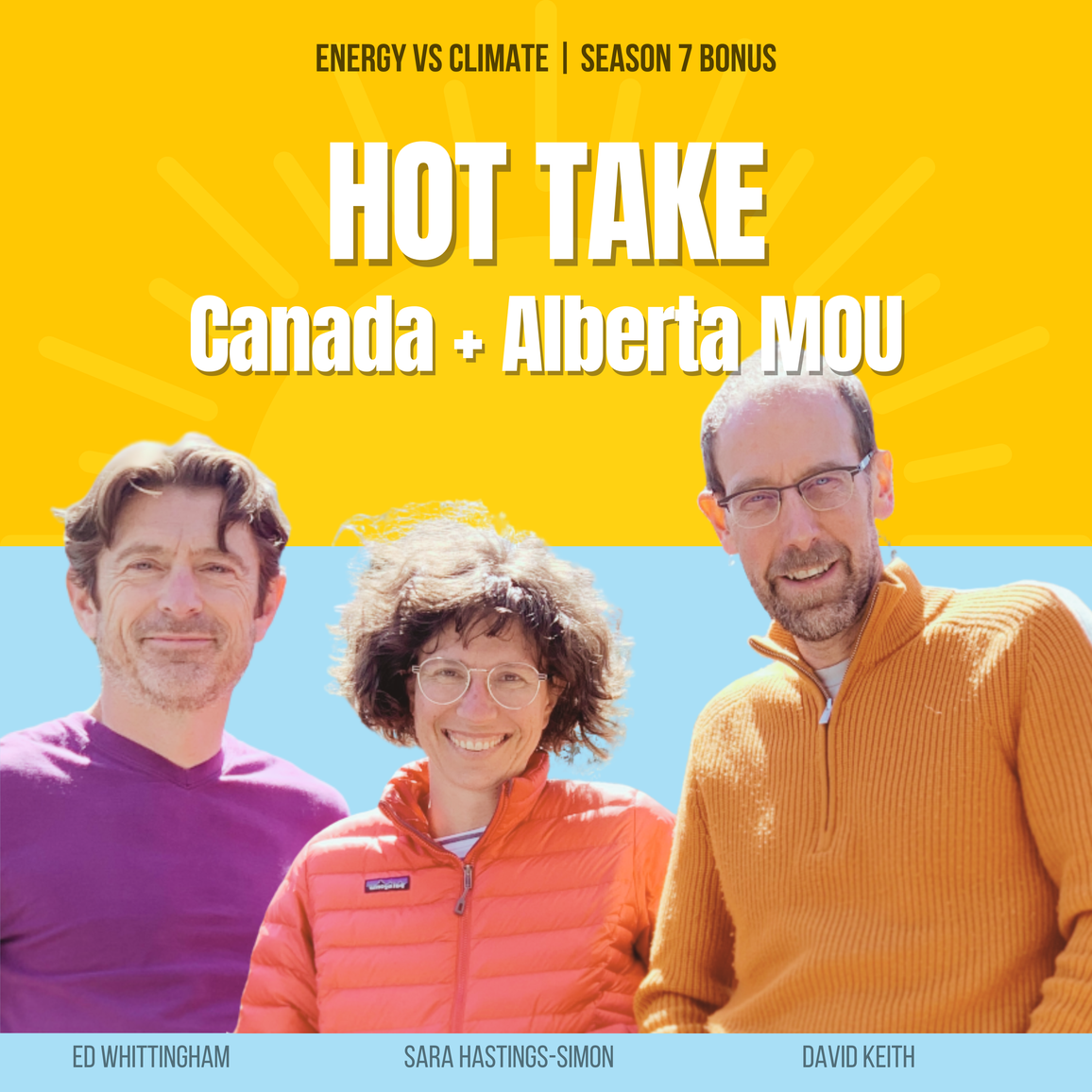
There are many takes on the big Carney-Smith energy agreement – we thought you could use one more.
The new Canada–Alberta MOU unveiled last Thursday is already generating more chatter than a pipeline hearing, and has set off a fresh round of debate about economy, emissions, and where the country is headed on energy. The hot takes have been flying. Naturally, we couldn’t resist adding our own, so we grabbed the mics the next day to sort through what it all means.
And because we weren’t the only ones buzzing after the news dropped, we’re also bringing you five on-the-ground reactions from attendees at EvC Calgary pop-up event the day the announcement landed. You’ll hear those right after ours — a kind of post-MOU tasting flight, if you will.
Episode Transcript
David Keith: As an Albertan, I'm worried about Alberta doubling down on oil and gas in a world where I think that we really are going to see, uh, oil and gas peaking and we're gonna see prices declining because of that, and I think it's unhealthy for Alberta to double down.
Ed Whittingham: Hey everyone, ed here. It's Friday, November 28th, 2025, and the three of us, David, Sara, and I are still processing yesterday's big Canada, Alberta MOU announcement.
The MOU is a political ceasefire of sorts. Ottawa and Alberta agreed to quote, work together to achieve the shared objective of establishing Canada as a global energy superpower. Unlocking the growth potential of Western Canada's oil and gas, renewable energy, critical minerals, and other resources that the world needs.
End quote at the heart of it is a commitment to explore a new bitumen pipeline proposal to the west Coast, all the while pursuing net zero greenhouse gas emissions and quote, reducing the emissions intensity of Canadian heavy oil production to best in class in terms of the average. For heavy oil by 2050 end quote.
And that's just the top line. There's lots more there to digest. So we figured why wait for a full episode when we can give you our unfiltered next day hot takes right now. And because we weren't the only ones buzzing after the news drop, we've also brought you five on the ground reactions from attendees at the EVC Calgary popup event, the day the announcement landed.
You'll hear those right after hours, the kind of post MOU tasting flight, if you will. Now let's get into it.
Sara Hastings-Simon: My hot take is overall. MOU is not a win for climate. It's a big step back actually on a lot of, uh, climate policies that were in place and trading a lot of real reduction for future promises. And, you know, I guess the, the jury is still out on exactly how that will come out and we can talk through all the.
All the different points, but essentially I see it as caving. If you want to, the pressure to step back from regulated emission reductions and requirements with this promise that, oh, those are really just backstops and we'll get 'em through the carbon price. Um, but if those are really just backstops and they were gonna never be in enforced anyway, then you know why were people so worried about it.
So, you know, I, I. I think we can debate whether it's the right thing to do. There's obviously a lot more going on than just climate and so, you know, this may be a trading climate for national unity or, or something else. Um, but I don't think that there's any four D chess going on when it comes to climate specifically.
I think there, it's just really a step back in climate action.
David Keith: I think, um, it certainly feels, first of all like a big deal. I mean a real sign that things are changing in Canada, that the car governments so quickly come to a deal like this, all else equal a strong industrial carbon price feels to me like a pretty good deal.
But on the other hand, the clean electricity regulations, uh, had strength and were pretty well formulated. So I see that as a bit of a wash. If there really are these strong prices, I'd say. Some of the critiques I've seen that I don't buy are the idea that there's a big environmental risk of a pipeline itself.
I think, to be clear, some, some viewers will probably say that I'm kind of minimizing it and of course there are pipeline leaks and there is a chance of a real disaster of an oil spill. But still, if you think of the big context, comparing it to the overall upstream impact of upstream oil and gas, uh, extraction, forgetting climate, just environmental impact, which are really big, or forestry or ag.
I think a pipeline is kind of small. Potatoes as in Albertan. I'm worried about Alberta doubling down on oil and gas in a world where I think that we really are going to see, uh, oil and gas peaking, and we're gonna see prices declining because of that. And I think it's unhealthy for Alberta to double down.
Ed Whittingham: I'll start by agreeing with you, David, regarding pipeline leaks and you know, there's gonna be much excitement and gnashing of teeth and rolling of eyes in British Columbia. This is gonna sound, uh, sorry, terribly dismissive around the threat of leaks. However, generally new pipes don't leak and if you really care about pipeline leaks, you should be focusing on.
The 1950s, 1960s pipe that we have in the ground that is at risk of leaking and doesn't have enough regulatory oversight. What I think if we, we pivot to climate, I think that the Smith government held climate hostage by putting a freeze on the nameplate price, the uh, of the carbon price, and under the the tier industrial carbon pricing system.
Like David. So I'm encouraged and long said, I've used the analogy of policies. Uh, with that the federal government has imposed, it's been like a stack of pancakes and you lay a noose, uh, pancake on the stack and it gets bigger and wobblier and teeters, and you could replace that all with a steep, sharp carbon price.
And this is actually an attempt to do that. What? I don't know. If they're talking about an effective carbon price at 130 bucks per ton, then the nameplate. The sticker price that you need is going full up to 170 bucks. And are you still then going to be getting at trading at that level? So how the two governments can combine and guarantee there's gonna be an effective price like that?
Well, to me there's some voodoo economics involved.
David Keith: One other thing I'm see happy to see going is I was never a big fan on the overall cap on oil and gas emissions. I felt like that just didn't seem like sensible policy. To be clear, uh, I think that we ought to be regulating carbon emissions, uh, but that should be done by some kind of pricing or cap and trade structure.
And given the fact that most of the consequences of the. Oil and gas emissions aren't at the point of a generation. Anyway, I felt that that was kind of a politically motivated overfocus on point emissions that weren't, you know, I agree they're a problem, but I felt like the go federal government had put too much effort into that.
So that, I think replacing that with a carbon price, I'm happy with.
Sara Hastings-Simon: Maybe we can just lead into our discussion on the carbon price. 'cause I think, to me, that's a big piece of it, right? So. I agree that, you know, if we had certainty that we were going to have $130 effective carbon pricing in the near future, then you know, maybe there could be somewhat of a reasonable deal when it comes to trading these things off.
You know, I think we don't even have to kind of make up what might happen or try to guess whether or not that's gonna go forward in the sense that we had an agreement that there was going to be in exchange for a pipeline, there was gonna be $170 carbon pricing. And, you know, with very little ceremony that, that has just gotten thrown out the window of like, oh, well that was never the case.
You know, it, it sort of reminds me of like, my kids, you know, doing, doing something. My son actually recently, this is a good one. I was trying to get him to cook dinner more and he was excited about the idea of getting to. To have his own special knife. And so the deal was, okay, if you cook dinner four weeks in a row one night, I'm not, not, not every night, one night age appropriate, I'll buy you this knife, right?
But then you gotta keep cooking dinner. So you know anyone who's a parent knows what happened. He cooked reliably four, four weeks in a row. He was on top of it, cooked dinner, got his fun new toy, hasn't cooked dinner since then. And this is what we're seeing playing out, right? And so to be clear, the MOU itself doesn't even say.
Any details about what anyone is promising about the $130 a ton, right? All it says is it will ramp up to a minimum effective credit price of $130 a ton. The parties, and I'm reading now from it, the parties will conclude an agreement on industrial carbon pricing. On or before April 1st, which doesn't mean it's gonna be 130 April 1st it says, examples of issues to be addressed in the new agreement include the date for introduction of the effective price and the price increases over time.
So, you know. I think anyone who thinks that this is going to be a real carbon price that actually drives, you know, climate action in Alberta, I would love to see that happen and be proved wrong, but I would make a pretty solid bet on that because I think that. You know, I was, I was reflecting on carbon pricing this morning when someone was saying, you know, does it work?
Does it never, does it not work? And I think where I ended up with is that, you know, carbon pricing, it's a tricky policy because if you really want to do climate policy. You can totally do it with carbon pricing and it can completely work. If you really want to not do carbon, uh, climate policy and have the appearance of doing climate policy, then you can totally use carbon pricing and you can, you know, just do enough with the price, but also the, you know, all these little details that people aren't gonna pay attention to, like the free allocations and the, all the rules around that.
And you can have a policy that does absolutely nothing. And so to me. The, the fact that the industry was screaming bloody murder over an emissions cap, and then there's this story that's turning around and saying, well, you know, the carbon pricing is gonna drive those emissions reductions anyway, and they're happy to have that one.
I think they, you know, you're, you're getting a pretty clear message about what people believe about how strong that carbon pricing is actually gonna be at the end of the day.
David Keith: You're convincing me. Is there a, can you explain? I don't. I'm being right. You know much more than me. Can you explain the difference between the one 30 that's in this agreement and the one 70?
Sara Hastings-Simon: I guess the one thing that is more potentially, again, impactful in this one is if you read and, and there's a lot of reading between the lines there too, right? Like there's not a lot of, to me this is really more like a plan to make a plan and, and
David Keith: a concept of a plan.
Sara Hastings-Simon: A concept of a plan, right? And like that does allow different people to read different things into it too, and, and read what they want or what they don't want.
But, but the way that I read it, and I think the way that people have been reading it, is that that minimum effective credit price really means that they are. Gonna do something to target the big challenge that we have now where you have a headline carbon price, uh, of, of a certain amount, but the effective price that credits are trading for is like sub $20.
So that, that could be real. But again, how much and when, um, over to Ed,
Ed Whittingham: you know, I think bottom line is that, uh, if you're Danielle Smith, you're feeling really good today. The, the Prime Minister at the end of the conference, the, uh, press conference at McDougall Center said, well, it's a good day for Alberta.
It's a good day for Canada. Uh, generally, like bottom line, it's a good day for Alberta if you support the Alberta, uh, economy being based on oil and gas, because yes, you've got sort of, uh, to, that's a great analogy you used with, with one of your sons there, Sara. So you've got this commitment, this concept of an agreement, you know, maybe, possibly.
And then look what. Look what, uh, the feds have given up, so they've given up the clean electricity regulation and, and it's a dangerous, it's another dangerous exemption, just like what they did with the heating oil exemption, when was it? September summer of 2024 for the maritime provinces. What they're saying is, Hey, if you come in and be the squeaky wheel, we're gonna give you some oil and we're gonna pull things back, and it just erodes the credibility of the whole system.
They push back methane by five years and you could say, oh, well, you know, we've got five years left to hit a 75% reduction target. Well, I'd say there's nothing like a deadline to focus mines. And the analogy for me is we had a 2030 coal phase out targets provincially, and then that became the federal law of the land.
And here in Alberta, they achieve that target six years in advance. So I think with methane you need that target and already they pushed it back. It's just gonna get slipped again. You've got methane, you've got the, the uh, the clean electricity regulation and the cap. That was the one give that everyone expected them to give.
And I say that I worked on the oil sands cap very closely back in 2015. It was a key part of the 2015 Alberta Climate Leadership Plan. But I never thought it was workable with how it was designed, and it was doomed to fail and it wasn't. You say it's a cap on emissions, it's not a cap on production. If they had to achieved that cap, it was in effect a cap on production.
You may have just said. So honestly, bottom line is Alberta got a great deal. How big a deal is the Guilbeault resignation? I think that's a big deal. I think it's problematic. Steven has pretty impeccable integrity and cred, and especially within Quebec and him coming out and saying. I can't support this and I have to leave cabinet as a result, that really is gonna resonate in Quebec.
Now if they're acting like a majority government and they've got lots of runway and they say that's a problem for the next election, great. But you know, they really did squeak through the last budget. So there, there's still a minority and they still have to pull coalitions together in order to get, you know, confidence votes over the line.
So I think it's significant.
David Keith: It seems like a example of things of Carney doing a bad job with Cabinet. That is, if you're negotiating a deal like this, to have the minister resign that way feels like a sign that you didn't handle it. Right.
Ed Whittingham: Well, and that's before we get to David Eby and Coastal First Nations.
You know, David Eby, in addition to not liking the decision or the contents of the MOU. Was saying publicly late last week, all this is being negotiated without me being involved, and he is going up publicly. So we, we should spend a bit of time on the pipeline itself. So the pipeline is, you know, the backbone of this MOU.
Does anyone really think in any scenario that a new pipeline is going to get built? I remain very skeptical, but Sara, I'd love your take.
Sara Hastings-Simon: Yeah, I mean, I'm, I share your skepticism, ed, with the caveat of, you know, if it's built with a hundred percent public money, then you know that it could be built right.
In the sense that I don't think that there's a business case. I don't think anybody's gonna choose to build it with private capital, but the concern would be. Kind of building off of David's concern with from Alberta, you know, okay, so fine. There's this, you know, potentially imaginary pipeline that probably nobody is really going to build.
And, you know, probably similarly without essentially a hundred percent public money, uh, the Pathways CCUS project isn't going to get built either. But once they're sort of out there, then there can be more and more pressure to, well, we need to, you know. Put the public money towards this and we need to get this built and this is critical for for Canada.
So I do worry that continuing to talk about it and sort of continuing to put it there puts us closer to actually building it in that way.
David Keith: I think that's, that's my worry as well. So I think offhand, if I was just asked to make a bet, I would have pretty low odds in their being a new pipeline. I think the idea of transplant expansion seems pretty believable to me, but the idea of a whole new pipeline really doesn't, I guess two reasons.
One is I think. There's a long, long time from planning to execution, as we all know. And during that time, once things are gonna shift, right now we're all sensibly scared of the wackiness in America. And you know, as a Canadian, I do feel like, man, I do want the idea of independent exports, but probably Trump will go, things will come back roughly to normal.
And long before real money is getting committed to this pipeline, this stuff will blow over. And the business of just moving well south will seem more reasonable. And at the same time, the oil market's gonna beginning to get weak. And so those things together suggest to me, it's very unlikely it gets built unless it gets built in this kind of nation building public money way, which is terrible.
And the way to deal with that is for Kearney and others to clearly articulate that this deal is only permission to do it if it's done with, with, with private money as opposed to kind of guarantee that it get done. But hard to know.
Sara Hastings-Simon: To, to avoid this from being only all negative. I will say that, you know, there was one good thing I think in the MOU, which was around building out interprovincial transmission lines, right?
And so, you know, as we've obviously talked about many, many times on this show, that that is a good thing for Canadian cooperation. It's a good thing for unlocking more renewables. Um, so I think it would be great to see that moving ahead. I, I still am concerned that if you have a. Only that, and you don't have kind of pressure or ambition, let's say at the provincial level to actually make use of those by building out a lot more renewables.
You can end up having transmission lines that don't actually help you as much. Right. The sort of bad news story, quickly, I go back to the bad, but the bad, the, the bad, uh, way for this to play out would be, you know, you build out all this great interprovincial transmission line between Alberta and BC and then you.
The free market, the, the competitive, uh, generation market in Alberta can't build any new renewables because there's no transmission in the province to connect them to. And there's too many places you're not allowed to build and so forth and so on. But, you know, there it does take time to build these interprovincial transmission lines.
So hopefully that gets built and by the time it gets built, we have a more rational approach to, uh, the electricity sector within Alberta.
David Keith: Yeah. Which again feels a little bit like your story with the kids cooking. Like hopefully it'll be more rational someday in the future. I think, I think to, to say something a little critical about the, the Clean Christie regulations were formulated in a way that really might have pushed A-C-C-U-S project to go on natural gas.
And the advantage of CCUS on natural gas or CCS on natural gas or cement is that, uh, this is actually something that in principle, that's exportable. All around the world. There actually maybe some drive, certainly on Samantha, I think on gas as well to do that. And it's a sensible thing to do in a climate constrained world.
But oil sands are a unique Canadian thing and developing CCS technology to oil sands really spends a lot of money and doesn't buy us anything much in terms of export and doesn't, isn't cost an effective way to deal with emissions. And so that's where I think. In that part, you know, to come back to the negative, the idea that we've given up on, on the clarity of the electricity regulations that might have incented something useful than the CCS department to the pathways thing, which A, I think probably won't work.
And B, even if it does work, I don't think incented something very useful.
Ed Whittingham: Yeah, yeah, that, and, but going back to the effective price of 130 bucks, that number wasn't pulled outta the air. That's roughly what, and I know from talking to the folks at, you know, the, uh, the Canada Growth Fund and some of the proponents, that's what you need as an effective price to get some of the CCS projects over the line.
Not speaking to Pathways, not speaking to Pathways at all. But David, to your point, like, uh, capture on Combined Cycle natural gas or I've talked about on this show before. Uh, Heidelberg materials and its Edmonton Cement plan. You get that price, then you can actually get a capture project done. Pathways. I think it's still a long ways off.
I think even though Alberta's got this good deal, are their shareholders really gonna, you know, think the world is getting serious on climate change and therefore we have to ante up and put all that money in. I think this is setting up for, in addition to the investment tax credit, a big fat check that the government would write to make pathways happen.
Uh, but I still have a tough time seeing that getting done. I do wanna say, and I know we're running outta time here. You wonder how much on the political side. So this gives Danielle Smith a political win. For Mark Carney, I'm a little, little less certain on the political calculus, I guess, you know, is effectively in a pre a progressive, conservative prime minister.
So he can win some of those voters over from the the old PC side and say, look, I can work with the oil and gas industry in Alberta. I do wonder how much this is a signal to the US and to Donald Trump saying that. And especially on the pipeline, we're prepared to go it alone. We can do this without you.
Take notice, even if most people recognize that a pipeline won't actually get built.
Sara Hastings-Simon: Coming back. I, I wanna come back to that, but just really quickly on Pathways. There was a kind of quiet, or, I don't know, it's right in print there walking back of the idea of net zero oil in this too, right? Very early on in the MOU it says that, you know, I.
They're gonna agree to increase production, um, while reaching carbon neutrality, I guess in Alberta and Canada. But then they have this line reducing the emissions intensity of Canadian heavy oil production to best in class in terms of the average for heavy oil by 2050. So, you know, I read that as basically saying.
Remember how we were talking about net zero oil? We're not doing that anymore. We just be promised to be the best of one of the most carbon intensive forms of oil production.
David Keith: So this is best in class compared to Venezuela. Like what's the comparator here? I guess they average classroom for every
Sara Hastings-Simon: oil. So it is a very small classroom.
Uh, I have one funny one to point. I don't know if funny is fair, but I thought it was interesting. There's a, there's a line about nuclear in there where they. Say they're gonna commit to having nuclear producing electricity and part of the decarbonized grid by 2050. So setting some, uh, generous timelines to get, uh, nuclear online in the province.
There.
Ed Whittingham: Well, like that New York Times op-ed that's, uh, ran, uh, what was it a couple days ago? Give nuclear power another chance. All we are saving is give
David Keith: nukes a chance. Me, meanwhile, China and elsewhere in Asia, they're actually being built out at scale. This shows you how we're just missing the boat.
Ed Whittingham: Yeah, we're missing the boat.
Like we miss the LNG boat. And whether you're, I'd say whether you're for or against LNG, I don't think you want a, a country that dithers and just, you know, doesn't, can't make decisions and can't get anything done. So whether you're pro or against, doesn't matter. In this case, the LNG ship or the LNG terminal left the harbor in Canada was largely left behind.
My, my Jerry Springer sort of final thought segment here I like, I'll come back to a point, David, that you made. This is for Alberta. While it's a win, it's signaling that Alberta is really doubling down on the oil and gas economy. And although we've seen, um, our friends at the IA kind of soften some of their estimates recently of when they think oil demand will actually peak because we're not seeing the policies in place that they thought would be in place.
You know that they're saying, you know, would, would cause, uh, o oil demand to peak by 2030. And they've backed off of that from somewhat, uh, somewhat with China. Demand is clearly peaking. OEC demand has peaked. It is a big bet on. Oil demand going up, hockey stick like growth. And you know, we, Sara and I, were at a, a little EVC popup yesterday and just around the room, a lot of people are in the nose say, well, you know, we're Albertans, but we are comfortable with putting still all our eggs in the oil and gas back uh, basket.
It's just a risky bet to make.
David Keith: This looks like a win for Daniel Smith's Alberta. And is it Albertan who didn't vote for Daniel Smith? I, I think it's a loss for, for long-term future of Alberta. I guess maybe it's a win for a kind of pragmatic centris politics that Carney's trying to move forward. If I really twist my Optim optimism in Bob, I could believe that if it's some kind of clever deal that helps him to get a deal with the us, then I'd really think it was worthwhile.
But it feels more like a giveaway.
Sara Hastings-Simon: Yeah, I think I, I agree very much with, with both of you on that. I think. If I'm being charitable, some of it like the oil and gas cap and others, is maybe really just a recognition that nobody was really serious about getting there. And so at least, you know, we have the cards on the table about slightly more serious about what's happening.
But I feel like with the carbon price and this. You know, future agreement about $130 a ton. I feel a little bit like, uh, Charlie Brown, or I guess all of Alberta and Canada is Charlie Brown in this case. Uh, getting ready to kick that football that, that Lucy's holding, and I really don't like our chances on that.
Um, but I guess we'll have to come back for a hot take in, I don't know, 20, 20 30 and we'll see what the carbon price is then.
Ed Whittingham: All right. That's enough from the three of us. Now let's roll the tape from yesterday's EVC popup in Calgary. Right after the announcement, five, keeners stepped up to my mic to share their reactions on the record.
You're about to hear from Juste Zukauskaite, Chetan Saha, Kate Easton, Nathan Ward, and Cynthia. Preferred to go by just Cynthia. Now here are their hot takes.
Juste Zukauskaite: Essentially. Thank you very much, ed, for giving me the rundown of what it is. 'cause I haven't had the chance to look into it a little bit more. But one thing that stuck out to me the most is that, um, essentially Canada's climate goals are going to be, need to redefine.
And, uh, for me, what personally here in Alberta, it means like, the next logical thing that comes into head into my mind is that, um, coal mining is coming back, uh, full, full speed essentially. And, um, it, it worries me a lot. That's, that's just what I'm thinking and especially since. Already Alberta's grid was, uh, carbon free and, uh, well, sorry, I should say coal free.
And, um, this is now just making me worry a little bit more about the, especially the environmental impacts that this is going to have.
Ed Whittingham: So tell me a bit more about coal now, and especially for our non Albertan listeners who may not be aware of kind of the controversy around coal mining and the eastern slopes of the Rockies.
Why you think this might be opening a door to coal coming back online in Alberta when I think it was effective at the beginning of this year and of last year, we got all coal. Fired electricity offline in Alberta.
Juste Zukauskaite: Well, we know already that Alberta had stopped, um, using coal, uh, to power, uh, our grid. And now coal is super cheap to mine, relatively speaking, and it is cheap, cheapest electricity source.
So it's just a logical step to cut a more, uh, money out of, uh, essentially. Producing electricity. This is a, this is literally the, the next step that's going to happen. In my opinion.
Chetan Saha: My take Ed, um, would be that I can almost, I think, like accept most of what the MOU said other than the suspension of the clean electricity regulations for Alberta.
Why it's gonna open a Pandora's box of now everybody coming, every province being like, you know what? I can do this. Uh, can you suspend them for me as well, is it was supposed to be a backbone. Like there was supposed, the federal government was supposed to have a backbone for like all the provinces need to do this, and now if Alberta can get out of this.
So can Saskatchewan. So can Manitoba. Like, even though they're pretty good, like Ontario can be like, you know what? If we need coal or if we need natural gas, they have, we have those speaker plans they can stay on. We don't really need to worry about that. It's just this was the chance for the federal government to kind of work with the provinces to increase not only better use of the inner tides and build them out for all the provinces such as BC, Alberta, enter Tai.
To kind of increase the use of BC's, hydro resources for Alberta, but also to move us towards those climate goals that even Kearney just a few months ago was like, yeah, we will do it. And now it's like, no, it's not gonna happen. Not by 20 30, 20 35, hopefully by 2050.
Ed Whittingham: But, but tell me like why would the suspension of the clean electricity regulations in Alberta say affect enter ties?
Chetan Saha: It's because, uh, my biggest thing, so what I've seen during my own like research and my master's degree was that the inner tie system between Alberta and BC is there, like it's, but it's not really used enough because we have enough, I'd say like rate taker here in Alberta who know that. Alberta's gonna be fine with the natural gas plants that we have with the cogen plants that we have, and we don't really have to worry about the hydro coming in and kind of even depressing the rates that, you know, have on top of the solar and the wind generation that we already have.
So with the, with the suspension of the clean electricity regulations that we're gonna come in effect now, there is, I'd say, really no incentive for the provincial government to be like, you know what, maybe we should start moving towards those. Better resources, not just for our province, hopefully for our entire country.
Kate Easton: Well, it's probably a great day for Canada, Alberta relations, but I I, there's so many questions. Um, I don't think it's a great day for Canada or Alberta. Basically the MOU, like what does it mean in reality? That is the, the fundamental question. Um, if you need a private proponent for a pipeline. I think it's great that they're requiring one.
Are we ever gonna get one? Because oil price is not great right now. Forecasts are not great. There's no one really lining up to, to move that pipeline forward. And then you look at other things with the, uh, pathways project, it seems like the MOU is indicating some financial support for it from both Alberta and from Canada.
Is that enough? And. Do the oil companies want a pipeline badly enough that they're willing to invest in CCS or not? So it feels like we got a pipeline that probably won't happen, a CCS project, it probably won't happen. Um, and now we've thrown other things out of the window, like the clean electricity regulation.
So what is good about today? I don't know.
Ed Whittingham: So I would agree in terms of. With CCS, I think that the government could pay everything on the capital cost and you still wouldn't have the companies going ahead with it if they have to pick up even a dime on the opex. And partly because their shareholders think that the world isn't gonna get serious on climate change.
So why should they? Why should they anti anything up? Give me, gimme your take on the Pathways projects in particular. And it sounds like you speak from experience.
Kate Easton: Uh, yeah, I've, I've had experience in terms of, uh, fundraising for oil, like trying to get government funding for oils, projects, um, environmental projects.
And it's, uh, yeah. But oil companies for the Pathways projects, they, they don't wanna spend money on it because they've got, they've got places they can spend their money that actually generate cash flow. Um, if we had a stable carbon tax regime where you had a predictable price increase like we used to have, and you could count on that being there for decades, and it takes decades of certainty, then yeah, maybe you would drive them to invest in CCS.
But CCS is so expensive, it's so capital intensive that. You're looking at time horizons that we don't have regulatory certainty for, and we've just created more uncertainty than we've ever had. Um, I mean, with with Daniel Smith freezing the carbon price, that created some uncertainty. Um, now Carney setting a different price than what we had before.
Like why didn't we just stick with the original ramp up the 170, $170 clan? I think that would've made, uh, investors more confident and more willing to come back to Alberta.
Ed Whittingham: If, uh, if you get an $130 per ton effective price, is that enough to get some of these projects, these CCUS projects over the FID line, including pathways?
And the big caveat with pathways is you have to build like what? A 200 kilometer pipeline from where you're collecting the CO2 emissions. Actually the pore space, you know, is like, you know, the PO space being in Cold Lake and you have to go there where sort of stratcon is, but. Like, don't you think $130 per ton will get these projects done?
Kate Easton: I don't think it's enough.
Ed Whittingham: Why
Kate Easton: they, they're just that expensive. Because like you said, you gotta build a pipeline and then the capture, the capture cost itself is really quite high. Um, I don't, I don't know what the latest costs are, but I mean, it's definitely north of a hundred dollars a ton. It's still, it's far cheaper to buy.
Credits by offsets.
Ed Whittingham: So what you're saying is you don't see the Pathways Project actually going ahead in spite of this S Grand Bargain in any near future.
Kate Easton: Well, it really depends. It depends on what the ITCs are. It depends on what financial support from Alberta and Canada means. It might mean the government pays for it, and if the government pays for it, it'll go ahead.
Is that what we want? Is that where we want our tax dollars going? Do we want our tax dollars paying for essentially pollution from private companies?
Ed Whittingham: Well, I, I'd put that question back to you. Do you want your tax dollars going there? Because on one hand, like one of the arguments is yes, this is going to decarbonize Alberta Oil.
It's gonna create a long runway for it still being viable in world markets. Then there was, uh, and I, I forget the, um, Simon Fraser prof in the globe today. I forget his name, was arguing that, you know, essentially the demand is softening. China's uh, consumption of oil is gonna peak by 2030. And in a, you know, lessening demand, lower price environment for oil, no matter what you do, Alberta oil doesn't really compete.
Kate Easton: Yeah, I think you've, uh, hit the nail on the head there. Um. It is very hard for Alberta Oil to compete. Uh, I mean, a few years ago I was looking at, uh, trying to move Alberta crude by rail and, um, Europe. We had very little interest from Europe. Because it would be too expensive for them to make our oil clean enough for them.
They had few refineries that could take our oil because of the sulfur content. Um, but the, even the ones that could, didn't want it because they could get lower sulfur content, oil that was gonna be cheaper for them to refine in the face of declining demand and our, you know, historical inability to compete in some markets.
I, I think oil. Yeah. There's gonna be increasing demand because of increasing population, but it really depends on where the rest of the world goes in terms of policy and in terms of how seriously the rest of the world takes climate change. Um, and if Europe is setting the example, I think we could go in the right direction and, and, uh, oil use will decline.
And we're already seeing, um, China and India showing signs of, of, um, moving away from oil. Uh, because for them it also makes sense. Why would they pay to import energy from other places when they can generate renewable energy in their, in their own countries?
Ed Whittingham: So, uh, what happens 12 months from now? Like, where are we at with Canadian climate policy and oil and gas politics?
Kate Easton: 12 months from now, we might know what this MOU means. Maybe I wanna talk just briefly about the, the 75% reduction in methane emissions. That is an interesting one. I, I wanna know, did they, did they put any research behind that number or was that just like, Hey, you hit 50% already, let's get you another 25% of the way there?
Uh, that's more what it sounds like. The industry reached the 50% reduction much faster than expected because there was a lot of low hanging free. So the question now is, did we already take care of that long low hanging fruit and it's gonna be really hard to get that next 25% and we do need that extra five years?
Or is there still a fair bit of low hanging fruit out there? I mean, there's still, I think a lot of em, methane emissions that are easy to mitigate in terms of technology. It's just a question of cost. With gas price being so cheap, it's still not economically viable, but. With $130 carbon tax, I think that does become viable for the methane reduction.
So I, I think the, the one thing that we will see movement on in the next 12 months is, is probably that methane mitigation piece.
Ed Whittingham: Yeah. And I, I've got some war stories I can tell around the initial methane target of 40 to 45%. Back in 20 15, 20 16. But yes, it's an important piece and we lose sight of it, but this announcement pushes back the target from 2030 to 2035.
Kate Easton: Yeah, so that is a little disappointing. Um, but I, I, I do think, um, the rate at which we can reduce methane is going to slow down because it gets harder as you, as you get rid of easy things. So, yeah, I mean we, we are effectively in 2026 already, so we four years till 2030. Um, do we need, was four years gonna be enough to get to another 25% reduction or do we need nine?
Will we get there faster than nine? And I think we've already seen some good things like, uh, emissions reduction. Alberta announced some funding to, I implement methane reduction technologies. Uh, and so I think that will help. That money comes out of the tier. So it sort of comes from industry indirectly.
Um, I, I think that will certainly help make a dent in, in progress towards that 75%. Target
Nathan Ward: used to work at WSP, so I was their national lead per solar, and then the current provincial government changed the rules on what it takes to develop a renewables project in, in the province and change the marketplace in terms of what?
Electricity is valued at and, uh, consequences lost my job after there was no more development or projects going forward. So
Ed Whittingham: actually this is 'cause we haven't had, we talked someone, so I'd love to, I know this is off topic from what happened today, but I was there, I remember that moratorium and it was August 15th, 2023 or something like that.
And I've told this story. I was just walking outta seeing Oppenheimer. With David from the podcast and, and Marlo Reynolds, former chief, step two, environment ministers, and I got the news. So the, uh, province of Alberta saw fit to put an, and in the end it was like an eight months moratorium. Yeah. On development, new renewal to, to say.
Yeah. Yeah. But, uh, you're saying that that had on the ground implications, including for your job?
Nathan Ward: Yes, absolutely. I mean. When there's no more projects being developed, the, the development pipeline dried up the existing project pipeline and final investment decision. A lot of those were delayed in limbo probably until now for most of these projects.
And when I see the future development of these projects not restarting, because there's still so much uncertainty in the restructured energy market or restructured electrical market. And then to compare and contrast that with a, uh, recent report from the BRC, the Business Renewal Center, the, the recent report, seeing the, the actual revenue that's gone into municipalities from renewables projects compare and contrast that with the losses from oil and gas companies not paying their municipal taxes.
It's quite the stark picture there,
Ed Whittingham: and with the clean electricity. Regulation when they're sort of suspending it for Alberta. And now regulation is designed to drive down the carbon inten intensity of, uh, Alberta's electricity grid, and now that's out the window as part of this grand bargain.
Nathan Ward: Yeah, I mean, as someone who's read values, it definitely doesn't seem aligned with the, uh, the prime minister's previous thoughts on environmental sustainability and paths to, towards.
Moving the country towards a future that actually works for humanity. It's, uh, quite problematic. It makes you, makes me think of a previous guest you've had on Andreas mom and how we can move forward as people who care about the land we're living in.
Cynthia: My hot take is very short and I am just wondering what the calculus is with.
The BC liberal mps, who are probably in very large number going to support BC people that they represent. And what are they gonna do? Or how is that gonna affect stuff? And that's my hot take. It's very short, but
Ed Whittingham: I'd say very pertinent hot take. So you think of a cabinet minister like Grabber, Gregor Robinson, former mayor of Vancouver.
So he's between a rock and a hard place on this one. And, uh, yeah, so we've seen one cabinet minister Steven Guilbeault resign as a result of this decision. He's in Quebec and Quebec's not directly affected. BC is very directly affected, so it is tough on those, uh. CMPs who have environmentally minded constituents.
Cynthia: Thousand percent. Yes. Yeah. Yeah.
Ed Whittingham: Big thanks to Juse, Chetan, Kate, Nathan, and Cynthia for jumping in with the rapid fire reactions. Next up on EVC, we're back to our regular programming with. Full episode on December 8th. We'll look back at the biggest energy stories of 2025 across North America trends. The surprises where we stand on the transition before doing some crystal ball gazing, but what to watch for in 2026.
Our guest will be Energy Innovations. Robbie Orvis. See you then.
About Your Co-Hosts:
David Keith is Professor and Founding Faculty Director, Climate Systems Engineering Initiative at the University of Chicago. He is the founder of Carbon Engineering and was formerly a professor at Harvard University and the University of Calgary. He splits his time between Canmore and Chicago.
Sara Hastings-Simon studies energy transitions at the intersection of policy, business, and technology. She’s a policy wonk, a physicist turned management consultant, and a professor at the University of Calgary where she teaches in the Energy Science program, and co-leads the Net Zero Electricity Research Initiative. She has a particular interest in the mid-transition.
Ed Whittingham isn’t a physicist but is a passionate environmental professional. He is the founder of Advance Carbon Removal, a coalition advancing demand side solutions for carbon removal in Canada. He is also the former CEO of the Pembina Institute, Canada’s widely respected energy/environment NGO. His op-eds have been published in newspapers and magazines across Canada and internationally.
Produced by Amit Tandon & Bespoke Podcasts
Energy vs Climate: How climate is changing our energy systems www.energyvsclimate.com
Contact us at info@energyvsclimate.com
)