Understanding China's Energy Transition: Experts Weigh In

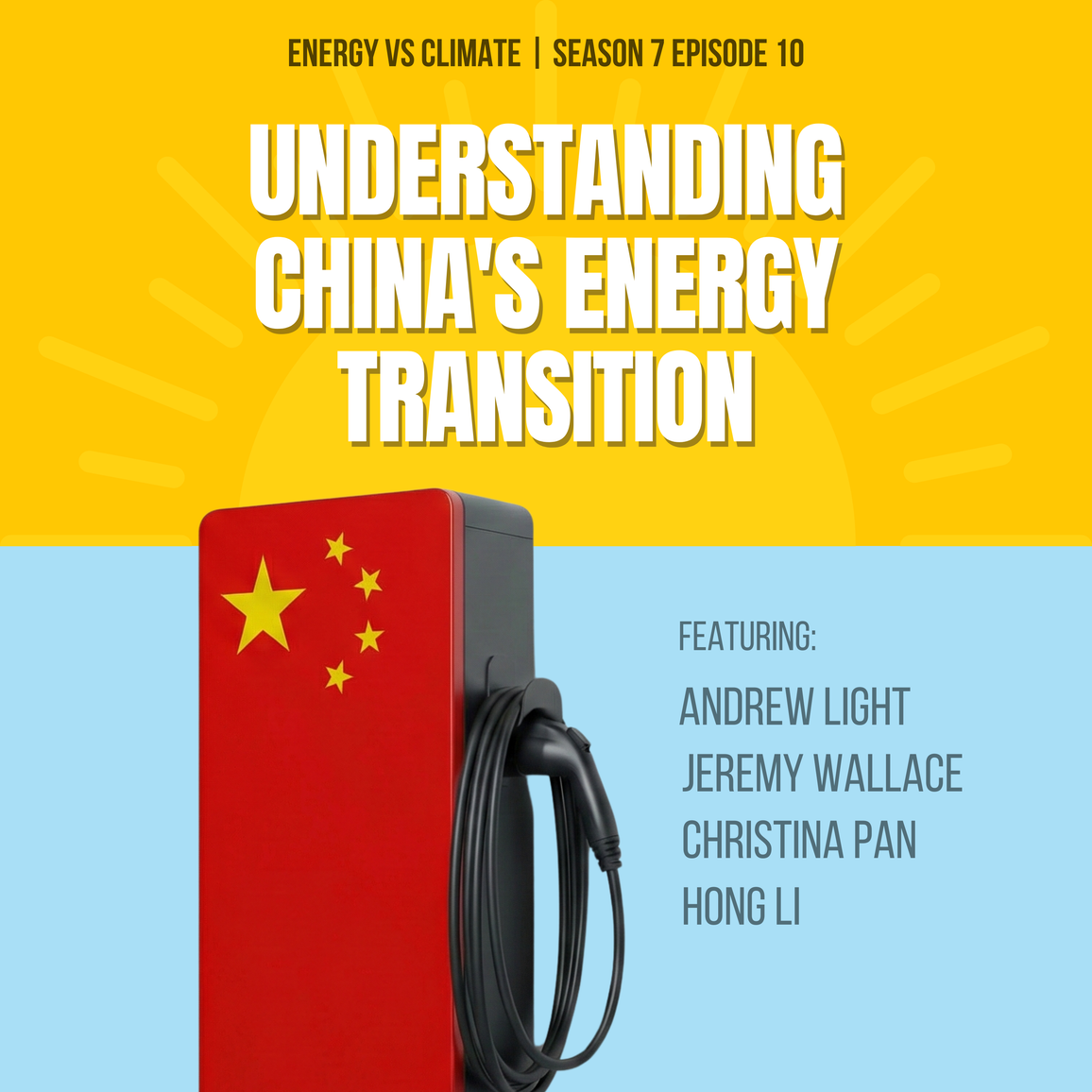
Featuring experts Andrew Light, Jeremy Wallace, Christina Pan, and Hong Li.
This episode is different. We're tackling China's energy transition, and instead of David, Sara, and Ed just talking about it, they went out and interviewed different experts on the subject.
Why China? Because it's arguably the most important energy story on the planet right now. China is the world's largest emitter. It's also the world's largest investor in clean energy. It manufactures the lion's share of solar panels, batteries, and now electric vehicles in the world.
Functionally, what happens there determines whether the world has any real shot at meeting long-term climate targets.
David spoke with Andrew Light, distinguished professor at George Mason University and former Senior Climate Official in the Biden administration.
Sara talked with Jeremy Wallace, professor of China Studies at John Hopkins and Christina Pan, a PhD candidate at Cornell researching renewable energy in China.
And Ed interviewed Hong Li, a professor at the Institute of Physics at the Chinese Academy of Sciences, and an expert on battery chemistry.
Three different perspectives followed by David, Sara, and Ed trying to make sense of it all.
Show Notes & References
(4:20) Half of China’s car sales were electric in 2024.
IEA, global EV outlook 2025, trends in electric car markets
(16:07) There are 18.64 million public charging piles for EVs in China. Canada has 33,767 public charging ports.
China Daily, China's EV charging infrastructure logs growth momentum (November 2025)
IEA Global EV Outlook 2025 Electric vehicle charging Note: has fewer numbers listed, but likely due to charging station count vs port numbers.
(27:30) China has committed to 7-10% emissions reduction by 2025 as part of the Paris agreement. China has also pledged to be carbon-neutral by 2060.
World Resources Institute, Statement: China Announces New Climate Target (September 2025)
Financial Times, China pledges to be ‘carbon-neutral’ by 2060 (September 2020)
(32:10) In 2009, China launched the "Ten Cities, One Thousand Buses" project to promote electric vehicles by providing subsidies for electric buses in ten selected cities.
IAA Mobility, Shenzhen – The City of Green Future
(33:25) 2014 Tsinghua University report on carbon emissions:
Tsinghua – MIT, Carbon emissions in China: How far can new efforts bend the curve? (October 2014)
(37:33) Institute for China-America Studies, China’s Fifteenth Five-Year Plan (December 2025)
(48:05) “Faced with the global warming trend, many coal-frontier countries including China have gradually come to develop flexible [coal-fired] power generation to support a novel energy system with increasing renewable energy.”
(57:55) Coal gasification grew by 18% in 2024.
Energy Tracker Asia, China’s Coal Plants Are Risking its Energy Transition (April 2025)
(1:0:10) Forbes, Nuclear Power Output Quietly Sets A New Record (August 2025)
Episode Transcript
[00:00:00] Sara Hastings-Simon: You know, yes, there, there is this government support, but I think what was really new to me was learning how much of the recent developments have really been driven by, you know, sort of capitalists, like competition, adapted to the local environments.
[00:00:16] Ed Whittingham: Hi, I'm Ed Whittingham and you're listening to Energy Versus Climate.
The show where my co-host, David Keith, Sara Hastings-Simon and I debate today's climate and energy challenges. This episode is different. We're tackling China's energy transition and instead of the three of us just talking about it. We each went out and interviewed different experts. Then we came back together to discuss what we heard.
Why China? Because it's arguably the most important energy story on the planet right now. China is the world's largest emitter. It's also the world's largest investor in clean energy. It manufactures the lion's share, solar panels, batteries, and now electric vehicles in the world. Functionally, what happens there [00:01:00] determines whether the world has any real shot at meeting long-term climate targets.
So we wanted to get beyond the headlines. David spoke with Andrew Light, distinguished professor at George Mason University and former Senior Climate Official in the Biden administration. Sara talked with Jeremy Wallace, professor of China studies at John Hopkins. And Christina Pan, a PhD candidate at Cornell researching renewable energy in China.
And I interviewed Hong Li, a professor at the Institute of Physics at the Chinese Academy of Sciences, and an expert on battery chemistry. Three different perspectives followed by the three of us trying to make sense of it all. Let's start with David and Andrew Light.
[00:01:44] David Keith: Maybe going back way back to China and I, I, as I recall, during the Trump one, you ran a kind of track two for World Resource Institute with, uh, with China.
So what would you say are the big factors that made China [00:02:00] so successful in clean energy, uh, especially solar and batteries.
[00:02:04] Andrew Light: The Chinese have wanted energy independence for a long time, for all the reasons that any country would want energy independence, um, which is because it's a, it's energy security.
So that's partly number one, is they wanted to, as India does as of many other sort of major powers, do they want to get off of this rollercoaster of being kind of at the mercy of oil prices, the fluctuations, which sometimes makes sense, but oftentimes do not, that are sort of the result of geopolitical events that cannot be con controlled.
And people can think back of all the examples in the last couple years that have sort of demonstrated that. And I think the same thing is true, um, for natural gas. You know, they don't want to sort of get beholden to countries like the United States on LNG and kind of things like this. So that's kind of point number one.
Point number two, I think that they absolutely saw. Exactly what I just described, that there are many other countries in their position, um, that want to sort of move [00:03:00] into some degree of energy independence. And in this world where most countries are not, uh, fossil energy producers and exporters like the United States, um, the, that, the, the, the most sure way to independence, if you can afford the transition.
Right is gonna be to, to do it Euro is to electrify everything and to go into, uh, into some kind of renewable. So I think that that's what drove a lot of it is they had an internal need they wanted to take care of.
[00:03:33] David Keith: What's your sense for, for solar in particular? Um, I kind of feel like I've heard different stories.
One story is that it was really a strategic decision that they made a bet and it turned out to be the right bet. But the other story is that, you know, that Germany started with this huge program that bought a lot of solar. Some Chinese manufacturers jumped in and started succeeding without particularly big government push.
And then once the train was rolling, the Chinese government saw a good thing going and jumped on. Is [00:04:00] that fair?
[00:04:00] Andrew Light: I think that's fair. I think, I think it was, I, if you go back and you look at the, the, the history of the five-year plans, right? You know, there's a continuity and a thread through there where you're looking for, again.
Energy, independence, energy, resilience, but lots of ideas, not all of them were, you know, basically electrifying everything and getting, you couldn't, if, if you go back and you look like 3, 4, 5 year plans, uh, ago, you would not have predicted what you see in Beijing today, which is like half of all the cars on the road are electric.
Right. You just wouldn't
[00:04:31] David Keith: Exactly. I mean, my. I, when I was working with the folks at, uh, Princeton, the carbon mitigation initiative people, I met a bunch of people from China in those days, kind of 20 years ago. Yeah. Who really believed there's gonna be coal, gasification, coal to liquids at giant scale.
They're gonna manage their, their world, uh, their, their, their, they manage their oil import constraint by gas to liquids, obviously. That's totally a joke now
[00:04:54] Andrew Light: that that's, that's right.
[00:04:55] David Keith: What about on nuclear? So my understanding is you at least had some role, uh, in [00:05:00] your, with your DOE hat on the Biden administration in understanding the relationship between what China's actually building in Westinghouse's, AP 1000 design and how to think about licensing.
So, I dunno what way you can say publicly, but, but I'm really interested to understand like, what, you know, how excited you are about the China nuclear build out, which looks pretty exciting to me. And do they contemplate exports?
[00:05:21] Andrew Light: 2, 2, 2 things I'd wanna say about this. Um, one is a little, and bear with me a short anecdote at the cop.
The, the sort of the UAE. A few years ago, uh, at the Big Climate Summit, I led the push with, um, some partners in the UAE to create this tripling nuclear pledge by 2050. John Kerry, you know, launched was the, the US lead for launching that. At the cop at the, at the actual meeting, I was on a panel on nuclear with a few, you know, interesting people, and one of them was a major, you know, f uh, figure, uh, sort of a very senior guy in the Chinese nuclear, [00:06:00] uh, corporation.
And I, and he said to me, he goes, oh yeah, you worked on the tripling nuclear, uh, pledge and helped to put that club together. And I said, yeah. He goes, yeah. We looked at that and we realized like, uh, that's too small a target for us. Right? So it was just sort of like, he's like, you know, that's, that's cute, right?
That you want to sort of like move towards the world tripling nuclear by 2050, but our plans already outstripped that, so we didn't wanna sign on to something that made us look weaker. So that's point number one. Mm-hmm. They're committed there. And yeah, it's not gonna be pretty with respect to the IP issues and stuff like that, I worked a whole lot on the resolution of those between Korea and Westinghouse in my last couple years in office.
Um, this one will be way, way harder. And really it's gonna be, I think, up to Westinghouse in terms of determining how they want to handle this. You know? 'cause it's a, it's a much tougher customer. The second thing though is on the export thing. So there, there we're seeing really mixed signals you [00:07:00] don't see, unlike, unlike the Koreans for example, you're not seeing a lot of appetite to build in other parts of the world.
You're not seeing a lot of appetite to get into tender, uh, tenders. Uh, there have been some indications of that before on the, on the large plants. Right. And there have been sort of indications in a few small countries in Europe where the Chinese were early on kind looking to be part of the, the process and.
My read on it is that a determination was made. Uh, we don't want to go with China. They didn't, also didn't wanna go with Russia, wanted to push Russia out of these tender, um, bids at the same time for obvious reasons. And then they were just sort of like, okay, the Chinese, as far as they could tell, did not do a full cork press try to push to get themselves back into the mix, which is unlike what we saw with other, some other countries.
On the other hand, and the other sort of point on this that I find curious and I don't quite understand, I mean the, the, of course the, the, you know, the sort of the magic, you know, word is [00:08:00] small modular reactors. Everyone wants in small modular reactors. The uses invested heavily in that. The Trump administration's actually doing now a lot more aggressive things than we were doing in the Biden administration to try to like jumpstart SMRs in some interesting ways, some of ways, which they will get some pushback on some of the ways which, which I would absolutely fully support as far as we can tell that Chinese are gonna get there first.
Right to operation, not just Operationalizable SMRs, which we have, but commercializing ones and the indications that I've seen are they're not looking to get into a big export market on SMRs. Hmm. Why that is the case? I don't know. And I mean, there may be some China watchers out there who have far greater insight into this, but I think it's part of, sort of like almost a parallel to the dynamic.
You, you identified correctly, I believe on solar. It's like the, the, the, the, the [00:09:00] planning process has got to see some wins, some reasons to. Get the internal machinery working and moving in that direction and then move forward on it. And the indications are now that that's kinda like not something they're looking for on big with it.
It could simply be as, as prosaic as this skepticism that there's actually gonna be a successful big export market for these things. Yeah. We've been talking about it, it's been driving so much innovation. But, you know, I mean, you know, the, the, the, on the one hand it's sort of like, you know, the, the people put it down to no one wants to be the first adopter.
I think we're probably getting over that pretty soon. And I think Canada maybe one of the first places, right? Where we sort of see that.
[00:09:43] David Keith: Yep.
[00:09:43] Andrew Light: But the, but the, but the, but, but then. After the first adopter. Where's the order book?
[00:09:50] David Keith: This is what I mean, where's the
[00:09:53] Andrew Light: order? A little might just be going, like, where's the order book?
Like
[00:09:55] David Keith: yeah, everybody talks about SMRs, but if the SMRs that are mostly, [00:10:00] that are close to being built now are all basically just smaller light water reactors, and it's personally not obvious to me that they actually make sense. Maybe existing lightwater reactors are a little bit too big, but it's not clear that making 'em that much smaller is gonna actually make them more economic.
[00:10:14] Andrew Light: The market could be really neat. Yeah. Yeah. Like one of the very last things that I did, um, in office in the Biden administration was to sign, um, an intergovernmental agreement with Lithuania on, on nuclear. And they've been going back and forth on lithium, on, on nuclear ever since the European Union basically, you know, uh, required them to dismantle a legacy, you know, Soviet reactor as, as, as, as, as part of their kind of like new energy plan.
And that's all done and it's kind of moving forward. And then they've had, you know, very different public opinions on it. Finally, they got a government that's willing, that wanted to move forward on it, and it looked like enough public support on it. And so for a country, Lithuania, they don't need a big, giant lightwater reactor.
Maybe they can see a, see a place for a, a [00:11:00] load balancing SMR, but that's a pretty small market for the kind of investment in the supply chain to produce these things at scale.
[00:11:08] David Keith: Okay. Maybe one last question. I mean, so you sure, you know, spent the Biden administration as a, the top foreign policy official at U-S-D-O-E, but you must have been obviously talking a lot with the people inside the kind of domestic side of DOE.
Absolutely. What, what, like of these markets that China's now dominating solar, a bunch of battery markets, if, if, if you were gonna have one of those that you hope the US or more generally the west would, um, grab back or compete successfully with China on, which one would it be and why?
[00:11:37] Andrew Light: There's two buckets.
I'd say in terms of the existing buckets, I'd sort of say if we were really, really, really gonna get serious about trying to build a domestic supply chain. On something that China already dominates on it's batteries. The bad news is of course, is like the EV credit went away, and so you've got like less of a drive on EV batteries, but the credits, when [00:12:00] it comes to utility scale batteries are still there.
And so you've got basically, you know, supply chains and you've got other kinds of things which can overlap a little bit. Technology will be different, all these kinds of things. And so batteries would be key with one caveat to where I think the Trump administration is being extremely smart. And the second thing is just to go in a different direction.
Advanced geothermal.
[00:12:21] David Keith: Yeah.
[00:12:22] Andrew Light: You know, kind of things like that. Which, if the US does have the technology, the US does have the expertise, you can sort of pivot away from our expertise on deep drilling and fracking and all that kind of stuff to perfect that technology and then figure out like, well, what is the export part of it?
What, what's, what's there's can be a lot domestically needs to be done, but then, so it's gotta be that category thing. There's other than geothermal, but that's the one that easiest come to mind. On the battery side, I'd sort of say the key, the absolute key though, of course, is critical minerals and materials.
Like if the Chinese continue to have a lock on that, then, I mean, you [00:13:00] can only build a domestic, uh, a, a domestic, um, uh, a supply chain, uh, that works on that in, you either gotta do it in partnership with the Chinese and find a way to do that. That was palatable and we were sort of doing all kinds of contortions to figure that out in the Biden administration.
And I don't know whether the Trump administration's gonna make that possible or not. It's still there. It's incredibly complicated, but it's still there. But that will be a, that will, as long as you classify China as a foreign entity of concern, which will not go away, you're always gonna have that, that, that hesitancy what the Trump administration's doing.
Now, I wish we would've done and started to do in 2021, you know, um, invest. This as a country. I mean the, the, the, the biggest hurdle I ever faced in the Department of Energy competing on nuclear, competing on any tender, on any energy process in the world is that we don't own anything. We don't own any company.
[00:13:58] David Keith: Really. Interesting. So you're saying that the, [00:14:00] what Trump administration is doing right, is actually putting cash investments into say minerals.
[00:14:05] Andrew Light: That's exactly right. That is the smart thing to do. And if it means that the government's gonna take part ownership in those things, which is something the United States government does not generally do, so be it.
I mean I think it's the smart thing to do. I had worked out a sort of a deal, you know, to try to use the strategic defense stockpile partly for civilian uses on critical minerals. It kind of got there, but was, there were lots of hiccups and you know, there's sort of legal difficulties in working this out in terms of the agreement.
But we were getting there and we were also encouraging the International Energy Agency to encourage other countries. To consider stockpiling in the same way that we stockpile, we all IEA members have to stockpile a certain amount of oil, right? So we can do these collective actions in the case of, of supply by cuts.
What the Trump administration is doing now about getting really serious and you know, they can, I don't care about the framing that they put it under. [00:15:00] There's obviously some overlap of defense needs there that will drive it. So be it if it gets the US government serious about investing in the stuff, which would be a.
I have to have access to them. Yep. In order to have any hope of building a battery supply chain, whether it's EVs or utility scale, that's essential. And so I'm really, actually, I applaud them for it.
[00:15:25] Ed Whittingham: Alright, up next we have Sara with Jeremy Wallace and Christina Pan
[00:15:30] Sara Hastings-Simon: sitting here in Canada. It was quite impressive to see the rise of, um, EVs in China.
Um, you know, I think it's fair to say that China's ev adoption is unmatched globally. I'm wondering what you think about what lessons the west can take from China's rapid scale up and in that, you know, what would and wouldn't work, uh, in the West as well too.
[00:15:52] Christina Pan: I think one of the first, um, achievements, um, or explanations for China's EV adoption [00:16:00] that I noticed in China is the widespread of the charging station.
And, um. As actually I have a statistics, um, which actually I didn't know before. So it's like by October, 2025, there are 18.64 million chargers in China. That was like really impressive. But on the other hand, I also checked this data, um, on Canada's side. There are 35,000 charging stations across China, Canada right now.
So that contrast is pretty huge and really shocking. Um, I think China have done a lot, um, to, um, engage the local government and also, um, the private sector on to build the charting station. Um, previously in the early stage of, um, EV development, ev industry development around 2009, I think China's central government, [00:17:00] um.
Was trying to ask the local, local government and, uh, state owned power companies to, um, help construct the power that the charging station. But later on, around 20, on 14 to 2016, the central government actually allowed a private sector to enter this area. So that was a really, um, big factor or a big explanation for a driver for the widespread quick development of the ev charting station.
And now there has, there the, now the entire sector, the charting stations sector has entered a, I would say, industrial consolidation stage. So now it has been monopolized and dominated by pretty big charging station companies.
[00:17:46] Sara Hastings-Simon: So I'm assuming that, uh, that many EV owners are living in cities, in apartments, so they don't have, um, you know, their own parking spaces in their, in their garages or something.
Is there are, are there a lot of charging stations in apartment [00:18:00] buildings themselves, or do they tend to be more in, uh, public kind of accessible And, and do you know the ownership structure of those chargers in the apartments? Are those also actually, uh, privately owned?
[00:18:11] Christina Pan: So that, that's a very good question because, um, one thing that really shocks me is, um, a lot of people or a lot of residents in Canada or in uk in the us, they charge their EVs in their own, in their own garage.
And that is hardly to see, um, in China, because most of the time, most of the, most of the time the Chargers, the charging stations are in, um, the public garage. Um, and it's ran by, usually those are charging companies, right? Privately built. Um, but some are publicly built. So, but actually the privately built charging station are quite large, but it's like still shared by the public.
The public usually need to like, um, um, go into some app and then it is [00:19:00] kind of like the, you pay for parking tickets in the us but, you know, but in the China put, people go to the app and pay for their charging.
[00:19:08] Sara Hastings-Simon: Maybe Jeremy, over to you. Um, are there other lessons that you see from, from China's rapid scale up of EVs in addition,
[00:19:16] Jeremy Wallace: I mean, I think the, the baseline expectation is that these cars are cheaper, cleaner, and better than ice vehicles in today already.
And so the idea that they should, that we should wonder about adoption is a bit surprising, especially from a Chinese perspective, where it's just very clear that these are, these are cheaper, cleaner, and better. And that, that, and of course, that's the choice that, that consumers will make. The fact that how that came to be, how these cars that were seen as kind of futuristic or difficult to imagine or just kind of not existent a decade ago, or two decades ago became a.[00:20:00]
This better option, better consumer option is I think a lot of the story. And there's definitely a governmental role there. The along the lines of subsidies that Christina was talking about and the infrastructure, which I think is really quite critical. But in large part, it's because of really cutthroat competition between various EV firms inside of China competing to make cars that the Chinese consumer would be interested in buying and creating.
Because there was a plethora of companies, there was a plethora of models and a plethora of variety of kind of like, um, at variety of cost points. So there's like luxury vehicles, but there's also super small kind of city cars that have variety of technologies. There was just a lot of different, um, it was a, it was a big sea and there were a lot of fish in that sea, and some of those fish have been swallowed by larger fish.
I, I don't know how far I want to go down this, um, metaphor, but it is very. [00:21:00] It was a very strong competitive environment that led to technical developments and improvements with better battery life. The transition from, um, NMC batteries to LFP batteries, the kind of like, uh, lithium iron and phosphate batteries that have become dominant.
China is just a kind of a step change where this was seen as a, a worse technology, but a cheaper one. And so that would never be attractive. But if you can, if it's much cheaper and only a little bit worse in terms of energy density, then it's a, then it's a huge win. And so that's, that's a major development that I think is allowed to ev adoption, to, to spiral.
And so I think there's this really, it's a, it's a pretty great story and I think one of the reasons why it's been, we haven't seen the adoption in other countries is that. They're not allowing their citizens or allowing their citizens to pay kind of market prices for these cars, these Chinese made vehicles because of concerns about local domestic auto [00:22:00] sectors and so on, which have real political, um, reasons behind them.
So I think the, like a simple answer to how to improve EV adoption in the rest of the world is to allow the rest of the world to buy Chinese, uh, EVs, but that has all these really messy knock on political consequences. And I think thinking through what that, what that might mean, um, is, is kind of what is kind of the task of, of today.
[00:22:28] Sara Hastings-Simon: Is it fair to say that that hasn't happened so much in, say, the US or, uh, or Canada because of, I mean, it's, it's hard not to see the incumbent automakers as sort of protecting their existing stock. Is that a. A fair explanation.
[00:22:43] Jeremy Wallace: I think that's fair. And I think we had all kinds of explanations about the efficient size of an automaker in the West being kind of like, of a sufficient scale.
And we just didn't have a lot of new entrants coming in with Tesla being the, the big exception. I mean, people talk about [00:23:00] EVs as it's basically like a, a phone with wheels and seats and lots of people in China companies thought that they could make phones and thought that they could make various other things.
So a lot of entrance came in, in part because of government support, like Christina said. But in, in part because it was a, a new area, it is a capitalist story in the sense that these are like. Entrepreneurs seeing a market opportunity, pushing co uh, kind of like reducing costs in order to win for market share and competition, putting profits down to zero in ways that like work the way that capitalism in some ways is supposed to work.
Um, which I think is a surprising story for the West. Thinking about China to learn about capitalism from China is a, a kind of, a little bit hard for people to imagine
[00:23:45] Sara Hastings-Simon: that explanation. It also makes me think of kind of how you know that in the incumbent automakers, you have more of almost like an evolutionary process that's creating these EVs, uh, as opposed to the, the bottom up design of a new EV [00:24:00] that doesn't come from the constraint of the way that they're, you know, a, a new entrant is already thinking about a vehicle, so,
[00:24:06] Jeremy Wallace: and it's stealing their profits, right?
Like it is it Ford makes a huge amount of money off of every EV or off of every gas truck that they sell. And if they start selling these. EVs that are much less profitable for them. It's just, it's hard to really get behind, uh, a transition in that way. This is the classic creative destruction story, right?
Like it's just, um, it's really hard to, to have your business kind of like transition from something that you do well and that you're a leader in that is very profitable to something that you just know you're not as good at and it's not gonna be as profitable. It's hard to really, um, push the, the institution in that direction.
[00:24:48] Sara Hastings-Simon: What, what do you think China's emissions will be in 2040 compared to today? You know, and you could, by what fraction will those, will that decrease, you know, what, what will that pathway look like?
[00:24:58] Christina Pan: Theoretically, China [00:25:00] previously has made that commitment, they would peak emissions by 2030, so that means if they can fulfill that commitment.
Their emissions will definitely be decreasing in 2040 compared to today. Right. And, um, but actually, um, the statistics showed this year, um, the emissions in China, I kind of, um, showed slow down or plateaued, uh, given the rise of the solar and the wind installment from the electricity generation. Um, what fraction it will decrease, um, from, well, one of my guesses is about the real estate because, uh, previously, you know, like China has a lot of emissions from the re real estate construction on.
However, with, you know, the housing prices have going down rapidly and, um. And there is a [00:26:00] decline in real estate, um, construction activities. I might expect the mission from the steel, from the cement and other building materials might fell. Um, keep fell in the future,
[00:26:12] Jeremy Wallace: as Christina said. I think those, the first question is when, when is the peak?
And I think we're likely to see 20, 20, 24 last year be a peak if this year emissions begin to decline. I think it's quite possible that they will not, um, ever reach the level that they reached in 2024 or maybe this year if it's a little bit, if it turns out it we're really plateauing and so like tiny increments up or down kind of could, could be a peak, but it doesn't look like a, a dramatic peak of any mountain that you'd want to climb.
Um, so I, I think we're really around the peak right now. And so 2040 feels like 15 years from now and that feels like a lot of time. And so I could see a lot of progress. And so I think my initial reaction is something, [00:27:00] well, if 2060, which is the time that China has promised to be carbon neutral, if we kind of think about the timeframe, well then.
One third of admissions kind of like being kind of like reduced, that feels like kind of approximately where you would want to be. And if anything that's a little kind of like pushing it out. I'm in finals mode for my students and so I, the students that have only finished a third of their papers, right, like, anyway, they should have done more.
But I think the, the other interpretation is that China's NDC just officially that they released this, uh, right before, um, the cop had, its 2035 target is only seven to 10% emissions reduction from peak. And it didn't even say when that peak was. And so if you think about that, well then to go from 10% decline to 33% decline in just five years doesn't, that doesn't make, um, a lot of sense either.
And so it's a, there's a lot of uncertainty in this space. I. [00:28:00] Think that the technologies are available and that there, it really, China does have a really attractive path to reduce emissions quite substantially, quite quickly, uh, in ways without a lot of costs. Um, because as Christina said, the cheapest electricity in the world is Chinese kind of solar and wind.
And if that can be displacing other kind of fossil fuels in the power sector, but also other industrial processes that can be electrified as we're seeing more and more, then I think you could have a real rapid decrease in, in emissions from the power sector as well as kind of China's electrifying its economy quite substantially.
This language of China being an electro state and all these other things. I think so I am, I think I'm probably hopeful that something like emissions down one third of their current peak. [00:29:00] By 2040 is something that I would hope that China could reach and China would reach. I think it's probably, it's.
It's certainly optimistic. Um, but I don't know how you get to carbon neutral by 2060 if you don't, if you don't progress, at least at that pace. And so it's because the, the easiest emissions to cut are gonna be these, it's gonna be really hard to do all of the things that we know are really hard. Right.
Um, that agriculture probably being the hardest. Right? Reducing emissions of agriculture, which are substantial in China. Not as substantial as in other parts of the world, including Canada. But it's a, but in, it's still a huge amount of emissions. And I don't know what the solution to a. Chinese pig farming and rice growing is going to be how you're gonna reduce those emissions.
[00:29:48] Sara Hastings-Simon: I heard from both of you that whe whether it's exactly this year or next year, it seems like China is on track or even more, more than on track to reach their goal of, of peaking emissions by [00:30:00] 2030. Um, I'm curious about kind of the, what's behind a lot of this. So, you know, to what extent is China's energy transition driven by climate goals at the front versus, you know, some combination of industrial policy or energy security and, and geopolitical competition?
[00:30:18] Christina Pan: Actually, my answer is not either, um, either all, it's like a chi. It's actually, the answer is, it is a combination of all these factors. And I think this is actually just a characteristic of China's approach to clean energy transition, or climate mitigation. The fact that the Chinese government use, um, climate policies, industrial policy and energy policies, they're inter intertwined and they're using the core benefits of, for example, energy policies to achieve or industrial policies to achieve their climate goals.
Um. I think that's like a very interesting, um, characteristic of China's approach and specifically, for [00:31:00] example, in the EV development. So, um, in the early stage when Chinese government decided to support the EV development, I think the energy security is a primary driver. 'cause there, um, there has always been a concern for Chinese central government as they rely mainly on oil imports.
Um, so developing the EVs is one of the solutions for Chinese government to reduce their reliance on the oil. But on the other hand, development EV is also definitely driven by the industrial policies and the Chinese government has provide at different levels, provide all those subsidies to the, to the firms and also to the consumers, um, to support EV industries.
Um. Since the Chinese government were worried that they can't compete for ice vehicles with the foreign foreign companies, um, in early 2000, especially after Chinese recession into, um, the WTO. So, um, and also I think what's interesting about auto, the [00:32:00] eeb development is it's also part of, it can also be attributed to Chinese concern about air pollutions.
So, and, and that is not being raised in the question, but I think that's a really important factor because, um, in early, um, in early 2000 when the, this is actually the first EV policies, um, the Chinese government initiate, it's called, um, 10 city a thousand vehicles. Uh, Jeremy should, yeah, Jeremy and I should also know bit like would know about this 'cause this is like the first demonstration project for Chinese government to adopt and most the city got selected.
The reason why most the 10 those cities were selected is because the, the high level of air pollution that these CC have and the Chinese government wanna use this pilot program as, um, as a tool to see, as a policy tool to see if, if it is helped to address air pollution. So I think, yeah, it's definitely a combination of these factors.
And another thing I said, um, I would say [00:33:00] the climate goal would be the much, uh, last factor the government, the Chinese government consider when thinking about developing those clean energy manufacturing industries. Um, I. As a backdoor story. Um, so in 2015 when Chinese government made a commitment of capping the CO2 emissions, um, at the Paris Climate Agreement, and this calculation, this commitment was actually based on a calculation by, um, a Chin Hui University Research Institute on, um, clean energy development or, uh, climate mitigation.
So this institute released a report, um, to the Chinese government, and this is a roadmap for China to capping the COT emission. And they expected that they predicted that China would be on its way to cap its, uh, COT emission based on the, um, the existing clean energy development. So I would say it's actually, um, the industrial policies, energy policies and, um, come first and then drive the Chinese clean energy transitions.
And that [00:34:00] helped China to actually commit to more international ambitious, uh, climate goals.
[00:34:05] Jeremy Wallace: I guess I'll. Say two things that, um, beyond just echoing what Christina's points were. One is that I think climate change and the reality of a climate crisis going forward underlies a lot of the action in the sense that a lot of the private firms kind of, um, in China jumped on European subsidies at the beginning in order kind of to move and like kinda develop their, um, develop these industries and then reduce costs, which makes them more attractive, which makes them grow and and so on.
So I think the, from, especially like the solar and wind and maybe battery sectors in, in that direction, I think really, and those initial policies were absolutely climate oriented. And so climate change kind of like as a, as a reality that we are all going to be facing. Does [00:35:00] kind of, I think, underlie a lot of the actual developments, um, and lead to the expectations that these will be industries of the future that thus the Chinese government should invest in as opposed to other technologies.
Right? They're not investing in like horse-drawn carriages because that's an old technology that we don't talk about any anymore. And so there's, I I, I do want to kind of like remember that climate as a, as a concern is a significant piece of all of this. And China as a place is a, is a country that is likely to suffer dramatically from the various kind of threats of climate change as we've already seen in various disasters, as well as just sea level rise, being in Shanghai and just seeing how close you are to the water and this, that there's not, you're not up, you're not up from the sea level that mm-hmm.
That very much at all. And these are massive cities with massive industrial and infrastructure, um, commercial real estate, what have you, and that there's just a real vulnerability there in China. Um. And then beyond that though, I [00:36:00] think I'll, I will just again emphasize that we shouldn't. We shouldn't think about climate action as some morality play, where it's like only those who are sacrificing are, are just and good.
So I don't want to kind of like denigrate the Chinese because they're not willing to sacrifice in a way that like we, we need to for climate action. Like it needs to be climate first in this like other way. I think they, they've pointed to and opened doors towards a, what I think is a much more attractive model in a world where lots of people don't have clean, like any, like access to electricity or any access to clean fuels at all to a, a, a, a better future.
And so to me it's a, it's a real story of success, um, that I think will accompany climate like real reductions in emissions. So that's, that's my hopeful bit. Uh, that's as, as, as much as I can say.
[00:36:50] Christina Pan: One of the things, um, I notice is, um, the Chinese government, they focus on, um, helping the EV industry to get stronger and more competitive.
[00:37:00] So, um, to do that they have to. They definitely need to support the industry from the very beginning. But then at the later stage, especially after 2000, uh, 2020, they need to reduce their subsidies for the EVs and ask those companies to compete each other. And in, in fact, as a matter of fact, this year it's, um, 15 five year plan and the, she, uh, somebody noticed that she did like both.
She re um, mentioned that not every city needs to support develop the ev. He made a public speak sheet about this. And then also in the, uh, 15th five year plan, the EV was not included in the plan, but, but the charting station definitely was actually mentioned in the, um, in the, um, in the, in the plans.
[00:37:44] Jeremy Wallace: I think Christina's really right that my emphasis on solar and wind and electricity is a little bit different than the EV sector where it really.
I think this geopolitical security kind of energy security, fear, straight of Malacca, [00:38:00] all these things by the China is a major oil importer and is worried about in a potential security conflict with the United States, that the United States might cut off access to oil and that that would be quite dangerous to the Chinese economy and the Chinese society, Chinese military kind of, um, possibilities.
And so there's a, there is a difference in sector and I think that's always, um, that's often the case in, in, in China that it's important to think about each individual sector because they, they really do differ. Um, but I, I don't know. I mean, I think there's a lot to say, um, that the, the, the Chinese government is willing to contemplate change and um, kind of like imagine a different, like China is, and in part because China was a very poor country, uh, in, not in the recent, relatively recent past climate is.
Significant. It is not something that I think is talked about all of the time and is not the emphasis. Um, politically. Even [00:39:00] natural disasters that occur inside of China are rarely framed as climate related in the way that we talk about often in, in the West. Um. And I think that's a, that's interesting. Um, even though China is acting, it doesn't really maybe wanna talk about this, uh, it doesn't wanna have a bottom up pressure on, um, for more action on climate change than it's familiar with.
Probably because of it, it, the climate action is tempered by all of these other concerns, it, economic and industrial policy related, as Christina suggested. So I, climate politics is a, is not something that is front and center in, in the Chinese political space. It is something that is incidental to these industries that they're excited to support and are happy globally to claim credit for, but is not, um, it's not a deep conversation where.
Industries or localities are really debating their future about are we going to have to leave because of [00:40:00] like climate risks or are industry gonna have to shut down because of like climate concerns? Those are conversations that the Chinese government is not interested in having today and is pushing off as far as it can.
[00:40:11] Ed Whittingham: And now my conversation with Professor Hong Li. Now, uh, I'm gonna ask you three questions and the first is China's EV adoption is unmatched by anywhere else in the world. What do you think, what are the lessons that the west can take from China's rapid scale up of its both EV production, but also EV consumption?
Mm-hmm. And what do you think? From those lessons would apply to the west or work and what wouldn't work to western countries.
[00:40:45] Hong Li: We should have a long-term clear target and consistent policy like 24 year or even 30 years. Policy should be consistent, not change, uh, randomly [00:41:00] lots and not so good for the, uh, electric vehicle development.
And in order to have this kind of industry, you need to have developed the production chain from the mining and to the raw material, to the battery material and to serve production and, uh, system integrion protection and also recycling to form a, a loop for the, uh, to counter the natural source and also to produce the, uh, everything in the environment friendly way.
This is a, a general policy and also is very accepted by the whole society. And in order to do this, you have a, a very developed production chain. You need a lot of expert, you need a lot of labor in this field. So the education becomes also very important. So in the university and in the, for the undergraduate, for [00:42:00] the graduate students, we have lot of less, uh, class to train the young people to learn, uh, how to, uh, what's the mechanic, what's the fundamental research, what's the scientific point, and what's the key technology in order to develop electric vehicle.
So this number is very big. Actually over a hundred thousand people, a student has been trained, uh, uh, previously, so. They have a lot of people, lot of experienced people to develop this kind of electric vehicle. I think in order to do this for the Western country, you need to have a education system to train people to realize the value, to accept the value for the whole society.
And also you need to set up, of course, the industry chain. So from the um, uh, from the mining, from the material production and from the cell production, and also the whole system. And also you need to have the experience, how to [00:43:00] use the battery for the different place because for different country you have different climate.
Some place are very cold, some place are very hot. So for battery requirement and performance is different. So you need to, to have different battery design, tech design. So for, for con, for this kind of things, you have should have, uh, uh, customer rise production chain in order to do this.
[00:43:25] Ed Whittingham: Let me to ask you, what do you think China's emissions will be in 2040 compared to today, and therefore, by what fraction will it have decreased?
[00:43:34] Hong Li: So the main target is very clear. In the year of 2030, the carbon dioxide emission should be up approach the peak error. And in the year of 2060 should be the carbon nutrient neutrality situation. And then, and so in the year of 2040, so the carbon, uh, the, uh, the carbon dioxide emission should decrease to 30 to [00:44:00] 50% of the level of 2030.
In another way is to decrease 20% compared to the 2020 emission in the year of 2050 will be 50%, only of the 2020. Emission, of course, in the year of two, 2060, we are, keep the neutrality. So that's a general prediction and based on a lot of issues, of course. So based on the, uh, technology and based on the development, uh, uh, status of the solid air, uh, and also the wind energy and the last, uh, months.
The chairperson he has announced, uh, in the year of 2035, the renewable energy, the total installed capacity, including the solar cell and the wind energy is 3,600 gigawatt hour, or you can call it 3.6 [00:45:00] tets. So that's a big barrier. It's a six times higher than the installed capacity in E of 2020. So if you have such kind of scale of the renewable alley, you need a lot of alley storage technology and you need also lot of battery for developing the electric vehicle.
Thus our. Uh, uh, the target from the 2030 2040, 2050 and 2060. So it's roughly, uh, it's actually very clear, but of course it's not so easy to, uh, reach those kind of target. But this become, uh, a national policy has, uh, has already accepted in the different level document.
[00:45:45] Ed Whittingham: What extent is China's energy transition driven by climate goals versus industrial policy, energy security, and geopolitical competition.
And I, I expect that [00:46:00] it will be driven by all of those things, but we'd love to hear what you think.
[00:46:05] Hong Li: Yeah, this is a good, uh, point. Good question at the beginning. So, uh, the, uh, climate change and climate policy. Uh, proposed by the west, uh, scientist. This kind of general idea has been accepted by all the people, or most people, and the policy decision people in the China climate target become the, uh, leading policy.
So, but of course, uh, in order to realize those target you have lot of other benefit. Uh, for example, right now, uh, the electric vehicle car and the, uh, Nissan Battery, Nissan battery and the solar cell become the top three, uh, direction for the export to the other countries. The, i, I mean the product to the export.
So because those kind of product [00:47:00] are really good for the whole, uh, for the whole world to, uh, change the climate, to make the, to use the clean energy and to use a lot technology and save the. Uh, uh, and improve the energy efficiency utilization. And also the, uh, this kind of, uh, general policy has not been accepted by each country, you know, uh, so some country, uh, has different idea, uh, still, uh, think the false allergy is, uh, is really important.
But in our country, we, we will decrease the thermal power station amount. And after 2030. So most of the power, uh, thermal power station were converted or transformed into the flex spread, uh, tool, uh, power station because, uh, because introduction of the renewable energy, we are [00:48:00] challenged the, uh, grid systems.
So in order to develop a smart grid, so the thermal power station, together with the renewable energy and with the hydropower station, uh, uh, to form a new structure of the energy. So for that reason, so we need to change the industry structure. And, uh, so it's not bad. It's a really, uh, uh, you need a lot of new technology, new size, new, uh, new production.
[00:48:34] Ed Whittingham: David. Sara, how are you doing? Ed,
[00:48:37] David Keith: great to be here. Little tired to be here.
[00:48:39] Ed Whittingham: Yeah, it's a Friday. Just to timestamp this, so by now, uh, keen, EBC listeners will have listened to three interviews, including one interview with a couple Chinese experts. Um, let's start. Sara, think of all the interviews now and maybe, you know, what are [00:49:00] one to two cross-cutting things that you learned from all of the interviews?
[00:49:06] Sara Hastings-Simon: One of the things that I think shows up in a lot of the conversations is that what China has done sounds to me a lot like good industrial policy. And, you know, maybe this is the, the typical example of somebody having a favorite topic and turning everything back to the hat, which, which I might be guilty of when it comes to industrial policy.
But, but I think there were another, a number of things that were mentioned by different folks that we talked to around this idea of like a lot of government support at the beginning, whether it was around, you know, the. First, uh, I've forgotten exactly the details, whether it's the thousand, uh, thousand ebs or, or the limited number of cities.
Um, so more government involvement. The government involvement, you know, upstream. This like building strong universities to create ca, ca capabilities. That are really quite directed. So not sort of throwing spaghetti at the wall around a lot of different things, [00:50:00] but picking out this, you know, electrification of transportation because it has various energy security implications, focusing on it.
And then at some point, sort of getting outta the way right, and letting we heard these themes of like, you know, yes, there, there is this government support. But I think what was really new to me was learning how much of the recent developments have really been driven by, you know, sort of capitalists, like competition adapted to the local environment.
So, you know, you have a lot of people with apartments, so you're looking at how do you create charging stations There might look slightly different in, in other places, but I think that to me is not a bad description of what I heard from, you know, the three, the, the, the three different groups of folks we talked to.
[00:50:43] Ed Whittingham: What, what really jumps out to me is with China's energy transition and everything it's doing on batteries, on renewable electricity, on EVs is how unromantic. The story is, you know, it's not, uh, across interviews, what came through to me is that China's success is not [00:51:00] at all ideological. It's it's institutional.
And that's, whether it's, Christina talked about EV charging Jeremy and market competition, uh, Andrew and energy security. Hong talked about batteries and grids. The, the common thread is really the state capacity to set direction, I think tolerate failure and then scale ruthlessly when they figure out that something works.
And we, in the west, often we're kind of arguing about motives and a little bit about consumer virtue or green identity. And China is just, you know, rolling up sleeves and building systems.
[00:51:33] David Keith: Yeah, I think, I think what seems clear is that China is able to do a kind of adaptive management. At least some kinds better than the West now.
So at least my understanding, which I don't still think I that confident about is that, that it's not like they had a grand plan for solar. To some extent, Germany started their giant feed in tariff and then that started to drive solar demand up and some Chinese companies started to do really well. And then the government kind of [00:52:00] came in on top and said, wow, these companies are doing well.
We'll give them a bunch of support. This is a thing we want at a national level. And then it drove. And this is part of a broad strategy that says the Chinese government identifies some areas where they want to compete. Those do become priorities, resources move towards them, but inside that competition, inside that area, they can have really vicious competition.
[00:52:20] Sara Hastings-Simon: Yeah, I think what's interesting about that is like, again, to me that doesn't necessarily sound like something that. Couldn't be or even hasn't been replicated, say, in the us maybe Canada less so. I think we have been less good, honestly, at, at kind of good industrial policy, but also that willingness to, like Ed was saying, sort of walk away from things that don't work.
Right. There was a little, a little bit of a blast from the past for me in Andrew's comments about coal, uh, to liquids of like, wow. Yeah, I remember when people were talking about that. And from a climate perspective, man, it sure is a good thing that that didn't end up, you know, being competitive with some of the other options, [00:53:00] uh, at least as far as I know now.
Uh, so, so that kind of, you know, the, this idea of like our, did we end up where we are with China targeting, where it is on climate because of, as you said, this sort of philosophy versus like, we sort of got lucky that this is the way things worked out in the, in the world. I
[00:53:22] David Keith: mean, the coal gasification could have been done with CCS.
I was involved with a bunch of folks at Princeton who were involved with the Chinese people, uh, bunch of senior people in China, energy planners, and there was serious talk about it. And that was an energy independence play. 'cause it would've turned, would've turned coal into either liquids to be a liquid fuel market or into, into gas or hydrogen.
And that would've decarbonized or not, that would've reduced local air pollution and reduced the sensitivity to foil, foreign oil and gas imports. And that was a sort of, I think, a plausible strategy. And what's cool is that as [00:54:00] that strategy became less relevant, because renewables got really cheap, they just moved away from it.
[00:54:05] Sara Hastings-Simon: And it's a little bit different than, right, like some examples I can think of, you know, in our neighboring province where there's still discussion about, you know, extending the boundary dam uh, coal with CCS project. So.
[00:54:18] Ed Whittingham: Oh, I think if you wanna talk CCS you definitely have to listen to our recent live show when we, uh, we expanded upon pathways.
But I wanna come back to the competition point because, you know, as I said, it's not about consumer virtue or green identity. And some of the things that we seem to see in the west, well, particularly in North America, it's Chargers everywhere. And I'll have to pull up the exact number, but, uh, Christina talked about the number compared and contrasted the number of chargers in China versus what we have in the West, and it's a shocking difference.
[00:54:53] David Keith: Maybe some thousand in Canada versus some million plus there.
[00:54:56] Ed Whittingham: Yes, yes, exactly. It's, it's kind of that kind of change, uh, uh, [00:55:00] delta. And it's brutal competition. And so you actually have a lot of firms dying along the way. And that's, I think, a pretty different starting point of how we talk about, or how we deal with EVs here in the west.
So Chargers were everywhere. You had EVs, cars got cheap very fast and be, as a result of that, the firms are really pushed into this brutal competition that allowed the creme de la creme to actually rise to the top. And so the, the behavior, the adoption was really about following infrastructure and price and not the other way around.
And I think that's quite unique. It's an uncomfortable lesson I think for Western climate policy and all these EV mandates, or now we've got rebates or everything that we're still trying to throw into it to try to increase adoption that have increased adoption, but we've hit a bit of a plateau, whereas China just keeps, keeps on going up.
[00:55:53] Sara Hastings-Simon: Yeah, I think there's a subtlety under the charger numbers, right? If you look at somewhere like Norway, [00:56:00] where. There's maybe in some ways more similarities, at least to the kind of demographic where people are living. Where I think there the story is more, you had like more EVs first that people were charging in their private homes and be able to use, uh, you know, like a plug that they could get in their garage kind of thing.
And so, you know, certainly the, the Chinese charge, like lots of chargers in the shared spaces, I think is at a very important pathway for somewhere, uh, some of the other countries that we've talked about where, you know, people are maybe more living in, in high rise buildings. I do think that in places like Canada, the.
Like having EVs available is key, but there is a little bit of a maybe other direction to the chicken and egg where, where you get the, um, you get the ev adoption first. I'm not just randomly actually saying this too, there, I've done some modeling recently with a, a postdoc, uh, led by postdoc that I work with Omit, um, which kind of has showed that that's the case, at least in the, in the Norway [00:57:00] example.
Um, but that, that competition and the willingness to let you know, sort of the losers or those that aren't, aren't competitive fall by the wayside, I think is also a really key piece of that adoption. And, you know, where, where that's harder, I think in Canada is where we do have all those incumbents. Right?
And I think Jeremy mentioned this, like, you know, if you have startup like EV manufacturers who are willing to sell EVs for very low profits, which I think we're very familiar with, from. The startup culture in general, um, they're gonna be able to make, you know, cheaper EVs than, uh, an incumbent who doesn't wanna cannibalize their own internal combustion engine business to sell EVs.
So, you know, I think there's some good, good reasons we've seen that faster adoption.
[00:57:52] David Keith: So my comment about them turning away from coal gasification when they saw it wasn't the future is wrong. [00:58:00] Uh, I took the time to actually look this up. So there's actually was an 18% expansion of coal gasification just in the last year.
There's a bunch of big projects, so this idea of really building it out for chemicals and, and, and for gas, synthetic gas for, for, um, for cities seems like it's a real thing. And I think what maybe I get from that is what they're shifting away from is straight coal combustion for electricity is as the elect, uh, is, is solar comes in.
But using that coal from this another thinks its biggest Maya in the world for, uh, coal gasification projects which plug directly into chemicals and fuels where they don't have another easy substitute.
[00:58:40] Ed Whittingham: I wonder if, David, just from your conversation with Andrew and given his vantage point from within the US government, and let's take EVs, did he see China's EV success as something that was deliberate, deliberately engineered from the top?
Or was it more that the state kind of [00:59:00] recognized to use the Canadian, you know, Canadian saw where the puck's going, even a little, little late, but then they just supercharged it. So I got the send from Hong that he thought their success around not just EVs, but uh, renewables and batteries, that they kind of made this bet in the early two thousands.
And that bet really could have gone sideways that he implied that there is a certain degree of, uh, and hopefully I'm not falsely attributing this to him, that there is a bit of a luck associated with, with where the world went. But then they supercharged everything. What, what was Andrew's take?
[00:59:36] David Keith: I think that's consistent with Andrew's take.
I think the interesting thing that Andrew and I spent some time on is nuclear. Where nuclear is is a different case where it doesn't seem, and that was a really interesting thing he said that they're thinking that much about export, but they really are building out their domestic industry and he, as I kind of hinted at it, he is probably limited to what he can say.
He's been involved in some of these negotiations 'cause basically they're building Westinghouse, [01:00:00] AP 1000, but that's not what they call it. But there's a bunch of, um, IP that is in the, the main reactor they're building and they really do seem to be building them out and now quite a pace. It's part of the reason the world's overall nuclear output is now higher than ever and growing faster than it has in a long time.
And I think that's interesting because that feels like a different case. It's not straight capitalism, it is a state decision, but it's not a state decision driven around exports
[01:00:30] Ed Whittingham: as, as opposed to what they're doing in the solar market. You know, it's. It's, it's not driven around exports. What kind of struck me from the interviews, if you take Chinese industrial policy, you know, we tend to, and I think western analysts tend to sort of tease it apart.
This is what they're doing on geopolitics. This is what they're doing on energy security. This is what they're doing to decrease oil dependence. This is what they're doing as an export strategy. And I think everything they're doing takes it all into account in their whole energy transition. So EVs originally, yeah, it's about decreasing reliance [01:01:00] on foreign oil.
And that's just in their geopolitical and, and security interests. What they've done with renewables is they've also made their grid a lot more resilient. Uh, what they've done with driving down the cost of solar panels, they've, you know, taken everyone out and they become the breadbasket for solar panels.
And it's all intertwined geopolitics security, export dominance, and ultimately, and, and, and not to dismiss that the Chinese themselves understand the climate science, we haven't really talked about it. They're not do-gooders. They recognize the climate science, and David, you'd be closer to this than me, but my understanding is they know that, for instance, in China, if you disrupt the monsoon season, that in certain parts of China that's going to have, you know, really negative impacts.
So they understand that
[01:01:43] David Keith: for sure. I mean, no, no, no question. But I think they were rational that air pollution and other pollution was a much bigger issue than climate. So I think that's been systematic. I think that's something you saw from Andrew. The five year plans focused on electrification, they focused on pollution and on these kinda energy [01:02:00] security things.
And to some extent, climate was something that rode along on the pollution focus. I think that may be changing now, uh, and I don't mean that in a bad way. I think that was the correct decision in the sense that pollution was really killing a huge number of Chinese people.
[01:02:14] Sara Hastings-Simon: I was gonna say there's a, a lot of similarities, David, I mean, again, like it feel sort of like, oh well we should be shocked that really in the end the stories are, have, have a lot of similarities between Canada and China, Israel, just people.
But like the same kind of thing I think happened here when you look at the coal phase out, right? It was the local pollution and the kids redu reduction in number of kids having asthma attacks and having to go to the hospital. That really carried the public support for the coal phase out, uh, in, in Alberta.
So it's sort of, to me that's just like a more general point that it's a lot easier for governments to tackle local pollution and be able to say, you know, we're doing this thing because of this impact that you can see directly.
[01:02:58] David Keith: Yeah, I think what's different is the role of [01:03:00] NGOs where, at least in the US.
Coal world. There's no question that some NGOs who were primarily worried about climate, but they were also worried about pollution, pushed some specific things like the mercury rules that would add to the cost where the conversion cost would be especially high, which helped to push some coal plants out over the edge, kill them off as gas got cheap.
So there was a kind of a squeeze play pretty, uh, rationally by the NGOs. I was on the EPRI Scientific Advisory Board at the time. I saw some of this where, where the NGOs, you know, did actually care about Mercury, but they wouldn't have done this if it was just mercury pollution. But they pushed that added mercury rule to add another like a hundred bucks at kw.
The coal people had to spend just as gas was getting cheap to put a bunch of the coal plants, uh, uh, offline, which was, I think, a great strategy. But in that sense, it's different 'cause the NGOs had significant role that, that they, that it wasn't coming from government.
[01:03:55] Ed Whittingham: And, and the NGOs were, were given a significant role in the way that the Chinese government would [01:04:00] tolerate, which is you can do a lot of things.
You can push for that just as long as you don't cross the line of actually criticizing the government and then you're going to lose your social license to operate or worse. I was there in 2014 and, and gave a talk of the China University of Petroleum, but there was a room full of graduate PhD and undergraduate students who were all specializing in Canadian energy.
A room full. So the professor brought me in, you know, he put it quite qualy. He said, listen, under the one child policy, if you're only allowed to have one child, you become very partial to that child's health. So if that child gets sick because of respiratory illness, then you get really upset and you have the capacity to get upset because now you've got a bunch of urbanites who have entered the middle class and they expect a middle class lifestyle and that includes their one child not dying prematurely from respiratory illness.
So it was the confluence of factors that allowed it to move pretty decisively. I, I would wanna pivot just 'cause Hong talked about the sheer number of people. [01:05:00] In China who are involved in the supply chain, but also the degree of training that they have. And that remind me of that cup story, where if they're gonna go on something.
In this case it was looking at Canadian energy and they're all befuddled by why we couldn't get pipelines built to the west coast at the time, I remember. But they just bring a tremendous amount of resources to bear and you have a lot of people working on it. So the China University of Petroleum was a university focused on petroleum.
Solely, that's what it did. And it had, you know, a large student population. And I think they've done the same with that, with EVs, not up and down the supply chain, but they just have an incredible number of people who are looking at it, solving, innovating, and failing, and then starting the whole process again.
And I don't think we have any, we have nothing close to that capacity here in North America.
[01:05:49] Sara Hastings-Simon: Maybe not on that topic. I mean, you know, I, I work at a university that basically got its start as that version of that for the oil industry in Canada. [01:06:00] Right. And, and so that, again, like, and you have examples, I mean, I'm really not an expert of that in that, but you have examples of, you know, universities in, in the, across the US that also were, you know, stood up to be focused agricultural and, and land grant universities and things like that.
So again, like, I guess I just, I see, hear, and see a lot of similarities from what we heard in these interviews to things that, you know, we have done or seen done, say in Canada when it comes to, you know, the oil, uh, the support and, and kind of. Development of people that can then go into the oil sector and, and build that?
I don't, I wouldn't say that that is unique. I would just say that again, you know, there is a focus now on that battery piece from China in a way that we're not seeing say, uh, say here. But I also thought it was super interesting to hear, you know, just, just how focused there, there is and how many people, um, I mean one of the other things that came through, I think across a number of the interviews was just this idea [01:07:00] that like the peak, and we can debate whether it will be exactly this year or next year or in five years, but that like, there really is a, a peak and, and stabilization and some kind of decline to China's admissions, uh, which is also like a really big change from, you know, how things have been going.
It's not that, you know, there was this sort of significant rise that's just going to continue forever. Um, and I think that's sometimes missed a little bit in the discussion about. Uh, China and climate.
[01:07:29] David Keith: Yeah, I think there's very wide agreement that we really will see emissions go down. The only question is how quickly they'll go down.
I, I like the fact that it sounded like you said admissions and that gets us to Chinese social, social policy or, or, or other questions or freedom of speech. But let's stick with emissions
[01:07:48] Ed Whittingham: well in, in frame. So, uh, when I talked to Hong about it, he laid out a pretty explicit trajectory of emission speaking around 2030 down sharply by 2040, roughly [01:08:00] half by 2050.
And it's all tied to what we've talked about, renewable capacity, grid reform, storage, EV deployment. And I have the sense that these targets are pretty normalized inside China's planning system. That they're not aspirational, they're assumed, but at the same time, and, and Hong, if you're listening, I don't mean to offend you, but he was attacking pretty close to the party line.
And I, so what I heard was, what is state policy? In a way that I think your interviews, they're allowed to, to, uh, deviate a bit more from the party line. And that's just, I think being an academic in China, that's just, uh, a constraint that you have to deal with. And in my discussion with Hong, it was, you know, very interesting, uh, super helpful and everything was towing very close, uh, to the party line.
[01:08:53] David Keith: That is the reality back to the, uh, admissions as opposed to the emissions.
[01:08:59] Sara Hastings-Simon: Gotta go [01:09:00] have to check the transcript. I guess I misspoke there.
[01:09:04] David Keith: Oh, it was, it was, I'm just teasing you. It was probably halfway in between. That's what my ear picked up. It was, dunno you were trying to say the right thing.
[01:09:10] Ed Whittingham: Any any surprises or like, you know, we kinda started with cross-cutting themes, but you know, any kind of aha moments you got outta the interviews.
[01:09:18] David Keith: Well one, one that I was pretty interesting, it's not directly actually about China at all, but you know, Andrew, who's been very senior in a bunch of Democratic administration, so he was like, helped negotiate Paris under Obama and then he ran this track two on China with WRI for during, during Trump one.
And then he was the top foreign policy person at de under Biden. He had several positive things to say about what Trump was doing. That kind of surprised me about kind of like their industrial policies actually doing something That was part of his response to my question about, um, what, you know are, are, have we lost the competition for everything?
And if so, if not, what are the things we're most likely to successfully compete in? And I think his answer, which was that, um, [01:10:00] very unlikely to successfully compete with pv, but batteries, there's more chance to compete in. I think that matches what I've heard from other people because there's such a, a range of different battery technologies.
I think there's still room for the US to find some niches when they succeed in
[01:10:15] Ed Whittingham: Sara, what about you?
[01:10:19] Sara Hastings-Simon: What were surprises? Um, I think a lot of them we've talked about already. Um, but I think just the, like the degree of competition, uh, that was happening along a lot of these lines within China. I mean, I had sort of heard it in terms of the solar panels and the idea that, you know, a lot of solar panel manufacturers in China are actually not making a lot of money necessarily.
Um, I think that that still kind of surprises me every time, every time I hear it. I think also some of that like shift in stabilizing, and maybe it's just a reflection of like how much time is passing, but just this idea of like. The [01:11:00] image of China and, and what the focus is and, and sort of what's going on there for me is probably like some kind of integration over, you know, the last 20, 30 years of my knowledge about China and just being reminded again that that is really not accurate anymore as a, as a reflection of, of what things are are looking like there now, you know, that you, you really have to some extent this story of like rapid development and growth, economic growth, but that at some point it does start to slow down naturally in some ways and that, that leads to a lot of changes on, on other things as well, including, including emissions.
[01:11:39] Ed Whittingham: Mm-hmm. And we didn't really, with China in my interview, at least, talk about the demographic cliff. China's about to go off that cliff and partly a result of the one child policy, and we'll see if they're able to keep chugging along with a lot less people, uh, 20, 30 years from now than what they're relying on right now.
You know, I think for me the takeaway [01:12:00] was it really is a systems story. You know, it's really about long-term policy, putting infrastructure first, brutal competition, and then really a willingness to experiment at scale. And the difficult question I think for the West is it's not whether we like or don't like China's approach.
I think you're hearing all of us express a little bit of fandom around China's, uh, approach. It's are we willing to learn from them and what parts can you actually take and adopt here? And that to me is still a pretty big question mark.
[01:12:35] Sara Hastings-Simon: I was just gonna respond to that. You know, what can you apply here?
And I think, you know, I would love to see us do good industrial policy, like I always say. Um, but I think we do have to wrestle with the fact that we have, you know, because Canada saw a more economic development earlier on, we have a, a certain income industry that's built around a more fossil based system.
And so [01:13:00] that is going to naturally make it harder to, to do some of these things.
[01:13:04] David Keith: I don't see that as being the dominant thing that makes it harder. So I do think there's laws to learn. I think we don't wanna replicate everything. China has had some terrible policies regarding both pollution and human rights, but I think that we could be much smarter about industrial policy, about managing capitalism better.
And you know, as much as we all talk and think a lot as a burdens about the oil industry in terms of Canada's total, um, size of Canada's economy, I don't think it. Fundamentally is the constraint that making Canada do badly on say growth. In fact, the productivity of the fossil fuel industry has been growing pretty well.
I think Canada has a bunch of deep structural problems about the way decisions get made, our inability to let dying industries die, some inability to foster innovation and ability to get this kind of competition. And I don't think it's the fossil fuel sector that mostly holds us back. I think it's some complicated set of [01:14:00] complacency in institutional culture in Canada and other Western countries is doing it.
[01:14:04] Ed Whittingham: Yeah. I will say, uh, you know, when I was giving that China, uh, university petroleum talk, as I say, they were astounded that not only we weren't getting pipelines done, but they weren't getting LNG export terminals done. And they kept asking like, why, why? Like, why does it take you years? And I said, well, that's part of our democracy and our, our particular form of democracy.
And I think on this show. Certainly during our, our live show that we recently taped, I think we agreed that we, we've allowed too much red tape to creep into the system, and that's really slowed us down. And people may like Mark Carney, they may knock him, but everything that I get from his government is he's really trying to cut down on some of that red tape because we've over-engineered it.
[01:14:48] Sara Hastings-Simon: I do think though, I mean David, I, I wonder to what extent we're sort of saying some of the same things, because to me a lot of those like structures and the, uh. [01:15:00] The way that decisions get made on where, say, funding goes for specific projects or what types of projects? I think that there is a really large influence that the incumbent industry has through, you know, its ability to do large scale lobbying and really just be in front of policy makers, you know, over and over again.
And I mean, I wanna be clear, like I'm not, I don't think I'm saying anything that's unique to Canada or to the incumbent industry that we have. I think this is like a pretty well document well understood that incumbent industries will use their power and their wealth to protect themselves. And so I think that dynamic, you know, plays out in, in, in why that is happening.
[01:15:47] David Keith: A hundred percent agree. Where I think I was disagreeing as I wasn't thinking the fossil fuel industry particularly was a big reason. Can as. Failing to say, you know, the, the basic lack of productivity growth in Canada. But let me [01:16:00] just kind of go wild speculating here. I mean, I think there are some ways that Canada is more challenge and it's something maybe particular to the relatively small number of provinces spread out in the line with kind of regional industrial folk foci so that you know, BC with its pulp and some oil and gas and then obviously what Alberta is, but like that aerospace cluster in Quebec.
And then there's some way where each of these things kind of becomes provincial champions and because in some way that it feels a little different. I think on the one hand from the US that just much bigger with many more states and it's more easy to lose stuff around. There's less kind of that kind of regionalism.
And again, different from like a small European country, I dunno, like France or Finland, just it's a different situation. I think there is more of a built in way where. Uh, Alberta is obviously, I think, too dominated by fossil fuels, but in the same sense, some of the lock and stuff on Quebec is too dominant.
And then the federal, uh, government caters to both in a way that I think is part of Canada's problem.
[01:16:56] Sara Hastings-Simon: Mm-hmm. Yeah. No, no, that's fair. I think maybe we're, we're probably much closer [01:17:00] then on, on what those issues are. And I mean, certainly there, I think there's been a lot of interesting things written about the challenge of really innovation and not just coming up with ideas, but really growing them in a place where you have naturally a small number of customers right near you.
Right. And so there's always this attraction to, like, going to say, US centers where you can be closer to a large number of, of customers. And I, I mean, I've heard stories about the way that that kind of impacted, you know, why, how Canada's, uh, automobile sector was set up and why we have all this manufacturing.
And, you know, we should probably have a whole show on, on this, uh, separately. 'cause there's a lot of, uh, interesting stuff there.
[01:17:39] Ed Whittingham: Mm-hmm. Well. Um, David, when you're chatting, when you're answering, uh, Sara's or rebutting, Sara, I saw you gave a thumbs up and then suddenly my Zoom screen filled with all these floaty thumbs up emojis with your name on them.
And that's disturbing enough for me to want to actually bring this conversation to a close. I'd also say that [01:18:00] there, there, there's a brew pub with a seat with my name on it right now and a bunch of friends there, and it's late Friday. So, uh, thanks. Uh, why don't we leave it at that and, uh, yeah. Um, I hope people enjoyed this, uh, this special episode.
Thanks for listening to Energy Versus Climate. The show is created by David Keith, Sara Hasting Simon and me, Ed Whittingham, and produced by Amit Tandon with help from Michael Edmonds. Our title and show music is The Windup by Brian Lips. This season of Energy versus Climate is produced with the support of the North Family Foundation, the Consecon Foundation, the Trottier Family Foundation, and you, our generous listeners. Sign up for updates and exclusive webinar access at energyvsclimate.com and review and rate us on your favorite podcast platform. It really does help new listeners to find the show. We'll be back in early March with a new episode on the climate pros and cons of artificial intelligence.
See you [01:19:00] then.
About Your Co-Hosts:
David Keith is Professor and Founding Faculty Director, Climate Systems Engineering Initiative at the University of Chicago. He is the founder of Carbon Engineering and was formerly a professor at Harvard University and the University of Calgary. He splits his time between Canmore and Chicago.
Sara Hastings-Simon studies energy transitions at the intersection of policy, business, and technology. She’s a policy wonk, a physicist turned management consultant, and a professor at the University of Calgary where she teaches in the Energy Science program, and co-leads the Net Zero Electricity Research Initiative. She has a particular interest in the mid-transition.
Ed Whittingham isn’t a physicist but is a passionate environmental professional. He is the founder of Advance Carbon Removal, a coalition advancing demand side solutions for carbon removal in Canada. He is also the former CEO of the Pembina Institute, Canada’s widely respected energy/environment NGO. His op-eds have been published in newspapers and magazines across Canada and internationally.
Produced by Amit Tandon & Bespoke Podcasts
Energy vs Climate: How climate is changing our energy systems
www.energyvsclimate.com