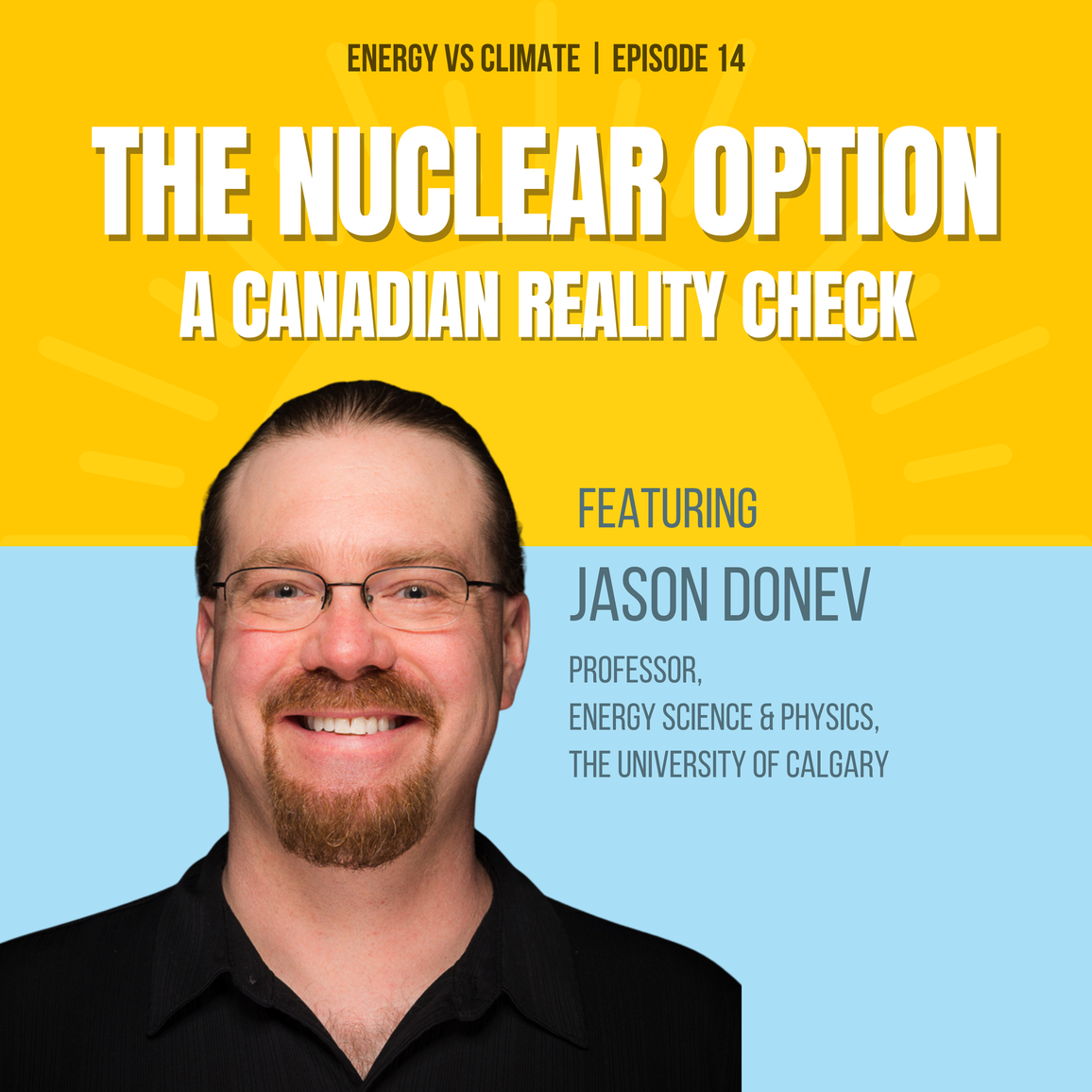
The Nuclear Option: A Canadian Reality Check with Jason Donev

Nuclear is having a global moment. But the story in Canada is a lot more complicated.
David, Sara, and Ed sat down with Prof. Jason Donev of the University of Calgary for a full, unsparing look at where nuclear fits in a rapidly growing and electrifying Canadian grid.
Jason is one of the clearest thinkers on energy systems in the country. He's also someone who started out opposed to nuclear and changed his mind.
We set this episode up to tackle two questions. First, what is the case for new nuclear right now, given rising electricity demand from electrification, industry, and AI. And second, why Canada, despite decades of experience, has struggled to build new projects beyond Ontario and New Brunswick.
A few things you'll hear about:
- Canada had a nuclear accident in 1952. Jimmy Carter helped clean it up.
- “Small” modular reactors can be up to 300 megawatts. A CANDU is closer to 700. “Small” is a relative term.
- Darlington’s BWRX-300 is a closely watched test case for Western SMRs. Will costs fall with follow-on units, or will nuclear repeat its Achilles heel and get more expensive?
It turned into a lively and wide-ranging conversation on costs, timelines, small modular reactors, and the deeper issue that keeps coming up with nuclear. The physics may be solved, but the politics and institutions are not.
Show Notes & References:
(3:20) George Monbiot, Going Critical (March 2011)
(4:12) UChicago News, The First Nuclear Reactor Explained
(4:44) Argonne National Laboratory, The Italian Navigator Lands
(10:00) World Nuclear Association, The Many Uses of Nuclear Technology (Jan 2026)
(10:50) Canadian Nuclear Association, History of Nuclear in Canada
“Coal has 1230 times more deaths and 273 times more emissions than nuclear.”
(13:40) Visual Capitalist, Charted: The Safest and Deadliest Energy Sources (November 2023)
(17:50) IAEA, Two More Countries Join Global Pledge to Triple Nuclear Energy by 2050 (November 2025)
(18:00) Carbon Breif, Wind and solar are ‘fastest-growing electricity sources in history’ (May 2024)
“Canada’s strong track record for safe nuclear operations means that commissioning a new nuclear plant requires navigating a thorough and complex approval process, which can lengthen project timelines, increase costs and amplify risks.”
(20:00) Public Policy Forum, Nuclear Powerhouse (March 2026)
“Commercial plants whose construction began in the late 1960s cost $1000/KWe or less (in 2010 dollars); plants started just 10 years later cost nine times that much.”
(29:40) Institute for Progress, Why Does Nuclear Power Plant Construction Cost so Much (May 2023)
“State-backed loans with low-interest rates allow China to build nuclear plants at a cost of about $2,500 to $3,000 per kilowatt, roughly one-third the cost of similar projects in the U.S. and France.”
(29:10) Renewables 2023 Global Status Report, Renewables In Energy Demand, Transport in Focus (2023)
“In 2020, the transport sector continued to rely heavily on fossil fuels, dominated by oil (90%).”
(44:00) Our World in Data, How does the land use of different electricity sources compare? (2022)
“Mixed oxide (MOX) fuel provides almost 5% of the new nuclear fuel used today and fuels about 10% of France's fleet.”
(47:40) World Nuclear Association, Mixed Oxide Fuel (April 2026)
(51:20) Michael Edmunds, Nuclear In The Alberta Market (April 2026)
Episode Transcript
[00:00:00] David Keith: That you have to now assess if I'm 10 million times more evil than Hitler or Stalin, or the combination I can play the, the, the voicemail that accuses me of being 10 million times more evil than Hitler and Stalin. It's from a Canadian too.
[00:00:14] Ed Whittingham: Well, just shows that Canadians can be just as nuts as any other nationality.
[00:00:19] Hi, I'm Ed Whittingham and you're listening to Energy Versus Climate, the show where my co-host, David Keith, Sara Hastings-Simon and I debate today's climate and energy challenges. On April 21st, the three of us recorded a live webinar with special guest Jason Donev of the University of Calgary. We titled the show The Nuclear Option, a Canadian Reality Check.
[00:00:39] Because nuclear is having a moment globally, but the story here at home is a lot more complicated. It turned into a lively and wide ranging conversation on costs. Timelines, small modular reactors and the deeper issue that keeps coming up with nuclear. The physics may be solved, but the politics and institutions are not.
[00:00:57] So, without any further ado, here's the show.
[00:01:01] So the question we're talking about today is, does nuclear work clearly does. Uh, but the real question is, does it work here in Canada? And so to help us unpack this and the Canadian reality, we're joined by Jason Donne. He's a professor of energy science and physics at the University of Calgary.
[00:01:19] And one of the clearest thinkers on, uh, the energy on energy systems that we have in the country. He also leads energy education.ca, which is the world's largest and most widely used energy resource for adults, and he is a, uh, reviewer for the Internet Intergovernmental Panel on Climate Change as well.
[00:01:38] Jason, joining us from Calgary. Welcome to Energy versus Climate.
[00:01:42] Jason Donev: Thank you.
[00:01:44] Ed Whittingham: So let's dive right in. Jason, you've spent a lot of time thinking about energy systems at a fundamental level, so perhaps you can give us the quick version of your background and how you think about nuclear energy in the broader energy system.
[00:02:00] Jason Donev: I, I, I like the, uh, the very cashy title of this, of this podcast, energy Versus Climate. I am somebody who is, uh, passionately concerned about climate change, but also really believe that in order to, to live the way we would like to live, we need access to energy. So, so energy versus climate, why not have both?
[00:02:20] Uh, and the answer is because if we want to have both, it's gonna be expensive, it's gonna be inconvenient, and it's gonna be actually really, really difficult to do both. I'm fond of saying that even if you think climate change is a big problem, it's probably a bigger problem than you think. Um, so I got involved with nuclear power as somebody who was opposed to it, who did not think nuclear power was a good idea.
[00:02:40] I thought nuclear power was a very dangerous idea, and the more I found out about it, the more I, the more I realized that we needed to be doing a lot more nuclear, along with doing a lot more solar and a lot more wind and a lot more everything else. Um, I mean, there's. Climate change is just a really, really big, big problem.
[00:02:56] Um, nuclear is an interesting technology. The physics of it is interesting. The science of it is interesting. So I got into it because they wanted me to teach it. And like I said, I started off being very, very opposed. But the more I learned about it, the more I was like, no, no, we, we, we need to be doing this.
[00:03:10] Along with a lot of other things.
[00:03:12] Ed Whittingham: Hmm. That makes me have a poll question. Regret. We could have done a poll question of how many people were opposed to nuclear power. Let's say 20 years ago, but have changed their mind since.
[00:03:23] Jason Donev: It was one of the interesting things that happened after Fukushima, actually, the number of people who, some journalists specifically, uh, George Monbiot comes, comes readily to mind.
[00:03:31] Who in the process of looking into what happened with Fukushima, were like, wait a second. What do you mean? That's it? This is as bad as it gets. And it was actually very, very little. But that isn't the story people wanted to tell. So, um, I, I, I encourage people to have complicated thoughts and feelings about nuclear power.
[00:03:48] 'cause it is a complicated, complicated subject. Um, which is why, you know, podcasts are better than say a meme about this sort of thing. Anyway, I interrupted. Go ahead.
[00:03:57] Ed Whittingham: Well, I just wanted to, uh, ask you to help us establish the global context. How, how long have we been using we as, as, as humans been using nuclear energy, and how widespread is it really around the world?
[00:04:12] David Keith: We've got an answer from a UChicago perspective. 'cause it's just a block away where I get my launch is where it started.
[00:04:17] Jason Donev: Absolutely. Do you wanna talk about Stagg Field and Enrico Fermi and the
[00:04:20] David Keith: Yeah. There's a beautiful sculpture I even have in Canmore, a little piece of, of Chicago pile number one, the very first, uh, system that released nuclear power.
[00:04:29] So yeah, it started at University of Chicago under the squash court with Enrico firmly making the first, uh, chain reaction.
[00:04:36] Ed Whittingham: And remember that piece, David? 'cause you brought it when we went to see Oppenheimer. And a glow in your pocket during the entire three hours.
[00:04:43] David Keith: Argonne lab, which many people know about as a national lab.
[00:04:47] It's this big national lab here. Here. The reason Argonne lab was there, as far as I understand the history is Chicago pile number one. You know, they pulled out the control rods and saw the beginning of the chain reaction, but then there was no heat removal or anything. It was just to show the chain reaction would work.
[00:05:00] And then they wanted to build a Chicago pile, number two, and I guess they already thought it wasn't maybe the best idea to do it in downtown Chicago. So they went out in the woods somewhere. Uh uh, some drive away. And that's where Argonne is now.
[00:05:10] Jason Donev: And interestingly, Canada. Canada did the same thing. Not much, not not long later. Um, at the, uh, at NRCAN on Sussex Drive, right? Like in, in the actual, uh, uh, n arkan building, we did a very similar graphite moderated reactor.
[00:05:26] David Keith: I didn't know that. Cool.
[00:05:28] Jason Donev: Yeah. So, so Canada, number number two in nuclear energy. I mean, I, I always want to throw in the, the caveat of. You know, when we're talking about nuclear energy, we are, we are assuming that, we are talking about when humans are deliberately causing nuclear reactions to happen.
[00:05:42] Every time you're using geothermal energy, we are using energy. Every time you're using solar energy, we are using nuclear energy. So a lot of the geothermal energy comes from nuclear. A lot of the solar energy comes from nuclear, well, actually almost all this solar energy comes from nuclear with. With geothermal.
[00:05:56] It's a little, it's a little trickier not to, not to split hairs here. 'cause I, I know when people say nuclear energy, what they mean is what started with, with the Chicago pile and after Enrico Fermi did the Chicago pile experiment, they had a, and it's, it's kind of funny, looking back at the history of this, they did this really, really amazing thing that was brand new technology.
[00:06:17] They did a long distanced telephone call, so they actually called Washington DC to say. That this was a success, but they were worried people were listening in, so they had to come up with a code. Um, so the Italian navigator has landed in the new world was the, was the code that Conan used. And the the response was, well, and, and how are the natives?
[00:06:37] And the, and, and the answer was very friendly. And that was how the long distance phone call announced. The Chicago pile number one that, that David's talking about.
[00:06:48]
[00:06:48] Ed Whittingham: That, that's fascinating.
[00:06:49] Jason Donev: So nuclear power is roughly as old as long distance telephone calls.
[00:06:53] Ed Whittingham: It brings in some sort of, uh, subterfuge into it as well.
[00:06:58] A cloak and dagger element.
[00:07:00] Jason Donev: A absolutely. And that that carries on with nuclear sector.
[00:07:02] David Keith: You've gotta stop us nerding out, ed, but I'm gonna nerd out for one more second. I think one profoundly interesting thing is there's sorts of really hard and terrifying things, and I think you undersold some of the downsides.
[00:07:11] Uh, we'll get to that in a minute. But I think what's interesting is you think about that very first pile. It's not, there was some fundamental facts you had to know, but in terms of the actual technology, you need to do it just stacking together chunks of graphite and chunks of ore. It's not obvious to me that you couldn't have done that.
[00:07:27] 50 years earlier, if you go back in time, I've wondered about that a lot. That is, there wasn't some big enabling technology. You had to have this knowledge, you need this particular spacing of graphite, bricks, and uranium chunks. But I would like some time to kind of go back and see could you have done that 30 years earlier?
[00:07:43] Uh, what would've been missing? It's not clear, but I, it's just interesting 'cause it gives you a sense of what's hard and easy.
[00:07:49] Jason Donev: The, the answer, it's 30 years, I'm not sure, but 50 years, no. 'cause you wouldn't have had the purity of graphite and you wouldn't have had the purity of uranium. Nuclear technology is really, really hard.
[00:08:00] And this is, this is one of the things about it being so terrifying when people talk about things like, well, what about waste? What about nuclear weapons, proliferation, and so forth. It turns out that nuclear technology is very, very difficult and that is both what makes it difficult to employ, but it's also what makes it difficult for it to just go completely, uh, catastrophically bad.
[00:08:20] Ed Whittingham: And when we're talking about nuclear energy, Jason, just the people I think use it synonymously and they think of its use in the power sector. Do we have many examples of it being used for industrial heat, either in Canada or elsewhere?
[00:08:33] Jason Donev: The quick answer is no. Broadly speaking, nuclear energy comes from the energy inside of the nucleus of an atom.
[00:08:39] That's why it's called nuclear energy. Physicists are terrible at naming things. I wanted to name my child, child number one. Fortunately, my wife overrode that. So when the energy comes from nucleus, we call it Nu nuclear energy. If you split apart a nucleus, that's fission. If you. Join two nuclei together, that's fusion.
[00:08:57] That's what powers the fusion powers. The sun vision is what powers our, our nuclear reactors. You also have, uh, nuclei just spontaneously undergo a transformation. This is radioactive decay. This is your alpha beta gamma decay. And with, with that spontaneous transformation, alpha, beta, gamma, that kind of, um, technology has a lot of industrial uses.
[00:09:22] Checking welds, uh, treating cancer, treating, um, uh, diagnosing other issues. There's a lot of uses, but we don't use fission to create heat for, um, for industrial processes. There's no fundamental physical reason we couldn't, but we tend to use it for electricity and while. Some co-generation, some, some heat has been proposed and, and looked at.
[00:09:50] It's very, very rarely gotten off the, off the drawing board. But we, we do, we do use nuclear technology a lot for industrial application, but not heat so much.
[00:10:01] Ed Whittingham: Got you. And sorry, the last scene setting question then we can get into, uh, uh, is nuclear having a moment globally and if that's the case, why? And then some of the, the challenges.
[00:10:12] It back to Canada. So we've had nuclear power generation in Canada for decades.
[00:10:18] Jason Donev: Yeah. Roughly 60 years.
[00:10:20] Ed Whittingham: 60 years in Ontario, new Brunswick. And so in Ontario of OPG, Ontario, our generation and Bruce power and no, uh, sorry. New Brunswick, you have NB power and I think in, uh, Ontario, at least each, uh, OPG and Bruce Power operating.
[00:10:37] Reactors give, give us a sense of the, the Canadian record with nuclear power today. We obviously haven't had a major accident or scare, uh, some other jurisdictions of them.
[00:10:49] Jason Donev: Yes, we have.
[00:10:49] Ed Whittingham: Okay. Yeah. Okay. We'll, we'll unpack that.
[00:10:52] Jason Donev: Sure. Uh, Canada, um, had the NRX and the NRU reactor Chalk River, which is a couple hour drive north of Chicago and.
[00:11:01] Back in, I think it was 1952, we had a, a reactor accident. And there was the, the US actually sent up part of their nuclear navy to help out, uh, to help clean up and to help, to help manage this. Um, and as quite, quite weirdly, um, Jimmy Carter was one of the people, the US Nuclear Navy set up, sent up to Canada to help with this.
[00:11:29] And given that he is. I think the longest living president in history. Um, I think there's something to be said for, we need to be careful about how we talk about radiation, you know, shortening people's lives and so forth. Because while radiation is absolutely dangerous and should be treated carefully and thoughtfully, nuclear accidents don't mean what people think they need.
[00:11:50] So, uh, when you have something like Three Mile Island Fukushima, uh, less so Chernobyl, but with Fukushima. Three Mile Island, what you have is a huge, huge media discussion. About nuclear power. But when you have something like wind scale or SL 1, which are also nuclear accidents that have happened, they did not capture the public imagination in the same way.
[00:12:17] So SL 1 was more deadly than Fukushima and three Mile Island combined, not Chernobyl. Chernobyl was much, much, much worse. Um, but when you have the SL one disaster in Idaho, which actually spread radioactive contamination. All over the northwestern United States and Southwestern Canada, which includes where I'm sitting right now, Alberta, there just wasn't nearly the public outcry.
[00:12:39] Uh, and I think, I think it just has to do with like how the media is handling this, how people are responding to the media and so forth. So Canada has had nuclear fallout. We've had a nuclear accident. What we have not had is the major story around things like Fukushima and, and Three Mile Island or, or Chernobyl, for that matter, which we can
[00:12:58] Ed Whittingham: also, and David, I, I, I know you've had SATs around Fukushima on the relative radiation exposure.
[00:13:04] That, uh, safety workers were exposed to in Fukushima relative to where they might be exposed to another air and in other parts of the world?
[00:13:12] David Keith: Yeah. See if I can remember the worst exposed couple people in Fukushima had a good fraction of a seavert is my recollection, which would be. Equivalent. Oh year is a test equivalent to increasing your 30 year cancer rate by percent.
[00:13:28] But I'm not, I had that number memorized and I've lost it. Now.
[00:13:30] Jason Donev: Those, those numbers are not, I don't remember them exactly either. Those numbers are, are relatively close
[00:13:35] David Keith: and that's the worst exposed people to be clear. So, so which is kind of equivalent to a big diet change.
[00:13:41] Sara Hastings-Simon: One step that I like on that though.
[00:13:44] Is the, you know, nuclear compared with coal for example, has resulted in, I think it's like, you know, 1% of the deaths per unit energy produced something, something of that order of magnitude.
[00:13:58] Jason Donev: I think that might actually be a little high.
[00:13:59] Sara Hastings-Simon: Yeah, I, I. Sort of less, let's call it less than 1%. Yeah, less than 1% exact number in front of me.
[00:14:04] But, but I think that's, you know, from the, from the direct risk and that old age one is funny 'cause my, we, we like to joke, my grandfather actually is one of the scientists who built the FLX beam reactor at. Lawrence Berkeley National Lab. So he was with, uh, he was with AMI back in the day. This is our family, family lore pretty fun stuff.
[00:14:23] I, I've never told you about that, Jason. Um, and uh, we always like to joke that, you know, he lived to be in his nineties 'cause he got just the right dose of, uh, radiation, uh, ah,
[00:14:33] Jason Donev: or ESIS
[00:14:34] Sara Hastings-Simon: while he was, while he was working back in the, back in the fifties. So.
[00:14:38] Ed Whittingham: Yeah. Uh, Jason, so, uh, how, how would you characterize the moment that nuclear is having globally?
[00:14:46] And then after that, we'll try to characterize what it's happening here in Canada, but is it, and, and we talk about, uh, on this show, the, the huge expansion of nuclear power that's happening in China. Are there other markets that are growing? Uh, and, you know, nuclear countries like France is the one that, that, uh, springs mind amongst the western democracies, is it expanding its fleet or is it growth really being driven in developing countries?
[00:15:15] Jason Donev: What I think we're seeing right now is that. And, and a number of people. Um, I, I, I predicted this, but not because I'm smart. I predicted this because I was angry and I made some, some offhand angry comments about 15 years ago that by 2025, climate change would be so obvious that you wouldn't need scientific training or special equipment to see it.
[00:15:36] And this, this now seems like I was prescient. And really what it was is I was, I was ticked off at people denying climate change. Back in 2010, which people still deny climate change, but, but now it's more a lukewarm thing. Um, what we're seeing is that people and governments and so forth are now taking climate change seriously.
[00:15:54] It's becoming personal. And this idea of, wait a sec, this might affect me too, not just somebody. Somewhere else. And what we are seeing at the moment, I think is a huge increase. Uh, a mushroom cloud, if you will, of interest in nuclear power as an option. And what we're seeing is a lot of conversation and we are starting to see action.
[00:16:16] China with a command economy, with a centrally planned command economy, China is able to implement nuclear in much, much faster ways than would ever be permitted in a place like France or Canada or the US or really anywhere in Europe. That kind of command economy allows for a growth in someplace like China, uh, that you'd, that would just be very, very difficult to happen in a democracy.
[00:16:43] What I would say is that in, in economies like China, where you can see rapid growth and rapid change, and it's not just nuclear, right? We're stings with solar. We saw this with hydro. We saw this one. We see this with wind, we see this with battery storage. When you're looking at the China command economy, people can just sit down and say, go, and then people scurry and do, and there's some advantages to that.
[00:17:05] There's some real disadvantages to that too. I'm not, I'm not in favor of switching to a command economy, but there are advantages to a command economy. So I think the conversation is happening in a lot of places, which is not the same thing as reactors going on in the grid. And unlike solar, unlike wind, uh, but very much like hydro, there is a huge, huge, huge lead time between we are doing nuclear, we're gonna do nuclear, and then you have to go through several elections before nuclear power is actually getting put on the grid.
[00:17:35] So this, this delay between the decision and everybody buying in and starting. Is, I don't know if it's a fundamental part of nuclear, but it is very much a part of nuclear and what I'm not opposed to, but it does cause nuclear problems. So there are almost 40 countries that have committed to tripling nuclear power by 2050.
[00:17:56] And if you look at that compared to solar, over the course of the past 40 years, solar has gone up by more than the factor of a hundred thousand, which is just mind blowing. But if we look at nuclear, nuclear doesn't need to go up by a factor of a hundred thousand. Nuclear needs to go up by like a factor of three, two.
[00:18:12] To being, to making as serious a contribution to greening the grid and greening energy as needs to happen. And those conversations are happening, but I think there's a lot of distance between the conversations that are happening now and actual reactors getting built and being put on a grid. Did I take that too farfield from what you intended?
[00:18:32] Ed Whittingham: No, not at all. Not at all. And it's, uh, I've got a, a perfect follow on question if I can call my follow on question. Perfect. Um, the risk of hubris. We've got a long list of NOx. Oh, not too long. Let's say we've got about a half dozen list of noxs against nuclear energy that we are batting around, uh, by email.
[00:18:53] Prior to this show, I always put at the top of the list, it's not saying this is an order of priority, but it's long lead time technology. For whatever reason, it kind of just rolls off the tongue that way. So in Canada now, we do actually have a new nuclear. Plant that is under construction, the Darlington new nuclear project that the BWRX 300 300 megawatts.
[00:19:14] So could you compare and contrast the lead time required for that project in Canada and Ontario with a very established track record of, um, building and operating nuclear assets to some of the new projects that are happening in China? You've said that it's faster, but by what magnitude?
[00:19:33] Jason Donev: The actual construction time.
[00:19:37] Doesn't really differ. I mean, China might be able to do like 20, 30% faster. I don't, I don't know actual numbers, but the actual construction is not What's different. What's different is duty to consult. Um, what's different is, uh, public consultation, the regulatory framework, the impact assessment, that's where you're throwing five to 10 years on a Canadian project.
[00:20:01] That China is able to do far more quickly. Um, and, and that's where I get concerned. Um, I, I, I regret to say that one of the things that I have predicted, uh, 'cause I like spotting off these predictions 'cause nobody, nobody really listens to me. So when I, you know, years later I wind up being right. I'm like, Hey, I said this before, and all the ones that I get wrong, I, I just, I just don't, I just, I just don't, don't repeat.
[00:20:27] But my prediction is that the next major nuclear accident is actually gonna be in China. I think it's going to be as a result of some of the speed at which their reactors were deployed. But China is looking at building more nuclear reactors in the next 20, 25 years than exist in the rest of the world combined just within China.
[00:20:48] Uh, and I hope I'm wrong about the next accident. Well, there will be another nuclear accident. There just will be, accidents do happen. Um. And then the question becomes, with those accidents, how well has the engineering put safety into place around that? So going from, we want to build a nuclear reactor to, we have a nuclear reactor between China and Canada.
[00:21:12] I would say it's about a factor of two, but it's not construction that's doing it. It's, it's a regulatory framework process. Did that answer the question?
[00:21:21] Ed Whittingham: Yes. Yes. And I'd love to turn to, to David and Sara to get their thoughts. So I'm just gonna run through the others on our, our list of knocks against nuclear.
[00:21:29] It's capital intensive. All alternatives are cheaper. The waste remains an intractable problem. It requires, you know, state donation level, uh, backstopping of insurance due to the liability risk. It can lead to or feed the proliferation of nuclear weapons. So maybe turning to Sara first, if you want to cherry pick what you like from that list, which would you think is a fundamentally real concern or not and and which are more contingent.
[00:22:06] So over to you, Sara.
[00:22:07] Sara Hastings-Simon: I'll, I'll go with sort of the ones I'm most worried about. I think they're all real concerns as is, you know, the idea that the only way to do it fast is by bypassing, you know, cons, consultation, and the things that are obviously, you know, let's not get into what China's doing, but are obviously the things that we need to be doing here in Canada.
[00:22:27] I'll say my biggest concerns about nuclear is, is not even necessarily about the technology itself, but the way that it is, and I think it's the perfect example of a technocratic solution that is put forward. Amplified by some, not all. So I'm not saying that all people that are supporting nuclear have this view, but by some used as basically a delay on action, um, to decarbonize in other ways.
[00:22:58] Are,
[00:22:59] Jason Donev: are you thinking Saskatchewan specifically?
[00:23:01] Sara Hastings-Simon: Uh, no. I mean, I'm not even gonna necessarily pick out specific regions. I think it's general. I don't think it's even Canada specific. Right. But, but what I'll say is there is, you know, the, the costs are relatively significant and we're at a point where in the US.
[00:23:18] Sent in Canada, you don't, I don't think you see this stuff being built without significant state support. And so then it's a question of, you know, how much money do you put into to nuclear versus other things, and how much is nuclear put forward as sort of, this is what we're going to do and so we're going to do that instead of doing something else.
[00:23:38] And that is my biggest concern with nuclear. And I don't think that I'm just making this up, you know, I think this. We see this playing out. So if you look at, um, I, I was reviewing a report, uh, just before the show called Eight Years On the Road, uh, on the roadmap assessing SMRs in Canada, which is by Susan O'Donald.
[00:23:58] Donnell and MB Ram Na, who I actually had a chance to interview at one point. So they reminded us in this report that in 2018 Canada put out a roadmap. Um, the first SMR was supposed to be operating in 2026. Um, we've spent about 4.5. Billion dollars, billion with a B in federal money, um, on nuclear. I, I did a quick phone a friend before this, uh, and asked Blake Schaeffer to give me the number of how much building a transmission line between Alberta and BC would cost.
[00:24:29] Um, and, and it's about somewhere in the neighborhood of, you know, three to $4 billion, probably a bit more once you have some overrun. So, you know, comparable amounts. And so I think that. We need to be really honest about the ways that nuclear is being used by many to delay action on other types of policies and other types of efforts to decarbonize.
[00:24:55] I also think the other, the other big sort of error that I see is this argument around the cost reduction, um, that we're gonna see. Right? And so there's a, there's a lot of talk, I think about SMRs or this new solution. It's gonna be so great because we can build lots of them and we can get this same kind of learning curve we've seen for solar.
[00:25:12] And Jason, you already, you know, answered this by saying that we need to build out about three times the amount of nuclear that we have today in order to, you know, decarbonize. And the, the whole magic of the learning curve is like. Orders of magnitude, not factors of three. And so the idea that we're going to see, you know, any amount of real cost reduction from some kind of scale up of nuclear in, you know, again, let's talk about, say the US and Canada or even throw Europe in there.
[00:25:42] I think that is just completely. False based on the amount that we're talking about. Um, I think that the, you know, it's in competition with other technologies for electrification. Certainly in Alberta there's this big push of like, oh, well we could, you know, use nuclear to decarbonize. The oil sands. And I think my answer for that is once you have a, you know, if you really believe that you had this great low cost source of, of low carbon energy, using it to then produce oil would be a very strange thing to do with it.
[00:26:14] Right. So you sort of, you, you've already solved the problem and now you've gone back into to, to uh, uh, kind of. Back into the original issue. So I just don't see where we're at now with the prices of renewables, with the ability, you know, the co, the falling cost of batteries, the potential for transmission lines, and where I.
[00:26:38] Think the state should be focusing the bulk of its funds. I don't, I don't see that path forward. So maybe my answer to you, ed, is a little bit, my biggest concern is really the economic one with this like subtext of, I think it's not only sort of somewhat foolish, but I think it's potentially harmful in how it is slowing, uh, or, or being used by some, again, as an element of climate delay.
[00:27:04] So I'll, I'll stop there after my bit of, a bit of a nuclear rant maybe, uh, if I have to, although I'll say, you know, it, it doesn't come from an anti-nuclear, like I said, I'm the, I'm the granddaughter of a, of a nuclear physicist, so I certainly also, uh, we talked last time, ed, about how I grew up learning about energy.
[00:27:22] I also grew up learning about the wonders of, of nuclear energy.
[00:27:26] Jason Donev: Sara, can I just trouble you to, to define how you are using technocratic? 'cause I've heard it used different in different ways. And just if you could provide a. A definition for for technocratic.
[00:27:35] Sara Hastings-Simon: Sure. So I will attempt to, with a, with a caveat that it's not, definitely not my area of expertise, but I'll say I'm using it here to describe the class of solutions to climate change that are focused primarily on a new technology will fix it, and it doesn't require us to grapple with broader, uh.
[00:27:57] You know, societal and energy system questions around that. But rather we can bring in this new technology and we can keep doing everything the same as we always were.
[00:28:07] Jason Donev: Like batteries are a new technology that we're bringing in to fix climate change.
[00:28:12] David Keith: I think technocratic is normally used in the phrase of things I don't like.
[00:28:18] Sara Hastings-Simon: Well.
[00:28:20] David Keith: I'm teasing, but I'm only teasing a bit. I think typically people have all these technologies they like, that aren't technocratic and the ones they don't like aren't, but, but
[00:28:28] Sara Hastings-Simon: I No, that okay, that, that, I think that is a somewhat fair point, although I'll say if, if one feels that they're being accused that the technologies that.
[00:28:36] Or, or that their favorite solutions are technocratic that also might say one, something about oneself. I, I will say that I think that to me, integrating batteries and renewables goes along with changing the way that the energy system is designed, right? It goes towards a much more. Sure you could do that with batteries without changing things.
[00:28:54] But most effectively is doing that in a, you know, way that's decentralizing, uh, energy, that's, you know, bringing in more demand side flexibility, that's changing ownership structures of renewable energy. So who's owning these pa owning renewables and so forth. So it's sort of, do you, are you really just taking one piece out and putting something in without having to change any of the rules or structures around it, which.
[00:29:21] Is more on the nuclear side, I would argue, or are you actually having to confront, you know, we need to change the amount of, of energy we're using or the ways that we're using it too.
[00:29:35] David Keith: It would be awesome. The quickest way to solve a problem is if you can just change one thing and everything changes, but nuclear power doesn't work that way.
[00:29:41] The costs are, frankly a joke. A fair way to summarize it is in the Western world at least, we just do not know how to build reactors at a cost. That's not a joke. We've unlearned. There's been some very nice analysis by, uh, some folks at Stanford, uh, Jonathan Kumi etal that looked at the, the cost of all the US reactor fleet because it was, there were mostly public utilities, so we could see the costs and people were building reactors at a reasonable price in kind of $2,500 a kilowatt.
[00:30:09] In current terms, back in the day. We've completely forgotten how to do that. So the actual cost of the completions in the Western world are, you know, well over 10,000, of course, $20,000 at kw, which is just a joke and nobody can really say clearly. What fix would be needed to change that? It certainly isn't a learning curve.
[00:30:30] There are a bunch of complicated reasons why nuclear is so ridiculous, expensive. It's, it's clearly not kind of inherent to the technology, whatever that means. But it's also true that there's no obvious fix. Something would have to be very different. In terms of my concerns about nuclear, I think the central concern to me is that, I mean, and lots of things are great in principle, but we just don't know a recipe to build nuclear plants that are reasonable cost in the west anyway.
[00:30:57] And China, maybe it's a different thing. I wanna pick at a few things. I think there's been a lot of hype, especially in Canada elsewhere about, uh, small modulars. This is not a new idea. When I was first at MIT, the nuclear engineers were talking about modular reactors. There are certainly some basis. There that could make sense where if things were all manufactured not on or if, if, if more of the big units were manufactured offsite in a production line.
[00:31:20] But the fact is the SMRs that are actually coming to market are, um, basically variants of existing lightwater reactors. And it's not a tall obvious that they will be, um. Cheaper. Indeed. The people who I trust think that they will not be cheaper, but I think we don't know until it actually happens. Um, I don't take the waste concern seriously.
[00:31:39] I think part of it is a lot of literature comes from the US and the us. Um, managed nuclear waste in a way that was just. Terrible, technically and politically, the so-called screw Nevada Act, but Sweden and Canada both seem to have pathways for nuclear waste storage that seem reasonable. There's not an objective of reason for high cost or concern.
[00:31:57] I think that basically nuclear waste has become a football by people who, for other reasons, don't want nuclear power and wanna block it that way. But I personally don't see the waste concern as serious at all. I do see proliferation concerns as serious. In a world where you really grow nuclear power a lot, there's no easy way that you don't make access to materials easier.
[00:32:16] And you know, Canada has a pretty. Clear track record on this. We, uh, built a cando reactor for a lot of good reasons 'cause we couldn't make the pressure vessels and we had, uh, the ability to make heavy water. But, um, Cando is just great for making weapons, great plutonium 'cause you can, um, drive things through the core quickly so you don't get the wrong ratio of the two.
[00:32:35] Plutonium, isotopes. And India of course, copied the caddy design to make weapons and John Jason's shaking his head so he gets a chance.
[00:32:43] Jason Donev: That is, that is not quite accurate.
[00:32:45] Ed Whittingham: Which part is wrong?
[00:32:46] Jason Donev: Um, ch uh, India used a research reactor, not a can-do reactor. Uh,
[00:32:52] David Keith: yes, I know. I didn't, I didn't say that. I said copied.
[00:32:54] Yes. I actually was a colleague of a guy who ran, I was a colleague of VK who ran the Shining Buddha project. Yeah, I, I, I think, yes, they did not actually use a can do that as correct, but they. But the core design of the tube, the, the, the, the tube design that allowed you to, to do relatively low burn ups, which is what was used at the hand for reactors as well, is what they copied and, and can do, does have that fundamental weakness.
[00:33:23] And, and I think there are lots of complicated branching waste. This could work. And they're, you know, one one, because the counter argument is that people want really, want nuclear weapons in advanced societies. They can get them. And so in some sense, the counter argument is that nuclear power doesn't mean that a rich country can or can't get nuclear weapons.
[00:33:39] A rich country could do iso enrichment and make nuclear weapons if it wants to pretty easily. Um, even probably Iran can even while being bombed by the Americans. But I still think that a world with a lot more nuclear power is a world with somewhat higher proliferation risks. Uh, very hard to assess whether that means we should do it or not.
[00:33:58] Um. But I think the central challenge really is managing costs. And, um, I don't buy Sara's argument about replacement. I mean, if you really did have a cheap, simple replacement for existing power generation, I don't think there's something inherently better about a more distributed power system. I just care about decarbonization and environmental impact.
[00:34:17] But I think we just don't know how to do it. And I think I'd really like to hear Jason's ideas about what it would, what, what are the either technical or. Institutional, regulatory, whatever it would be, business changes that you need to make to actually build significant numbers of reactors at a reasonable price in the West.
[00:34:36] Ed Whittingham: Yeah, and that, I'd love to hear that as well. Thank you for teeing that up, David. And maybe Jason, uh, as an adjunct to that, you could talk about this, this notion of an unlearning curve whereby each successive project. It gets more expensive rather than getting cheaper is the way that it should happen with big energy infrastructure.
[00:34:56] And we, so nuclear is expensive. We know it's being built at much cheaper rates per kilowatt installed in China. I think the latest figure is 3000 US per kilowatt installed. So it's not necessarily the technology, it's the way we've chosen to build it. But how has, what has been the experience of other Western democracies?
[00:35:16] Building new nuclear, like is it just irreconcilable with western democracies and it's gonna have that unlearning curve, or is this, there's a better way of doing it that in particular in North America, we've not yet discovered.
[00:35:29] Jason Donev: I, I, I do agree with what, what David said about nuclear waste being a football and being handled phenomenally poorly in, in, uh, in the US for, for a number of reasons.
[00:35:41] But, but to, to Sara's point, the achilles heel of nuclear is absolutely. It takes a long time. The time value of money makes it not makes sense. There's no cheap way to, to do it. We don't have a small, small module. Reactors are not small. Let me be really, really clear about that. Um, a can-do reactor is 700 megawatts electric and change, and these small module reactors are 300 megawatts in change.
[00:36:06] That's not actually small by I think any reasonable definition of small. One of the things I'm fond of saying is that uh, people on the political left don't trust big business people on the political right. Don't trust big government. And one of the problems with nuclear is you need both big business and you need big government for nuclear to work.
[00:36:24] And from the standpoint of when we are looking at wanting to decentralize electricity, nuclear is the worst possible solution. And I think that there is an emotional response to nuclear. From the standpoint of it's central, it's controlled by people. I don't trust it is reasonable to not trust a number of the people who've been involved with nuclear.
[00:36:45] Nuclear has in its history, as does a lot of other industries. But nuclear specifically has, its in, in its history reasons to fundamentally distrust nuclear. Uh, the, the radium girls as an excellent example, uh, the uranium mines through Africa were. We're really, really atrocious from the standpoint of taking advantage of the indigenous people.
[00:37:06] Nuclear has a lot of history to answer for, and when nuclear was being built cheaper, we were doing things that we should not have done. We were doing things that were in a lot of ways atrocious and in. The unlearning. Some of what we were unlearning was learning new things that got in the way of us being efficient.
[00:37:26] And being efficient can very much be the, uh, the enemy of doing what's right. So when, when, when it gets down to what problem are we trying to solve, climate change is a wicked problem in terms of it being technocratic as as defined here. I don't see nuclear necessarily being less technocratic than relying on batteries, which ha do have a huge waste problem.
[00:37:51] Having grid level batteries would have a waste problem that I would feel very uncomfortable with. I was worried about solar. Uh, waste for a long time. And the more I learned about it, the more I, the less worried I got about the waste from solar. It is a thing it needs to be dealt, dealt with, but I think solar wastes can be dealt with properly.
[00:38:07] Battery to waste, I'm a lot less comfortable with. There is no plug and play solution for climate change, uh, as far as nuclear being used in the oils, oil sands. I think it's truly important to remember that when we're talking about transportation, almost every country in the world, more than 90% of their, their transportation energy comes from oil.
[00:38:29] Uh, exceptions are places in South America. I know Brazil has a, a strong ethanol. Um, but transportation is largely oil and oil is not extensively used for electricity. There's a, there's been a big push with EVs to try and, and, and, and unify those. I am personally, however, very opposed to nuclear innu sands for reasons that are probably beyond the scope of what we're gonna have time to talk about.
[00:38:52] But I can understand. Where there is the difference between what we're doing with electricity and what we're doing with transportation with oil, I think it's really important to remember that what oil has been used for is recently is not a lot with electricity in terms of will nuclear ever be effective and affordable.
[00:39:13] The refurbishments that happened at Darlington were done way ahead of schedule and under budget. This. This was something that the nuclear industry got really, really proud of. But the difficulty is, the story out there about nuclear is all about, you know, cost overruns. And a lot of the cost overruns have been political.
[00:39:36] The nuclear reactors that were built in the eighties in Ontario went way over budget, in part because an anti-nuclear NDP government came in during the 1980s halted construction. So you had all of this startup and then everything got halted and people were still paying interest on the original loans, and that drives up price.
[00:39:57] So the, the entire nuclear industry at the moment is watching what's happening in Ontario with the first of a kind cost, and I am almost willing to guarantee that the first nuclear reactor built of this BWRX that's happening at the Darlington site in in Ontario, I'm, I'm almost fully to guarantee it will go over budget.
[00:40:14] However, the question is what happens with the second one? And I think Ontario at the moment is making the very calculated risk, um, for the reward of if they're right and the BWRX is the, a big reactor in the future, they will have a workforce that is prepared to go and deploy a thousand of these. If they're wrong and they can't get this right, then I don't know that nuclear does have much of a future.
[00:40:44] So there's an awful lot riding on this because I agree nuclear needs to be cheap enough.
[00:40:50] Ed Whittingham: The, the workforce benefits. It's something that you see, you know, really trumpeted in Ontario. In fact, there's a protect, uh, Ontario ad that, uh, you know, has Doug Ford sort of saber rattling toward the US and saying he is gonna protect.
[00:41:07] Ontario and Nuclear actually features in that. And just as a one anecdote and we're looking, I'd love to get to a little bit to Western Canada. If you look at the Saskatchewan NDP that released its energy policy recently, it talked a lot about nuclear and, and the job creation benefits in Alberta here, it had one small passing reference.
[00:41:30] It was largely negatively framed. So this is something that it's much more, it's nuclear power and, and the economic impact or economic benefits, much more part of the furniture in Ontario in the same way that oil and gas here in Alberta is part of the furniture. But, sorry, Sara, you've got a comment on cost.
[00:41:48] Sara Hastings-Simon: Yeah, I was just gonna throw in one more, I mean there's, there's a sort of, I guess, somewhat well known paper back from 2020, looking at sources of cost overrun in nuclear power plant, uh, by, uh, coming out of Jessica Transits group. Um, it's part of a broader, you know, body of research. Jason, I'm sure you can comment on it too.
[00:42:07] Uh, looking at costs, and it certainly
[00:42:09] Jason Donev: is that the one looking at France.
[00:42:11] Sara Hastings-Simon: This one is us, I think. Okay. Um, but it certainly talks about, you know, the safety related factors and the fact that we're, you know, doing some things better, raises cost. I think also my impression, and, and again, correct me if I'm wrong here.
[00:42:26] But a big part of the costs of the nuclear plant are really the labor costs and the construction costs. And so there's also some underlying, you know, economic differences when we talk about the cost of doing this in China versus the cost of doing this in Canada. I don't think you're ever going to find, nor.
[00:42:43] Do we probably want people to find workers in Canada that are willing to build these plants for the same wages that they are paid in China to build these plants too. So, um, just to throw that in there, in this sort of general question of like, well, why can China do do this so cheaply? I think that there.
[00:42:59] There is that element of, you know, part of what's making solar inexpensive is that we're able to, uh, outsource if you want a lot of the construction costs, which are the manufacturing really fundamentally of the panels, um, to lower cost countries.
[00:43:18] Ed Whittingham: The, the, the cost issue we know is, is crucial. And I say this, uh, just yesterday I had a conversation with two people from the Think tank Lead Prosperity.
[00:43:28] They commissioned some polling. And what they found is 52% of Canadians in their poll think that nuclear will be part of the energy future for Canada, but only 5% are willing to pay for nuclear if that's going to trigger rising costs in their energy Bill. So it's a huge disconnect. We want it, but not if we have to pay more for it.
[00:43:53] And there is that impression that, uh, there isn't a lid on nuclear costs. Uh, David, I know you want to jump in about land footprint.
[00:44:01] David Keith: Yeah. I wanna say one of the. Fundamental things I really am excited about, about nuclear. That to me is one of the long run reasons I really want to see nuclear developed, which is, you know, any energy source has environmental impacts and one of the irreducible environmental impacts is land footprint and nuclear power is as good as it gets on that.
[00:44:20] Uh, source. So to give you a sense of it, wind power, if you wanted, supply a substantial fraction of the world's energy source. By wind power, you're really talking about having environmental impacts over a significant fraction of the world's land, like 10%. Um, for solar power, that number's more, like 1% that is real.
[00:44:37] Solar productivity is about 10 watts per square meter on average. And so if you. Time doing 10 terawatts, you're talking about 1% ish of the land area. But that's not nothing. It starts to be real environmental impacts as it grows. Um, and nuclear is much better, better by an order of magnitude or more even when you count the whole footprint, including, um, the mining and the waste.
[00:44:58] And so I think that's a kind of fundamental thing I like about nuclear power. Important to say some positives.
[00:45:04] Jason Donev: I wanna address some of the things that Sara said about, about China. Um, one of the things that we're going to see is that the wages in China are going to go up. This is one of the things that happened when Romania joined the, my family's from Romania, and when Romania joined the European Union, and it wound up, you know, flooding the market with, you know, like there's, there's lots of cheap labor and then that rises everything in Romania.
[00:45:27] Then, you know, other countries wind up coming in. So part of what China's trying to do is it's trying to modernize its economy. I don't think that, I do think that the, the people in China who are doing these constructions, you know, 25 years from now will be making 10 times as much money. You're right.
[00:45:45] We're, we're not going to be able to get construction costs like that now, and neither will China when. When we're 25 years in the future, if everything goes right, if everything goes wrong, if they're, if they're still getting paid the same amount in 25 years, then then that's gonna be a real catastrophe.
[00:46:00] Ed Whittingham: We're gonna take some questions now from the audience and maybe two or three, I think is all we have time for. Uh, and getting back to waste. We know, and, and David you referenced it, the US basically spent. Decades trying to build a permanent nuclear waste site. I don't know if it's Yucca or Yucca Mountain.
[00:46:19] They got deep into it and then politics killed it and now they've got no long term solution of waste sitting all over the place. So that's the bad case. David, you'd mentioned that Canada and Sweden are doing a better job. Uh, I Andreessen asked how is France dealing with its nuclear waste? Jason,
[00:46:35] Jason Donev: there are 31 countries in the world that have, uh, nuclear power.
[00:46:40] Compared to roughly a dozen have nuclear weapons, just big round numbers. Um, all 31 countries that have nuclear power are at some Stagge of we are going to dig a deep pole in the stable geologic formation and put our waste there permanently. So all three one countries are, have come to that same conclusion.
[00:47:02] Canada has especially good geology for this. What France has done that's a little different from some of the other countries is that France has done a fair amount of reprocessing of their fuel. I have a nuclear fuel bundle here. It's empty. Um, when you send this through a nuclear reactor, the uranium in here, it starts.
[00:47:23] All uranium and then only a small fraction of it actually winds up going, undergoing that fission. Some of it winds up getting turned into plutonium. Some of it winds up, um, being fission apart, but most of it actually stays uranium. The French, and they're not the only country in the world to do this reprocess, and they actually take that plutonium out to put it into what's called a multi oxide fuel, Mox fuel, MOX, that can then go through again.
[00:47:49] But they, but all nuclear to power still requires some long-term solution for where this, which is going to be very radioactive, can become less radioactive over. Time, which is the time is usually quoted in a million years, and I think that's a reasonable number to use. So that's what France is doing, is that they are in the process of looking for a geologically suitable place.
[00:48:14] Also, all 31 countries have decided, and it's all, it's very clear across all the countries that have nuclear power, they want to bury their, their nuclear waste in their own land. They don't, France does not want to ship their nuclear waste to Canada, for example. Despite the fact that we have great geology, the politics of that are just a non-starter.
[00:48:34] Ed Whittingham: I think we have time for, well, maybe we'll squeeze in two, but I'm going to, uh, go to James Van Lewin and read his question. I share Sara's concern about technocrats employing fission powers a stalling tactic, but I expect the nuclear chickens will come home to roost. A lot sooner than the technocrats expect.
[00:48:54] Given the cost and risk issues with fission power, is there a legitimate case for investing in fission power rather than solar plus wind, plus geothermal plus best.
[00:49:05] Sara Hastings-Simon: Maybe I can be a little more generous towards, towards nuclear on this and say that, you know, it's exactly my concern with the sort of crowding out or the use of nuclear as a delay tactic.
[00:49:16] So, you know, if, if there was a plan to say, uh. You know, take Alberta for example, there was a plan to say, let's both invest in building out nuclear and invest in building out more wind and solar and, and all of these things. Like if, if there could really be a political momentum towards that, then you know, the part of me that says, well, let's throw a lot of things at the wall when it comes to trying to decarbonize our sources of electricity and electrify more things.
[00:49:46] Um. There is a cost element that comes in to me that feels less worrisome from a, from nuclear being a delay. It's really when people come with nuclear and say, well, no, let's not do this other stuff. Let's do nuclear instead, that I think the alarm bells should ring about, you know, what, what's really the underlying motive here?
[00:50:10] And, and it's a subtle difference, right? And so I think that is, um, it makes it tricky to kind of sometimes unpack.
[00:50:17] David Keith: China, of course, really is doing both. So I mean, it's clearly possible to do both. Um, I, I think the answer is that, that there are good reasons to invest in nuclear long run. The, the kind of compactness and environmental footprint is a good reason that the problem is how we figure out how to do it a reasonable cost.
[00:50:35] Ed Whittingham: I've got a question that builds upon that, and I think this will be the last question that we can take. It's from Rob Trump Lay and I'll, uh, I'll paraphrase it. Rob got lots of time on the mic in our last episode. If you haven't, uh. Heard the turning the tables episode. Check it out. Uh, to summarize it, it's asking about the economics of nuclear.
[00:50:55] Are the economics of nuclear even, uh, more tough in the electricity mixes of today than they were 50 years ago? And maybe this is the way we bring it back to Alberta, so Alberta doesn't have a crown utility. It's unlike Ontario or Quebec or New Brunswick. It has an energy only market. Jason, is that going to limit the potential of, uh, nuclear being used in Alberta?
[00:51:20] Just 'cause the market structure doesn't work for it?
[00:51:23] Jason Donev: Yes. And I feel a little funny answering this question, uh, because one of the students you have working to, to help form this, did his senior thesis with me on this, this very, uh, process. So I wanna give a shout out to Michael Edmonds and his, his, uh, senior thesis.
[00:51:38] The answer is, yeah, uh, when you have. When you have state orange utilities, um, it's a lot easier to get nuclear or hydro for that matter. Off the ground, up and running because companies are really, really allergic to waiting that long for the return on investments. Um, I also share Sara's concern. I'm very pro-nuclear, however, I'm very, very much opposed to let's wait until we can get nuclear on the grid to start acting on cloud climate change.
[00:52:07] The time to act on climate change was 40 years ago, and the, you know, we can't do that. So we, we need to be doing as much as we can right now when we have something like an energy only market, which. For listeners here, what that means is that, uh, different electricity providers come to the table and say, I can produce electricity for this amount of money right now.
[00:52:31] And then they go into a bidding system and then whatever is cheapest gets in, uh, at the moment is, is a, a a a quick, quick over. Overview of that, and nuclear does not do well in that kind of market. Nuclear wants to get a very, very definite, this is how much we are going to get paid. So they can take the risk of, of prices going up and down off the table.
[00:52:58] Um, natural gas, which is where Alberta gets most of its electricity from, does really, really well in an environment that that allows the. The, the market to go all over the place. Um, Alberta has very expensive electricity compared to the rest of Canada, compared to places like Ontario where 60% of the the.
[00:53:20] Grid is nuclear Quebec, which did not get mentioned previously, but Quebec did actually have two nuclear reactors that got shut down. Hydro was simply cheaper. Natural gas was simply cheaper. Um, and when it comes to energy versus climate, there's a cost aspect of, we have been, you know, fossil fuels are great, but what do you do with the waste?
[00:53:42] You breathe it in, you let it change the climate. We've gotta do a lot to change that. To, to Sara's point, we cannot afford to waste. We cannot afford to kick the can down the road and this will be expensive. This will unquestionably be expensive, which is unfortunate 'cause people got used to paying cheap.
[00:54:03] But whether we're talking about electricity or even just transport, I love bicycling, but I like having the convenience of a car that's coming to a close. And that's what climate change is really doing for us, is it's making things a whole lot less convenient. It will be expensive. And when we have things like the energy only market in Alberta, it is very, very difficult to do things like nuclear power or I, I'm actually inclined to think it would also hit things like geothermal, but.
[00:54:34] We'll see what winds up happening.
[00:54:35] Sara Hastings-Simon: Yeah, I was just gonna say, I mean, there's definitely ways to, to keep those costs lower, but, but you're absolutely right that in Alberta's competitive market, it's new. Something like nuclear and even something new like geothermal is not gonna happen without some kind of, uh, intervention from, from the government.
[00:54:52] And, you know, there's ways, again, to do that well and poorly, right? So if government is taking the risk, they should be also getting some of that upside. So that's another thing that I would certainly be looking for in the way that those con. X are structured right. You there, there are sort of good ways to provide government support and there are bad ways and we should do it in the good way,
[00:55:11] Jason Donev: but it, but the, the energy only market really favors the short term.
[00:55:16] And, and in terms of, you know, build it up quickly, get it out and. Even with the coal fired power plants, Alberta's notorious for running its coal fired power plants in a very short term, run it into the ground where if they actually maintain things properly, the coal fired power plants would, would last a lot longer and, and, and require a lot less intervention.
[00:55:37] Ed Whittingham: Thanks Jason. This was terrific. Uh, you know, nuclear sits at the intersection of, you know, engineering and economic realities. We know that technically we can build it economically. It's hard. Institutionally, it's incredibly hard, especially in places. Like here in Canada, but you were very helpful in helping us to unpack that today and, and we're grateful, so thank you.
[00:56:03] Jason Donev: Thank you for having me.
[00:56:05] Ed Whittingham: Thanks for listening to Energy Versus Climate. The show is created by David Keith, Sara Hastings Simon and me, Ed Whittingham, and produced by Amit Tandon with help from Michael Edmonds. Our title and show music is The Windup by Brian Lips. This season of Energy versus Climate is produced with the support of the North Family Foundation. The Consecon Foundation. Trottier Family Foundation, and you are generous listeners.
[00:56:29] Sign up for updates and exclusive webinar access at energyvsclimate.com and review and rate us on your favorite podcast platform.
[00:56:38] If you enjoyed this episode, check out our earlier nuclear debate from season one, episode 10 with MP and Green Party of Canada leader, Elizabeth May. During that show, we tackled many of the same questions, but from a very different perspective.
[00:56:51] We'll be back on May 5th. With a new show featuring Vijay Vaitheeswaran of the Economist, we'll dig into how the latest global energy shock is playing out across regions, what it means for demand and policy, and whether peak fossil and peak emissions are actually insight are still well over the horizon.
[00:57:08] See you then.
About Our Guest:
Prof. Jason Donev is a tenured professor teaching Energy Science and Physics at the University of Calgary. He leads EnergyEducation.ca, the world’s largest and most widely used energy resource for adults. Prof. Donev teaches courses on nuclear power, solar power, hydropower, thermodynamics, as well as a broad introductory course on energy systems. As a reviewer for the Intergovernmental Panel on Climate Change, Prof. Donev works to help people understand nuclear power's role in providing reliable energy without emitting greenhouse gases.
About Your Energy vs Climate Co-Hosts:
David Keith is Professor and Founding Faculty Director, Climate Systems Engineering Initiative at the University of Chicago. He is the founder of Carbon Engineering and was formerly a professor at Harvard University and the University of Calgary. He splits his time between Canmore and Chicago.
Sara Hastings-Simon studies energy transitions at the intersection of policy, business, and technology. She’s a policy wonk, a physicist turned management consultant, and a professor at the University of Calgary where she teaches in the Energy Science program, and co-leads the Net Zero Electricity Research Initiative. She has a particular interest in the mid-transition.
Ed Whittingham isn’t a physicist but is a passionate environmental professional. He is the founder of Advance Carbon Removal, a coalition advancing demand side solutions for carbon removal in Canada. He is also the former CEO of the Pembina Institute, Canada’s widely respected energy/environment NGO. His op-eds have been published in newspapers and magazines across Canada and internationally.
Produced by Amit Tandon & Bespoke Podcasts
Energy vs Climate: How climate is changing our energy systems
www.energyvsclimate.com