Alberta’s Energy Transition: Economics, Emissions, and the Hard Trade-Offs (LIVE)

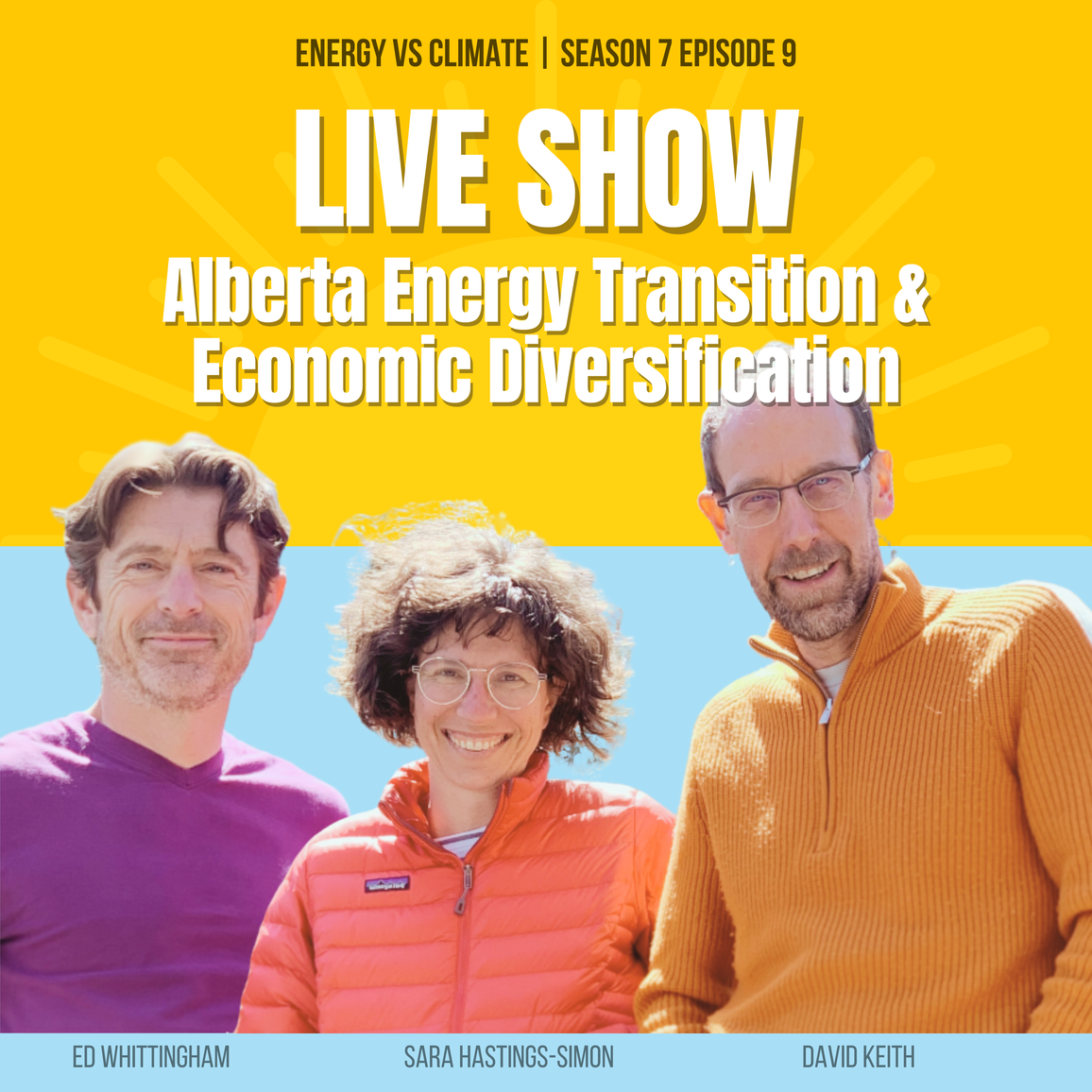
Recorded live at the Energy Transition Centre in Calgary
David, Sara, and Ed took on one of the toughest questions in Canadian climate politics: what does energy transition actually look like for Alberta?
They dug into emissions, economics, diversification, and the uncomfortable trade-offs that tend to get glossed over in public debate.
It's a fun conversation with an extended Q&A from the live audience.
Just a note, unfortunately we had some mic issues so apologies for any audio hiccups you might notice.
Thanks as always to Avatar Innovations for being such gracious hosts.
Show Notes
(9:35) Approximately 64.3% of global oil use is for transportation, while 18% is used for non-fuel purposes (e.g., petrochemicals).
IEA, how is oil used globally?
(10:10) “Electric car sales are expected to exceed 20 million in 2025, representing one-quarter of total car sales”.
IEA, global EV outlook 2025, trends in electric car markets
(11:30) Oil sands producers will continue operating while Western Canadian Select (WCS) crude prices remain above C$40 per barrel, with most projects exhibiting operating costs in the C$25–30 per barrel range.
(14:50) “The cost of storing electricity with utility-scale batteries has fallen to just $65/MWh (¢6/KWh) excluding China and the United States”.
Ember, Batteries now cheap enough to deliver solar when it is needed (December 2025)
(16:40) See the Ember report on power generation and electricity mix by major country:
Ember, Global Electricity review 2025, Major Countries and Regions (April 2025)
(20:22) Electrek, Electric vehicles reach tipping point in China, surge to 51% market share (August 2025)
(26:30) View the change in greenhouse gas emissions in Canada by sector (2024 report: 440 megatonnes)
Canadian Climate Institute, Early Estimate of National Emissions
(57:20) Global spending on the clean energy economy is increasing and now exceeds investment in fossil fuel development.
Scientific American, “Clean Energy Spending Will Surpass $2 Trillion This Year” (June 2024).
Episode Transcript
[00:00:00] I think we have to be serious about how brutally competitive the world is, and I think the idea that we should just hope that if we just have fair competition, everything will work out, is unrealistic. I think we do need government at the federal or provincial level making some big bets.
Hi, I'm Ed Whittingham and you're listening to Energy versus Climate, the show where my cohost David Keith, Sara Hastings-Simon and I debate today's climate and energy challenges.
On January 27th, we were back at the Energy Transition Center in Calgary to record another show before a live audience. This time we took on one of the toughest questions in Canadian climate politics, what energy transition actually looks like for Alberta. We dug into emissions, economics, diversification, and the uncomfortable trade-offs that tend to get glossed over in public debate.
Thanks as always to Avatar Innovations for being such gracious hosts. We all had a lot of fun with the conversation and I hope you [00:01:00] do
too. Just to note, unfortunately we had some mic issues, so apologies for any audio hiccups you might notice. Now, here's the show.
Thanks so much Kevin, and thanks for your whole crew for hosting us again.
As you'd mentioned, this is the third inter, uh, third consecutive show that we've done. Uh, can't say annual 'cause, just because of our complete disorganization, given Sara's absence last year. We weren't back last year, but we're committed to making it an annual and uh, it's great.
You were just worried you wouldn't get enough people.
Since I wasn't there.
We, we, we, Sara, we're we're, we're nothing without you. Without you. This band doesn't, doesn't run. We're, we're gone.
Well, I, I do notice that David and I are wearing name tags and Sara not, because Sara obviously assumes that people will just know. Who she is.
I need a little ego boost 'cause my kids are doing like an energy unit in school right now.
And they were sitting in the other room like studying for their test and they absolutely refused to let me tell them [00:02:00] anything about energy.
We, we got a combination of sort of fandom but also I got an ego crush on on Sunday. 'cause Ed and I were on a backcountry with back country, uh, skiing and we were doing the up track with some other Albertans who we were chatting with and their dog, um, chatting with the dog too, had these cool boots.
But anyway, then one of 'em turned around and said like, I recognize your voice from energy versus climate. But he recognized Ed's voice. He had no clue who I was.
He practically went up to David and said, and you are.
I said an appendage. Well, thank you, David.
That's right. We, we, we had another, another guy with us, uh, my friend Jeff, but we said that Jeff was really you in disguise.
Yeah. Yeah. Well, it's, it's great to be back and we love, uh, being here and, and the partnership. And, uh, I will note we did a show on offsets a couple years ago, two, three years ago.
And it is our, like our [00:03:00] most popular show ever. So these live shows can and resonate. And just to let you know that, you know, I'm putting you all on notice because we would like you to participate. We're gonna get there. Hopefully we won't just be three, uh, monotonal talking heads for too long. Uh, we're gonna save a bunch of time at the end for audience questions.
And just so you have the extra heads up, you can see a stand. You're welcome to line up and, uh, in front of, we also will have Michael, Michael, raise your hand. Michael. Michael. There he is. Gonna have a mic and he'll be roving around. Um, the goal for tonight, we kind of said, well, what should we talk about?
And, you know, it's kind of Alberta's energy transition.
And what we wanna do [00:04:00] is unpack Alberta's role within these very shifting energy markets, uh, Alberta transition. And as we're always trying to do, we want to try to steer away from the happy talk. And get to the hard truths, get to have a, a more honest conversation than what we think we've been having to date.
And to do that, we're, we're all gonna open just with a few thoughts on topics related to Alberta's energy transition. I'll go first and then David, and then Sara. And then we're gonna open it up to a three-way conversation between us and looking at my watch by about quarter two or ten two. Then we'll turn to your questions.
So, you know, uh, don't hesitate to start thinking of them now for me and just to put my cards on the table around an honest conversation. I want to acknowledge perhaps what is abundantly obvious. I'm gonna start with Alberta and Canada, and David's gonna go macro and talk about, [00:05:00] uh, world, the world and, and global oil markets to state the obvious, you know, Alberta's and Canada's economies are heavily dependent on.
Oil and gas right now. And in fact, and, and this is something I picked up from you, David, when we were chatting, Alberta is nearly in the one barrel per day per person club, which is pretty rare amongst advanced industrialized countries. We're not a country, but we're a jurisdiction,
but we, we might be a country
ah, should we cover that topic too?
Should we? Yeah.
Too soon.
Yeah, too soon. Too soon. Um, and, and as part of that, you have to recognize that the roughly, and it depends on your yardstick or your measuring stick, but the 300,000 workers. Who are in the oil and gas economy or adjacent to the oil and gas economy, let's face it, they earn good money.
They earn often more than, uh, the workers in other [00:06:00] industries. So that's one hard truth that I think we need to sort of look at when we're talking about Alberta's energy transition. And in effect, you could call, and many have Alberta Petro State given its dependence on the oil and gas economy. The second hard truth is the oil sands is a very good cash flow business.
And I'm gonna sp specify the oil sands and, uh, it's, it's of course, you know, subject to the price of oil, uh, in the world. But generally it kicks off a lot of good cash flow. We as Albertans, we're very accustomed to the public revenue that it generates. And frankly, as Albertans, we appreciate the good schools, the good hospitals that have, uh, in contrast to a bunch of other provinces in the country.
You know, you can tell when you drive out of Alberta and get into other provinces when you see just the difference in the road quality. So I think those of us as Albertans,[00:07:00]
when we talk about energy transition, we often say that Canada and Alberta will be leaders in the energy transition. And the analogy I use is. If the world were transitioning away from wine, would you expect the French to be leading that transition? Kevin, I know doesn't like that analogy. We've debated that one.[00:08:00]
Rather, you would look at it and they say they should be kicking and screaming that way. But we have this happy talk of saying that we like to be leaders. And if you look at the actions of the Carney government, especially in the last few months, you could argue that they're doing the exact opposite, that they are actually emphasizing or even doubling down on Canada's dependence on the oil and gas economy.
So that's my opener. My cards on the table around what I think. In terms of Alberta and energy transition and displaced within Canada and the world. David, you want to talk to us about some ideas you have and some forecasting around the future of oil markets in particular and how that's gonna affect our place?
Yeah, so I'm gonna speak as a, a nerdy guy who doesn't really work in oil and gas, and my main job is in Chicago. I'm gonna tell a [00:09:00] bunch of Albertans about the oil market. Um, and yeah, I basically just asked my AI to summarize and I'll repeat what it says. Um, but I think I'm gonna give you the, kind of, the punchline I think is that, um, you know, lots of the political talk here is that if the federal government wasn't holding us back, if Alberta really wasn't an independent country or if Danielle Smith was, was, was Prime Minister, we, um.
We'd have this break, boom, and we were able to export a lot more. And I think this is just nonsense, and I want to say a little bit about why I think it's nonsense. So let's kind of go to the basics of where oil is going and what might happen over the next, say half decade or decade. So just to kind of remind you to break it down, a global oil demand is roughly a little over 60% for transportation.
That's including road transportation and aviation and shipping. Those two are about equal now, both at about seven or 8% of total. Then beyond that, there's petrochemicals about 15% and 20% for a bunch of other little stuff. Petrochemicals is growing. We can talk about transportation. Obviously aviation is [00:10:00] gonna grow and keep growing and I don't think aviation is gonna get off fossil fuels for a really long time.
Uh, but, but the biggest chunk of that road vehicles, I think will, uh, last year, 2025, uh, global sales of EVs and um, and hybrids were about 20, just over 25% of global sales. Um, reasonable projections put that at kind of in the mid thirties in just a couple years. Obviously it takes a while for things to move through the vehicle fleet, but you don't have to be a genius to do the math and figure out that by like 2030 this is gonna be taking a real bite out of global oil.
And I think it's not gonna stop. And I think it's easy to think about. The fact that we have this, um, hideous blowhard in charge of the country or the crack house down south who's saying a bunch of things that imagines gonna change it. But I think the fundamentals of, of, of electricity getting cheaper in lots of ways, not we could talk about markets that it's not [00:11:00] of batteries getting cheaper of these vehicles getting cheaper.
I don't think it's gonna stop. I think it's just an argument about exactly how quickly it goes. So that's how I think about it. And I think looking at standard forecasts, people expect oil demand to be pretty flat from here, peaking late this, uh, decade with, you know, global typical price forecast kind of in the $50 a barrel, WGI or a little above world.
And so my understanding, again, this is what my AI tells me, somebody may tell me I'm totally wrong. The operating costs of Alberta, uh uh, oil sands are, are of order 20 to 30 depending on which business it is. So those guys can keep making money for Alberta with their existing assets for a long, long time.
It's gonna be a very long time before oil prices are below that, but the cost you need to build new investments is more like $70 or so when people know much more than me on a WTI basis. And I just don't think there's any world where that happens in a sensible way. [00:12:00] Plus it's relatively high carbon oil, so it's both high CapEx oil and it's high carbon oil.
Wanna end with the fact there's lots of talk about, uh, the idea we're gonna do CCS projects. I was on the original, I was the only academic, a bunch of other business people on this original federal panel, that provincial panel that kind of recommended a bunch of this stuff for, for CCS in Canada. But I have never been convinced that putting a bunch of money into CCS no oil sand makes any sense from the point of view of an Albertan.
It's not gonna do three things. It's not going to fundamentally protect the oil and gas revenues that we, uh, need to keep Alberta going while we transition to something else. It's not gonna transition to something else 'cause it doesn't build any value add that we can sell to somebody else in a meaningful way.
And I don't think it does much to emissions. 'cause in the end, emissions in the oil sector are really driven fundamentally by changes in demand. There's plenty of supply. So I just don't get it and I would like to have a conversation about it.
So David. I'm, I'm thinking of the durable [00:13:00] chunks of the, you know, the, the industries that are dependent on oil and gas.
And you're right, I think aviation is one. I think petrochemicals is another. I think freight would be a third, but I also wonder about mobility in emerging markets. And I tend to think that two things happen. Climate activists tend to underweight the stickiness of oil and gas and oil and gas infrastructure in emerging economies in the same way that I would say energy nerds tend to underweight how quickly economies can flip, or economics can flip with, uh, with electrification.
Both are assuming sort of single growth curves where it's a portfolio. But I want to go back to, I want you to convince me and people here that emerging economies will really choose electricity for their mobility instead of staying rooted in oil and gas.
Who, who knows? I want to hear what [00:14:00] Sara has to say on this, but, um, I mean, what obviously.
Question is, how could the forecast I said be really wrong? I think one way it could be really wrong is that especially the, the places that have growing demand like Africa really get their political act together, do much better. So if Africa suddenly transforms and there's really rapid growth, that'll change the carbon trajectory in the oil ag trajectory for sure.
But I think it, it really has to be that China looks like it's kind of peaked. India's going up, but, but, uh, north America and Europe are going down. This is all oil demand. It's really hard to see unless Africa suddenly gets it together, that it's gonna change. I was somebody who was the skeptic. As many of you listen to this, uh, uh, podcast, know of how quickly either batteries or solar would go, but the answer is they're just going incredibly fast.
I've been to India, I'm doing much stuff in the Indian government now, talking to people on the ground. There are, there are contracts for solar plus four or six hours of battery storage that are closing at just a few cents a, a kilowatt hour. I, I just think this is, and, and the battery electric vehicles are flooding into [00:15:00] relatively poor countries from China.
So I think it's gonna happen faster than the energy nerd said. Not slower.
Yeah, I, I think I'm more on that side too. Right? And I think. To take a step back, I think there's a couple of things that are helpful to sort of acknowledge when we think about where this future might go. And one is that we have a lot of sort of truths, or almost, let's call them beliefs about energy that are really shortcuts in our thinking, right?
Like the energy system has to a large extent, behaved one way for the last a hundred years, maybe even more than a hundred years. Because of that, there are many things that we sort of know to be true that, that are not really fundamental truths, you know, in the way that like the laws of physics are fundamental truths.
And so I think that there are, there is the potential for a lot of blind spots. And I think you also have a situation where there's a little bit of a, like, uh, the, the boy who cried wolf, the energy nerds who cried energy [00:16:00] transition or something where there is a tendency to say, okay, we've been talking about this for a while.
And I think that, that we continue to underestimate the way that the transition of a country's development and sort of development, meaning its increase of energy, can look very different when you have these very much lower cost, you know, solar storage, electric vehicles and so on. I'll give one example or sort of one data point and then I'll talk a little bit more about maybe the, the theory overall.
But I just, um. There's a new report from Ember. They, they publish all kinds of really cool energy graphs. I don't know if like, it's just energy nerds that look at them, but I feel like they should almost be front page news. So they,
you, you, you're kind of dreaming. Yeah, but I, I,
we can, you can dream, right?
[00:17:00] Um, but, but this graph is great. It, it looks at how the energy mix has transformed for countries as they, you know, as, as ti goes on, as they, as their GP increases, whatever it is. And so for the US it traces out an. What Canada wasn't on this graph, but I imagine it's very similar. It, it traces out this very clear curve from being essentially a hundred percent bioenergy powered to, you know, almost close to a hundred percent fossil powered.
And now it's starting to come back up and move towards, um, having more, uh, more, more electrons that are, that are powering it. And what's really interesting is I think that, that that experience that, you know, we have all lived and the people that are, have taught us about energy that are in the companies that we work with, have lived.
And the people even before that is like this, this is this fundamental truth that that's how energy use follows. And then you start to look at, now they add China to the graph. [00:18:00] And whereas the US hit something like 90% in their, they call it fossil detour, China got to about a 70% fossil dependent system before it started to sort of turn around and move towards the electricity.
And India now is starting to show, at least on this graph, a sign of, of turning around at about 55%. And so, you know, you have these like, in some sense, similar experiences of GDP growth and then they had a whole bunch of other graphs that basically said the same thing. You know, the amount of coal that's being used.
But I think that these underlying technologies and the cost of those technologies being different when these other countries are going through this phase of, of economic growth means that there is a very real world where they take a different path. And that is not just sort of by [00:19:00] chance, but there's actually, you know, countries out there as much as, as folks like Trump and others are trying to ensure that, uh, developing countries are, are using more oil and gas.
There's others.
Where he said among other things, uh, you know, was this quote of like, revolution is not a dinner party. Um, but it's really a insurrection or violence with one class overthrowing another, and so. I, I found that quite interesting. 'cause I sometimes I'm pushing back on this idea of like, oh, well the energy transition, you know, here, that's just like an attack on the oil and gas sector.
Right. And I, and people, you know, the Trudeau wants to kill the oil and gas sector and, and I don't think that's really true, but the leaders of other countries that the world definitely do want to, you know, go after the oil and gas sector and [00:20:00] their tools are, are, you know, principally financial and others.
But I think that to some extent they really are succeeding in that goal. Um, I think there's a big debate about exactly how fast that will go, but there is, you know, as much as you want to sort of have, we push back on the framing of the, the boogeyman, you know, fighting the oil and gas sector, there's sort of a way to understand that as, as that's what it, what is going on.
It's just we don't get to like, stop that in, in Canada necessarily.
Yeah. I mean, energy transition in the discussion, I, it'd be another hard truth we can talk about. It's extremely divisive. It's full of, uh, misinformation and disinformation. We did show on that relative to EVs, and there doesn't seem to be any clear path to getting out of it just in the way that there isn't a clear path to convincing a sizable chunk of the US population that the 2020 election wasn't stolen, that those unfortunately views seem to be just set in concrete right now.
And so to your point, I [00:21:00] think I definitely can concede China because now you've got more than 50% of new vehicles rolling off assembly lines are electrified. And as I learned by the way, here's a foreshadowing, we're gonna have a show on China that features each of us interviewing different China experts and then mashing it all together, hopefully in a, in a decent cut.
And then, uh, responding to what we hear. But when I talked to Hong Lee, who is a battery chemist with the China National Sciences Academy, uh, he really looked at it and said, listen, the Chinese made this bet in the early two thousands, and in some ways they got lucky. So we credit them in saying, you know, they're great Soothsayers and Nostradamus.
In some ways they got lucky with a bet, but they really went all in and they retooled the state. It'll be more interesting to see what happens with India. We'd had that show with Jay, Cindy to talk about it. And I think India can still go a couple ways. [00:22:00] But one thing we know for the world, and if you're producing oil, is that India isn't going to absorb the slack and oil demand that's coming outta China because its economy is based on different fundamentals.
So to your earlier point, David, I really wonder what's gonna help happen in Sub-Saharan Africa.
Yeah, and I, I, I don't wanna overstate, I mean, I think, I think the world's still gonna be using a lot of oil in 2040 and 2050.
I think that that comment about, you know, they got lucky as sort of an interesting one and in some sense you can take it even further and say that like that was [00:23:00] the only reasonable bet to make for a large country that wasn't a petro state. Looking at how to, you know, grow their energy use so. I think that, that, to me, that comes back to like, you have the same kind of dynamics that we face here in Alberta where you have the challenges of an incumbent industry that is able to, you know, influence to a large degree and, and get a lot of government support and things, which is not unique at all to the particular incumbent industry we have.
That's sort of a natural dynamic of a, of an incumbency. And with China, you just had a different setup in terms of, you know, what the incumbents were, who they, who they could have. Been so I don't, it's almost like it was a lucky bet, but maybe it was more just for them. Lucky that, you know, it happened to be the thing that they had to back was the thing that, you know, cost came down faster.
I wanna pick up on one thing you asked about developing countries or commented on, I think precisely because of the dysfunction. Lots of [00:24:00] countries like say take Pakistan because the centralized electoral power authority is doing a terrible job. That means that all these people are buying, local people are buying, uh, a small solar and, and batteries.
To be clear, that's not cost effective. If Pakistan was run, run really well, you do larger solar and you do more gas and so on. But in the actual way that it is run, which is pretty badly, that's what's happening. And that actually means the central grid is gonna like lose customers. There's a big, a big reshape coming and that's true in a bunch of other countries.
But the net effect is partly because solar and batteries are easy to cite and they're easy to buy. Even in countries that are relatively dysfunctional, you're just getting a lot of them. It's going very fast.
Excellent. Well, in China yet tune in, you'll listen to Hong Leave the National Academy of Sciences and, and everyone else, it'll come out in a few weeks.
So let's then bring it back to Alberta and I want us to talk about credible past to Alberta. Let's say it cares about climate [00:25:00] and let's say that you know it, it's going to do its part for Canada to try to meet its international obligations in reducing emissions. It's hard to imagine the oil and gas industry meeting those climate targets.
And not doing something like curtailing production unless there's a moonshot. But I want you to talk about how can we bend emissions here without breaking the economic base. And perhaps you could talk about what should we do and what should we definitely not do? And maybe the starting point is to what degree should we take public money?
And if we say not all, some of Alberta's oil production and gas production is low carbon. Well, let's say there's a chunk that's high cost, high carbon. Should we be taking public money and spending it on trying to get these producers from the high cost high carbon quadrant down to the low cost, low carbon quadrant?
I feel like I'm leading the witnesses [00:26:00] and hopefully this will come up in questions, but I'd like to hear what you have to say.
Yeah, so, so I would say no, even though, you know, I'm certainly a proponent of government investments in technologies, but there has to be the right reason that you're doing it for.
Right. So in particular, do you have some kind of future potential where costs will come down or some barrier to making these investments and without that, uh, you know, it would, it would happen otherwise. And I think I just, I don't see that justification in the case of reducing emissions from the, from the oil sands.
As David said, you know, there is cash coming out of this sector, right. So I think the extent to which there, you know, should be money spent on reducing those emissions, A good chunk of that should come from, you know, the, the revenue from that sector. Now, whether or not that's like actually politically feasible to do, I think I have a, I have a lot of [00:27:00] doubts.
I do think that when we think about, you know. The decarbonization story in Alberta. In some ways it's sort of helpful to separate it out into the story of sort of what's happening with oil and gas and everything else. Um, and so Alberta, I, I wrote down a couple numbers just to give us some context to discuss.
So, Canada's emissions from 2005 to 2022 overall, uh, went down 8% during that time. So you had more economic activity but with lower carbon intensity. And a lot of that actually came from decarbonization of the electricity sector across Canada. So closure of the, of the coal plants. Um, I should say this, this is all coming from the Canadian Climate Institutes four 40 mega ton, uh, report.
Um, in Alberta you had, so Canada 8% down. Overall Alberta is actually 8% increase and that was made up primarily of elect. Electricity again. Uh, emissions down by about 10% is probably more. This was to [00:28:00] 2022, so that's probably a somewhat larger number actually if you look out to today because the, the grid is continuing to change the oil and gas sector emissions up by 17%.
So of course that a huge part of that is just more activity. Some, um, more energy intensive. Also the, the SAG D um, while with some improvements in carbon intensity. And then interesting actually industry, the rest of industry, agricultural transportations and buildings were basically all essentially flat.
So I think there's something to break this into two parts that like it. It makes a lot of sense, I think, and it's, you know, part of our, I think, responsibility also to do things to reduce our emissions in those sectors, right? To continue to, um, which again is largely not completely, but largely, uh, electrifying a lot of uses of energy.
So whether that's transportation, whether that's buildings, doesn't mean it's going to a hundred percent overnight, but, you know, moving towards that and producing electricity with lower emissions. I think those are things that [00:29:00] we both have a moral responsibility to do. I think in many cases they also probably make sense.
Uh, you know, if you do them in the right way, you either you can, they're cheaper or they can be more comfortable, or there's, you know, all kinds of different reasons. And then there's the, the oil and gas elephants, literally of the, the size in the room where, you know, we, we can talk about what, what is, what makes sense, and then what also is politically possible.
'cause I think we have to face that too, right? As much as I would love to say, let's have a, you know. Cap on oil and gas emissions. I hear that's not particularly popular. Uh,
I, I wonder why, although Sara, you and I kind of worked on it with the Alberta Climate Leadership Plan and I thought it was a great tool.
But sorry, just before you jump in, Dave, just 'cause you talked about subsidies and just put a fine, or sorry, public investment, but a fine point on it. Would you say there shouldn't be investment tax credits for decarbonization in the oil and gas industry? And if you're saying there shouldn't be tax investment [00:30:00] tax credits 'cause that's avoided tax revenue, should there be investment tax credits for things like clean tech manufacturing and the renewable electricity industry?
So I think you could, I'll, I'll say a couple things. First. I don't think there should be, you know, 75% of the value tax credits, which is sort of what, what, um, some people are talking about, you know, 72. 72, okay. In
Alberta, but only when it's stacked with a provincial tax credit.
You know, should there be. 10% or something like that.
You know, I think there, there's more room for discussion on both. I mean, interestingly, the, the electricity sector, a lot of the big developments of wind and solar that we saw happening at in Alberta happened before the renewable tax credits that the federal government came in and put in place. So, you know, I'm sure that my friends in the renewable sector would like to have those and, and probably don't like what I think about that.
But yeah, just is that really needed or, you know, I think that [00:31:00] if you're going to have some tax credits in the energy sector, then you should make sure that you're building a level playing field. And I guess my preference for that playing field is pretty low.
I, I obviously care about emissions. I've worked on climate my whole life.
But I think Alberta's problem is, is to manage emissions in some way that's kind of reasonably responsible stream means it's focusing on reducing emissions in the normal Alberta economy, leaving kind of oil sand aside, which are a separate thing connected with the global oil business. And then finding a way to build a successful value added businesses in Alberta that will make this economy work over decades ahead, where it's not gonna be oil and gas.
And to be clear, when I say not oil and gas. I think say two decades out, there's still gonna be a bunch of oil and gas production, but it's gonna be declining. And that means less skilled jobs. 'cause it's just kind of like a, an opex play where you're grinding it out and there's gonna be people working hard.
But employment especially high value employment will be going down. And in that world, [00:32:00] Alberta really has to think about what it's gonna do. And we have this huge skillset with both business skills and engineering skills and trade skills and lots of things that, that, that, that make this province great.
I think. Province needs to be somehow thinking to the extent that, again, collectively about how to win. It's something else. It's not necessarily energy. I was interested to hear in the conversations, uh, uh, uh, just in the, before we started that Alberta innovation has sort of officially added aerospace, and so did, did did you category And that might not be a bad bet.
I think that that uses a bunch of the skills, kinds of engineering skills, potentially this place has. I think what worries me is the idea that we're gonna put a bunch of that effort into trying to, to reduce the emissions intensity of oil sand in a way that just doesn't, in the end build an Alberta future that we need.
Because in the end, CCS and oil sand is a, a niche market, more or less niche to Alberta unless Venezuela suddenly builds, uh, its oil's hands, which doesn't seem likely. So it's just, it's not a big export case. And, [00:33:00] and you know, if people can do it reasonably cheaply and reduces emissions cost effectively, great.
I'm not against doing it. I just am against it being a central play.
I see Kevin Krausert, he's biting his tongue to the point where blood is streaming down his mouth. But that's okay because as our, uh, host with the most, uh, he's gonna get the first question, and I'm just letting you know that in, I'd say about 10 minutes.
Unless we continue to lick the sounds of our own voices, we'll move to questions so we can get you involved. Um, yeah. Uh, David, to your point, I wonder if we should be really focused on capturing as much wealth as possible from, and I said off the top that the oil sands is a high cash flow generating industry.
Not just the oil sand, but those industries capture as much wealth as possible. And then to take that and serve, really bet on, you know, what are the next on, on economic diversification. I know we should actually define economic diversification, but that can be in Alberta [00:34:00] we all talk about critical minerals.
We talk about, um, advanced plastics, we talk about healthcare. Batteries, AgriFood, agribusiness. There's a whole bunch of different things. And just to put my 2 cents worth in, I'd agree in terms of the workforce that we have, we have a highly skilled, highly trained workforce. And hopefully I'm not coming to happy talk.
But, uh, and we've got communities that can take those workers and they can train them. We've got a provincial government that can train them. I know that we can do some rationalization between what U of C offers versus what U of A offers versus what U of L offers. Uh, we should do that in a more concerted way, but generally we've got these tremendous assets.
Don't,
don't forget, say that now. The proud father of a kid who take machining at sat.
Yeah, yeah, yeah. Absolutely. Yeah, that's right. Hey, that was, that was really how far everyone clap for sat. Yeah.[00:35:00]
Here, here. I agree. The question remains. So I listed up a bunch of sectors. What do you bet on? Yeah, and this is a thing, and going back to the Emerson report of 2011, that in its time was the latest, greatest sort of, uh, treaties on economic diversification. Had some good ideas. Some of them.
It then landed with a thud, with a stelmach. And the latter days of the stelmach regime, it got shelved. There's some good information and it seems every report, after every report that proposes.
So I'll, I'll propose a couple things there. I mean, to go back to one of the other questions you, you had is, you know, yes, I think we are going to see. A lot of wealth still coming from the oil and gas sector, and it does behoove us to use that in, in wise ways. [00:36:00] And in fact, I think it's likely that we will see time periods where the oil price gets very high, right?
And, and this is, this whole concept of this transition that we're talking about is not, uh, you know, orderly. Like we line up and we reduce demand by this much, and we reduce supply by this much and it matches out. In fact, we're likely to see much more volatility than we have in the past decades because we're getting used to a totally different dynamic of, you know, contracting demand.
When you play that all the way out to the end, um, you know, I've become really interested in my own research around. What do we even start to do when we think about systems that start to get so small that they are no longer resilient? Eventually they get so small that they just can't function anymore, but at first they, they become sort of less resilient and, and we actually don't have a lot of experience with this.
You know, one example would be like the phone system, the wired phone system where you have places where government has basically stepped in. I'm more [00:37:00] familiar with it in California, and there's sort of a mandate that you have a supplier of last resort, quote unquote, so that people are still able to get fixed line phone service if that's something that they want.
And that may be discussions that we need to start having about, you know, again, this is not at all tomorrow, we're talking about decades in the future, but, but something to start planning for. What I think can happen sooner is that volatility. But to answer the actual question you asked, I, I think. To me, part of the answer is actually in the process, not the what you do.
And I think part of an important part of that process actually is that you want to set up a system, you know, a sort of research and innovation system that is relatively sheltered from political wins. And we have some good examples, right? I mean, I think the us you know, recent times, not withstanding, has some really great kind of ways that they have set up the research and development and innovation system that has allowed them to [00:38:00] create, you know, a lot of really impressive things and, and there's some clear rules.
And those involve things like indeed putting it arm's length. From policy makers so that there isn't too much political environment, you know, having a strong, uh, capacity within the state to make decisions about what to fund, to be willing to, you know, fund a lot of different things and then start to whittle that down as they sort of compete.
So there's sort of a whole, I won't go through the whole list. I think we once did a whole show about, uh, industrial, um, I'm forgetting the word. Yeah. Industrial decarbonization and sort of what you do like, uh, to, to support. So I think we don't have to reinvent the wheel there, but we have to be very careful in how we set up the system that is going to, you know, invest that money wisely.
I'll start with the narrow thing on, on, on CCS. I think one way to say this, if I had. Dollars to invest in CCS if I put them into cement plant, [00:39:00] CCS here and I can, it costs me a given X dollars to save a million tons a year. Let's say it costs me the same X dollars to save a million tons a year in oil science, which it may not, but let's say it did.
I'd rather put it on the cement plant because if you learn about that, that is an exportable thing. You know, roughly, I forget the number 6% or so of global emissions or cement plants, a whole lot of 'em are gonna have to decarbonize. If an Alberta company figures out a really good way to do that, that's a thing you can sell around the world.
Whereas if you figure out a really good way to decarbonize an oil science plant. There just aren't a lot of buyers. And I think that fundamental thing is something to think about. A related one for CCS actually, you know, to a shout out to some of the audiences interesting ideas about combinations of biofuels in CCS.
There's a bunch of these, there's several different Alberta companies pursuing these. Those are also things that can make low carbon fuels or hydrogen in different ways. Uh, with, with carbon sequestration. Those are things that are also exportable. So I'd rather see that than, than oil sands as to like what [00:40:00] outside energy sector, uh, Al Alberta should do to, to successfully diversify.
I'm not the right person to ask. I think the obvious thing is. We're not living in the same rules-based international order we were before. And I think we have to be serious about how brutally competitive the world is. And I think the idea that we should just hope that if we just have fair competition, everything will work out, is unrealistic.
I think we do need government at the federal or provincial level making some big bets how to do that in a way that's reasonably depoliticized, where those bets don't have all the obvious problems to go to making those bets, which is that then you keep betting on the loser after you had it, or it's in Quebec or wherever.
I think, I think I don't know how to fix that problem, but I think if Canada wants to compete globally, either the RD side or in different industrial sectors, there has to be way where you try and put a little poker chips on a lot of things and then when one of them is working, there's some mechanism to really [00:41:00] double down And on the ones that aren't working, you kill 'em.
Yes. And I, I agree.
Easy to say.
Yeah, easy to say. And we still, as far as I can tell, we're nowhere close to where we're actually gonna make those bets. And especially with something that's around divers, uh, diversifying the oil and gas industry. What I'd love to do with the time that we have left for us, enjoying the sounds of our own voices, and then we'll turn it to the audience, is let's talk about in an era with a breakdown of the rule space international order, where, as I said earlier, I think energy is gonna become very exciting and not in a positive way.
That we've got despots, we have oil tanker, ghost ships, we have Russia flexing its muscles. We have the Trump administration threatening invasion of Nat NATO allies. Like a bunch of shit can go sideways, and that's gonna have big impacts on. Oil and gas markets, as I read in an [00:42:00] almost daily basis when I get my Eurasia group updates, how do the oil sands fare and let's just kind of, you know, set the table.
If it's not going to be into your point, Sara, it's not gonna be, let's say a sharp,
where you're gonna get to some peak at some point. And let's say it could be this decade, it could be first half of the 2030s, and then you're gonna have this plateau, and then you're gonna have this gradual decline. How does the oil sands fare? And I ask not as a disinterested party, I ask as an Albertan, and once again, I'll completely acknowledge that a good chunk of our public coffers are dependent on oil and gas and the oil sands being the biggest chunk of that.
And I'd love to hear, if you can, a case for the resilience of the oil sands under, you know, new [00:43:00] economic and geopolitical conditions in a case against the resilience of the oil sands.
We should talk about who is for and who is against I'll, I'll say something. I don't know whether it's for or against, but I think.
To me, one of the biggest things that happens, as I mentioned before, when you combine this sort of new world of plateau or declining demand, and then it gets even more amplified by a more disordered and less kind of collaborative world, is the potential for volatility to just go to levels like we haven't seen before.
Volatility, price volatility.
Price volatility. Yeah, exactly. And so, I mean. I'm like thinking through this live. I didn't prepare thought thoughts on this, but I think that leads to various things for, you know, a, a province that is very highly dependent on revenues from that sector, which are then very tied to the price as much as, again, I feel like it's a broken, it's everybody's [00:44:00] favorite thing to say.
We need to get off the resource rollercoaster, but it's a little bit like we're about to go from the, you know, Mickey Mouse, like kitty coaster to, to the loop, de loop or something like that. Uh, and, and I think we need to think even more seriously about how, you know, what kind of mechanisms we can use to, um, absorb that volatility, right?
Like really like financial mechanisms. And because as I said, I think that you're going to see.
You know, gets us through that time. And again, I, I go back to, you know, I think fundamentally a lot of this stuff is about having good structures within governments. Um, and, and good, you know, sort of strong, uh, approaches that, that lead to the [00:45:00] right kind of outcomes is relying less on one individual that's, you know, sitting in a seat and more on saying, how can we design the system to require, you know, that that kind of volatility smoothing, I think that's gonna get even more critical in a way that we haven't seen before.
I mean I, my expectation for oil science is they keep kind of grinding along producing that we're not that I don't see a lot of stuff being shut down, uh, for a long time anyway, but that I just don't see expansion and I see the more and more shifting to just operating to try and, you know, minimize op cost and maximize extractive value.
I think the question of whether we'll see more volatility is really interesting. I think it's really interesting to have Sara say this. I mean, who the heck knows? Predicting the future is so hard. I think overall I would kind of bet the other way, but you could certainly imagine, I mean if Russia really politically implodes, uh, that's, that might.
Temporarily drive oil prices high 'cause they're such a big producer. I think you could imagine worlds where, you know, let's say the [00:46:00] electric vehicle stuff keeps happening even faster. I think Sara, and I think it will be, there may be times where sort of the o remnants of OPEC really try and drive prices low.
So I think you could imagine really low prices. It's very, very hard to know. Overall, I kind of don't expect me more volatile, but I am not an oil market expert, so who
knows? Yeah. Yeah. And, and although might, might, uh, seem farfetched right now, we are one Arab spring away that would affect the house of sod from oil price volatility being absolutely unprecedented.
Russia, for sure that regime falls. The Putin regime falls. Let's all hope for that personally. Yeah. It would be, uh, have a huge effect. The House of SOD would just fundamentally remake oil markets.
Yeah. I, I was on a panel many years ago, was someone who made the point that. The sort of resiliency and reliability of liquid fuels like oil, you know?
Yes. In, [00:47:00] there's some inherent ways that, that there is some reliability to it in the way that, you know, it's easier to store than electrons and stuff like that. But there is also, you know, a giant sort of military complex and world order that goes into also creating that reliability. So I think part of my.
And, and I think you're right David, you know, yeah, it could go either way, but I think there is a, a reasonable way of thinking of it that, you know, if that world order gets more volatile, it's going to also hit the kind of systems that create this still relatively steady stream of, you know, trade and balancing.
Uh,
but, but I think the big point, maybe we're gonna turn to the audience a second now, is that I think at least part of the Albert of politics that fundamentally is built around the idea that it's like the Fed's keeping us down. If it was a free market, we could really make much more for oil and gas.
Maybe some of you believe that maybe it's true, but if you really believe it's not true, then we need to somehow find a way to shift the Alberta conversation. So we start to have an adult conversation about what [00:48:00] Alberta does next, which, which is not about getting the feds off our back. It's about actually thinking about what this problem is does in a world with the oil markets actually going down.
Could just off from my own opinion. It's a large resource, long-lived assets, stable rule of law. We are slowly but surely dropping the emissions intensity of the oil sands on a, on a per mar, uh, per barrel basis. And it's really integrated, integrated into us, uh, refining. So my bet is it's gonna be pretty long lived and pretty resilient, but enough from us.
Yeah.
So we are contractually obligated.
It was an MOU,
it was an MOU with personal liability riders to give Kevin Krausert the first question. And we are only too happy to do that. So he's gonna model good behavior and get up to the mic stand.
But I thought the deal was he doesn't actually have to model good behavior.
He's not required to ask a real [00:49:00] question. He can just attack. I didn't read
fine print, cheesy.
We all, we all read the memo in detail and there was, there was no room for negotiation. Um. Uh, honestly, thank you. That was actually a really insightful, um, uh, analysis, I think on, on where we're at and I think a lot of points of alignment.
Um, I'm gonna maybe quickly open with, with where Ed started, that if the world was, uh, transitioning from French wine, would we ex or if the world was transitioning away from wine, would we expect the French to be global leaders in that transition? Um, which if you actually remember was you brought up as at a point, uh, right before we introduced Mark Carney, uh, as his first speech, um, after he led G Fans in Calgary.
It's
an oldie, but a Goldie.
Yeah. Um, and what I would, my response at the point was I didn't think the world was transitioning off wine. I thought the world was transitioning to ized wine, whereas [00:50:00] actually I think right now, and what a terrible world that would be it. Um, whereas I actually think right now the world is potentially transitioning from wine to cognac.
And I, I wanna make that point around the heavy oil demands and, and what the, I, it like, to me, conversations on oil demand. There's just like, what is that? But let's, let's subset what we're actually talking about. And that's heavy oil. And so there's what, 10 million barrels of heavy oil produced, uh, globally, A date Canada with the largest, uh, three and a half or 4 million.
Um, next up you have Russia. After that, you have Angola and Nigeria, and then after that you have Venezuela. So all as I'm saying, not all wine is cognac. Not all oil is heavy oil. And what are the uses of that heavy oil? That demand is actually in things like asphalts and, um, plastics and meshes, and actually a ton of non combustion uses.
So you look at India, reliance is just built, [00:51:00] uh, in by a million barrel a day heavy oil refinery. Where are they gonna get that heavy oil right now? Um, hence the MOU or I don't know if that was an MU but the trade deal between India and, and so the point is not all wine is created the same, just does not all oil is created the same.
Second question or second point before I get to my question is, so you've all identified we're in this kind of frightening geopolitical world, um, and our competitors are some pretty unsavory groups on the heavy oil front. Um, and our oil industry is the most productive economic sector of the Canadian economy by a country mile measured by, uh, amount of labor per hour put in on economic output.
We all recognize this is an area we've struggled in 'cause our innovation is struggling. So we've got a pretty reasonable and good sector there. So if we're now at this point of saying we're [00:52:00] screwed on our net zero targets, um. We've got a tool in our toolbox that the world might want more cognac and less wine that we can sell, and the world's not willing to pay another cent for the energy transition.
Why wouldn't we actually use this moment to double down on emissions intensity? And that's I think, where I would push all of your thinking to say, okay, maybe we don't have to spend this much money on it, but maybe we think about what an emissions intensity world actually does look like. And then that starts becoming a race.
We can win in a world where we're not talking about whether we're in a 90 million barrel or a day scenario by 2050 or 140 million barrel day scenario, but I think we all agree we're not in a 30 million barrel day scenario. And if we take that logic and replies it, natural gas, we win every day of the week.[00:53:00]
Without his dollar subsidy. So why wouldn't we send our investment banker across the world to go and sell that mission, and it gives us a fighting chance on the next wave of tech technologies.
I have a couple of thoughts on that. I think it comes to me, a big part of it is like, is it who's, who's spending that money or whose money are we spending and where is that economic benefit going?
Right. And I think that is a big piece of, of this, that that sometimes gets a little bit. I dunno if glossed over is not fair. But as David mentioned, and I think I agree, like there's certainly a world where you can continue to operate the oil sands as a cash cow. And what we see is, is, you know, many companies doing that right?
And, and providing dividends or, uh, doing share buybacks. And so the beneficiaries of tho of that money is not necessarily as much the, you know, broad general public of Alberta. As you know, we can [00:54:00] debate what it should be, but. I guess my, my question that I would turn around and say is like, well, if there is all this money coming out and there is a world where that continues to be a cash cow because there, there is all this interest and, and market for it, then why should public money go in to this business?
You know, if, if that's part of what should get done, why shouldn't the companies take some of that money that they would otherwise be sending to investors and invest that in building CCS and, you know, reducing emissions, which I think is a perfectly reasonable thing for them to do. Right. So let me be clear, I'm not saying that I don't think that companies should do that.
My question is what's the, uh, what, what's the need for, or the argument for a lot of public money going into that versus the money that's, you know, coming out of the industry being used in that way.
Two thoughts. One, you'd mentioned asphalt, and this one's for Peter Poole. The environmental architect William McDonough in designing buildings said in his field, asphalt is [00:55:00] thought of as two words, assigning blame.
Remember that one, Peter? Uh, sorry I had to throw that in. Uh, the other one is, and, and coming back to pathways, you know, we kind of alluded to it and pathways, it's been around for a donkey's age by this point, and it's, uh, like a big sort of blunt force instrument for reducing emissions intensity. And you would say that's good.
However, we seem to be in this perpetual, uh, Mexican standoff, like the stalemate in that, and we remain in this stalemate in that. You've got the companies who say, well, you really have to pay us to do this. Or give us this unrealistic carbon price. We didn't talk about carbon price, but you know, get up to 130 bucks effective carbon price.
And then we'd look at it and it's gonna be cheaper to do that than it is just paying carbon penalties or, you know, we're gonna stand here and, and, and not do [00:56:00] anything. And this is why I become, and as a booster for CCS back in the day, back in 2008 when we had David Keith come in and we did a CI would say we, when I was at the Feminine Institute, and David came in and he was our keynote and we were excited, and yet we'd still haven't seen the progress, aside from a great project like Quest, which I think is, is a terrific project.
And partly I think it's because for shareholders to anti up some portion of what they think companies should invest in order to drive down emissions intensity. Then they have to think that the world is gonna get serious about climate change. And I'm not convinced that the shareholders actually think the world is gonna get serious about climate change.
And I would say I'd look at that and as a guy, climate activist, I haven't worked on the issue as long as David, but I've worked on it for my own donkey, my own donkey's age. You'd look at it in the last two years, you would say, why would we ever make that bet? The world is not getting serious on it. So we'll never anti up our share.
So therefore we need government to pay for the [00:57:00] whole thing. And government's not gonna pay for the whole thing.
My, my donkey's older than your donkey.
Considerably. Your donkey is less known on the ski trail than my donkey.
Uh uh, I actually think the world is serious about climate change. I think one way to think about it's the world last year spent about 2 trillion on clean energy, and that's sort of roughly 2% of the global economy.
And the big question is, if. We'd invented an infinitely cheap, no environmental damage way to take CO2 out of the air. So the client problem is completely off the table. There was no client problem. What would that investment have been? And one answer is it would've been 2 trillion in any way because clean energy was just paying for itself.
I don't think so. I think there's a whole bunch of incentives and a whole bunch of reasons distributed from both national policies to local policies and individual policies that are driving it. I think there's no easy way to tell, but my sense is, you know, something of order, half of it would go away in a world where there [00:58:00] was no actual climate concern.
So I think in fact, the world is spending a lot of money and a lot of political attention on climate. It's not doing it in the way that some economists thought was some magic single carbon price. Uh, but in fact, I think there really is action. I think the action is driven by the fact that people can really see climate impacts in the real world.
And I think though it's not clear that for people or, or. Countries or businesses begin to really act on climate that dealing with kind of residual emissions from the all admit, I don't know much about it, and I'll admit it's a little segmented out heavy oil sector as opposed to the main oil sector are really where you're gonna focus.
I think you are gonna focus mostly on reducing carbon by decarbonizing through electrification and through decarbonizing heavy industry and, and through primary e uh, energy supply that's non-carbon. And so I think.
I wonder how much [00:59:00] elasticity there is. Like it's segmented, but there is some way that, uh, refiners can, can change. I admit that that's not easy. Um, I'm just skeptical. There's a real big value add for kind of low carbon heavy oil. Uh, just to, just to conceive a point that I agree with, I think gas is really different.
I think, I think there is obviously a global LNG got, uh, a glot coming up, but I think that, uh, gas is a really different story in decarbonization and there are some of the arguments that come from folks more on the political right here, that, that we should actually, you know, take some credit for exporting LNG.
I don't think those are not, I think that's a really different story.
So, uh, why don't we give, Kevin, you're the host with the most, I was, give it like a 32nd rebuttal. I drop the mic and then we'll turn to
someone else. It's Daniel. Yeah, I was just gonna say, I'm bringing cognac next year. Um, uh, so we're, we're upgrading, but guess might be my, my thinking.
I, I, I'm loving this. We've gone from, uh, most So you're now saying that some heavy oil is [01:00:00] cognac. It's better than wine. It's more expensive. That's a really, I mean, that, that really is the kind interesting claim. It's the heaviest, I gotta say, I just gonna a jerk here. But, but if you are right, then the, the, the, the differential against WGI would have the other sign.
Um, because we're turning heavy oil into gasoline, which is what it was never designed for in Houston. 'cause we can't build pipelines. Um, uh, but what I will say is, um, uh, we've got a tool in our toolbox. The current climate strategy is not working. Why wouldn't we use one of the few tools we have in our toolbox to negotiate this crazy geopolitical world and come up with a new strategy and a new vision?
And that's, that's a, that's, that's, that's my point. I'm not saying how much, I'm just saying maybe a little bit of cognac next year.
Fair. Fair. And I would say the cognac to wine analogy, I use this with hydrogen, taking clean electrons, converting them into hydrogen is like taking [01:01:00] champagne, converting it into water, and then selling it for triple the price.
Alright. Um, I have one comment and two questions. The first comment is with the proverbial french discussion and the wine discussion, I think it's very easy to look at the past and judge the past from today. So when you go to business school, everybody looks at Kodak and say, Hey, you know, they have the digital camera and they just put it in the archives.
We love a blockbuster, like, hey, you know, they could have bought Netflix not once, but twice. And they decided not to do it. So knowing 50 years down the road who are gonna be the, you know, business cases we're gonna studying in the energy sector, like hey, they had the opportunity to buy, um, enhanced geothermal startups and they didn't do it, or natural hydrogen or something else.
So I think that conversation is more complicated. Um, my first question is about what can [01:02:00] the Western Democratic societies do to be able to match China? I think it's a bit of a fair comment to say that, that they were lucky where Comp compet, um, comparing two very different beasts. You know, China is a centralized economy state where they can do, you know, investments and they don't have a return on investment.
They have to come back to investors. Um, you know, in the next year or two years, they can buy a mine in the Congo and sit over there for 30 or 40 years. Because they know that it's gonna come in the future. That's not lucky. That's a completely different system. And on the other hand, when it comes to, um, uh, CCUS and oil, how the conversation changes, if we moved into a world full of CBAs with carbon border adjustment mechanisms when you wanna send oil to South Korea or Japan [01:03:00] or India and China, and then emissions are not just a nice to have attribute, but actually something that is gonna cost you money.
So
I can maybe comment on the China one. I feel like I'm spoiling the China episode, but that's okay. It's all, it's a preview of the China episode. Um, I mean, one of the things that I learned from the discussion that I had, again, with, with Jeremy Wallace is that the. Uh, there is of course things that have come out of China that have been, you know, largely state supported, but the success with EVs and the EV manufacturers, there is much more of a sort of traditional startup story.
You basically had companies that thought that, that sort of didn't have the baggage of an existing incumbent auto industry who, you know, would rather
an internal and combustion engine than makes kind of startup level money selling an ev. And also who didn't quite have that [01:04:00] same view of like, what.
I, I look at it at an ev, not like a sort of another version of this like super complex thing that, you know, only big companies are building, but it's kind of like a phone on wheels and like, maybe, maybe me and my buddies could get some money together and build that. And then there was some other guys who did it and some other guys.
And you know, we're, we're gonna try to get the market share, so we're gonna sell that for very, very low.
We can talk about whether it's luck or, or not luck or other things, but it just like, it was a different playing field that, that China was facing coming in. You know, they didn't have this sort of investments in the, in, in the, [01:05:00] um, ICE engine and the internal combustion engine where they had to kind of make less profit by selling the new thing.
So in some ways that's almost like the standard, like you talked about business school, that's like the standard creative destruction, you know, challenge story. Um, so, you know, may maybe it's helpful or not to talk about whether or not that's, that's lucky, but I think it is useful in just thinking about energy transition overall and whether it's.
About where government is investing or, or how we sort of plan things to just remember how much that incumbent industry has a, has a role to play or has an influence about the paths that we take, right? I mean there's even these concepts of, now I'm going into professor mode, but like path dependency, right?
And, and how we, you know, end up on a, on a certain path that, that we continue down along. And we can say that that's a challenge, but I think it, the reason that it's useful to think about that is that it tells us something about where we can go and, and what kind of, [01:06:00] um, tools that we have that we can redeploy and in other ways as well too.
Yeah, I mean, I don't know how we're gonna respond. We Canada, other western democracies to China, but I think it's a real challenge. I think in some ways I.
So I think part of the reason that they've been so successful, uh, has been very effective adaptive regulation. If you look, we all know about. Batteries and EVs. But if you look a little bit ahead for driverless vehicles, they've got this system that's kind of got not just central state control, but a bunch of, um, city and province level control.
It's got a very adaptive system that's allowed, that's not unregulated. There've been serious regulations, but they're different regulations. They've been adapting fast and [01:07:00] they're learning very fast for autonomous vehicles and they're likely going to win. And it looks like the same is true for drugs.
Now they're actually finding ways to get drugs through trials. They're not, they're real trials with real regulators, but they're doing it in a more responsive way. And I think, you know, a counter argument would be they're doing it obviously in something. It's in many ways an autocracy that has less respect for human rights.
But I think we need to learn from it. I think we need to learn to make some big choices at the government on which they've done by sector, but that inside that sector, they allow vicious competition. And I think. They, we need to figure out a way to do that because the way in which China is just becoming the manufacturing hub for the world should worry the rest of us.
Maybe I'll add a couple things on China. We should really respond to his question about CBAs and if that's going, but, but let, let,
very, okay.
Yeah. Okay. Let, let me say a couple things on China first in defense of Hong Lee of the National Academy of Sciences, because I don't want [01:08:00] Hong to wind up in some gulag equivalent in Unan province.
Uh, and I don't want falsely attribute that he said, uh, they were lucky. Hong was, we discovered is on the watch list, which, uh, yeah, means that he has to tow the party line pretty quickly. If you listen that interview, you'll hear him tow the party line. But I think what I inferred from that was they'd made this pretty big bet and there was a bunch of macroeconomic and geopolitical things that could have knocked that bet sideways, including the Iraq war of 2003, which in the end didn't destabilize, uh, terrifically infer prolonged period, global energy markets, the financial crisis of 2008, 2009, that didn't bring down all markets for working capital, which it could have.
And then also the fact that China inherited kind of the, the, the solar panel innovation baton, the learning curve baton from other jurisdictions, namely California, Germany, [01:09:00] and Australia. And they picked it up and ran with it. Uh, and, and some of these jurisdictions really kind of seeded that innovation in that market to China.
So in that way, I think they got lucky. And that is partly why they are. You know, just the bread basket of clean energy tech, uh, in the world today. Quickly on CBAs,
carbon border adjustment mechanisms. For those who don't know all the acronyms, I think the answer is, if there really is an effective CBAM, that means that, uh, there's some export penalty for this heavy oil, then, then that's where capitalism should work and there'll be investment dollars to clean it up.
Yep. Okay. I know, I know we got Joe on deck. Joe,
can we talk raw politics? So elections 2013, arguably the first climate election, I would think with, uh, wild Rose leader Daniel Smith saying that climate change was a real, a week before the election, of course the Blake Fire falling that, and then that was a big change.
Um, fast forward a decade later, [01:10:00] climate disappeared off the Alberta stage. Uh, energy was there. I would argue it was an energy election. It was people voting for, um. For energy that elected our current government. Um, and then just looking at the 2024 US election, very much an energy election and then the last election here in Canada, very much not neither on the agenda, right?
It was all about affordability and, and, and sovereignty. So here's the question. You have to write policy for the alternative party. I'm not saying which that alternative party is to the current government for the next Alberta election. And is climate on the agenda? Is it not on the agenda? If it's on the agenda, how do you to frame it for the electorate, knowing that climate's getting worse and arguably it's not the top five issue anymore, but arguably voters still care about this?
Mm. [01:11:00] Wicked question. Wicked question. Uh, Sara, we've both been. Somewhat involved in weighing in on that for one of the parties here in Alberta. I don't want to,
just to be clear, I'll land talk to any party that wants to ask me questions, so
as will I, but one party doesn't talk to us.
I, I like to sometimes say like, I do policy, not politics, but I think you're right that it's really in some sense a politics question.
Figuring out how to, how to make up your tent around the issues and how to. Bring people kind of along in a, in a positive story that you're telling. Um, I just had a thought that totally went outta my mind that I was gonna finish on. Uh, it was really good too. It was like super insightful. It was gonna [01:12:00] have all the answers
corner Sara, during, uh, when we wrap up and, uh, yeah.
Feed her a beer and that thought will arise. Uh, David, do you wanna add something?
Yeah, I mean, I'm, I think, I think the answer is I wouldn't say that much about it. I'd make it clear the climate was a real issue. I'd have have it built into some policies for housing and transportation, but not in a major way.
And I'd really focus on, on understanding the stuff I've been talking about, understanding how Alberta moves forward in a world where, where the oil market is gonna peak, where climate change is real, but it's how we respond to it more than what we do to somehow magically solve the climate.
Yeah. And, and, and Joe.
At the risk of being a testy host. So challenge one of the premises of your question and that is that the 2024 election in the US was about energy. I don't think so. I think it was about a bunch of different things and I think energy has been off the radar screen. I think in Alberta though, if we have an election as scheduled [01:13:00] in 2027, then you, you could talk about energy transition, maybe not leading with the climate foot and, and maybe that's shade of shades of nuance that people don't get.
But I think you have to look at the economy and say, but we've, based on any given day, 20 to 25% of our government revenue on a rapidly cycling commodity price or commodity prices, is that a wise thing? And if it isn't, what do we do? And I think that's, that's a rich conversation to have and I really trust Albertans to have that conversation and to weigh in int.
I remembered it, so now you're gonna find out it wasn't as good as I said. But, uh, but, but I think there's two messages that go very much along the lines of what you were saying, ed. You know, one of them is really thinking about things like affordability. And I would argue that Alberta is a sort of special case where this like resource, uh, volatility, um, and, and financial volatility is, is sort of a version of [01:14:00] that for our province.
But I think actually even broader and more fundamentally, it's like coming back to, you know, flipping that, that story on its head and saying, you know, we're the, we're the government and we're here and we can do good things, right? And that, and that comes to like figuring out how to build government capacity to, uh, in invest and, and create diversification.
It comes into, you know, governments can like, provide good services and we can, you know, I, I think a lot of the solutions that also relate to climate are actually wrapped up in taking some of that back as you know. Obviously we're not in New York City. I'm not saying that that's the kind of messaging that's gonna win an election here in Alberta.
Um, but I think there's some interesting lessons to, you know, put through an Alberta filter of, of the messages that resonated there.
You mean we're not gonna get free buses?
I'll, I'll add, I mean, I, I think it could work for an alternative party to kind of hammer this government on the kind of realism of their implicit idea that somehow the whole whale patch is just [01:15:00] held back.
And without these federal people on our backs, it would go fast. I think if you buy, and maybe I'm wrong, but if you buy the kinda arguments I'm making that they're just fundamentals that say that's not the real world we're in. I think hammering, uh, Smith on the fact that she's, that she's not defending the real world, that just talking reality, I think would be helpful.
Okay. We're gonna move into the rapid fire phase. Okay. And by rapid fire we've got three questioners at the stand mic. That's right. Uh, you three gentlemen, and we're gonna keep our answers like 30 seconds.
Specifically, I found out with some research that the extra oil we got through TMX was not primarily made into combustion fuels. It was made into petrochemical products in Chinese refactor, in Chinese, uh, petrochemical, uh, facilities in Saudi Arabia. They use, uh, gasoline, kind of heavier naptha based inputs, um, for, for creating petrochemicals.
And in Alberta, thanks to Peter Lawhead, as, as many people know, [01:16:00] we use natural gas liquids, are we, um, perhaps by sending extra bitchin to China. So basically we're taking ourselves out of the, uh, value upgrade process by putting more bitman through TMX. What do you think about that?
30 seconds David go.
Might be true. Good, good role modeling. Yeah.
I'll answer a slightly different question like a politician, but, uh, just say that I think we need to be thinking about the demand side for plastics and other downstream oil products. And this, this idea of, you know, to some extent we're responding to demand. We do see a lot in, there was a failure of an agreement recently around reducing, uh, the amount of plastics that were being generated.
And I think that is a little bit the next battlefield around demand for oil going forward.
I think the Dow net zero project is a great project [01:17:00] and I think it's worthy of, you know, a deal with the can, the growth fund for industrial decarbonization, uh, even a contract for a difference. I don't see the bitman going down the pipe, uh, through Transmountain and whether it's looping around the corner and going us, or going kinda, I don't see that as fundamentally detracting from the viability that I don't think there's that much competition for supply.
James from Pitcher Creek, recovering astrophysicist. Um, in a future, uh, defined by values-based realism, a new paradigm, does the, the value priorities shift from abundance to resilience? And if so, in that context of resilience, how do fossil fuels compete with renewables when you have the option to adopt renewables anywhere on the face of the planet?
Wind and solar plus batteries, right?[01:18:00]
How the, how do fossil fuels compete in that resilience focused, and that's the imperative, essentially.
I think it's very segmented. I think for parts of transportation, fossil fuels are gonna be competing for a long time because of the enormous energy density of, of liquid fuels. I don't think that's gonna get competed out for a long time.
And, and I think it's also important to remember that while batteries are suddenly getting cheap enough against my guess to deal with diurnal variability from solar and really compete, it's a long way to compete with seasonal. And what that means is that the cost of of electricity, that solar plus batteries in places close to the equator is fundamentally a lot cheaper than here or north.
I'll say. A lot of people live close to the equator and it does, you know, a, a sort of breakdown or more challenges with this global trade and sort of global playing nice with [01:19:00] each other, I think does tip the scales somewhat and, and makes it more expensive to get that resiliency from fossil fuels in a, in a global world.
Again, not, you know, not kind of overnight, black or white, but, but a change to the, the economic calculation,
uh, developing countries. I think in the short term, I laid my cards on the table. I think in aviation freight, some parts of mobility, we're still gonna be locked into oil and gas for some time, for some time in the next 20 years. And I think electrification will have a tough time competing.
I think it's more like 40 years.
I think it slow.
Yuri uh,
thanks, ed.
Last question.
Okay, I'm gonna try and thread together [01:20:00] three concepts from the discussion tonight, and I appreciate, uh, what you guys are bringing forward here. It, it's, it's great. Um, so first concept, Kevin. Thanks. Um, isn't it a good idea to be reducing the emission intensity of our, um, fossil fuel industry?
I think that's good. Sara's comment, who's gonna pay for it if it's not the government? And, um, David's, uh, let's put spread. How do we spread these poker chips around so we, so we can, um, quickly identify who the winners are and then, uh, focus those, uh, poker chips. Um, so the question is, is what do you think of direct investment as a means to pay your carbon tax?
So it's come up in tier in Alberta here, uh, where you can pay, um, invest in. Greenhouse gas abatement directly within your own company, within your own operations, um, as an equivalent to paying carbon tax. I'm not referring to the zombie credits. I, I think those are a horrible idea, but it is a way to pay [01:21:00] for greenhouse gas abatement without government intervention or government support, and it spreads those poker chips around because each company that is paying carbon tax, you know, a fraction of that carbon tax, they can invest it within their own operations.
And that's a great way to lubricate the abatement purpose.
I, I, I'll keep my, uh, answer to three words rife for gaming.
Yeah. I go with bad policy that's double counted and not needed. Because if you invest in carbon emission reductions and you're subject to a carbon tax. Then you get emission reductions and you get money by doing that.
So it's sort of a just a way to sort of magically invent more money that you're getting by doing that.
My co-host nailed it.
I get blunter when you force me to be shorted.
Thanks for listening to Energy versus Climate. The show is created by David Keith, Sara Hastings-Simon and me, Ed Whittingham, and produced by Amit Tandon with [01:22:00] help from Michael Edmonds.
Our title in Show Music is The Windup by Brian Lips. This season of Energy Versus Climate is produced with the support of the North Family Foundation, the Consecon Foundation, the Trottier Family Foundation, and you are generous. Listeners, sign up for updates and exclusive webinar access at energyvsclimate.com and review and rate us on your favorite podcast platform.
It really does help new listeners find the show. If you enjoy this episode, check out our other EvC Live from the Energy Transition Center shows. On offsets and carbon removal, you can find them back in seasons four and five respectively. We'll be back later this month with a show on China's energy transition featuring interviews with a variety of China observers and experts.
See you then.
About Your Co-Hosts:
David Keith is Professor and Founding Faculty Director, Climate Systems Engineering Initiative at the University of Chicago. He is the founder of Carbon Engineering and was formerly a professor at Harvard University and the University of Calgary. He splits his time between Canmore and Chicago.
Sara Hastings-Simon studies energy transitions at the intersection of policy, business, and technology. She’s a policy wonk, a physicist turned management consultant, and a professor at the University of Calgary where she teaches in the Energy Science program, and co-leads the Net Zero Electricity Research Initiative. She has a particular interest in the mid-transition.
Ed Whittingham isn’t a physicist but is a passionate environmental professional. He is the founder of Advance Carbon Removal, a coalition advancing demand side solutions for carbon removal in Canada. He is also the former CEO of the Pembina Institute, Canada’s widely respected energy/environment NGO. His op-eds have been published in newspapers and magazines across Canada and internationally.
Produced by Amit Tandon & Bespoke Podcasts
Energy vs Climate: How climate is changing our energy systems
www.energyvsclimate.com
)