NEW EPISODE: A "Fireside Exit Interview" with Steven Guilbeault

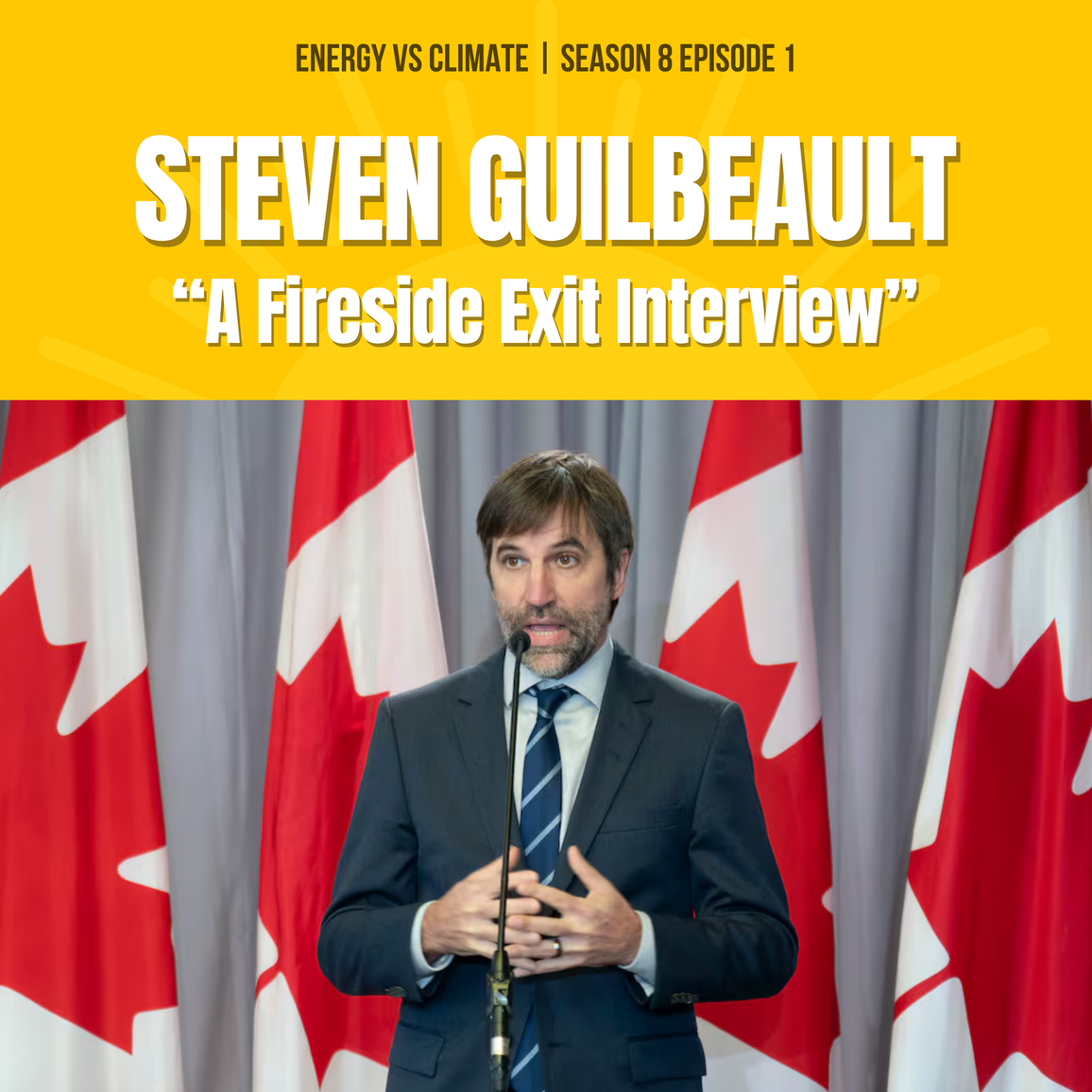
After seven years in federal politics, four of them as Canada's most prominent environment minister, Steven Guilbeault is out.
On September 17, Ed sat down with former Canadian Environment and Climate Change Canada minister Steven Guilbeault for what we called a "fireside exit interview."
Steven spent more than three decades in Canada's environmental movement, then spent seven years in federal politics, four of them running Environment and Climate Change Canada. He resigned from cabinet in November 2025 over the Ottawa-Alberta pipeline deal and left Parliament for good in early September, saying Canada is backsliding on climate action.
We recorded it live in partnership with Protect Our Winters (POW) Canada at its 2026 Leadership Summit. David and Sara sat this one out; it was just Steven and Ed and a room full of POW's supporters and ambassadors. Ed's known Steven for a long time, so they had a frank and insightful conversation about climate, advocacy and the vicissitudes of political life.
Episode Transcript
[00:00:00] Steven Guilbeault: So I get a, this very angry text message from Marlo the day that the announce, the, the announcement of the MOU between the federal government and Alberta is, is, is announced. Like, "What the... And how can you stand by this, Steven? I can't believe, like, this is crazy." And I'm like, "Marlo, I'm resigning from cabinet
[00:00:21] Ed Whittingham: Hi, I'm Ed Whittingham, and you're listening to Energy vs Climate, the show where my co-host David Keith, Sara Hastings-Simon, and I debate today's climate and energy challenges. On September 16th, I sat down with former Canadian Environment and Climate Change Minister Steven Guilbeault for what we called a fireside exit interview.
Steven spent more than three decades in Canada's environmental movement, then spent seven years in federal politics, four of them running Environment and Climate Change Canada. He resigned from cabinet in November 2025 over the Ottawa-Alberta pipeline deal and left parliament for good in early September, saying Canada is backsliding on climate action.
We recorded it live in partnership with Protect Our Winters Canada at its 2026 Leadership Summit. David and Sara sat this one out. It was just Steven and me and a room full of POW supporters and ambassadors. I've known Steven for a long time, so we were able to have a frank and insightful conversation about climate advocacy and the vicissitudes of political life.
So without any further ado, here's the show. I've been looking forward to this for a while. Uh, I've courted Steven to be on the podcast for some time, and telling a story, being in a backcountry hut, trying to clip, like, satellite texting and work through his handlers so we could get him on. But they're a little skittish while he's a minister, but hey, you're no longer a minister.
No longer a minister. So, uh, it's Steven G. off the leash, which I'm really looking forward to. I, I just want to introduce you. So Steven, you haven't got up, you haven't introduced yourself to others. I'd love to just sort of tell people a little bit about you.
[00:02:01] Steven Guilbeault: My name is, my name is Steven, and I'm a recovering politician.
[00:02:11] Ed Whittingham: So, uh, Steven, so for those who, uh, of you who don't know Steven, he's got, like, he's worked on climate environment for decades, and we're kind of dating both ourselves. Uh, but he co-founded Équiterre in 1993. He was, uh, senior director there from 2008 to 2018. He was campaign manager at Greenpeace. He scaled the CN Tower as part of that, uh, photos of which were used by the government of Alberta liberally in certain news releases.
And, uh, and he's advised, uh, and is again advising clean tech funds. So maybe before I go any further, you want to just talk about your, your new role?
[00:02:52] Steven Guilbeault: I officially stopped being a member of Parliament on August 28, and I, since then I've launched my own consulting firm on climate, nature, um, sustainable finance, international negotiations on climate and nature.
And just, uh, last week, one of the workers fund in Quebec called Fondaction, which is a $7 billion fund, uh, very progressive on, on climate, nature, social transition, has announced that I will be advising, uh, the, the, the, the CEO and the, the senior management on, on these issues.
[00:03:28] Ed Whittingham: Uh, you can check out Jeff Jones of The Globe and Mail has a great article about it from a couple of days ago.
[00:03:32] Steven Guilbeault: Jason Kenney also did a tweet about it.
[00:03:35] Ed Whittingham: Oh, I, g- oh, wonderful. Yeah.
[00:03:38] Steven Guilbeault: He, he- They, they miss me.
[00:03:39] Ed Whittingham: Laudatory. That's right. Yeah. I too have had Jason Kenney tweet about me. Yeah.
[00:03:45] Steven Guilbeault: We have that in common.
[00:03:47] Ed Whittingham: We do. Do. We've both been the most hated man in Alberta at a time. Just like Jason Kenney was, and we both quit before he could get fired, so, uh, that's another thing.
Listen, the first time that I really got to know Steven was at COP 16 in Cancun, and it was great to see, you know, amongst the many things you've done. You know, I think you've been Canada's finest climate diplomat, uh, for, uh, decades, and it was great to see you in action as a minister. But the COP 16 in 2010, you weren't a minister yet.
But I'd known of Steven Guilbeault because Jeffrey Simpson, who was another columnist with The Globe and Mail, had written quite a lengthy piece, and it was rare that he profiled someone in the environmental community, about Steven. And kind of the message was, like, "Keep an eye on this guy. You know, he's someone to watch," and kind of went through your background and your interests and, and your skills.
And I, I thought of that when you and I were at COP21 in Paris together. I was running the Pembina Institute. You were, uh, you know, senior director at Équiterre, and we had this night, uh, Canada night, where we kind of celebrated some of what Canada had accomplished, and by then we'd had the Alberta Climate Leadership Plan and lots of things.
And then we got together, got a bunch of premiers, if you recall, together at our Canada night and kind of celebrated provincial action as well. And Amit, if you can show that photo, there's, uh, sort of environmental leaders and a bunch of premiers of the day. And then to Simpson's point where he said, "Watch this guy," you could watch him because look at this guy.
This guy knows where the camera is- ... at any time. I call that Steven's blue steel look, and that's when I knew this guy is going places.
[00:05:30] Steven Guilbeault: Well, since we're talking about this picture, this was probably one of the most embarrassing moment of my life, um, 'cause I, I get there and there's all these premiers, and I'm introduced to someone, and I say, "Who are you?"
"Oh, I'm the Premier of Manitoba." I had no idea who he was.
[00:05:46] Ed Whittingham: Yeah, well, we, we had that. We, we, we both shared that problem. But, uh, so after this then, it wasn't long before you actually entered federal politics, so that was 2015. And then 2019 you became the MP for Laurier-Sainte-Marie, and, uh, not long after that you became Minister of Canadian Heritage, and then, uh, Environment and Climate Change minister, uh, from 2021 to 2025.
And on that we'll talk a bit, but you had a huge impact on, like the oil and gas emissions cap, clean electricity regulations, EV mandate, uh, and a bunch of other files. Um, and thank you, first of all, thank you for your service to Canada.
What I want to do is take you back to pre-politics. So in 2016, and this is-- As to prepare for this, I went into my MacBook, did a little search on Steven Guilbeault, and some things like old emails popped up, but including a speech you gave at the Liberal Convention in 2016 in Winnipeg, and your speech, and you know, you said, "Hey, come in and address the whole convention," was called The New Normal, and the new normal in 2016 was carbon pricing.
The new normal was, you know, Alberta had taken the single biggest step on climate action of any jurisdiction at any time. The new normal was Marlo and Julie and other colleagues working on the Pan-Canadian Framework at the time, which would then was the federal statement, feds catching up to some of the action of the provinces.
That was 10 years ago. So I'd love for you to start by reflecting. Here we are in 2060, uh, 2026. Is it still the new normal as you described it in 2016?
[00:07:38] Steven Guilbeault: No, it is not. Um, I mean, s-some of you who followed this may recall that in 2016 was also when the Pan-Canadian Framework was, was adopted. Uh, Prime Minister Trudeau, um, invited all of the premiers to a conference in Ottawa.
There was a science briefing on climate change that was, that the emcee was one of our, one of our astronauts, David Saint-Jacques. Um, like, can you imagine today the prime minister inviting all of the premiers and them showing up to a climate change briefing and to, uh, leading to a national agreement on climate change?
I think that would be very challenging. The politics of climate change in Canada and in other places in the world have gotten, uh, a lot more complicated, a lot more polarized Uh, and, you know, when I said it was a new normal, I mean, it was a very hopeful time for us because we, we, we, we had a federal government that truly believed that we needed to fight climate change, that was ready to put in place things that many of us had been talking about for ages and that seemed almost impossible to, to, to, to s- to see implemented.
And, and there it was, it was happening. So it was a time of, of great joy and, and great hope. It's a bit more complicated right now.
[00:09:05] Ed Whittingham: So what-- Walk us through, like, what's changed? And think of the geopolitics. Like, can we blame the new normal entirely on the Trump administration, or is there more?
[00:09:13] Steven Guilbeault: No, there's more.
I think, you know, a decade ago, the environmental movement had this incredible ability to mobilize people. Um, I organized, uh, when I was at Équiterre, um, we would organize, like, large marches in the streets of Montreal with fifty thousand people, three hundred thousand people, five hundred thousand people, because we, we felt at the time that we needed to create this w- w- what we call, we would call in French a rapport de force, this-- We needed to show political forces that we were also a political force collectively, and that we had a voice and that we could have an impact.
And I think it was, it was instrumental in, in, in, in leading Amongst others, the Liberal Party of, of Canada and, and Justin Trudeau's government to be very ambitious on, on, on these things. And I think what has changed over the last decade is that the organizations that had this capacity, this capacity to mobilize people really shifted, and I think for, for, for good reasons.
They, they, they shifted their focus from, from public mobilization to policy work because the door was open with the Liberal government. In terms of climate policy, you, you could talk about just about everything, and, and there was n-- I mean, there were a few things that the federal government in Canada cannot dictate the use of natural resources because as per our constitution, the use of natural resources is a provincial jurisdiction.
So I, as environment minister, couldn't tell Alberta that they can't use their oil no more than I could tell Quebec that they can't use their water for, for, for dams or, or wind, for, for, for wind turbines. So but other than that, the doors were wide open, so I think the movement and the organizations really shifted from public mobilization to policy work because there was an opportunity to influence policy, and there was an appetite by the government to, to hear ideas and proposals about new or better policy things we, we could do in the country.
I would argue that a lot of the things that we're seeing in terms of moving backwards on climate change in Canada is not a result of Donald Trump or the trade war. It's used as an excuse. We don't have to do that to face the challenges po-- that is posed by, by the, the Trump tariffs and, and, and, and the trade war.
[00:11:42] Ed Whittingham: The new normal at the time was a heady time, and I knew things had changed and, you know, as the executive director of the Pembina Institute at the time. The Notley government got elected May fifth, twenty fifteen, and a week later, I was up in Edmonton meeting with then Notley administration environment climate change minister Shannon Phillips.
The big difference, we went up, and it was an evening meeting, and normally you'd go up and you'd meet with then the old prog- Progressive Conservative, uh, of Alberta Party, and it'd be daytime under fluorescent lights. You'd have stale sandwiches. And we went up, met with Shannon and her chief of staff, Brent Dancey, who ended up being just as much her bodyguard as he was the chief of staff, given all the threats she received.
And they said, "Hey, should we order in Thai?" And we're like, "Oh, things have changed. Thai food? A government that wants to eat Thai food?" And then the, the same thing, as you say, with the Liberal government when, uh, it was elected in October twenty fifteen. It was pushing on an open door, and we felt like the dog that had caught the car.
Everything we would ask for, and we'd go in and talk to Marlo and Julie, and people were very sympathetic. In talking about now the new new normal I wanna show you a clip from the Prime Minister's, you know, much feted Davos speech from earlier this winter, and then I wanna ask you just about the climate implications of it
[00:13:03] PM Mark Carney: What does it mean for middle powers to live the truth?
Well, first it means naming reality. Stop invoking rules-based international order as though it still functions as advertised. Call it what it is, a system of intensifying great power rivalry where the most powerful pursue their interests using economic integration as coercion.
[00:13:26] Ed Whittingham: So maybe the point I want to talk to is stop thinking about the international rules-based order as like the organizing principle.
We're now in this era of great power rivalry. What does that mean? And, and you've been Canada's top, um, climate diplomat for a long time, both outside of government, inside government. What does it mean for international climate diplomacy?
[00:13:49] Steven Guilbeault: I certainly understand what the, what the prime minister was trying to, to say in, in that speech.
Uh, I think there's, there's some truth to it. But at the same time, I mean, the international order architecture is still there. It is resisting the numerous attacks by the likes of, um, certainly the United States, but, but also other, other nations that have tried to, to challenge it over the-- o-over time.
A-and I think the reason for that is, is simply the fact that the vast majority of middle powers and smaller countries see that they're-- the only way that they can have a voice in those conversations, and you can choose whatever conversations we're talking about, whether it's climate, whether it's trade, whether it's nature, whether it's AI, the only way they can have a voice internationally in these conversations is through multilateralism.
There's, there's no, there's, there's no other way. So of course, some would like it to be my way or the highway. Donald Trump, think of, you know, some of the BRICS country who would like to s- nothing better than to say, "We don't need the United Nations," and, you know, "Us larger, more powerful nations w-will solve those problems.
We'll decide how we do this." But it's not-- uh, I mean, the system is not being dismantled. It's, it's certainly being, being challenged. We will meet again next month in, in Armenia, uh, for, for the negotiations on the implementation of the COP fifteen agreement on nature. We will meet in November in Turkey, uh, for COP thirty-one on, on climate change.
And guess what? Pretty much everyone's gonna show up for those negotiations. Even the United States, they're not the most, um, constructive or active participant in these negotiations. But interestingly enough, the US isn't trying to derail these negotiations. They could do that. It's not a strategy that they've, they've, they've decided to adopt so far.
They show up. They don't really engage. They don't participate much. So the system is holding. Those of us who care about these issues We have to work together to ensure that this system with, despite all of its flaws, continues to be the forum where we have those conversations. 'Cause otherwise it, it is going to be left to a handful of powerful countries to make the decisions on behalf of all of us, except that we won't have a voice in, in those decisions if it doesn't happen in this rule-based system.
[00:16:26] Ed Whittingham: Yeah. And, and I think of last year, did a lot of work on international diplomacy around carbon removal with the G7 Summit that Canada hosted. And we were working with a bunch of the G7 countries and really kind of shepherding agreements around some sort of joint statement. The interesting thing with the US administration, you know, we took a six-month pause, and then they came back and said, "Well, we won't obstruct, but you can't use the word 'climate' or 'carbon.'"
So then it was like twisting yourself into knots until it got completely unworkable, and then we said, "Okay. Well, Canada's gonna do, like, a bunch of smaller agreements, sort of bilateral or small multilateral agreements with-" We, we could
[00:17:05] Steven Guilbeault: talk about forest fires. The Americans said- Yeah ... "Okay, yeah, we can talk about forest fires."
So you know, you take your wins where you can.
[00:17:11] Ed Whittingham: Yeah. So I mean, you know, the prime minister is big on his middle power thesis, and as part of that middle tho- power thesis, it's striking new alliances and, and also, like, flexing our middle power muscles and punching above our weight. So are -- when you left, do you think, like, climate will be one of those issues where we'll flex our middle power muscles?
[00:17:30] Steven Guilbeault: I don't think Canada w-would like to do that. I think many of our allies would. Uh, the Europeans, for example, aren't backing away from their climate commitments. They aren't dismantling their, their climate change ar-ar-architecture. Uh, Australia's doing I mean, they have their own challenges. Like Canada, they're a big exporter of, of fossil fuel, na-namely coal, but they're also doing a lot of very interesting thing domestically.
Australia will be the, the chair of, of the next climate COP, COP, COP 31, uh, Chris Bowen, the climate change minister there. So I, I think that m-maybe that's not what Canada would want, but I think many of our partners may impose on us this, this agenda because under Prime Minister Trudeau, climate change was, was a central issue.
Like you can-- I would debate anyone who would, who would want to say otherwise. For, for Prime Minister Trudeau, climate change was always one of the top three issues of his mandate. Sometimes it was number one, sometimes it was number two, sometimes it was number three. Like Environment Canada had become a, like a central agency as much as the Treasury Board is or finance.
In 2021, uh, when the, the cabinet was, was formed, I was named environment and climate change minister, Prime Minister issued what w-what I, what i- what are called mandate letters. And mandate letter is basically the instructions of the Prime Minister to all of his ministers. And before Justin, this was a very secretive and private document.
No one ever saw it except the minister and the deputy minister. But Justin said it's going to become a public document so that people can know and hel- and hold us to account on what we're supposed to do. My mandate letter was the second longest after the finance minister. So, you know, the, the environment department and environmental issues were at the core of the mission of that government for, for 10 years.
It's not like that now. Unfortunately, uh, environmental issues and the environment department are, uh, they've been pushed out the very limit of our solar system. Like it's not, it's not what it, what, what it used to be. But It, it can be, and, and we've shown in Canada, Canada's the fourth largest oil and gas producer in the world.
Uh, and I think Kara was talking about this earlier today, like what we do matters. Like we're, we're not a big country in terms of our, the size of our economy, the size of our population, the size of our climate footprint. We're a very big country. And, and I think what, what, what we have been able to show between twenty, twenty fifteen and twenty twenty-five is that public policies matters.
For the first time in the history of our country, we were able to reduce pollution levels while the economy was growing. That had never happened before. The only time in our history where that had happened, where, where pollutions went down was because of the financial crisis in two thousand and eight and economic recession, uh, COVID, but never because of public policies.
And I'm not saying, and we can probably talk about that, I'm not saying that everything was perfect. I'm certainly not saying that I was perfect as a minister and all of the decisions I made were in line with, with the fight against climate change, and that is certainly a challenge of being in power. You oft-- you sometimes have to make decisions that you don't necessarily agree with personally, um, uh, based on a, a number of different factors.
But, but we, we, we, we've shown that we can do this in Canada. And although now things are not great on, uh, on that front, I am Convinced that two years and three years, maybe four or five, there will come another group of people in power in Ottawa who will say, "This has to be a priority again." And, and I think people like Marlo, like Julia, like Ca-Catherine McKenna, myself and others, 'cause you never do anything in politics alone.
Like you, you pick up the work that others have started. You, y-you work with many people and allies inside government, outside government to make things happen. But there'll come a group of people who say, "This is a priority, and, and we want to pick it up again." And they will need people like us to, to make this happen.
[00:22:01] Ed Whittingham: And, and the irony, so we're i-in effect kinda comparing and crass-- contrasting Justin Trudeau with Mark Carney. I was part of, uh, with the company Stripe, which is the big, like, point of sale company and quietly the largest privately held company in the world. They process one percent of, uh, global, uh, global, uh, economic transactions.
But they're big into carbon removal, and December ninth, twenty twenty-four, I was part of two people at Stripe that briefed Mark Carney, who was then a lowly Stripe board member, on sort of what we wanted. We wanted to call the Prime Minister and say, "Hey, Prime Minister Trudeau, put carbon removal on your G7 agenda."
He was incredibly literate. He knew all the people. He understood the science. He asked great questions. There was no convincing involved. The, the funny footnote is that week he and the Prime Minister, we asked him to call the Prime Minister, they chatted. By Friday of that week, Justin Trudeau was firing Chrystia Freeland on a Zoom call that Mark Carney was part of.
She then quit, you know, with, uh, great fanfare the following Monday, and Canadian modern political history is different. Yeah. I j- So blame it on carbon removal. Yeah. That's... I, I wanna go now and, and talk, I think with the time we have, we, we really do need to talk about pipeline politics, because it is again kind of a topic du jour.
Your career, your political career has kind of been bookended by pipelines, if you think about it. Because for those who don't know, Steven, when he was elected as MP, he was very public saying, "I'm elected, but I'm not supporting the Trans Mountain Pipeline," which the Trudeau government had signed off on, uh, in 2016 and really supported.
And one of those checks I did of emails, there was an email that you shared with a group of us climate activists about meeting with Trudeau's principal secretary, Gerry Butts, saying, "Here's the political calculus. We need one pipeline for Alberta. We need the Notley government to be in place, or else we're gonna lose a lot more."
So you went in and said, "Yes, I'll support the government, but I won't support this pipeline." Very clear about that. And then you resigned, in effect, resigned, uh, 20- 25 from cabinet From cabinet. Thank you. Yeah. Yeah, and as an MP in 2026, because of the MOU deal that was struck between your government at the time and Alberta, that included very prominently support for a pipeline.
So you could live with the government with the TMX pipeline without supporting it, but you couldn't live with the government with that second pipeline. So what, what changed for you?
[00:24:33] Steven Guilbeault: When I was approached to run for the Liberals in-- I was approached in twenty eighteen. I announced that I was running for them in twenty nineteen.
I, I thought for many months, it was a very long thought process. Um, okay, so do I want to go in politics? If so, who do I want to go with? Do I want to go with the Liberals? Uh, do I want to go with the Greens? Do I want to go with the NDP? Um, obviously from a philosophical position and policy position, I agree with a great many things that both the Greens and the NDP, um, are, are promoting.
I was looking at what the Liberals had done. I disagreed with the pipeline, but they, they were putting in place carbon pricing. They were working on, uh, you know, investing more in, in, in clean tech and renewables, in home energy retrofit, uh, in EV rebates. So I, I, I thought to myself, "Okay, well, if I go with the Liberals, if I'm elected, if the Liberals are reelected as the government, maybe there's a chance I make it to cabinet."
There's no certainty. And I, I did not ask for a cabinet seat when Prime Minister Trudeau asked me to run. I did-- The only thing I, I-- The only condition I, I posed to me running for the Liberals is, is exactly the one you mentioned on pipeline. I said, "Prime Minister, I'm happy to run for you, but I won't defend the pipeline.
I wasn't there when that decision was made. I feel it's your project, and I'll defend everything else, but not that." And he said, "Fine. I have no problem with that." I said, "You know, if I make it to cabinet, maybe I can work to implement some of the things that many of us have been talking about for, for so long."
And so that's why I decided to, to, to run for, for, for, for the Liberals. So why, why did I agree to run for a party that had just bought a pipeline but decided to leave a party that was-- had decided to, to buy another one? For a couple of different reasons. I mean, we're ten years l-later. We know so much more about the impacts of climate change.
Months before my resignation from cabinet, we had an election campaign. The Liberal Party had a platform which didn't mention pipeline once, whi-which didn't talk about this pivot to fossil fuels, which doesn't-- whi-which didn't talk about this deregulation agenda that the government is putting out the door.
And I was the Prime Minister's Quebec lieutenant. I campaigned in twelve, fifteen different ridings in the province, promoting Mark Carney, climate change champion. So I felt that I-- I mean, I had a moral obligation towards the people I had spoken to, and especially people who had elected me three times in a row in Laurier-Sainte-Marie.
Many of them elected me and have elected me because of climate change, because of their concern for climate change. So we had-- that's not what we had told them we were going to do. Uh, we were, we were doing a, a one-- one hundred and eighty degree without any r-reason I could explain to myself, let alone to, to, to peop-- to, to my constituent.
And I felt that I-- I-- first, I couldn't stay in cabinet, um, so I resigned. So I got-- So f-some of you may have met Marlo Raynolds. Marlo's over there. He was, as I said, was chief of staff to two, uh, two of my predecessors, longtime environmental activists like you and Edie of the Pembina Institute. So I get a, this very angry text message from Marlo the day that the announ-- the, the announcement of the MOU between the federal government and Alberta is, is, is announced.
Like, "What the-- And how can you stand by this, Steven? I can't believe, like, this is crazy." And I'm like: "Marlo, I'm resigning from cabinet." As a cabinet minister, you have to, to be, uh, you know, there's this thing called cabinet solidarity. You can disagree when cabinet meetings are happening, but once a decision is made, you have to abide by that decision.
You have to defend that decision. That's how our political system works. Um, and I felt I could not do that, so I, I resigned from cabinet, which is-- it doesn't happen very often in our political system that a minister leaves on a matter of principle. It happens every once every twenty years or so in, in, in, in Canada.
I decided to stay as an MP for the Liberals, uh, because I was hoping that I could try and influence some of the things that were coming, like the nature strategy and a few other things. And I also wanted to see what would be the, the result of the negotiations between the federal government and, and Alberta.
I was very, uh, worried. I wasn't very optimistic, but I said, "Okay, I'm gonna stay and try and push in a different way as a member of Parliament, not as a cabinet minister." I wrote some op-eds. I did some interviews. Uh, and interestingly enough, no one from the government, not the Prime Minister's office, no one told me to shut up.
I did a lot of interviews. I was very public of my disagreement with my own government on the MOU with Alberta and what we were sacrificing to, uh, through this agreement and, and, and the pipeline. I think they didn't tell me to shut up because they was-- they were afraid I, you know, I, I don't know, I'd leave or something, which I ended up doing.
Um, but so I stayed for about six months, and, and then when I saw the result of the, the ne-- the, the negotiations with-- between Alberta and the federal government, and I don't want to inundate you with numbers, but when the Trudeau government comes in in twenty fifteen, the projections are that Canada is going to overshoot.
So Canada was going to overshoot our target for twenty thirty, which was to reduce emissions by thirty percent. We were going to overshoot it by at least ten percent When I left, uh, as environment minister in-- at the end of 2024, beginning of 2025, analysis from organization like the Climate Institute, which is an independent organization, showed that we were on our way to be at -36% in 2030.
So we went from +10 to -36 if we kept going the way we were going, and our goal was to be at least -40. So we weren't, we weren't quite there, but we, we had done g- like not, like collectively, we'd done tremendous progress in, in Canada. And with the agreement with Alberta, we'll be lucky if we hit -15 by 2030.
So we're not-- it's not as bad as under Harper, where we were going to, to overshoot, but we've, we've cut basically our climate efforts in Canada by half. So, so Canada's still fighting climate change, but nowhere near to the same level, uh, as, as we were just, just a, just a few years ago. And that's, in my view, uh, a-- it's totally a political decision.
It, it has nothing to do with Donald Trump. I mean, a lot of things that our plan would address are the emissions from the oil and gas sector. The last thing on earth that Donald Trump wants is to impact oil export from Canada to the US. So one of the last sectors that would be ever impacted by trade war with the United States would be the oil and gas sector because the Americans want our oil, and they want our gas.
So this idea that we had to sacrifice our climate plan because of-- So I understand in certain sectors, you know, steel, automobile, okay, maybe you want to ease up some of the measures because these sectors are being really affected by tariffs. But In, in many other instances, we, we did not have to do what we're, what we're doing now.
[00:32:20] Ed Whittingham: You were unique in many ways, including, like you said, uh, resigning on principle, and that's a rare thing. Uh, and I think you should be proud of it.
[00:32:30] Steven Guilbeault: I was, I was unique in, I was unique in other ways. Um, you, you don't find a whole lot of cabinet ministers who have been arrested a number of times in, in their professional capacity.
So, you know, no driving under the influence or anything like that. But one day we were having a conversation about, uh, bail reform in, in Canada and the justice system. At one point I, I raised my hand and I said, "Prime Minister, I'm probably the only one around the table who's ever been out on bail, so I have some experience with with that."
That prime minister thought it was a pretty interesting intervention.
[00:33:10] Ed Whittingham: It's-- Well, there it's great to speak from experience- Yeah ... at the cabinet table on things like that. And that's ultimately the expression of empathy too. Are you also unique in that I don't know any minister of the Crown, the federal Crown, who has been more attacked by a province and named and blamed and shamed than you were.
And, you know, a little bit Jason Kenney, but it was really Danielle Smith. And yet you had to go to Alberta. I remember, you know, I attended a dinner with you in, in Alberta, and you said the irony was, you know, you're getting absolutely, you know, publicly maligned, but then you're meeting at, uh, MacDougall Place and the pri-- the, the Premier Danielle Smith pops in and says, "Hey, Steven, you know, let's, let's figure out a way to work together."
But that's hard because, again, I am not knowing a minister who is more publicly attacked by a premier. So how, how do you build resilience in the face of that?
[00:34:05] Steven Guilbeault: She actually came and said, "Oh, I heard you're in the building. I wanted to come and shake your hand and say hi." And then, you know, a few months later, Tucker Carlson is in town, and she asks him to put a bullseye on my back physically, not figuratively speaking.
I think you as a-- you, you stop, largely stop watching social media or reading social media. Unfortunately, people around you still do. My, my-- You know, I, I know it took a toll on, on members of my team who-- Like, I could stop going on Twitter and, and, and not look at Facebook. They still had to do it, and they saw all these, all, all these things.
You try really hard not to take things personal from people who don't know you personally. It-- Easier said than done, but y-you know, it's, it's, it's not the It's a, it's a journey. Um, a-and, and you also try and, and focus on, on, on, on what's positive. Uh, you try to l-- as much as you can, it's not always possible, but to leave that out.
[00:35:15] Ed Whittingham: Yeah, I mean, I experienced that personally. Yeah, you too.
[00:35:18] Steven Guilbeault: I mean,
[00:35:18] Ed Whittingham: of course. A, a, a line in Jason Kenney's stump speech in the twenty nineteen election, and that's where I learned that, you know, reputation is actually what people who don't know you think- Yeah ...what they read. The people who know you know who you really are, and you fall back on that, and you fall back on family, you fall back on friends- Friends ...you fall back on nature too.
What, what-- now that, you know, you're all-
[00:35:40] Steven Guilbeault: Can I talk about friends for a second?
[00:35:42] Ed Whittingham: Yeah, please, go ahead.
[00:35:44] Steven Guilbeault: I said earlier that not everything I did I, I agreed with as a minister, and that's, you know, that's a challenge. I have four kids. I-- how many peoples have kids here? So I don't know about you, but as a parent of four, I never win all of my battles at home.
I-- So when I came into politics, I was under no illusion that I was going to win all of my battles in a country of forty million people. One of the battles I lost was arguably this oil platform off Newfoundland called Bay Du Nord, which I approved as environment minister, and it was a really shitty day.
Like, I spent my life in the climate movement fighting the expansion of the oil and gas sector and new infrastructures, and that day, for a range of reasons we won't get into, I had approved that, that oil platform. And I, and a, a number of my ex-colleagues from the environmental movement, like, really criticized me, rightly so, as- Équiterre sued you, right?
Yes. I mean, not- The group you co-founded. Not personally. They weren't going to seize my bike. But they sued me as a minister of the Crown, yes. And you know, you're in Ottawa, you get home, you're alone, it's eight o'clock, you've had a really shitty day, you're by yourself, and then a little bit later, the phone starts to ring.
I start getting text messages and, you know, stuff on WhatsApp, and it's my ex-colleagues, but still friends from the environmental movement who are telling me, "Hey, listen, we really criticized you today, uh, but you're still our favorite environment minister." And I think, y- you know, I, I think they wanted to, they wanted to let me know that many of them understood that maybe this wasn't a decision I would have made if it would have ju-just been me, but it wasn't just me.
It was me on behalf of 40 million people. It's a complicated decision. And, and that, you know, the, the role that groups, environmental groups and, and groups like Protect Our Winters play, it can manifest itself in very different way Some people think that lobbying or activism is, is a hammer, and maybe sometimes it needs to be a hammer, but I think often it's a bit of a scalpel and, and you, and you have to be like careful and targeted in, in, in, in the way you do things and understand that the people who take decisions don't always necessarily...
Maybe they agree more with you than, than, than, than you think. And, and you know, it's, it's an art more than, than, than it is a, a science. But it, it, it really helped me personally that day because it was very difficult to, to see that, you know, people, some people at least understood where that was coming from, what that decision was coming from.
[00:38:45] Ed Whittingham: It sounds like that was a g-regret, but it was a very difficult one. And again, in the-
[00:38:49] Steven Guilbeault: Oh, yeah ...
[00:38:49] Ed Whittingham: in, yeah, with, uh, the spirit of cabinet solidarity. Now that you've left and you've recently resigned as an MP, like tell us, like what's an accomplishment you're real-really proud of?
[00:39:00] Steven Guilbeault: I, I spoke about the fact that, you know, when I was there, environment was at the heart of many things that was happening.
And, and o-obviously it wasn't just me. It, it was, it was many colleagues around the cabinet table. It was people who preceded me. It was the Prime Minister himself. It was people outside pushing. Um, I, I mean, I probably a COP 15. So who-- for those who are not familiar, there are a number of conference of parties.
So these are UN meetings. There's, there's a United Nation convention on climate change. There's one on biodiversity. Um, so the one on biodiversity was supposed-- There was a meeting that was supposed to be held in, in China in 2014 and, uh, in 2021 and couldn't because of COVID. And then it was supposed to be held in China in 2022 and still couldn't because COVID lasted longer in China than in, in, in, in many other parts of the world.
And organizing these meetings, it's, it's pretty-- it's a big deal. Like it's tens of thousands of people from all around the world who show up. It's 190 countries that, that, that come with their, with, with their diplomats and their negotiators. It's journalists, it's civil society, it's indigenous, it's unions.
So it takes usually about a year or two to organize one of those meetings. The United Nations wrote to us in June of 2022 saying, "Hey, can you do that by December? Can you organize one of those by December? Oh, and by the way, Canada, you'll have to work with China because China i-- has the presidency of that meeting because it's supposed to have in the-- it was supposed to be in China."
I don't know if you people recall in 2022, the diplomatic relationship between Canada and China wasn't exactly rosy, like it was just after the two Michaels trade wars with, with, with, with China. We hadn't had a minister in China in like five years. So I go to the prime minister and I say, "Hey boss, the UN wants us to do this meeting.
Not a-- we don't have a year or two, but we have six months. Oh, and by the way, we have to do this hand-in-hand with China." I think many people, prime minister's office, and maybe the prime minister himself seriously questioned my sanity at this point. But to his credit, Prime Minister Trudeau said, "Yes, we're gonna do this, uh, because we have an obligation to try and help the world come to an agreement."
So not only were we able to organize this meeting in, in record time, um, but it is, to this day, it is known to be the most successful international nature agreement ever
So 194 countries agreed to protect 30% of the planet and oceans by 2030 and, and do a bunch of o- of other things, but that's, you know, one of the big commitment. And, and I, you know, I find if I had not gone into politics, maybe that would not have happened. Maybe they-- no one would have said, "Hey, let, let's do this."
If I hadn't decided to run for the Liberals instead of the Greens or the NDP, for which I have tremendous respect. By the way, at my retirement party in Ottawa, Elizabeth May came, a number of NDP MPs came, Bloc MP came, obviously Liberals, no one from the Conservative Party. Um, some of them came to me and said, "Hey, listen, I would love to go to your party, but if I did that, it'd be the end of my career with the Conservative Party," um, because of the fact that both you and I are very popular in those circles.
You know, that's one thing I'm, I'm very proud of, um, and I didn't do that, um, alone. Like I-- Next week, there's a big meeting in New York. It's called Climate Week. We have a dinner on Tuesday with a bunch of ministers from the UK, from, um, the Maldives, uh, the European Union, uh, a number of, uh, Latin American country who were instrumental in helping me land this.
Like, you never do these, the, the, these things alone, and we're, we're getting together 'cause we're still working together. We have this network, and we, we, we scheme, and we do things, and, and that's That, that's, that's really important. I think, you know, in French we have this saying, um, uh, "Alone you go fast, but together you go far," roughly translated.
Tout seul on va vite, mais ensemble on va loin. And that's always been my view of politics, or the work we do collectively in, in, in social and environmental movement. Like you, no one by themsel- I mean, of course, you know, David Suzuki and, and people like that are, are amazing. David Suzuki has a lot of people helping him do what he does.
He's amazing at a number of things that he does, but he doesn't do it alone. So i- it's, it's been my view of, of politics, of, of diplomacy, and of trying to move the needle in, in Canada, and I think we've shown that we can do that w- and we've done so. I mean, I could talk... You know, we, we included the right to a healthy environment in, in, in, in Canada's bodies of laws.
That had never been done before. We, we, the plastic ban, uh, on, on single-use plastic. Um, we've, we've done a number of things, and things that are still in place now, and I think a number of them will survive this government and, and, and, and governments to come.
[00:44:27] Ed Whittingham: Listen, our, our tight 45 is up. I do wanna say, though, with that cop you're talking about, as we're on the beach and just after we'd been swimming and comparing abdominal surgery scars, I don't imagine many people know this, but that cop where you pulled that off is one week after you had, had abdominal surgery to remove a tumor from your abdomen, and yet you're up and within a week walking and pulling that off.
Yeah. So, uh, you are an environmental warrior. Thanks for listening to Energy vs. Climate. The show is created by David Keith, Sara Hastings-Simon, and me, Ed Whittingham, and produced by Amit Tandon. Our title and show music is The Windup by Brian Lips. This season of Energy vs. Climate is produced with the support of the North Family Foundation, the Consecon Foundation, and you, our generous listeners.
Sign up for updates and exclusive webinar access at energyvsclimate.com, and review and rate us on your favorite podcast platform. This helps new listeners to find the show. If you enjoyed this episode, check out our show with climate scientist and another recovering politician, former BC Green Party leader Andrew Weaver.
It's episode 18 from back in May 2021. We'll be back soon with a conversation with author, journalist, and environmentalist Bill McKibben, also recorded at the Protect Our Winters Canada 2026 Leadership Summit. See you then
About Steven Guilbeault:
Guilbeault was first elected as the Member of Parliament for Laurier-Sainte-Marie in 2019 and served as Minister of Environment and Climate Change from 2021–2025. He has previously served as Minister of Canadian Heritage. In 1993, Guilbeault co-founded Équiterre, the largest environmental organization in Quebec, and served as its Senior Director from 2008 to 2018. He also worked as a Director and Campaign Manager for Greenpeace, and was a Strategic Advisor for more than 10 years at Cycle Capital Management, a Canadian fund dedicated to the development of clean technologies. Guilbeault has worked for Deloitte & Touche as well as Copticom, a consulting firm specializing in the green and social economy.
About Your Energy vs Climate Co-Hosts:
David Keith is Professor and Founding Faculty Director, Climate Systems Engineering Initiative at the University of Chicago. He is the founder of Carbon Engineering and was formerly a professor at Harvard University and the University of Calgary. He splits his time between Canmore and Chicago.
Sara Hastings-Simon is an Energy Systems scientist studying energy transitions at the intersection of policy, business, and technology. She’s a policy wonk with a love of data. With a PhD in physics from the University of Geneva she has worked at both McKinsey & Company as a management consultant, and the Pembina Institute where she founded Business Renewable Centre Canada. Dr. Hasting-Simon is now a professor at the University of Calgary where she co-leads the Electricity Centre. She has a particular interest in the dynamics of the mid-transition, a concept she co-developed.
Ed Whittingham is a Canadian climate and energy leader with more than 25 years of experience across public policy, clean technology, corporate strategy, and the non-profit sector. He is the former Executive Director of the Pembina Institute and has worked with governments, companies, universities, and civil society organizations in Canada and internationally on complex climate and energy issues. Today, his work focuses on helping build and scale climate stabilizing solutions. He serves as Founding Director of the Advance Carbon Removal Coalition.
Produced by Amit Tandon & Bespoke Podcasts
Energy vs Climate: How climate is changing our energy systems
www.energyvsclimate.com