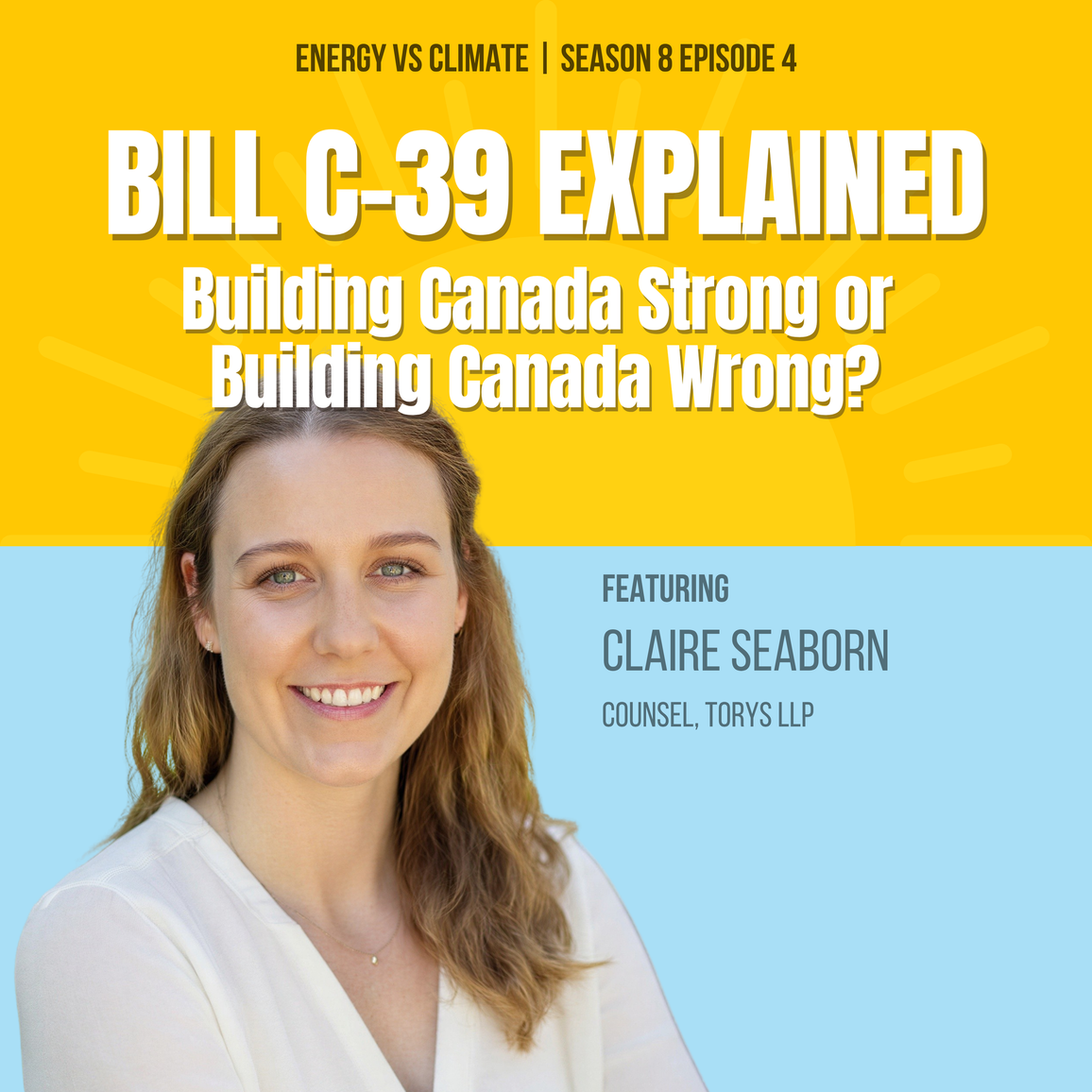
Building Canada Strong or Building Canada Wrong? Bill C-39 Explained | With Claire Seaborn

How would federal project permitting work under Bill C-39?
On October 29, Sara and Ed recorded a live webinar on Bill C-39, the Building Canada Strong Act, with Claire Seaborn of Torys LLP. Claire is a former Chief of Staff to the federal Minister of Energy and Natural Resources, and she co-authored Torys' technical analysis of the bill.
Ottawa says C-39 will get major projects built faster without lowering standards. Critics say it hands ministers sweeping new powers at the expense of nature, workers, and Indigenous rights. Sara and Ed are the resident non-lawyers, so Claire kept it in plain language, with help from a couple of restaurant analogies.
Episode Transcript
[00:00:00] Claire Seaborn: Projects in Canada are over-regulated in terms of the complexity of the systems that apply to them. They are also grossly under-regulated when it comes to a number of protections, and it's, it, I find it's really hard for people to hold both those ideas at the same time.
[00:00:17] Ed Whittingham: Hi, I'm Ed Whittingham, and you're listening to Energy vs.
Climate, the show where my co-hosts David Keith, Sara Hastings-Simon, and I debate today's climate and energy challenges. On October 29th, Sara and I recorded a live webinar on Bill C-39, the Building Canada Strong Act, with Claire Seaborn of Torys LLP. Claire is a former chief of staff to the federal Minister of Energy and Natural Resources, and she co-authored Torys' technical analysis of the bill.
Ottawa says C-39 will get major projects built faster without lowering standards. Critics say it hands ministers sweeping new powers at the expense of nature, workers, and Indigenous rights. Sara and I are the resident non-lawyers, so Claire kept it in plain language with help from a couple of restaurant analogies.
David sat this one out. So without any further ado, here's the show. Prime Minister Carney calls the Building Canada Strong Act, Bill C-39, the most consequential economic legislation of this parliament. It runs more than two hundred and forty pages and amends 19 laws plus four regulations. Ottawa says that it'll get major projects built faster without lowering standards.
Meanwhile, some environmental groups, some unions, and some First Nations leaders say it hands ministers sweeping new powers at the expense of natures, nature workers, and Indigenous rights. And the politics, frankly, around it could not be hotter, or at least it could not be coming in a hotter overall context.
If you think in the last four weeks, we had the, uh, Parti Québécois in Quebec return to provincial power after a long hiatus. Uh, Alberta voted to stay in Canada. Hooray. Uh, BC elected a conservative government promising, quote, "Cut red tape like it's never been cut before." And back to Alberta, an Alberta court said Ottawa's environmental assessment law is still unconstitutional.
So all of this begs the question: Are we building Canada strong with the Building Canada Strong Act, or will we inadvertently end up building Canada wrong? So this topic really begs a well-rounded lawyer with a wealth of experience across sectors to help us all make sense of it, and for that, look no further than Claire Seaborn.
So Claire. Claire is a lawyer at Torys LLP in Toronto, where she helps clients advance infrastructure, energy, and mining projects, revol-resolve project-related disputes, and navigate permitting and compliance processes. Uh, prior to that, and how I got to know her, she spent five years in senior roles at the government of Canada, most recently chief of staff to the Minister of Energy and Natural Resources, and prior to that, director of policy and legal affairs to the Minister of Infrastructure and Communities.
And that's actually, through that capacity, that's when I first got to know Claire. Uh, fittingly for the purposes of today, she co-authored Torys' technical analysis of C-39. So welcome to Energy vs. Climate, Claire Seaborn.
[00:03:27] Claire Seaborn: Thanks so much for having me, Ed.
[00:03:29] Ed Whittingham: Well, thanks for joining us and, and helping us to, yeah, make sense of what is a fairly complex topic.
So what we're gonna do, uh, the format for the next hour is Claire is gonna help us with something primer-like on what part one of the bill actually does, and we'll explain why part one. And then the, uh, three of us, including Sara, we're gonna dig into the bigger question, and ultimately, is C-39 good or bad for Canada?
So let's get to the, the three parts of C-39. Today we're focusing just on part one, but before we do the dive into part one, Claire, what are the other three parts, and why did the government bundle them into one bill?
[00:04:08] Claire Seaborn: Thanks, Ed. Part one modifies the federal project permitting regime, um, nine laws specifically, including the Impact Assessment Act and the Building Canada Act.
Part two is focused exclusively on the transportation sector, and that actually modifies even more, 10 laws across the government, including the Transportation Act, the Marine Act, some legislation related to port authorities. We won't get into that today, but also an interesting piece of the bill. And then part three changes, um, labor relations requirements under the Canada Labour Code and the Wage Earner Pro- Pro- Protection Program Act.
Um, so it's a single bill, I suspect, because all three parts are really aimed at achieving the same goals. Getting projects built faster and also getting goods moving more quickly through supply chains. And these goals are very central to the government's agenda right now. There are plans to diversify trade, and also, I, I would argue, to maintain national unity.
Um, I would also assume that the government put this all into one bill because they wanted it all tabled before the Alberta referendum, you know, all in one package that I think, you know, that was timed i- in some way. Uh, and also, interestingly, the government has decided to put together a special parliamentary committee in the House of Commons to study this bill.
Um, so by putting it all into one bill, they can strike a special committee that studies exclusively this one bill and not other, uh, legislation that's traveling through the process. So, um, this bill is being studied at the moment simultaneously by the House and the Senate. Uh, and there's committees, uh, happening, um, you know, this week, uh, debating the bill and, uh, considering amendments, hearing from experts, et cetera.
So it's very live at the moment.
[00:05:55] Ed Whittingham: Yes. Uh, the parliamentary process is in full swing, and actually I testified to a parliamentary committee just last week on a separate topic, on CCUS and, uh, carbon removal. Actually, I shouldn't say separate. They're of course linked, uh, in terms of what, uh, the federal government hopes that we'll be able to build in Canada.
You know, and to your point, I guess, around government objectives, you know, it seems to me that Mark Carney and Michael Sabia, the two bankers running the country, are really driven by, first and foremost, disentangling the Canadian economy from the US one, and then beating back two secessionist movements in the country.
And I'm roughly paraphrasing what Michael Sabia said some months ago. And it seems like they're so far successful in beating back one secessionist movement. We'll see what happens with the second one in Quebec with the Parti Québécois in power now. But let, let's, let's get into specifics. So How does C-39 change the permitting process for the different categories of projects that will come forward?
And I'm thinking of nuclear power projects, mining projects, oil and gas, renewables, transport and transmission, et cetera, the, the, the full gamut.
[00:07:05] Claire Seaborn: C-39 part one is primarily about speed. It's about projects moving through federal processes more quickly. And al- when the bill was introduced in the House, the government also published a cabinet directive.
And if you haven't taken a look at that, I think for listeners, it's really worth reading that cabinet directive because it provides a lot of additional guidance and understanding on what the government's trying to accomplish with this bill. The cabinet directive together with the legislation sets out this one-year timeline.
The one-year timeline is intended to apply to all federal processes, whether it's through the Impact Assessment Agency, the nuclear regulator, the Canada Energy Regulator, or whether there's no lifecycle regulator at all, and that project is only applying to a federal permit, like for example, through Fisheries Canada, uh, just a Fisheries Act permit.
It's ... What's interesting and very new about this bill and the cabinet directive together is saying regardless of what federal decision is being made, that decision needs to be made in under a year. Um, and, uh, so I think that's sort of the most important thing to say off the top. But as you say, uh, this bill applies in really different ways to different categories of projects, and I think it's worth breaking that down because often when we talk about this bill, people lump together sort of projects writ large, and the changes that are made are so dramatically different depending on which sector and which type of project we're talking about.
So I think it is worth, like, just briefly breaking down by, by sort of project type. Um, and I would start with the nuclear. So with nuclear, projects were previously jointly reviewed by the Impact Assessment Agency and the specialized nuclear regulator, and after this bill will be only reviewed by the nuclear regulator alone.
So, um, in either case, if significant adverse, uh, environmental effects are found, cabinet is still making the decision, and in either case, it is the same environmental criteria that are applied. It's the body that is doing the review that has changed. So that's nuclear. On the mining side, uh, just by contrast, there really aren't a lot of changes.
Um, thing-- the, the mining projects that trigger a federal environmental review will continue to go through the Impact Assessment Agency. They will continue to receive permits from the different relevant departments like, for example, fisheries that I just mentioned. What changes there is really just the speed and coordinated approach.
Um, oil and gas, it gets a little more complicated. So pipelines specifically will now go to the Canada Energy Regulator alone instead of jointly between the, the Impact Assessment Agency and the Canada Energy Regulator. Whereas oil extraction, it depends on the capacity. So below a certain capacity, a smaller scale, they will be reviewed now, uh, after this bill is passed, uh, exclusively by provincial regimes, whereas above a certain threshold will continue to be reviewed by the Impact Assessment Agency.
Um, and then there's offshore oil and gas, which again, is a different pathway, uh, altogether. If it's offshore oil and gas and we're talking about Newfoundland and Labrador or Nova Scotia, it goes through a discrete lifecycle regulator set up specifically for those provinces. And if it's outside those provinces, it goes to the Canada Energy Regulator.
Um, so that's also a, um, sort of a different pathway just on the oil and gas side. So transportation, um, also a change to their pathway. For, for projects that go through the impact assessment process, that is largely unchanged. However, if a transportation project does not require the Impact Assessment Agency, there's a new transportation projects office that will now assist with the permitting of those transportation projects.
Um, there are not meaningful changes to projects that are located on federal lands or projects that are located in the territories. Um, and, uh, renewables, I would say, are largely unchanged except for some subtle changes to the, uh, the project list regulation under the Impact Assessment Act. Uh, and same with, uh, waste and water projects.
Um, what am I missing? I guess hydro, I would put in with renewables. So what-- when folks ask me what changes for me in this bill, the first question I ask them is, "What kind of project are we talking about?" Because the answer otherwise is a, is a very long one.
[00:11:24] Ed Whittingham: Yeah, I, so I, I guess incorrectly thought of this bill as providing a single window of review, and I think under the old approach...
And then as part of this, just to, to foreshadow a couple things, I'd love to do a little bit of a deeper dive on nuclear, and then I'd love to turn back the clock and, and look at the history from Harper to Tru- Trudeau to now the Carney government. But I, I thought of it before as, as kinda using a restaurant analogy.
You ordered your appetizer from one waiter, your main from another, and dessert from a third, and each one could say no for one project. But What you're saying is you'll be given one waiter, depending on your project, who will take the whole order. Kind of the back kitchen hasn't really changed, except that the kitchen has agreed to make sure that the food comes out, I'm, I'm killing this analogy, that the food comes out, uh, in, in much less of a time than it would previously.
And to that waiter analogy, it's not one waiter a whole, working the whole, uh, restaurant. You've got sort of one waiter per sector in this case. Does that- Mm-hmm ... do, does that make any sense?
[00:12:30] Claire Seaborn: It is so funny that this is the analogy you've chosen, because I also prepared a very similar analogy related to kitchens and restaurants, and somehow you and I are, like, hilariously on the exact same wavelength.
So I'll try, I'll try my analogy, which is actually s- super similar to yours. So, um, there isn't one window. Um, there's not one window on, on project permitting in, in federally. Um, I wouldn't describe it that way. After C-39, the project proponents still need to navigate all of the different departments.
There's 14 departments. I would say the average project might have to touch between two and five of those departments, uh, uh, in some sort of a way. So sounds like they probably have to talk to between two and five different waiters, uh, to make sure that they're getting their, their order in. Uh, what has changed, though, is this new concept of a single decision statement, and that is after a project applies for its permits, goes through its environmental assessment, goes through its life cycle regulator as, as, uh, applicable.
Um, under this bill, there are more instances, not all instances, but more instances when the ultimate decision statement that the government is making actually covers multiple different departments' decisions instead of the decisions being received all at once. So to just build on your analogy, it means all of your food is more likely to come on one plate rather than on a bunch of different little plates all at different times and sequentially.
You know, you want your food when it's hot, and you want it to all come at the same time, and, uh, that's really what the single decision statement thing does. But just to play off your analogy, the way that I think about, uh, C-39 and the federal permitting process generally is that it is the kitchen. It is not the menu.
And by that I mean, um, we're trying to improve the efficiency of the kitchen, the workflow. We're trying to train the workers, which are the public servants that are doing this work. We're trying to get them to act more, uh, efficiently and effectively, and that doesn't need to change the quality of the meal, and it also doesn't necessarily impact what the output is going to be.
It depends what, what projects come into the system. Uh, and this is simply sort of the forum where the projects are being assessed and reviewed. Um, it is, it doesn't determine, um, sort of what's coming out.
[00:14:54] Ed Whittingham: Good. And, and I do want to do a deeper dive on nuclear Been thinking a lot about nuclear power. And by the way, I love it that we mind-melded on that analogy.
For the listeners' benefit, this was- we chatted yesterday, but we did not chat about this analogy. It is a mind meld. In the same way, I'll say, Claire, you're unique in that just as we were thinking it, well, we should probably do a show on C-39, you came forward and said, "You guys should really do a show on C-39, and you know what?
I can do it for you." And it's like, perfect. You, you're the best guest ever. I
[00:15:23] Claire Seaborn: actually am a mind reader, it turns out. Uh, I just read your mind. That's what I do.
[00:15:29] Ed Whittingham: Oh, wow. That's both creepy and scary. Um, now- Um, uh, before we go to nuclear, Sara, uh, do you wanna come in?
[00:15:39] Sara Hastings-Simon: Yeah, I mean, I, there's, there's a lot to say here.
I think it's really helpful to understand, you know, the, the fact that these are, there are these separate parts to the bill. Um, and I think we'll probably get into it a little bit more later about what it means for Canada, um, where I think, where I think I have some more thoughts.
[00:15:58] Ed Whittingham: Got you. Okay. Well let's, let's go down to nuclear because...
So yeah, a- and, and I think listeners will know I've been, I've been working on a series on nuclear power, and the premise of it is, hey, this is the third nuclear renaissance that I've gone through in my career, and the first two produced lots of hype, but not, not really any infrastructure in the ground.
And I think we should be producing new nuclear, uh, nuclear power, and I hope that this third renaissance isn't just a bunch of hype as well. And so I'm trying to tease that out and s- separate, you know, fact from, from hype. We did a town hall at Toronto Climate Week, and I was really happy that we had former Ontario Energy Minister Todd Smith up there, and he said specifically, you know, "We just have to reduce the duplication," and call the, it- that's called the Canadian Nuclear Safety process.
He called it better than fine. So then Claire, tell us specifically, does, what does C-39 do for nuclear?
[00:17:04] Claire Seaborn: Yeah. I think for this we need some history. So under Harper, the Canadian nuclear, um, regulator, the life cycle regulator, reviewed nuclear projects alone. When Trudeau brought in C-69, which became the new Impact Assessment Act, at that time, a new system was created where the Impact Assessment Agency and the nuclear regulator would jointly review those projects, and the intention there was to ensure that this, that the Impact Assessment Agency was looking at a set of environmental criteria as the same set as they're looking at for any other project.
Uh, because a lot of those environmental impacts still remain regardless of whether we're talking about a nuclear project or a mining project or anything else. What, what the sector found over time is that, um, it, the, having the Impact Assessment Agency involved, there was a fear that it would slow down those reviews.
To be honest, I'm not sure if we actually have enough evidence, and we, I don't know that- C-69 and the Impact Assessment Act was able to, to really live on long enough for us to know if that was true or not. There was a lot of perception there. I think it's possible it could have slowed down. It's also possible that over time the speed might not have been dramatically affected.
But what is true is that it's an yet another desk that a project needs to go across, and yet another set of public servants that need to review a project. And given that the Impact Assessment Act criteria on the environmental review can be applied by the nuclear life cycle regulator, the decision was made in C-39 to just e- eliminate the role of the impact assessment agency and just allow the life cycle regulator to do its work on that same criteria.
Now, this does have a lot of merit to it as an argument. They are a specialized life cycle regulator that understands the project from the very beginning to the very end. It is a very, uh, particular, uh, regulatory regime. It's a very complex one, and it's one that has extremely high standards when it comes to safety, environmental protections, uh, in Indigenous consultation.
You know, that regulator has a very strong reputation already for upholding those, uh, those standards. So I think at this point, time will tell if, um, when the CNSC is reviewing these criteria alone, if it is seen as sufficient to the, the, the stakeholders, the Indigenous groups, the folks intervening, uh, in the assessments of those projects.
And we'll also see how quickly they're able to do it and, and whether they can adhere to that, that fast timeline.
[00:19:34] Ed Whittingham: Yeah. You know, interestingly, and by the way, I've since I've, I've g- done a similar town hall in Saint John, New Brunswick, which was fascinating and, and we had the Deputy Minister of Energy there, and then we also had the head of, uh, NB Power, Lori Clark, uh, that will come out.
But when, w- when we did that one in June, we put to the audience And, and maybe it, it's a, it's a rigged vote, but we said, "Hey, what would you choose speed or legitimacy over this? Democratic legitimacy." And perhaps not surprisingly, everyone said, "We want democratic legitimacy." And I get that, and I understand, like, for my...
The, the goal shouldn't be to go as fast as possible when you're dealing some- with something that, you know, it's low risk, very high consequence. It should be about doing it right than doing it fast. Handing reviews to the CNSC, the Canadian Nuclear Safety Commission, and cutting out the duplication with the Impact Assessment Agency, that seems on the surface to make sense.
But it seems to me that the C... From what I hear, the CNSC is already stretched, and its best people, now that we're going through this third renaissance, are, like, being hired away by industry, uh, now that they're building again. So I, my concern would be that C-39 is giving the CNSC a bigger job that it can handle.
But- Hm ... do you have any thoughts there, Claire?
[00:20:57] Claire Seaborn: Well, I mean, the Impact Assessment Agency is stretched, too. I think, you know, the public servants can get hired and work at any of these different, um, regulators. But I, I just think it is really important in this conversation to separate speed from rigor. Like, you can have speed without sacrificing rigor, and I will say that over and over.
I really believe that that is possible. The other thing C-39 doesn't do is change people's, um, legal rights in whether it's the duty to consult or whether it's the right to bring a judicial review or another kind of legal challenge. So, you know, if folks are feeling dissatisfied with the process, those court related processes remain available to them.
Um, and, you know, it may, uh, slow down the project, and that is the incentive on the proponent's side to make sure that they're doing all of those things, right? But there's one more thing I'll mention about the CNSC, and what's really different now than it was when C-69 was, was being drafted, um, is that now we are seriously looking at nuclear outside of Ontario, um, in different parts of the country, in Alberta, in potentially one day even in the North.
You know, there's parts of the country looking at nuclear now in a really, really serious way. So we need to have, um, confidence, you know, industry confidence, and then, I guess, provincial confidence. You need, you need the provinces to have confidence in this regulator, and that is so important. And having a single regulator that is, has a long reputation that is seen as not a, a creature of any particular political party is really important, I think, for that provincial confidence so that provinces can, you know, grow their nuclear sectors for the first time and be able to rely on a federal regulator to do that assessment work.
[00:22:40] Ed Whittingham: That's right, and, and yes, we're looking at new nuclear. I assume, Claire, you didn't purposely omit Saskatchewan from your list? No,
[00:22:46] Claire Seaborn: n- of course, Saskatchewan too, yeah.
[00:22:48] Ed Whittingham: Yeah, I think it would've, it's, the nuclear would happen sooner in Saskatchewan than Alberta given Alberta's- I think so ... market structure and the history of Cameco and, and how it- Yeah
co-owns Westinghouse and the AP1000 now. Um, but let's, uh, you'd started, you took us, and I wanted to go- My
[00:23:03] Claire Seaborn: friends at Cameco are now gonna be upset that I didn't, uh, that I left Saskatchewan out in my initial remark, but please go on.
[00:23:09] Ed Whittingham: Oh, we'll swear the live audience here to secrecy, and we'll just patch it up in post.
So you're gonna sound wonderful, and you can send that to your friends at Cameco. Um.
[00:23:19] Sara Hastings-Simon: It's all good.
[00:23:20] Ed Whittingham: Uh, y- you'd started kind of taking us, uh, through a walk down, uh, history lane and talking about the Harper era, and then of c- and, and I remember, you know, I was running The Pembina Institute at the time, and then there was this big campaign against then C-38, which was this big omnibus bill that the Harper government had brought forward, and, uh, a, a bunch of, uh, environmental groups and unions and even religious groups got together, and they had this campaign called Black Out, Speak Out, and on a certain day everyone blackened their websites.
Uh, the Liberal Party, which was not in power at the time, did the same thing, and then 2015 happened, and we got a new government, and the Trudeau Liberals started changing things. So maybe can you tell us now that shift from Harper to Trudeau, and then you've already talked about kind of the shift from Trudeau to Har- uh, to, to Carney, but yeah, let's, let's, let's look at Harper to Trudeau.
[00:24:13] Claire Seaborn: Yeah, sure. So, all right, let's go back to the Economic Action Plan. I was a law student at the time studying environmental law at the University of Ottawa. I was doing the Ecojustice Environmental Law Clinic, actually. And, uh, shout-out to Stewart Elgie, um, who, uh, was, I think, writing one of his textbooks on this subject that I, you know, gave him some help with.
But anyway, back to that time. Oh, all
[00:24:35] Ed Whittingham: environmental roads lead back to Stewart Elgie. That's my shout-out, too.
[00:24:40] Claire Seaborn: Oh my gosh, ab- absolutely. Um, okay, so what was different about CEAA 2012 is for the first time, Harper decided to use this project list approach, where there was a regulation added to the environmental assessment process, and that regulation set out the categories of projects that the regime would apply to and said, "Every other project, let's leave this to the provinces.
Only projects that fall within this project list concept, um, i- are gonna be captured by it." And that was an effort to sort of narrow and be much more clear about what federal jurisdiction was and what is provincial jurisdiction. So I think that's an important thing to just remember that that's what was happening at that time.
You know, I, I looked up the numbers, and under CEAA 2012, I, there were about 200 projects that entered the system. For about half of those projects, they were either, the, the assessment was terminated, suspended, or found to not be required. For the remaining half of them, they were approved with conditions, and they took anywhere from sort of two years to 10 years, but, like, an average of three and a half or so years to go through the process.
So, you know, not, not, uh, not the same timelines we're talking about now, which is important. Of course, then we got the upset from the environmental community. We had the Idle No More movement, et cetera. And when, uh, Trudeau came into power, it, it was at a time when the Canadian public was really expecting and gave Trudeau a mandate to reform this regime.
Um, that was clearly, uh, an aspect of that election. And, um- You know, at the, uh, I would say there was a lot of concern about litigation tying up project approvals as well. So then 2015, Trudeau comes in. The government spends many years before I joined, um, the, the federal government doing quite a lot of engagement and consultation on this, like many, many years of it, and ultimately passed the Impact Assessment Act in 2019.
So I ... Just to compare on the numbers, uh, less than 100 projects have gone through the Impact Assessment Act process so far. About a third of them, the assessment was terminated, suspended, or found not to be required. Uh, for, um, like, the, that's for example, I guess more recently, like da- some data centers, uh, natural gas facilities, a small bridge, a small airport.
Those are the kinds of things where the government says, "You know, this just doesn't meet the threshold for, for what we think is, um, a project that requires a federal assessment." For a third of the projects, the assessment is already complete, and the average of that took just over four years or so, and the remaining third are still in progress.
And, um, that sort of brings us to where we are now under Carney, which is this interesting mixture of the Harper regime and the Trudeau era regime. It's like a sort of a, a mixture of the two. We're keeping the project list concept from the Harper days. We're keeping the, uh, lifecycle regulator lead from the Canada Energy Regulator and the CNSC from the Harper days.
Uh, you know, but we're also keeping the impact assessment criteria and the, the climate change objectives and a lot of those things from the Trudeau era, um, that are, are still very much alive and well under, under C-39. But what's different under Carney, like sort of the main thing that's changed is this speed thing, um, and the focus on the one year, the one year of federal.
And I have to clarify that if the project is going through an impact assessment, there's also a one-year period before that year when the proponent has to gather and submit their information. So when Carney campaigned on a two-year environmental assessment process, that is actually consistent with what C-39 is.
It's one year on the proponent's side to collect all the information, submit their application, answer the agency's questions, and then it's one year for the government to do its permits and do its environmental assessment. So it's really, uh, in a lot of ways a two-year process, and again, under the impact assessment regime, sorry, point of clarity, before the two-year process begins, there's also a 180-day, six-month planning p- period that happens before that.
So, you know, in some ways it's actually kind of a two-and-a-half-year process. So if I was gonna compare, um, you know, the, the three-and-a-bit years under Harper or the four-and-a-bit years under Trudeau, what, what Carney's now looking at is sort of a two-and-a-bit years process overall.
[00:28:58] Sara Hastings-Simon: It's really interesting to hear this comparison, and I think one of the things that it has me thinking of, Ed, when you asked this question of the, you know, how this compares and, and how we got here, there's this overarching difference in where we are when it comes to, you know, kind of energy transition, talking about meaningful alternatives and the potential to actually s- start to move away from fossil fuel systems that's very different from, you know, the Carney era time where, uh, you know, m- maybe if you had a good imagination, it was possible to see that this was coming, and I would argue actually that we should have seen it more.
But, but I think many people didn't think we would be where we are today when it comes to the cost of things like solar, when it comes to, you know, the deployment of electric vehicles and, and all this stuff. And so I think there is an element of this The fact that, you know, speed is one of the f- one of the focuses and, and the idea that the approach, you know, if your, if your ultimate goal is to try to build a lot more fossil fuel, uh, systems, i- it sort of looks different in that backdrop.
Speed becomes more important, and also, um, you know, just, just kind of getting things built no matter if you're also enabling, you know, renewables to be built as well becomes more important. Um, and the, you know, if you, if you kind of ask this question of how, how we got here, I think it is interesting. I had this conversation.
I, I used my phone-a-friend, uh, privilege and, and talked with Martin Olszynski, who, uh, has been a guest of the pod before and is also a lawyer, uh, who to help walk through, you know, what, what's going on in C-39 with me. And I mean, one of the things that he pointed out was there seems to be similarities between C-39 and the bipartisan bill, uh, that I guess goes by SPEED.
I think they have more, more interesting naming conventions than we do, uh, down in the States. Um, but the bipartisan bill, um, that's also sort of has this same general thrust of, like, trying to get things built. Um, and maybe we'll, we'll talk more about that and kind of is it, is it good or bad? But, um, but just I think the similarities are worth pointing out because I think there is...
You know, to, to view what's happening in Canada as, like, this Canadian-only thing or something that was only invented here, I think does miss the way that, um, you know, this is a, this is a kind of global strategic conversation when it comes to, uh, you know, fossil fuel interests trying to figure out how to get things built.
Um, and so just in terms of some of the similarities, um, you know, when I asked Martin more details about that, some of the things that he pointed out are, you know, both of these bills have provisions for bypassing the first level of court, so going straight to the court of appeals, bypassing the district court.
Um, you have, I guess, in, in C-39 similar provisions for, uh, projects of natural intere- uh, national interest, um, and some other abilities for the court, um, you know, in the US to not, not be able to issue permanent injunctions against the project. Um, in C-39, the government can issue permits to allow projects to proceed even before the assessment is done, so sort of this, like, ability to, like- Get things moving.
Um, also, you know, he pointed out this, this idea that there's more deference to, um, state-led environmental assessments, and there's some of, some of that's mirrored, uh, in, in C-39 with that, um, like, limitation on the sizes that you were talking about, Claire, or the MOUs that have been signed. Um, and of course, the shortened deadlines, right?
Where, you know, it's fair to say that the US bill goes even further on that in terms of, like, quite short deadlines and, and then you just get to build it otherwise. Um, but I think that that is-- it's important to kind of consider, you know, when we get into talking, I guess, next maybe a bit about is this good or is this bad, I think where we got here is not by accident, right?
It's not sort of like, oh, we stumbled into this. Uh, not, not that I'm implying you're saying that, Claire, but that we, that we kind of stumbled into this thing and, like, let's see what, what, what it does to, to fossil fuel build out.
[00:33:07] Ed Whittingham: Yeah, and I'd love, uh, Claire, you, you can put your, your colleague Martin on the witness stand and cross-examine him in absentia.
Tell us what you think of, of his take on it, and feel free to use a restaurant analogy.
[00:33:19] Claire Seaborn: Well, listen, I love talking about US permitting reform. I'm not an expert in it, but I'm very interested in it, uh, dating back to I was actually an intern at the Embassy of Canada in Washington, D.C. in 2011 in the Environment and Energy section, uh, at the embassy, and Harper was the Prime Minister, Obama was the President, and my job was to go to Senate hearings and congressional hearings and report back to the government of Canada on all the things they were saying about our country and also about lessons learned and, you know, in, in specifically in environment and energy.
Also, all sorts of different bilateral environment and energy issues, not just permitting, but, uh, this is an area of interest for me. Um, and, uh, you know, the, uh, I just have to point out I love that you mentioned that they name bills better in the United States 'cause it's so true. Like, the predecessor to the current bipartisan permitting bill, the acronym was SPEED, and I'm like, "That's beautiful."
Like, the goal of the bill was to make projects go faster, and they managed to make the acronym for the bill SPEED, and I just thought that was so brilliant. I'm like, "Why can't we do that in Canada?" That's fantastic branding. I thought it was so good. Um, but, uh, so interestingly, um, the United States never had their C-69 era.
Like, when we went through under Trudeau this extensive consultation, extensive legislative process to reform our environmental assessment regime. Uh, it was, you know, painful and time-consuming, and a lot of ideas came up, some of them great, some of them maybe not amazing. But we, we had that as a national conversation, and the, in the States, that conversation has just kept stalling and stalling and stalling and stalling, and they are now, like, extremely overdue.
So there's a lot of things that we have actually already solved for in Canada that the United States has not. So in some ways, I see the bills that are traveling in the United States as doing some catch-up to the things that Canada's already done. And even years ago, like, tw- I think it was, um, my colleagues will correct me if I was wrong, 2023, when Joe Manchin was the chair of the Senate committee and invited Jonathan Wilkinson, at the time Minister of Energy and Natural Resources, to talk about how good our environmental permitting regime was because the United States wanted to learn from it, which is just amazing and something I think we don't fully appreciate.
At the same time In typical American fashion, they're both behind and ahead at the same time. Um, and now with their bill, there's a lot of things that they're doing that C-39 does. You mentioned the, uh, the, the skipping directly to appellate courts. C-39 has a section there on skipping directly to the Federal Court of Appeal, uh, the early works provisions.
There's definitely, um, some parallels there, but they're trying to solve for a lot of different things that I think some of them we solved for previously, some of them we're trying to solve for now. And what's so interesting about this bill, and I'm sort of reassured to see it, it'll be really interesting after the midterms to see how it changes what it looks like in its next form.
Um, uh, but, uh, what's interesting is it really does build on the Biden administration's work on permitting, which the government of Canada studied and watched extremely closely, and definitely led to a lot of this work around single decision statements, coordination across all the different departments.
'Cause the US and Canada are dealing with the same issue, which is that there's too many federal departments responsible for permitting projects, and it just, it's too, it's really, really hard to coordinate. Anyway, so that's, I think, maybe the end of our tangent into US stuff, but I think it's great that Martin mentioned that to you, and it's, uh, will make a really amazing master's or PhD paper for someone to compare the two regimes.
[00:36:53] Ed Whittingham: Uh, I'll, I'll take us back to US stuff, and actually, you know, thinking of a couple US authors. But first, I love your story about being an intern at the Canadian Embassy in 2011, 2012, and reporting back to the government of Canada what the US government was saying about it at the time. What an innocent time there, Claire, 'cause I imagine so many times they're like, "Well, nothing to report.
You know, the US government isn't saying anything, or if it is, it's saying good things." If you had that job now-
[00:37:18] Claire Seaborn: Oh, yeah, it-
[00:37:19] Ed Whittingham: Yeah. Yeah .
[00:37:20] Claire Seaborn: I know, I know. That job now would be, uh, a lot more intense. At that time, I... And you know, they would say things about us. They would say things about the nuclear sector or, you know, there was always something that came up.
We always had our endangered species issues. Water doesn't, you know, respect borders. Um, there's, there was al- always all sorts of issues. But yeah, very different then than it was now. The relations between the countries were in a different place, that's for sure.
[00:37:45] Ed Whittingham: Yes. What a different time we live in now.
And so the US authors I'm thinking of are Ezra Klein and Derek Thompson and, of course, their now seminal book, Abundance, that came out in 2025. And, you know, it makes this case that- Liberal democracies following the best of intentions have layered sort of legislation upon the legislation upon regulation upon policies, procedures.
And as a result, we just lost the ability to build things. And, you know, we talked about nuclear, and I think nuclear is this great example where the US, uh, arguably the West, uh, has lost the ability to build nuclear quickly and anywhere close to on time or on budget. We'll see what happens with Darling- the Darlington SMR project, um, as opposed to, and not that it's an apples to apples comparison, autocracies like, uh, China, where they're building it very quickly and at astoundingly cheap prices.
And so i- in abundance says we've overcomplicated things, and, you know, you actually... if you care about clean en- energy, you have to pull some of that back, and you have to be honest about that and see where liberal democracies have gone too far. And it reminds me, back in the, the oil sands battle days or called the Tar Wars days, when, you know, without naming names, certain colleagues in the environmental community was like, "Great, we can use this process, and we can stymie or delay this oil sands mine or pipeline."
And I said, "Yes, but look at that as a temporary victory because those same processes can be hijacked by nefarious forces to stop the wind farm that you want to go ahead in Ontario and were being used." So it seems that we're rationalizing things. But then again, when you just look at the politics, and I understand that we're, you know, that, uh, we're talking about legislation, not necessarily about politics.
You know, we had Steven Guilbeault on EvC, uh, in September, and, you know, he said, "Gee, I helped the Liberal government and Carney. I was the Quebec lieutenant. I really helped him get elected," and he had that stunning comeback or led the Liberals, you know, from the political wilderness back into power. And he said, "All the time I was stumping, there was never a deregulation agenda that the government was putting out the door in the platform."
And then, you know, he used that, he used that, that expression, deregulation agenda. So coming back, I guess, at the highest level, I'd love to hear from you both. It's a big question. Is C-39 good or bad for Canada?
[00:40:25] Claire Seaborn: I, I think I'm gonna come back to the analogy, which is that permitting is the kitchen, it's not the menu.
So permitting reform determines how quickly projects move through the system, but it's industrial policy, it's investment, uh, it is all these, they're pro- government programs. Those are the things that determine which projects enter the system. Um, and I will really, I just, I believe that very strongly. I, I just, I think that the, the system itself should be made more efficient, and it is up to other government decisions beyond permitting reform to make the choice about which projects it is that enters the system.
So if, you know, all the orders are coming in hamburgers, then y- you know, everything, the kitchen's gonna keep producing hamburgers. What we need is other orders to come into the system to diversify the economy, but the way that you do that isn't necessarily by tweaking and touching the permitting system.
I think it's way beyond that. You know, it's industrial policy, it's, it's all sorts of other things. Um, so you know, I don't know. That's, that's my answer on this, and just to answer your question even more directly, like, I do think C-39 is a step in the right direction. Um, overall, I think it is net good for the country.
I think there's some aspects of it that will, uh, you know, raise some uncertainties. There's some parts of it that it's really hard to tell exactly how they're gonna be implemented, or how provinces or proponents or the public or Indigenous communities are going to react to it. But I do think it's on the right track.
And, um, just, just to your point about, um, you know, the overcomplication of what's happening in government, I'll just give a quick shout-out to David McLaughlin and his work on the task force on modernizing government, because they are trying, and I'm giving them some advice on this, um, in a few areas to how do you really get in there and try to, um, sort of str- I don't know, clean up, um, modernize, improve those really, really difficult aspects of this, of the government system, uh, towards some of these protocols.
[00:42:27] Ed Whittingham: Great. I'll turn to you, Sara, but, uh, also a shout-out to David McLaughlin and all the work he did as chair of the National Roundtable. Funny story, someone, and I can't remember who, got it in his or her head that David McLaughlin was the president of the Pembina Institute when I was there, and so I'd always get e-mail showing up at the office addressed to David McLaughlin, President, Pembina Institute-
[00:42:47] Claire Seaborn: Why?
[00:42:48] Ed Whittingham: DC, Ed Whittingham, CEO, President, Pembina Institute. Uh, uh, how? Why?
[00:42:53] Claire Seaborn: He just, he gives president vibes, I guess. He
[00:42:55] Ed Whittingham: gives pres- Yeah. Yeah. It's an imponderable. Uh, Sara, love to hear your perspective.
[00:43:01] Sara Hastings-Simon: Yeah, I'm trying to figure out how to put it into a restaurant analogy, uh, just so I can fit in. Um, although, although I liked the, I like the mention of the industrial policy.
I feel like that's, like, the bat- my, my bat signal or something. Um, you said it well, Ed, when you talk about regions and, and let's say, you know, China, places that are able to build this stuff quickly, and I mean, I'm guilty of it, too, right? Like saying, "Oh, well, they can just do this," and like, "Wouldn't it be nice if we could do that just without the, you know, human rights violations and whatever else, you know, bad things are going on there."
And I think that it's worth taking a minute with that comment because I think that's where the crux of the issue really lies to me, with lies for me, which is to say, you know, sure, you can paint this, like, beautiful picture of abundance, of like, well, what if we just had all these great things and, like, we didn't, didn't have the bad things?
Uh, you know, we'll just pretend we can do one half of this without the other, and I think that that is, uh, you know, a very naive, uh, specifically when you talk, when you're talking about the book and those authors, it's a very naive way of looking at what's going to happen, you know, in, in the absence of, of regulations that are preventing the bad stuff from happening, right?
Like, you know, you only have to go back to, uh, I mean, it's, I guess it's longer than our lifetimes, but you only have to go back to times before the, um, you know, Clean Air Act and this, and these kind of things to see, like, just what a horrible, horrible, uh, environmental situation we were living in without, without these, uh, constraints.
So- I think it's a, it's a, it's a bit of a dangerous way of thinking that I, you know, again, completely understand why it's attractive and it, it sounds good, right? And, like, I'm even guilty of, of falling into it myself, but I think that, um, it's, it's particularly challenging. And so when you come then to this idea of, like, reforming or speeding up the permitting process, you know, for sure, no question that that done well would be a good, would be a good thing to do, and I think, um, you know, yes, having that paired with, like, the right kinds of projects coming in and say, you know, maybe the right kind of climate legislation that was, uh, actually, um, you know, m- holding projects to account for, uh, for emissions that they are gonna be creating downstream elsewhere in, in various different ways, uh, whether that's, you know, carbon border adjustments or others, um, I think that that, that could work.
But I guess I just worry about the way, you know, similar, we've talked on this show that, like, with carbon pricing, you know, you can have carbon pricing and do it well and have good climate policy. You can also have what looks like carbon pricing on paper and do it poorly and end up with, you know, no climate policy, and I think the same is true when it comes to permitting.
Um, and certainly, you know, having multiple layers is a barrier to getting projects built, but it is also a, you know, safety against one of those layers failing. And so I do worry that, you know, in a... As I said, where we are now in a world where the wh- the whole kind of climate game is not just about building clean stuff alongside fossil fuels and a sort of all of the, of the above strategy that, you know, maybe never was really a great plan, but at least was somewhat more credible a few decades ago.
Now, you know, we know that we, we really can't afford to build any new fossil infrastructure if we're gonna get anywhere close to our climate goals. And so, um, doing things that enable that build-out and that lock-in, um, you know, I think I worry a lot about what kind of path that, that sets Canada on for the future.
Um, I mean, again, understanding that, of course, you have, you know, Alberta and separatism, and you have all these, these kinds of things. I don't wanna pretend that there's a easy solution. Um, but I just think that there are a lot of challenges that, that can come if we allow a lot of that steel to get into the ground.
[00:46:54] Ed Whittingham: Yeah. I, I, I don't have much to add, and I really do wanna get us to audience questions. I think, except to say with deregulation, like, it, it seems to me that the pattern across liberal democracies has been to regulate. Regulators regulate. Legislatures le- legislate. And it has been this pattern of increasing complexity, and, and Sara, you made sort of a compelling argument as to why we need that.
And now we're going through what's called a blowback moment, where we're deregulating in a way I think we haven't since the 1980s. But then after the 1980s, we re-regulated, and so I wonder if it's actually going to be enduring or we're one left of center new government away from putting it all back in place from stakeholder pressure and special interests.
But, um,
[00:47:44] Claire Seaborn: so- Wait, can I just answer that really quickly, Ed? So, like, what I think is that projects in Canada are over-regulated in terms of the complexity of the systems that apply to them At the same time, they are between the federal and provincial, I'm not just talking federal, on both levels, they are also grossly under-regulated when it comes to a number of protections.
And it's, it, I find it's really hard for people to hold both those ideas at the same time, but it, it, I believe that there is a simultaneous over-regulation and under-regulation, uh, issue happening in projects at the exact same time. One on complexity, and then one on the quality of the protections that are being applied.
[00:48:25] Ed Whittingham: Well, given that you're a self-proclaimed mind reader, Claire, you can tell whether people can actually hold those two thoughts in their minds with one glance.
[00:48:33] Claire Seaborn: And I know you can, Ed. Apparently. I know you can.
[00:48:36] Ed Whittingham: You're reading my mind now. Um, all right, and my mind is saying, "Let's get to audience questions."
Uh, one, so we've got a question here, uh, and sorry, I'm scrolling, scrolling, scrolling. Where does the, uh, Indigenous FPIC, free, prior, and informed consent fit into the processes? So far they seem to be getting short thrift. And I, and I just wanna add a couple points of context. So BC just elected a conservative government, and I know this doesn't actually have to do with Bill C-39 explicitly, but has promised to repeal DRIPA, the, the Declaration on the Rights of Indigenous Peoples Act, and then notably the Cold Lake First Nation very recently launched a judicial, filed a judicial re-, uh, uh, review application of the federal government's decision to refer the new Pacific Link pipeline to the major projects office.
And in doing so then they're deeming that project to be of national interest, and it's hard to imagine, you know, going through that process and being a special interest project and, and, and not getting full policy approval. And they're concerned about that. So now back to you, Claire, tie that in with where are we with FPIC and C-39.
[00:49:53] Claire Seaborn: Okay. The duty to consult is a constitutional requirement, and nothing about C-39 changes that Nothing about the repeal of DRIPA in BC changes that. Everyone needs to remember that our Constitution fortunately protects the duty to consult at a legal level that is superior to either of those laws. So that is the good news, and that is the, um, place from which all of these conversations always must begin.
What C-39 does is change the process through which the consultation occurs, and the Cabinet Directive actually does more to affect that than the bill itself, because the Cabinet Directive assigns different departments and regulators as the lead for the federal government, uh, on Crown-Indigenous consultation, and that is an effort to make it easier for Indigenous groups to interact with the federal government and for the federal government to meet its duty, um, in a efficient way and in a way that doesn't cause further confusion in the context of a project.
So I think that that's a really positive aspect of the Cabinet Directive and C-39. C-39 also has a number of, uh, places where the timelines, the legislative timelines, can be suspended or paused if the duty to consult is not sufficiently met, and I think that's really, really important that those exemptions are there.
And that means that if the government doesn't think that the duty is being met, they can pause those timelines. And if, you know, the project decision goes ahead anyway, again, those Indigenous groups have access to courts to challenge that as needed. On DRIPA, I won't say too much about, uh, DRIPA in BC, but, uh, my own early take is that the repeal of DRIP- DRIPA is unlikely to dramatically change any legal obligations that apply to projects in BC, but it does have the potential to significantly change the expectations, the perceptions, and the buy-in on Indigenous participation and consultation of projects in BC, and that could ha- could have a very real impact on timelines for approvals, uh, and, you know, the ability of projects to move forward.
So it's gonna be really interesting to see what the new BC government does here. Um, you know, I, I, I actually think that the path... You know, they've made the decision to repeal DRIPA. I think now their task is very obvious, which is make sure that they are working really, really closely and understanding the perspectives of Indigenous groups, uh, so that they don't inadvertently, um, sort of handicap themselves in, uh, in their own projects agenda.
So, um, that's what I would say there, and, um, you know, and Indigenous governments are, they just are going to be super central to so many project decisions in BC and across the governmen- across the country.
[00:52:42] Ed Whittingham: Excellent. So I want to move on, get another hopefully couple questions in. We've got a question: Is there any worry about provincial governments taking advantage and ignoring environmental issues?
So this gets to the broader question of what is the impact of C-39 on the provinces? I'd mentioned Steven Guilbeault's concerns, at least. Um, he, he quit, of course, over the MOU between the federal government and Alberta. I'd mention off the top, the Alberta Court of Appeal just released a new decision, and, you know, Albertans just voted to stay in Canada.
So let's maybe just start on Alberta first. How do you think Alberta is going to react to C-39?
[00:53:24] Claire Seaborn: I will start by saying our constitution really doesn't make this stuff very easy. Resources are provincial, but the environment is shared between the federal and provincial government, and I cannot see this issue being settled in my lifetime.
I do not think that in my lifetime there's gonna be a moment when all the provinces and the federal government say, "We did it. We found the balance. It's right here. It's this line, and we found it, and everyone's happy." Like, that's just never gonna happen. So I think the main thing that we all need to accept is that there will always be tension around this in Canada, around this issue, and that tension will probably just continue to accelerate.
And I think it is much more about what level of tension are federal and provincial governments willing to withstand at any particular moment, um, and that will determine much more what sort of, um, policy decisions we end up with. So it's more about the tension that we're, we're able to tolerate here. Um, listen, it's, it's interesting because- The Alberta Court of Appeal just put out a decision saying that they still don't think that C-39, or that, sorry, the Impact Assessment, they have not opined on C-39, that the Impact Assessment Act is constitutional.
So we don't know yet what will happen there. Will the government introduce amendments on C-39 that purport to address that proactively? That would be very fast if they did that, but maybe it's possible. Uh, will we end up with another Supreme Court of Canada decision? Maybe, maybe not. Um, so this is, uh, an area that's extremely unsettled.
But the other thing I will just say about the provinces generally, which I just think is an interesting thought experiment, and maybe the listeners wanna come on this thought experiment with me. I thought when I worked in the government of Canada during the Trudeau years, what would the country be like if during the t-years that Trudeau was in power, the federal government was conservative and the provincial governments were all liberal or largely liberal during all of those years?
What would our environmental assessment and projects policies look like? And it is such an interesting thought experiment to think about how the jurisdictional tension could have gone the, a different way, right? Another way, where provinces could and have the power to significantly enhance their environmental assessment regimes.
Uh, and you know, how, what would that do to the federation? What would that look like? It's possible we'll enter that era at some point, but I feel like we've been in the current regime for so long that people forget what powers provinces have and that they, some of them have, and some of them have not exercised, um, at certain, at different moments in the past sort of 12 years or so.
Um, and I find doing that thought experiment helps me think about what provinces, uh, what provinces could be doing.
[00:56:13] Ed Whittingham: So mind reader, Claire Seaborn, did the audience come along with you on that thought experiment? You should know.
[00:56:20] Claire Seaborn: I hope so. I hope so.
[00:56:21] Ed Whittingham: Yeah. Yeah. Sara, I'll, I'll retire now that, uh, that joke. Uh, Sara, uh, and then let's see if we can squeeze in one more question quickly.
[00:56:30] Sara Hastings-Simon: Okay. I'll, I'll try to be quick. First of all, I just, I really love the point, Claire, that you made about that we're not gonna, like, get to the answer, which is, uh, a good reminder and one that I often forget. Uh, and I will try to channel you and my grandfather more, who at the end of his, his life always used to say, "We just muddle along."
And that I think is the best that probably we can hope for here, versus that we're gonna have some, some great answer, and that's, uh, I think that's really important to remember. Um, I also really liked your, your point about that, you know, we're, we're kind of both simultaneously over-regulated and under-regulated, and I think that's a great way of, um, you know, succinctly explaining that bit about, you know, if you, if you remove this one part of over-regulation before you fix the under-regulation, there's, you know, reasons to, to have concerns that things could go sidewise, sideways.
It doesn't mean that there isn't, you know, genuine over-regulation in some ways, and I think that applies very much when it comes to the, you know, provincial piece, right, where you say, okay, if you, if you are in this state of having this piece, these pieces that are under-regulated, um, there, I think there is a legitimate concern that, you know, you can open up more development or, or more sort of bad things happening if you don't keep that, uh, you know, imperfect, uh, over-regulation in place.
Um, yeah.
[00:57:44] Ed Whittingham: Great. Okay. I'll stop there. I'm gonna get one more question in, and then we're gonna have to wrap. Um, so are there any details in C-39 that may reduce the credibility of the approvals regime and end up being a net negative in terms of getting projects approved quickly? And at the risk of retelling, like, an old war story or an anecdote that I may have told on the show before, I remember talking to Ian Anderson when he was CEO of Kinder Morgan, the company that's building the Trans Mountain expansion, and he told me, he said, "Li- I said publicly, like C-38," this is in the Harper days, "everything they're doing with that omnibus bill is making my job harder because people are aflame with indignation.
They're so upset, and they're gonna do everything they can to, to block the project." And when he said that, the, he said that on like a Friday afternoon publicly, and Saturday morning he was getting a call from the Harper PMO saying, "What are you saying?" And basically getting browbeaten by some staffer in the PMO at the time.
Claire, like think of it and maybe a thought experiment, could anything in there be counterproductive? And in the end, the chief thing about the bill is speed, let's say, it's going to inadvertently slow things down.
[00:58:54] Claire Seaborn: Well, we haven't talked that much about the Building Canada Act, which is what, at the outset of the pod, we talked about all these different categories of projects, but we didn't talk about this, the PONI category, so the Projects Of National Interest.
That is a new process where it's a new minister that right now it's LeBlanc, the Minister of One Canadian Economy in this context, who, um, makes the decision and sometimes with cabinet on, um, on those projects that are, that are designated under C-5. Um, so that is a novel regime, and it is therefore very untested by courts, and courts can have an ability to slow down project construction.
The second thing I will say is related to the Building Canada Act, which is the regions of national interest concept, uh, that's in there. C- it, it is rooted in the Impact Assessment Act's, um, uh, uh, regional assessments process, which I think is very positive. I think that's a really good idea, and it makes a lot of sense to consider the environmental effects, uh, and the impacts and the intersection of projects in a particular region.
The point that I'm making is that for both PONIs and RONIs, Projects Of National Interest and Regions Of National Interest, these are new. They're just really novel legal concepts. So if there was anything that, um, you know, could result in significant sort of court delays, it's, it's probably in that space just because of how novel it is.
[01:00:25] Ed Whittingham: The PONIs and RONIs. PONIs and RONIs. Restaurants and kitchens, mind reading this episode has had everything. Listen, I know we could keep going, um, but we're at time. Claire, thank you so much. You came in and what people are reading about, but still, you know, full of legal concepts that are hard to digest.
You really made them digestible for resident non-lawyers like myself and Sara, and, uh, hopefully all the non-lawyers, lawyers in our audience as well. So thank you so much for your time and expertise.
[01:00:56] Claire Seaborn: Thank you so much. It was a lot of fun.
[01:00:59] Ed Whittingham: Thanks for listening to Energy vs. Climate. The show is created by David Keith, Sara Hastings-Simon, and me, Ed Whittingham, and produced by Amit Tandon.
Our title and show music is The Windup by Brian Lips. This season of Energy vs. Climate is produced with the support of the North Family Foundation, the Consecon Foundation, the University of Calgary, and you, our generous listeners. Sign up for updates and exclusive webinar access at energyvsclimate.com, and review and rate us on your favorite podcast platform.
This helps new listeners to find the show. We'll be back on November 17th with a live webinar show on geothermal energy, featuring Michael O'Connor of the Mountain West Geothermal Consortium. Hope to see you then.
Show Notes & References
[00:00:35] Bill C-39, the Building Canada Strong Act ; Details on the Bill’s progress
[00:01:14] Government of Canada introduces legislation to transform how Canada builds
[00:01:37] APTN News, AFN says Bill C-39 ‘fundamentally flawed,’ calls for its withdrawal
[00:05:25] Legislative Committee on Bill C-39
[00:07:20] Cabinet Directive on getting projects built in Canada
[00:23:00] Cameco and Brookfield Complete Acquisition of Westinghouse Electric Company (7 November 2023)
[00:23:37] Pembina Institute, Websites black out across Canada in support of nature and democracy (4 June 2012)
[00:24:18] Economic Action Plan 2015 Act, No. 1
[00:26:33] Impact Assessment Act (S,C, 2019, c. 28, s. 1)
[00:37:55] Abundance, Ezra Klein and Derek Thompson
[00:38:33] Government of Canada, Darlington New Nuclear Project
[00:39:44] Energy vs. Climate, A “Fireside Exit Interview” with Steven Guilbeault
[00:42:09] Task Force for Modernizing Government, The Functionary: Carney Speed
[00:48:54] Backgrounder: United Nations Declaration on the Rights of Indigenous Peoples Act
[00:49:15] Conservative Party of British Columbia, Repeal DRIPA, Promote Economic Reconciliation
[00:49:25] Cold Lake First Nations Files Judicial Review Over Pacific Link Pipeline Decision
[00:53:16] Business Council of Alberta, Statement on the Impact Assessment Act Alberta Court of Appeal Decision
About Claire Seaborn:
Claire Seaborn is a lawyer at Torys LLP in Toronto who helps clients advance infrastructure, energy and mining projects, resolve project-related disputes, and navigate permitting and compliance processes. Previously, Claire spent five years in senior roles at the Government of Canada, including most recently as Chief of Staff to the Minister of Energy and Natural Resources. Claire’s sustainability-focused approach to advancing major projects has been recognized with awards from the Women’s Infrastructure Network, Forward Law Review, and Clean50 Awards. Claire studied political science at the University of British Columbia, studied law at the University of Ottawa, and is a licensed lawyer in Ontario, British Columbia and England & Wales.
About Your Energy vs Climate Co-Hosts:
David Keith is Professor and Founding Faculty Director, Climate Systems Engineering Initiative at the University of Chicago. He is the founder of Carbon Engineering and was formerly a professor at Harvard University and the University of Calgary. He splits his time between Canmore and Chicago.
Sara Hastings-Simon is an Energy Systems scientist studying energy transitions at the intersection of policy, business, and technology. She’s a policy wonk with a love of data. With a PhD in physics from the University of Geneva she has worked at both McKinsey & Company as a management consultant, and the Pembina Institute where she founded Business Renewable Centre Canada. Dr. Hasting-Simon is now a professor at the University of Calgary where she co-leads the Electricity Centre. She has a particular interest in the dynamics of the mid-transition, a concept she co-developed.
Ed Whittingham is a Canadian climate and energy leader with more than 25 years of experience across public policy, clean technology, corporate strategy, and the non-profit sector. He is the former Executive Director of the Pembina Institute and has worked with governments, companies, universities, and civil society organizations in Canada and internationally on complex climate and energy issues. Today, his work focuses on helping build and scale climate stabilizing solutions. He serves as Founding Director of the Advance Carbon Removal Coalition.
Produced by Amit Tandon & Bespoke Podcasts
Energy vs Climate: How climate is changing our energy systems
www.energyvsclimate.com