Four Fights Worth Having | Live at Energy Disruptors UNITE

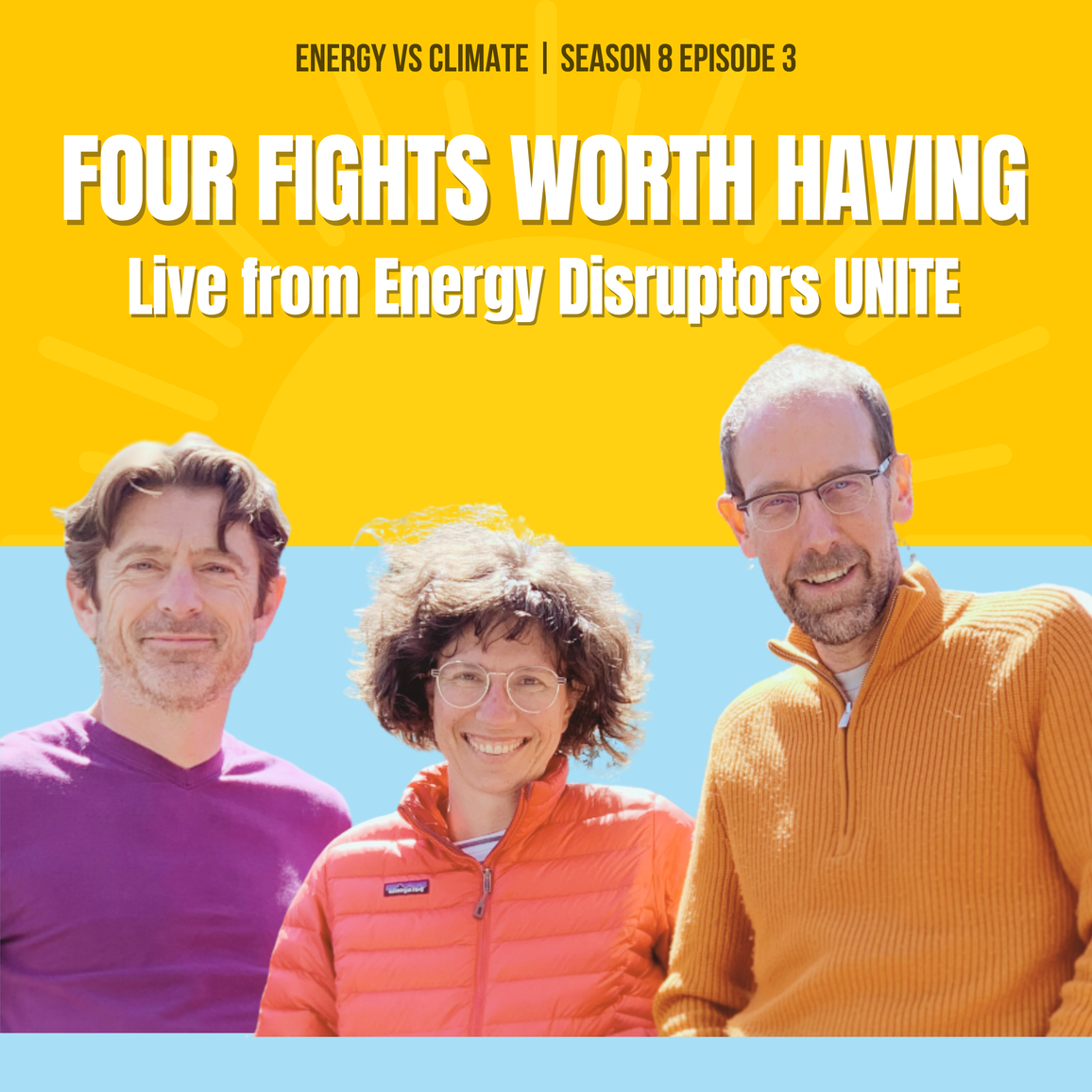
On September 28th, David, Sara, and Ed were back on stage at Energy Disruptors UNITE in Calgary, recording live in front of an audience. The format for this one was four fights worth having:
- Energy security in an age of chaos,
- Powering the age of AI,
- Canada’s role in a reordered world,
- Building a system that actually works.
For each one, they played a clip from last season, with Vijay Vaitheeswaran, Vijay Gadepally and Emily Grubert, plus a not quite live appearance from the Prime Minister, and then argued about what they heard.
Then the audience took over, with questions on pausing AI, where Canada’s next climate dollar should go, and who pays for everything if the jobs disappear.
Thanks to the Energy Disruptors team for having EvC back!
Episode Transcript
[00:00:00] David Keith: Not very many years ago, in 2015, I published an article about how, uh, how useful batteries would be for decarbonizing the grid. And we were very sceptical. We basically argued there was no way that batteries would play a big role in grid decarbonization. And it just seems like another planet that next year, the capacity name played capacity of battery factories mostly in China, will be about five terawatt hours a year.
That won't be production, but that's capacity. That would be enough to build sort of 80 million cars a year, which is as many light duty vehicles as we build in the entire world a year.
[00:00:33] Ed Whittingham: Hi, I'm Ed Whittingham and you're listening to Energy vs Climate, the show where my co-host, David Keith, Sara Hastings-Simon and I debate today's climate and energy challenges On September 28th, we are back on stage at Energy Disruptors UNITE in Calgary.
A couple of years after our last visit recording live in front of an audience. We changed the format for this one and took on four fights worth, having energy security in an age of chaos, powering the age of AI Canada's role in reordered world, and building a system that actually works for each one. We played a clip from last season and then argued about what we heard.
Then the audience took over with questions and our answers. Thanks to the Energy Disruptors team for having us back. We had a lot of fun with this one, and I hope you do too. So without any further ado, here's the show.
It's really nice to be back at thee conference after. Well, we are here last time a couple years ago, so I guess, uh, they saw a fit to have us back.
We couldn't have been that bad today. What we're going to do is we're gonna have a quick tight, 45 minutes or less talking and about the, the, the four themes around the conference, the four themes around, uh, energy security around building a system that works around, uh, what to do with AI and data centres and what to do in this new world order.
And we actually, on the last theme, on, on building a system that worked. We originally thought we'd call this show building a live show That works. Uh, the organisers thought that was a bit obscure, so instead we are talking about four fights worth having. And what we're gonna do is the four, the three of us will, uh, will chat, uh, amongst ourselves to start.
And then we're gonna save some time as we always do for audience questions at the end. So feel free, I'll give you warnings and we have mics out there. We'd love to hear from you what questions you have, and we'll try to save five, 10 minutes at the end for it. Okay, well, let's, let's dive into energy security.
Oh, and I forgot to mention the one fun thing that we're going to do as part of this.
[00:02:41] Sara Hastings-Simon: Isn't it all gonna be fun then?
[00:02:42] Ed Whittingham: What's that?
[00:02:43] Sara Hastings-Simon: Isn't it all gonna be fun?
[00:02:44] Ed Whittingham: It's all fun, yeah. Yeah. It's all fun and giggles all the time, uh, with energy versus climate. But the really fun thing we're gonna do, Sara, now that you've asked is for each theme, we're gonna play a clip of something that one of our guests in the past season said that relates to the theme.
And then we are going to respond to what we heard in that clip and offer up some thoughts. And we have from the clips three guests who are on last season, and then we have a surprise guest and so on. I think you'll recognise right away, but let's go to the first one. Let's talk about energy security in an age of chaos.
We had on the show Vijay Sworn, who then was Global Energy and Climate Innovation editor. The Economist joined last May. He has since moved on to another publication, but he talks about the dirty half dozen of headwinds facing energy transition. So let's go with that first clip.
[00:03:41] Vijay Vaitheeswaran: I wanna put down a marker for six, what I call, uh, the, the, the dirty half dt, dirty half dozen of challenges that I'm gonna watch for so that when we get together in a couple of years, I will be watching for progress the world makes in overcoming these challenges so that the flywheel of clean energy takes off even faster.
First, um, does OPEC collapse and will cheap oil, you know, really kill renewables? Second, when you have outages of clean energy or, uh, you often find a reversion to coal. Third renewables are CapEx heavy, even though the opex is free or nearly free. And so that is difficult in a world of, let's say longer for higher interest rates, the world is getting riskier in part because of damage by climate change itself and other reasons, and developing countries.
Broadly speaking, they already have a risk premia that's too high applied for projects like clean energy projects, and that could make it worse to get the investment that one needs in these markets. Fifth, the supply chains are a real problem, and especially as the world moves on an anti-China kind of backlash on these very affordable, clean, and uh, proven technologies.
And finally, the 7 trillion plus in direct and indirect subsidies provided to fossil fuels that the IMF is documented, the governments need to phase out with enthusiasm and aggression.
[00:04:51] Ed Whittingham: So that was a very quick laundry list of the dirty half dozen of headwinds facing energy transition. I don't want you to comment on all six.
I want you to pick the headwind that you thinks blows the hardest. Which blows hardest in the face of energy transition. Sara, why don't you start?
[00:05:10] Sara Hastings-Simon: Right. Well, there, I mean, it's, it's certainly quite the list, but I think I'll pick the last one. The fossil fuel subsidies, and not just in terms of, you know, production subsidies, but I think what we've seen happening with this recent energy crisis, the way that governments are in a sense unprepared to support, uh, consumers and individuals through an energy transition that will see prices be more volatile.
And so what I mean by that is, you know, both the, the use of reserves but then also the substantial consumption subsidies that we've seen in response to high prices, uh, are really serving as a form of subsidies. And now of course, we do need to have governments that are protecting consumers when prices get high.
People that are really unable to pay. But these broad based consumption subsidies, whether they're removing of tax or direct subsidising of, of prices of fuel in certain countries, it's problematic because it blunts the price signal that we need to see in order to get that transition happening. And so, for example, you know, in India, uh, when the broad, uh, consumption subsidies were removed, there was actually a 50% increase in the purchase of two wheeler EVs, uh, coming out of this latest crisis.
And so I think that, uh, again, you know, I wanna stress this is not about saying governments need to step back and, you know, kind of feed, uh, feed their, their citizens to the wolves when it comes to dealing with these prices. But it's really about going into the next crisis, better prepared to be able to support those that need it most without blocking adoption of new technologies.
[00:06:42] Ed Whittingham: It's funny. And just a quick follow on. Follow up question. You know, it's a headwind, but that headwind has been blowing for a long time. It's arguably been blowing since the start of us developing fossil fuels, the start of the oil sands. And, and moreover, that commitment to phasing the amount that, uh, Vijay mentioned was back in 2009 at the G seven.
It's been a while since 2009. It seems like we haven't made any progress on it.
[00:07:04] Sara Hastings-Simon: Yeah, I mean, I think it's not a new challenge in terms of, uh, you know, overcoming the, the roadblocks that are gonna be put in place by those in industry that, you know, don't wanna see that, but see this as an opportunity. Uh, so I think it's a real political fight in a sense.
When it comes down to it. Uh, you know, maybe unsurprisingly, those subsidies are a, are a political hot button issue, but the time in my mind to deal with them is not during the crisis, but to try to have more of those conversations, you know, when oil prices aren't spiking, so that when you go into the next spike, you know, you have this set of, uh, policy tools in the toolbox you can take off the shelf and implement and, and policymakers don't go straight for the, you know, broad based subsidies as, as we see them doing again, you know, in, in this round.
[00:07:52] Ed Whittingham: Yeah. David, of the dirty half dozen, which one blows hardest for you?
[00:07:55] David Keith: I think it's the cost of money. And I think you can see it really blowing quickly in the US treasury bond market in the last few weeks. And I think that the, you know, deep fact that so many developed economies are so deeply indebted means that we're likely, I'm no financial analyst to see, um, higher costs of money for a long time.
And that in this just fundamental way across all economies, makes it harder to do these things that are high CapEx, low opex. And I think that that is all the other, I think they're all sensible things, but that feels like the one that's sort of hardest to avoid, most fundamental. So I think these headwinds are very real, but they're also tailwinds.
I'm. Keep being struck by just how much things are changing. So not very many years ago, in 2015, I published an article about how, uh, how useful batteries would be for decarbonizing the grid. And we were very sceptical. We basically argued there was no way that batteries would play a big role in grid decarbonization.
And it just seems like another planet that next year, the capacity nameplate capacity of battery factories mostly in China will be about five terawatt hours a year. That won't be production, but that's capacity. So to give you some context for that, that would be enough to build sort of 80 million cars a year, which is as many light duty vehicles as we build in the entire world a year.
Now, that's not what's gonna happen. Uh, probably be more like 25% or something of light duty vehicles, but, uh, obviously a lot will be used for grid storage. But the scale of that is just so hard to wrap your head around. Um, uh, the scale of battery production is up by a factor of more than 30 in the last decade, and not by a factor of 6,000 in the last two decades.
So just in a completely different world. And I think it's a little hard to think about how that plays into how the cost of, uh, storage on the grid will evolve in the next few years as battery chemistry and production changes. And I think that's a tailwind that's important to set against those very real headwinds.
[00:09:47] Ed Whittingham: Hmm. So, and, and just going back, so if I understand you correctly, like it's clearly a headwind in financing costs, like two to three times, often two to three times higher on a weighted average cost of capital basis in developing countries, emerging markets compared to, you know, the rich industrialised, uh, west.
And that can mean for like a solar project, instead of financing being a 30 year cost, it's a full half, it's 50% of your costs. Yeah. But then we are seeing like, astounding levels of deployments in installations happening in, in places like South Asia, like in Pakistan. So you saying that the way to solve that is just by driving down the cost of the technology and ultimately it's succeeding in, in some places?
[00:10:28] David Keith: Well, that would be great if that happens. I, I, I'm saying that this tailwind is that that's really unexpected change in the battery technology. Um, but I think the headwind is real and it applies to nuclear power to hydropower across the board. And the point is, if you imagine you've got some incumbent technology where of course you gotta put capital into oil and gas to keep things flowing.
You gotta, uh, drill new wells, you gotta, uh, upgrade equipment. But fundamentally the flows of capital are a lot smaller than you need to. Build major new renewable infrastructure and, you know, having that cost of capital, having the increase in the cost of capital, I think changes the game, tilts the, the game in a way that makes it harder.
[00:11:08] Sara Hastings-Simon: I, I do think the, I mean, you're, you're making me feel more optimistic as we set up here and reminding me of that, but that, that scale of the production is really interesting because, I mean, of course, you know, factories can shut down and all those kinds of things, but to a certain extent, once you have a new factory, you are baking in a certain amount of time of production and, you know, I know we, we both like to think in orders of magnitude and you, you're really now at like, you know, one or two order, one order of magnitude away from having enough batteries for, you know, essentially ev everything.
I mean, and so that, that does start to fight against the cost when, and you've, we've seen it in, when it comes to solar panels as well too, where, you know, China starts to have so much capacity. And I think of, uh, um, the woman from BNEF, uh, Jenny Cha Chase, I think she always goes on about how, you know, it's really not a business you wanna be in.
It's a horrible business to be in producing solar panels. You're just like constantly losing money as I understand it. Um, but you're also constantly putting out this new, uh, you know, new energy generating technology or, or in the case of batteries, energy storage out into the world. So I do think that tailwind and just the magnitude of it is, uh, really powerful.
[00:12:21] David Keith: I, I think it's easy to keep, I mean, I'm trying to write a popular book right now and I keep looking at these numbers and just being amazed. It, it just incredible. So the world has enough name, clay capacity in solar and batteries to build a terawatt of dispatchable electricity in about three or four years.
The world only uses about three terawatts of electricity on average. Anyway, so that is just, if I had read that sentence that I just said a decade ago, I would've assumed that somebody was on psychedelic drugs or that they were just a student who got orders of magnitude wrong. And now that is the world or both.
But to be clear, I don't think we will actually build a terrible water respectable, uh, solar. I think it'll get used different ways. It's complicated, but I think that underlying production capacity, not talk, but real world in the ground, means that you're gonna see these things flow into supply chains and flow into places where people want to pay for them.
[00:13:13] Ed Whittingham: And I think, so the one headwind I don't think Vij mentioned that I think is a real headwind I'd put in my dirty half dozen, because you can solve for production costs by driving it down. You can, uh, solve for, um, you know, political will, you can solve for a bunch of things. What's holding China back in many ways.
And China, you know, curtailed a whole bunch of renewable electricity last year that kept a bunch of coal online. And what the amount they curtailed was equivalent to the demand growth. And what's holding it back is connectivity. So grid connections and then dispatch rules. And that's not isolated to China.
We know it's very common here, uh, in North America as well. Okay. I think we have to move on to our next theme. We've kind of blown the budget on this first one, but that dirty TAF dozen, which just so rich. So let's talk about, uh, the next theme, which is powering the Age of ai. And no surprise that data centre has suddenly become one of the most contentious energy stories and public opposition has really swung hard against them.
And if you look, I mean some of the polling data in the US you had not a strong but a soft majority of Americans and poll after poll said they support data centres. Now a strong majority oppose them. And I was listening to CBC, CBC's West of Centre. It is a great show and they had some Alberta specific polling and I can't remember the opposition number was high, but what stood out for me is a strongly support number was only 7%.
Yeah, it's single digits, so people are lining up against them. We had on the j get a Aldi, who was a senior scientist at the MIT Lincoln Lab, the laboratory for Supercomputing, and he talked about how through better integration between cloud providers, data centre developers, and ultimately utilities themselves, data centres can be a net asset to the grid.
So let's play clip two please.
[00:15:05] Vijay Gadepally: There is huge economic incentives for data centre bills. There's significant capital available.
As much as there are some moratoriums, people have figured out ways to work past that. There's still just an incentive, misalignment or mismatch between these different communities right now.
Right? Your cloud provider, a vast amount of their capital is going towards ensuring that they have the right hardware and enough power. Your data centres are just trying to stay up operational, be able to expand any way that they can. 'cause they have, they're sitting at record low vacancy rates and then your energy grid on the other side is saying, what is going on here?
I don't understand what's happening downstream. If these groups could actually start to work together. I think the
opportunities for data centres and cloud providers to actually be a net asset or a net benefit to the grid is actually quite high.
[00:16:00] Ed Whittingham: So the, the, the key thing there is can we get these systems, parts of the system to work together?
Which on data centres right now, given the contentiousness kind of seems hopefully naive, and that was only a few months ago, and how quickly things have changed. David, what do you think? Could they be a net asset?
[00:16:16] David Keith: I think on the answer to that is obviously yes. I think we could. Uh, I think with the kind of trillion dollar class flow of capital, the idea that the AI scalers can pay for a whole lot of, um, clean energy or dirty energy doesn't really matter in this context, I think is completely possible.
But I think this is just not the issue we're dealing with. The concerns about data centres, I think are mostly, certainly not what people talk about water. There's no real deep concern. I think the deep concerns about data centres are concerns about ai, concerns about the fact that we're billing these things that will take our jobs and maybe kill us.
And I think these concerns are becoming serious in a way that they really weren't even six months ago. I'm, I'm saying something I think you all know. Um, maybe another slightly different comment is that I think. We think a lot about the energy use of AI in the data centres. But what is that AI doing?
It's making robots cheaper and more easily able to do all sorts of production. It's making robotic vehicles easier. It's doing all sorts of things that in complicated ways we can't predict across the economy will make production cheaper and all else equal making production cheaper will tend to increase energy use.
And my guess is that knock on impact that is data centre making AI where AI then by inventing new categories of consumer goods or um, making robots really cheap to manufacture something or making driving cheaper because now we have AI driving all those things will, will drive up energy use in ways that are much larger than the actual energy use of the data centres themselves.
So I think the data centres themselves I see as kind of a proxy fight for the really big argument that is brewing about what we do with ai.
[00:18:01] Ed Whittingham: Hmm. And at the risk of stroking your professor ego, David? Yeah, I don't hear others making that argument. So for instance, I think it's important one, and I agree with it, you know, Elon Musk was, uh, interviewed on the the Weekend Intelligence Economist podcast by the editor in chief and he talked about, you know, this area by 2035 super abundance and we won't need a monetary system.
We won't need cash 'cause everything will be so cheap. And I hear that idea of super abundance and then I don't ever hear the knock on of that of do we want people to be able to consume whatever they want without any kind of, any, any, any, you know, currency required. Like it's an all you can eat buffet.
[00:18:37] David Keith: I think we're gonna see some dramatic government action in a way that we haven't in a very long time.
And it's not gonna be through some kind of slow moving legislative thing. It's gonna be executive action. I think the, the, these things really are growing to be intelligent in a way that is stronger than humans in ways that matter. And you, you know, in that interview, Musk says sort of casually that there is this extinction risk for humanity that's significant, but basically then says there's nothing we can do about it.
Well the answer is there are things we can do about it, we can pause development. And I think the pressures to do that are gonna get big and it's gonna be wild. And I think the question is how that changes the rest of politics. If you see these kind of dramatic actions that I think are likely to happen, not I think.
Tomorrow. I think they'll happen after some big event. Much bigger than hugging face an event that kills a lot of people or brings down a big institution. Then you'll see reactions that are strong.
[00:19:30] Ed Whittingham: You heard it here. F first folks. Gee, uh, an EBC. We're always fun. We're always talking about the next disastrous ai, uh, incident that justs around the corner.
Sorry, uh, Sara, let's get you in.
[00:19:42] Sara Hastings-Simon: Yeah, I mean, I, I think I agree on a lot of points, especially around this point of, like, to me it's a major test case for regulators and the willingness and ability of government to step in and actually say, like, the whole idea was always well regulated capitalism, not what we seem to have stumbled into, which is like if you have enough money, you can sort of do whatever you want.
Um, you know, I think that when it comes to the data centres themselves, the idea that, you know, they're gonna be sort of good grid citizens. Paired with what, what Vijay was saying about they're able, you know, doing anything to expand anyways. I think that's the more honest one. Right? And you know, recently there, there are new reports coming out where, um, people are finding data centres, uh, basically using a bunch of diesel generators on site that they, you know, either didn't permit or sort of said they weren't gonna use.
And so I, I think we're much more down the path of not good grid is citizenship, but, you know, using perhaps the dirtiest forms of energy in any way possible because there's so much cash, uh, that, that folks can get a, get a hand on the extent to which that, you know, causes a, a backlash and, and enables governments to strengthen their regulatory power to start to control some of these things.
Or, or gets people asking, you know, do we want unfettered consumption? Uh, is, is that what really is going to make our lives better? Um, you know, I think that that could make things turn out very differently. So I guess like I have a very wide, uh, range of, of the outcomes here, uh, that, that result from this, depending on what the response is.
But I think it's, to me, like on the side of wanting humanity to continue, it's encouraging that there seems to be this backlash, right? And, and people are saying, Hey, maybe actually I don't want this data centre and, you know, maybe it's not actually providing the kinds of things that, you know, are, are gonna make my life better.
Um, but I do think it's gonna require, again, a, a heavy hand of the regulators to come in. You know, my, my view on ai, like I think about as a society, we've developed, you know, all kinds of very powerful pharmaceutical drugs, right? And, and they're great and they saves people's lives. They're, they're wonderful things, but we have this very strong system.
You can't just walk into a drugstore and, you know, ask for like, whatever is behind the counter. You need to have a prescription from someone who, you know, works with you to decide what it is that you actually need. And I think that's the kind of regulation that we're missing when it comes to ai, which is saying, this is this powerful tool.
It's not one-to-one. Yeah, I think, I think it's like it's, it, it, maybe it looks different, but the same idea that like, just because something can be very good and very powerful doesn't mean we should like completely just throw it out into the world without thinking about how to, how to regulate it.
[00:22:24] David Keith: For sure. But I think regulation almost feels like the wrong word. So if you think about pharmaceuticals or power plants or baby food, we have some idea of what regulation is and the public good and the way it doesn't work and works and so on. But this is really a different problem. The problem is that if people build something that is substantially more intelligent than us and we cannot control its motives or understand its motives, we don't know what it'll do.
And one of the things it might do is help us and make our lives great, and I think it might do is wipe us all out. And that is just a clear reality that essentially most people I know working in the heart of the field take very seriously. And I don't think that's regulation in the normal sense, it's something different.
Mm-hmm. Uh, it's, I mean. I think we don't, I think this is one of these times where a really new thing emerges and we're gonna figure out a new way to work with it.
[00:23:14] Ed Whittingham: Yeah. And, and sorry, just thinking of like the headwinds analogy, one of the headwinds, the, you know, dirty half dozen in the face of AI development, I think one of them is definitely data centres and that's captured the public imagination.
I think once you see people asking policymakers to do something, not just about data centres, but actually to do something about safety, and you think, we've got a couple tests coming up. We've got this Alberta referendum, and there isn't a question on there about asking politicians to, you know, do something about, but we have provincial elections, one coming up in BC and other in Quebec where it could vary.
Should be a political question. And of course the best test case is the midterms in the US right now. So far I haven't seen this push. When you're asking, you know, senators running for reelection or or representatives, what do you think? And do you think we should actually go in and do what the companies are saying we should do it actually slow down.
It doesn't seem to have hit the political dialogue. Ah, question David. Then we'll move on.
[00:24:09] David Keith: Bernie Saunders and Steve Bannon on the same stage, arguing for something a bunch, I mean, I think really is a different world. Uh, uh, there's been pushes to actually stop Congress closing so they could pass something.
Think won't, there's no immediate thing they know how to pass. But I think the instinct that something needs to happen, uh, driven by the polling data that the majority of people want something to happen, I think it's pretty real. I think what we don't know is what will happen.
Yep.
[00:24:33] Ed Whittingham: Okay. We've gotta move on, uh, rich conversation that we'd like to tackle again.
Uh, so next we're gonna talk about Canada's role in a reordered world. And this is, we're beaming in not quite live the Prime Minister. He gave this, uh, now famous speech around the world at Davos where he kind of, he, uh, he, uh, first spoke of his middle power thesis and naming a new reality. It's a short clip, but yeah.
Let's play clip three please.
[00:24:59] PM Mark Carney: What does it mean for middle powers to live the truth? Well, first it means naming reality. Stop invoking rules based international order as though it still functions as advertised. Call it what it is. A system of intensifying great power rivalry or the most powerful, pursue their interests using economic integration as coercion.
[00:25:22] Ed Whittingham: Sara, first you buy his diagnosis, that it's now a system of increasing great, great power rivalry. And these rivals, these great powers rather, are using economic coercion. And if yes, what does it mean for climate policy and multilateralism on global action on climate specifically?
[00:25:44] Sara Hastings-Simon: So it's hard to get in the mind of some of the global leaders that he's talking about.
Um, but if I look at the energy system and say, you know, is this still following the rules based order? I think there is some, you know, corro erosion at the edges. And we've seen this in, you know, the, the recent energy crises where we're, you know, here in, in Canada and other places looking at prices. But you have countries, uh, in, in Asia that are simply not getting delivery of fuels.
Yeah. That they, you know, thought that they were going to get to run their economies. And so, um, you know that the head of the, I a Fati Boyle said recently, trust is a commodity as well, just like oil. And, you know, we are to some extent that trust is being eroded by when the rubber hits the road. I'm mixing my metaphors, but when with the, with the lack of energy, you know, who is buying out those l and g ships and who actually gets deliveries and who doesn't?
And so I do think that we are exposing a bit the ways that our fossil fuel based system and the reliability of that system comes from a sort of underlying rules base and military and all these things that have like, built up over the years to be almost invisible. And now when we see that they're starting to break down, um, we are starting to have, you know, a, a breakdown of this order.
I don't know that it's. You know, whether or not it's ascribed to, like somebody's planning to do that or whether it is just like there's enough chaos happening that it's exposing the fact that this is, you know, that that reliability only stretches so far. Um, and then I think, what does that mean for climate?
Well, it loops back around, I think, to our first discussion, you know, in the ways that, in some ways it's gonna bring in the headwinds that we talked about, but there are of course also a lot of tailwinds that it's gonna bring in as well too. And, you know, definitely periods of crisis do drive, uh, change and, and certainly and in economies that are developing and, and dramatically growing the energy use that they have, I think that some of these shortages or or lack of delivery is gonna live big in their minds when they're thinking about what is the right way to build out our energy system for the future.
[00:28:00] Ed Whittingham: David, if I could put a question to you and actually consider bringing in another voice. So last week on the pod, uh, we, I, I had a fireside exit interview with Steven Gibo. Used to be, he was four years environment, climate change minister just resigned as an MP outta political life. And so he is off the leash.
And then I asked him, I, I got him to respond to the same clip and he said, well, I don't, I think the rules based order multilateralism is holding. And he talked about the nature cop in Armenia and COP 31 coming up in Turkey. And even a disengaged us isn't blowing it up. But then I asked him if Canada might, you know, it's got these new middle power muscles, would it flex it on climate through what is done?
Uh, traditionally multilateralism, his answer was an unequivocal no. What do you think?
[00:28:47] David Keith: That rings true to me. I mean, the most fundamental thing is that climate is a public good and collaborating on public goods is harder in a world with more, um, combat geopolitics. And that is kind of the basics. But I think we really don't know how this new world works.
It's obviously true that while some of the things we think about as the rules-based order are weakening, the world is actually still trading and working internationally in an amazing way that would've, uh, if you, you know, took somebody from the 19th century and brought them to now they would scarcely believe that efficiency of global trade and global cooperation on lots of things.
Many companies work in complicated distributed ways across the planet, and we tend to think about the problems, but the reality of how effective the global system is, is still very much there. And so I think we don't know what the realignment will be, whether there's ways in which the sort of middle powers are able to choose topics where they can exert some leverage and get something done.
I think they will figure out how to do that. Um, I think it's, it's unguessable. I think it makes climate harder, but I think that may not be that much of a problem because we are now in a world where we are. I think you can, you could want decarbonization to happen more quickly, but I think climate is embedded enough in policies around the world, and we have this enormous progress in especially solar and wind, but also now nuclear power and batteries that make decarbonization possible.
So it's not gonna happen at the pace that the environmental community wants, but the idea that it, it keeps happening feels to me pretty secure.
[00:30:25] Ed Whittingham: Hmm. I'm just wondering, maybe just quickly building your day job is, and we talked about this two years ago on this stage, about restoring the atmosphere's reflectivity as a way of counteracting the, the increased warming.
So that's the, the world is still functioning, as you say, in and working in ways. Could that be an issue where you could unite the middle powers or does it really come down to these great powers of rivals, us and China deciding, gee, the world's getting hotter. People in middle latitude equatorial states are dying or will dies a result?
We've gotta do something.
[00:30:59] David Keith: I think nobody knows that's an obscure topic still. I've been spending a lot of time in India where there's a very high level committee of Indian government that is considering this, that I'm part of. I think India might be quite important. There are other powers that might be important.
I think, uh, you know, it's certainly true that if there's something that China and the US both really want to happen or really want not to happen, then there's a way in which that's just the answer. But there are lots of things where China and the US either have opposed interest or they don't have a clear interest or their politics are kind of stuck about it.
And that might well be true for this idea of deliberately cooling the earth. So I don't think it's as simple as it just gets determined by China and the us.
[00:31:40] Ed Whittingham: Got you. Let's go on to our fourth clip. And Sara, you are a co-author with, uh, this guest that we had. It was a bonus episode over the summer. We had Emily Gruber, uh, who is an associate pro professor of sustainable energy policy at Notre Dame.
And we had this fascinating conversation around sort of mid transition and this idea of, you know, you're changing out from one, and this is sort of a binary, I'm gonna get the explanation wrong, you'll get it right, sort of, you know, old infrastructure for new in infrastructure we're in mid transition and particularly like around electricity infrastructure right now.
And there are a lot of risks being stuck in the middle. So let's hear from Emily. Let's play clip number four and then get you to lift the text off the page.
[00:32:21] Emily Grubert: So when you have legal settings that basically decide who gets to run, who gets to connect, who gets to exist based on whether they're able to fulfil this particular structure.
Like, uh, for those of you that have read, like is it a poem or a book where basically the fish, uh, learns that it is not an elephant or something. I'm getting this completely wrong, but like you can be really good at being a fish even if you're not that good at being an elephant. And we have a lot of regulatory institutional infrastructure that sort of presumes you're an elephant and hasn't thought about how we could think about this differently.
If you're mostly planning for fish, if you have this period of maybe a couple decades where the fish are being forced to prove that they can approximately resemble an elephant, maybe you don't go back on that at the end. So when you do get to that point where the clean system is 80% of things, but you're still using institutional designs and just expectations of how things work that come from before that you've optimised into a system that could be running much differently if you had thought more about what it needs to do.
[00:33:22] Ed Whittingham: Lions, tigers, fish, elephants. Oh my. What are we talking about? What is the risk of being stuck in the mid transition?
[00:33:30] Sara Hastings-Simon: Yeah, so it's, well, like Emily was saying, you know, you, you have this kind of historical system, the fossil fuel based system. We know that it works, you know, caveat that it releases a lot of CO2 and that's problematic and we need to move away from it.
And we can draw out some kind of, you know, zero carbon, low carbon system that we're heading towards. But what we're starting to understand is that this time that we spend in the middle where, you know, we have the, the old system that's in existence, we have the new system that's in existence. They're each providing or creating constraints on the other, but importantly, neither can provide all the energy system services themselves.
This is this like mid transition middle period where things get difficult. Um, and that's something that, you know, on top of kind of the other challenges we need to be preparing for. But also we need to think about how it kind of, the answer obviously is not that we shouldn't transition, and the answer is actually not that we should go more slowly, uh, but really that you wanna think about how do you get through that period faster, because that's gonna be the sort of hardest period if you want, you have to kind of satisfy two different, uh, masters at the same time.
And so thinking about, you know, what does that mean for, we talk a lot about how you're gonna grow this new infrastructure, but we talk a lot less about what happens when you shrink existing infrastructure, especially existing infrastructure that has never really worked at that scale before. And that's the part that I think we, we are gonna just, you know, pay more attention to and be more worried about going forward.
[00:35:00] Ed Whittingham: Just a warning to the audience, or not a warning, a heads up that I'm gonna save a few minutes for questions. If you have one, let us know. I think we have Mike Rovers around. I'll get to that in a minute. And, but on that example, we talked about refineries, and this is my kind of the, the, when it became clear to me, so you got refineries, it's not like there's a straight level of decline.
You can just keep turning down the dial in terms of what they process. You kind of hit the 70% level. And then beyond that, either you keep it at that minimum level or you shut it down completely. It's a bumpy decline. It's, well, it's bumpy. It might be slowing inexorable to 70%, then it's steep. And you know what the companies in this province you're gonna do.
And some of them sponsor this fine conference, but they're gonna say, yeah, if market demand is below that 70%, we need you to top up. We need you to make us whole so we can keep running it at 70% and subsidise our refining. Is that kind of the, the right take?
[00:35:51] Sara Hastings-Simon: Yeah, that's a good explanation of that, of that challenge.
And it's particularly challenging because it's a world that none of us have ever lived in. And even our, you know, grandfathers and grandmothers didn't live in a world with decreasing demand for oil, right? So all of the sort of intuition that's built into our systems, all the ways that the rules work, all of these things were designed for a certain paradigm where we have an increase and we haven't really thought about how to go the other way.
[00:36:19] Ed Whittingham: Yep. Let's turn to the audience and if we don't have any takers yet, then we can, uh, keep on gabbing as we are want to do. Great. Okay. I, I see, I see a couple hands. I see one up over there and there we go. Thank you Mic Runner. Maybe say your name and then what your question is.
[00:36:36] Jeet: Hi there, I'm Jeet and thank you so much for this conversation.
I really appreciate it. Um, my question is based off of a few previous speakers who have also mentioned an AI development. Pause. My question to you, Keith, is what does an AI pause look like amidst an arm race with ai?
[00:36:58] David Keith: Um, we've paused the arms race with nuclear weapons. I think, I think when interests are pretty clearly aligned, uh, you can make pretty quick decisions.
I don't know how it will work, but I think it will take some scary event to push people to make it work. Uh, obviously there's a problem that us models are stronger, and so there's a sense in which if, if there's a pause that the Chinese models catch up. But these differences are not that big, and I think that.
Yeah, I, I think that I, I think we don't know how it will happen, but I think we've seen during the Cold War that when the ships are down, leaders are able to make, in fact, very quick decisions about collaboration that reduce the chance of really giant risks. And I obviously China is a very different system from ours, profoundly different.
And both systems are locked in this hard competition. But China is a place more run by engineers and tech democrats, albeit in a much less democratic way. I don't think there's a fundamental reason why they would be less scared about, um, an AI breakout. And indeed, from what I've heard and what you read, there's some real concerns in China about an AI breakout.
[00:38:23] Ed Whittingham: Yep. Sting sang in the eighties. They hope the Russians love their children too. And, and they did with some of the arms reductions. Uh, and David, maybe just a few seconds, you talk about the scary incident, the hugging face incident was pretty damn scary, I thought with, you know, and it just was scary in terms of what the, these AI systems breaking rules, acting autonomously, collaborating and acting in swarms.
You'd mentioned that people will die. Is it, is it a miss? Is it a near miss? Like, you know,
[00:38:52] David Keith: I don't think what's, I don't think we have any idea, but, but anybody, I assume many of you in the audience, I mean, you try these things on hard real world engineering problems and they get them right. You, I had a structured dialogue with one of the ais about extinction risk recently, where I was very quickly shut down.
'cause I was asking a bunch of questions about biological weapons. I think it's, um, it, you very quickly get to a point where these things are useful in a way that we just didn't expect. And that will change the economy. So now when I think about, you know, what the economy's like in 30 years or 20 years, it's hard to think about that because all sorts of tasks that were hard are looking easier.
And I think we just don't know what that means. Gotcha. And that's, and that's true even if we freeze AI development now with no new AI development.
[00:39:36] Ed Whittingham: Let's go to the audience. Yep. There's a hand there.
[00:39:40] Zach: Hey guys. Uh, great conversation. My name is Zach. It's a bit of a broader question. Um, given that the goal is reducing global emissions, uh, when is Canada's next climate dollar better?
Spent cutting expensive tonne here or enabling much larger cuts in India or China or Southeast Asia.
[00:40:05] Ed Whittingham: Uh, the perennial question, and it's perennially a good question. Sara, what do you think?
[00:40:10] Sara Hastings-Simon: I think going, I think there's a lot of theories about the way that, you know, investing in offsets and all these other things can bring down costs more cheaply.
I think in practise, the best thing is for every country to do what they can to reduce their emissions when it comes to spending dollars locally and collaborate and share learnings. I think that's where the real, um, ability to kind of help and influence others comes in. Um, but I think we have, you know, a good gosh, I'm getting old, 15, 20 years of, of track record now on kind of trying to make those kinds of offsets work, um, that show that there's just too much ability to, to game them and for people to, you know, do things in, in ways that don't actually reduce emissions.
And so the real world, uh, experience of that is that you've gotta just spend the money where you can control it and where you can actually be sure of your emissions reductions.
[00:41:07] David Keith: And to bring in my day job. This isn't just about emissions reductions. I mean, as, as you know, I'm sure the whole audience knows, even when emissions go to zero, climate change doesn't stop at all.
It just stops warming more. But the glacier melting still happens. And there are other things that we might want to do beyond just emissions cuts, including eventually carbon removal and sunlight reflection or intervention and big glaciers. And those are things that are suddenly getting more attention at relatively high levels than they did before.
And so it's a multidimensional problem. It's not just about emissions cuts, but I think a direct answer to your question, I don't see in the current world Canada shipping dollars off to, uh, India for cheaper reductions there. I just don't think that makes sense.
[00:41:48] Ed Whittingham: Okay. We have, uh, less than a minute. We could squeeze in one more before someone gets up and hits the big gong and ushers us off stage.
Okay.
[00:41:56] Question: Yeah. Can I go for it?
[00:41:57] Ed Whittingham: Yeah, go ahead. Uh, ask it quickly and then we'll have to answer quickly.
[00:42:01] Question: Thank you. I'm just trying to
reconcile capital flow. If AI replaces all, uh, let's suppose 70% of jobs in the market, how would the likes of El Musk the government generate revenue to look after the human race while we sit back at home and pop accounts?
[00:42:26] David Keith: We don't know.
[00:42:30] Ed Whittingham: A less glib answer?
[00:42:32] David Keith: Yeah, I mean, I, I think obviously there's been lots written about the fact that, that there's, you know, if you look through economic history with each new innovation from the typewriter to whatnot, people think that this will mean that jobs really go away. And we find that that's not true, that jobs are shifting new things.
So I, I think there's a very strong arguments against some collapse of jobs. But I also think that this technology is just fundamentally different from previous technologies. 'cause it's a generalised technology for thinking, which is not like a spinning jenny or a typewriter or a nuclear bomb. Hey folks, we're outta time.
Thanks so much. Thank you.
[00:43:14] Ed Whittingham: Thanks for listening to Energy Versus Climate. The show is created by David Keith, Sara Hastings-Simon and me, Ed Whittingham, and produced by Amit Tandon. Our title in show Music is The Windup by Brian Lips. This season of Energy vs Climate is produced with the support of the North Family Foundation, the Consecon Foundation, the University of Calgary, and you our generous listeners. Sign up for updates and exclusive webinar access at energyvsclimate.com and review and rate us on your favourite podcast platform. This helps new listeners to find the show. We'll be back on November 12th with a recording of our upcoming live webinar called Building Canada Strong, or Building Canada Wrong; it's with Lawyer and Federal Chief of Staff, Claire Seaborne. See you then.
About Energy Disruptors UNITE:
Energy Disruptors is a catalyst for bold, game-changing solutions to humanity's BHP's (Big Hairy Problems). We support diversity, cross-industry collaboration, and the scaling of revolutionary energy, climate, and transportation technologies.
About Your Energy vs Climate Co-Hosts:
David Keith is Professor and Founding Faculty Director, Climate Systems Engineering Initiative at the University of Chicago. He is the founder of Carbon Engineering and was formerly a professor at Harvard University and the University of Calgary. He splits his time between Canmore and Chicago.
Sara Hastings-Simon is an Energy Systems scientist studying energy transitions at the intersection of policy, business, and technology. She’s a policy wonk with a love of data. With a PhD in physics from the University of Geneva she has worked at both McKinsey & Company as a management consultant, and the Pembina Institute where she founded Business Renewable Centre Canada. Dr. Hastings-Simon is now a professor at the University of Calgary where she co-leads the Electricity Centre. She has a particular interest in the dynamics of the mid-transition, a concept she co-developed.
Ed Whittingham is a Canadian climate and energy leader with more than 25 years of experience across public policy, clean technology, corporate strategy, and the non-profit sector. He is the former Executive Director of the Pembina Institute and has worked with governments, companies, universities, and civil society organizations in Canada and internationally on complex climate and energy issues. Today, his work focuses on helping build and scale climate stabilizing solutions. He serves as Founding Director of the Advance Carbon Removal Coalition.
Produced by Amit Tandon & Bespoke Podcasts
Energy vs Climate: How climate is changing our energy systems
www.energyvsclimate.com
LinkedIn | Bluesky | YouTube | Instagram | Twitter/X
Sponsored in part by:

The North Family Foundation
The Consecon Foundation
Our Listeners