Here Comes the Sun: Will Solar and Batteries Save the Day? | Special Episode With Bill McKibben

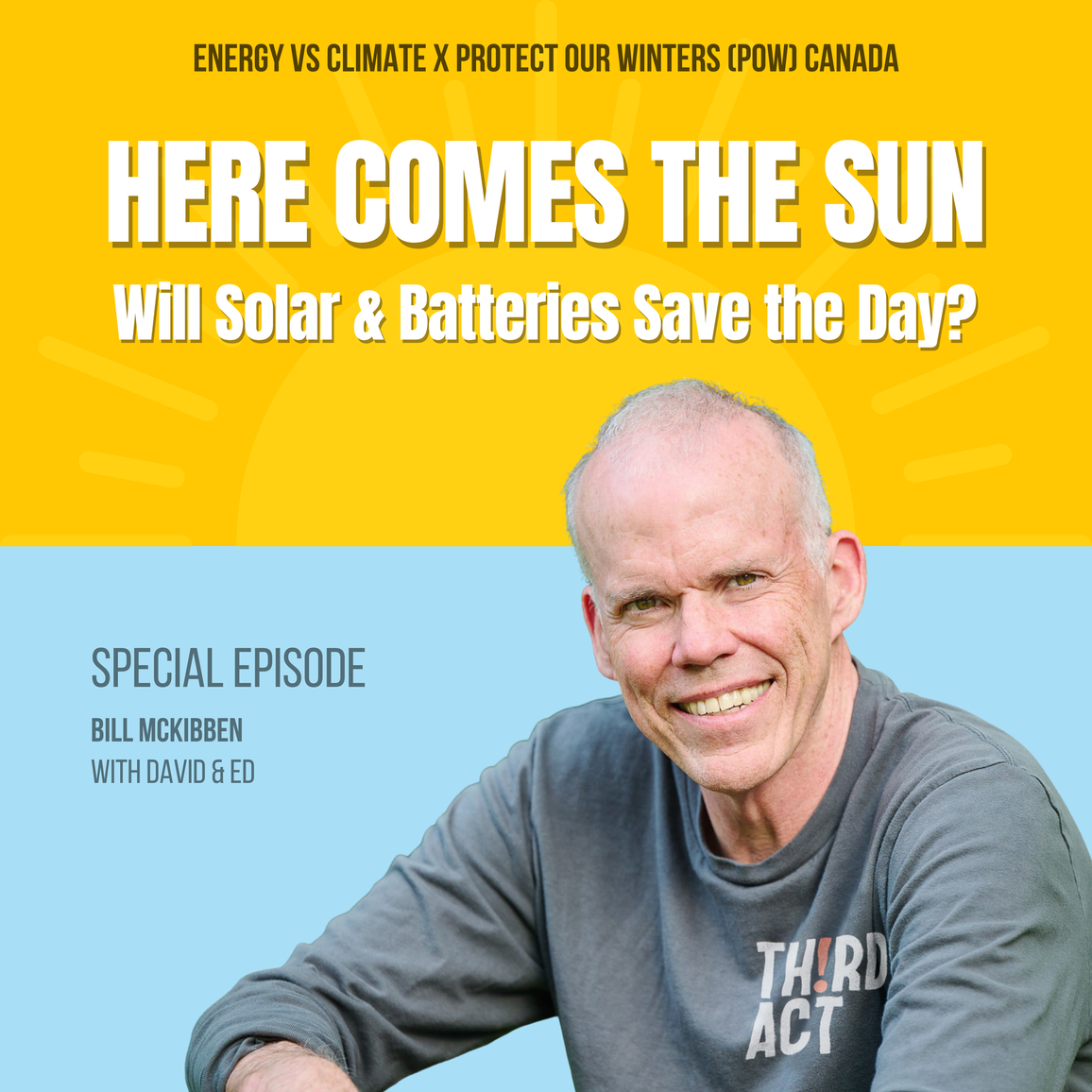
Bill McKibben has been sounding the climate alarm since before most were paying attention, but lately he's finally feeling some optimism about solar power in particular.
On September 17, renowned author, journalist, and environmentalist Bill McKibben joined us remotely at Protect Our Winters (POW) Canada's 2026 Leadership Summit. He was there to talk about his latest book, Here Comes the Sun: A Last Chance for the Climate and a Fresh Chance for Civilization.
Bill is the founder of 350.org and more recently Third Act, which organizes people over 60 for climate action. His 1989 book The End of Nature was pretty much the first written for a general audience on climate change, and his new book argues solar has already won the economic argument.
Note, this episode runs differently than our usual format. Bill opens solo for about twenty minutes, then David and I join him for another twenty minutes of conversation. Sara sat this one out.
Episode Transcript
[00:00:00] Bill McKibben: One effect of Donald Trump's invasion of Iran has been to remind leaders around the world that though sunlight travels 93 million miles to reach the Earth, none of those miles go through the Strait of Hormuz
[00:00:16] Ed Whittingham: Hi, I'm Ed Whittingham, and you're listening to Energy vs Climate, the show where my co-hosts David Keith, Sara Hastings-Simon, and I debate today's climate and energy challenges.
On September 17th, renowned author, journalist, and environmentalist Bill McKibben joined us remotely at Protect Our Winters Canada's 2026 Leadership Summit. He was there to talk about his latest book, Here Comes the Sun: A Last Chance for the Climate and a Fresh Chance for Civilization. Bill is the founder of 350.org and more recently Third Act, which organizes people over 60 for climate action.
His 1989 book, The End of Nature, was pretty much the first written for a general audience on climate change, and his new book argues solar has already won the economic argument. Bill teaches at Middlebury College, writes regularly for The New Yorker, and like POW's audience, is passionate about skiing. In his case, Nordic skiing.
A heads-up before we start. This one runs differently than our usual format. Bill opens solo for about 20 minutes, and David and I join him for another 20 minutes of conversation. Sara sat this one out. So without any further ado, here's the show.
[00:01:27] Bill McKibben: Look, I'm going to be, as advertised, a positive human being, but not for a few minutes.
Uh, we're just gonna talk for a brief minute about where we actually stand right now and what, in many ways, a difficult place it is. Uh, I did, as advertised, write what's generally called the first book for a general audience on climate change back in the 1980s, and all the things we said would happen back then are now happening.
It could've been written about, say, the summer of 2026. It appears that this year will probably end up being the hottest year we've ever recorded on this planet. But if it is, it's a record that will last a, a very short amount of time because 2027 is definitely going to be the hottest year in human history.
The El Niño now aborning in the Pacific is o- of historic scale, and it will drive temperatures, uh, far higher than our species has experienced in the past. It's a preview of weather on Earth circa 2045 or 2040, um, and it's going to be, I'm afraid, a devastating preview. I think we can expect more of the heat waves, uh, floods, and fires that have come to mark our experience with climate change, um, and I'm afraid it will be filled with dismal scenes, not unlike the ones we had to watch two weeks ago on the border of Nepal and Tibet.
I've actually stood at that border crossing that was wiped out in that video and n-know a lot of people in that neighborhood, and that one hit hard. It was an entirely predictable disaster because if you raise the temperature, uh, five degrees Fahrenheit, which is what we've done in the Himalayas, it's only a matter of time before a lot of ice melts and things crash down below.
In fact, the scariest thing about that, the, the good satellite video we now have of the glacier that, uh, started to collapse, is that 99% of it is still intact and hanging above that valley. Uh, and there are 50,000 glaciers in the Himalayas and the Hindu Kush. This is going to be a recurring feature, I fear, of life at, uh, high elevation and high latitude in the years to come.
The more devastating part of this is not the fires and floods, is that we're now starting to do Systemic damage to the most important features of the planet's climate system. Uh, the jet stream draws its power from the temperature differential between the poles and the equator. Uh, as we warm the north, that jet stream gets increasingly stuck in funky, uh, high amplitude positions that, among other things, help create these massive heat domes, like the one that in twenty twenty-one created such havoc, uh, across BC and the Pacific Northwest.
And where I live on the East Coast, we're now paying far more attention than we were even a year ago to what's happening in the Atlantic, where, among other things, fresh water pouring off a melting Arctic ice cap and Greenland ice shelf is changing the salinity and hence the density of seawater in the North Atlantic and putting at risk the giant heat distribution engine that are the big currents of the Atlantic, like the Gulf Stream.
Um, we used to think that that was a problem for the twenty-second century, but we no longer think so. The, the chief scientific authorities, uh, mostly European, have been saying in the last, um, uh, few months that there's a remarkable chance of f-real failure on these systems in the decades ahead. I-if that happens, that alone will be the largest single civilizational event, I think, that our species has yet seen.
So the peril is very real and the time is extremely short. Our window to do much about, uh, things is closing, um, and, and closing more rapidly than we would have hoped or that we would have thought even a little while ago. So that's the bad news. Um, and I w-- I won't provide more. I'm gonna switch to good news, which is that for the first time in the forty years of this climate fight, we actually finally have one scalable weapon with which to not stop global warming, it is too late for that, um, but to keep it from, uh, getting worse than it has to be.
And it's worth remembering at this point that each tenth of a degree Celsius rise in the global average temperature moves a hundred million or more people out of a relatively safe climate zone into a relatively dangerous one And that weapon is the sudden availability of cheap, clean energy. Uh, this is the stuff that we've spent our whole lives calling alternative energy, energy from the sun and the wind, which is best understood as just another form of solar energy.
The sun heats the earth differentially, producing the breezes that turn those majestic turbines. Uh, those two things, sun and wind, and the batteries to store that power when the sun goes down or the wind drops, have, in the course of this decade, become cheaper than the alternative, which is burning fossil fuel.
We live on a planet where the cheapest way to make power is to point a sheet of glass at the sun. That development, again, only about five years old, is an epochal moment in human history because setting stuff on fire is how human beings have earned their keep for a very long time. Darwin said that fire and language were the two things that marked our species out.
The archeologists tell us we've been burning stuff for at least seven hundred thousand years. When we learned to control the combustion of coal and gas and oil, we called that the Industrial Revolution, and it produced modernity. But the cost now is too high. The cost, first of all, to the climate system, which I've been describing, that's the existential risk.
But there are also the fact that about nine million people a year, one death in five on this planet, is attributable to breathing the combustion byproducts of fossil fuel. There's five million schoolchildren in New Delhi, two and a half million of them have irreversible lung damage from breathing the air And there's the third cost, which has come more sharply into focus this year.
As long as we depend on, uh, fuel that's only available in a few places, the people who control those few places will end up with way more power and wealth than they should have. Vladimir Putin using his winnings in the hydrocarbon casino to launch a land war in Europe in the 21st century. Uh, the King of Saudi Arabia, uh, Donald Trump, who so far this year has attacked the countries Venezuela with the second-largest oil reserves in the world and Iran with the third-largest oil reserves in the world, all in the name of energy dominance.
My knowledge of Canadian politics is eh, but I, I think it's pretty clear that, uh, uh, uh, that Alberta is throwing, uh, wrenches into the works too, uh, based on its ability to control the flow of fossil fuel. So it would be a different, and to my mind, much better world if we were able to produce a lot of power, uh, everywhere with our own resources, and I think I'm not the only one that realizes that.
One effect of Donald Trump's invasion of Iran has been to remind leaders around the world that though sunlight travels ninety-three million miles to reach the Earth, none of those miles go through the Strait of Hormuz On, and in the months since that invasion in March, we've seen incredible increases in uptake of solar technology and of EV and e-bike technology and of heat pump technology around the world, but particularly in Asia, where the impact of the closure of the Strait of Hormuz has been most profound.
Just to give you some sense of scale, the pace at which this stuff is now moving is been pretty remarkable. It's been centered in China, which has put up about half the world's clean energy. Um, uh, this time last year, the Chinese were putting up three gigawatts of solar panels a day. A gigawatt's the rough equivalent of a large coal-fired power plant.
They were building one, uh, and one of those out of solar panels every eight hours. Uh, in California, which has taken this seriously, uh, now there are enough solar panels and wind turbines that most days the world's fourth-largest economy can produce the majority or 100% of its electricity from renewable power for long stretches of the day.
At night, when the sun goes down, the biggest source of supply to the California grid is usually batteries that spent the afternoon soaking up excess sunshine, batteries that didn't exist three years ago. The net result is that California has cut Uh, its use of natural gas to generate electricity by about half in three years, which is a very big number, the kind of number that applied globally begins to make some difference.
The beautiful stories are coming out of the developing world, where people are quickly learning to use all this. Pakistan, uh, probably the biggest victim of climate change on Earth, with summertime temperatures that often reach a hundred and twenty-five degrees and with, in twenty-ten and twenty-twenty three, the two worst floods since Noah, has one geographical advantage: a border with China.
Across it have come enormous numbers of cheap Chinese solar panels, uh, which people have gone on YouTube and TikTok to learn how to put together. They've built something like the equivalent of half the national electric grid in eighteen months. Go on Google Earth and look at the rooflines of, uh, Karachi or Lahore or Islamabad, and you'll see what's going on.
That's now happening in Africa, which is the fastest-growing solar market in the world. And there, in many cases, it's providing power to people who've never had any and were never gonna get any from the fossil fuel regime. Um, it's very inspiring to watch. Uh, the place on Earth that's now putting it up faster, even than, even than Africa, and this is a bittersweet story, is Cuba, uh, where the US government is systematically trying to throttle a country by cutting off their supply of oil.
Most hospitals and schools have been shut down. To the degree that they can do anything, it's by putting up large numbers of solar panels, which they're quickly doing. Not quickly enough, I fear, to forestall, uh, their collapse, but that's what they're trying. I could go on for a long time, but we don't have a long time.
Let me say that all of this has been enough to convince the fossil fuel industry that they represent-- that they are facing a real threat, and they have responded to that threat in the way that they know best, which is to apply large quantities of cash to vulnerable political systems in order to make sure, uh, that they extend their business model a little farther.
In the US, during the last presidential campaigns, um, candidate Trump told the fossil fuel industry that if they gave him a billion dollars, he would give them what they wanted. They ponied up closer to half a billion, but that turned out to be enough, um, because He's shut down wind farms that were ninety percent complete off the coast of New England or tried to, put federal land off-limits to solar panels, uh, on and on and on and on.
It's been an absurd spectacle, and he has used the threat of tariffs around the world to sell American liquefied natural gas. You can get a break on your tariffs if you promise to pony up a few hundred billion dollars, uh, to buy LNG. This is not enough to s- to stop this conversion. The economics of renewable energy are so enormously rosy that the state that's putting them up fastest in America is now Texas, headquarters of the world hydrocarbon industry.
Um, but they're learning to use batteries and things in remarkable ways. But, uh, uh, it is enough to present the real possibility of slowing down this transition here and around-- in North America and around the world. And slowing things down at this point is the last thing we should be doing. Um, as I said before, we are nearing a series of difficult tipping points, and we need to be accelerating dramatically the pace at which we are decarbonizing the planet, and the best tool we have for that is this clean energy.
So I think that one, maybe the crucial job for advocates at the moment is to figure out how to speed up the pace of this process. Um- We've been doing a lot of work here in the States around that. Last September, we had this big event across the country that we called Sun Day, a kind of celebration of this emerging renewable energy story.
Um, and we had about five hundred events, and on the back of that, we took that, you know, human energy and used it to power a, a legislative onslaught this spring that saw us manage to pass in ten state legislatures, uh, uh, permission for Americans to join Europeans in installing what we call balcony or plug-in solar.
Those of you who've been competing in Europe in the last half decade have seen doubtless the deployment of these systems. Uh, there's half a million-- there's five million across Europe. You just go to IKEA, put down a few hundred euros, come home with solar panel designed to be zip-tied to the railing of your balcony.
On the back is a plug which you plug into the wall. No electrician needed. Um, it produces twenty percent, twenty-five percent of the energy an apartment might use, so not everything, but not nothing either. Uh, it was illegal until this year in most of the country, and now we're making real progress, and we will continue even in the very difficult political waters of Trump's America.
We're gonna do the same thing globally this summer, and I hope that some of you will peel-- feel impelled to help. We're gonna do what we're calling a global version of Sun Day on the summer solstice at the end of June. You can go to Sunday.earth for more details. And when you do, one of the things I hope will intrigue you is that w-we think beyond the scientific necessity and economic pragmatism of this work, there also lurks the real X factor of the fact that it's just simply beautiful idea.
The sun which is the most charismatic object in our corner of the universe, albeit the only one you're not supposed to look at directly, already gives us light and warmth, and via photosynthesis, it provides our supper. Now it's willing to give us a lot of the power that we need. Uh, and that's a beautiful, beautiful thing.
Um, when I was writing this most recent book of mine, Here Comes the Sun, I of course borrowed the title from George Harrison. Uh, it turns out that that's the, um, most streamed Beatles song, uh, uh, that there is on Spotify or, uh, wherever else, um, because it's a beautiful song, but also because it celebrates this deep human connection.
In fact, when we were doing a playlist for Sunday last year, we found hundreds of songs about the sun. Um, everybody worth listening to has at least one. Stevie Wonder has three. Uh, it's a lot more than the list of good songs about fracking. The bottom line really came to me last September, uh, when the new pope summoned a few of us over to Rome for a, uh, discussion about the 10th anniversary of his predecessor, Francis's great encyclical on climate change, Laudato si'.
And it was a, it was a wonderful meeting that included, uh, a talk by the new Pope, Leo, who it turns out is a bizarrely normal, uh, Midwestern American guy. He said, "We're gonna keep doing all this Francis stuff on the climate. It's completely important. It's at the heart of our theology now." And then he said, almost in passing, "In a few days, we're-- we'll flip the switch on the new solar farm we've built outside Rome, at which point the Vatican will become the first fully solar powered nation on Earth," which good news.
As I said when I got up to speak, I said, "Your Holiness, uh, thank you for that." And it suggests the, the motto, the slogan under which we should fight going forward, uh, energy from Heaven, not from hell. And I, I-- those of you who've had the chance to visit, uh, the tar sands up above Fort McMurray will have some sense of the hell to which I'm referring.
Um, this is a truly remarkable moment potentially for human beings. As I say, and as I think we'll get into as we talk with David, it's not like this solves the climate crisis. It doesn't. It can't. We've waited too long. We're gonna have to do a lot of other things. But this is the first big tool that we have had.
We can deploy it far more quickly than we are even at present, and we should. In fact, it offers the chance on a, on a stricken and divided world for the f- most important group project in human history. One is it is possible to envision the nations of the world coming together to use this cheap new technology to make sure that everyone has access to energy, and that the worst of the climate crisis is blunted, buying us as much time as we can to let next generations figure out how to continue dealing with the dilemma that we have walked into.
That's where I will end. Many thanks to you all for listening. More importantly, many thanks to you all for your advocacy and good work. It's a, uh, great pleasure to imagine you all up there. Let me just end by saying there are more important reasons than the end of winter to fight climate change, but that's an important one.
Um, winter is a remarkable thing. It is the most whimsical moment on our Earth when friction gives up its remit for a little while, and all of us get to slide across the surface of the planet. There's nothing sillier or more fun than that. Uh, and the idea th- of it coming slowly to an end as mud season extends deeper into the autumn and earlier into the spring is one of the saddest things I can think about.
I hate a January rainstorm more than almost anything on Earth, and it's one of the reasons that I keep doing what I do, and I'm awfully grateful that y'all are doing the same thing. There, I'll stop.
[00:22:55] Ed Whittingham: Yeah, thanks, Bill. Um, David, uh, why don't you take a few minutes to offer some of your own thoughts?
[00:23:02] David Keith: So one of the consequences of a, a long career is you get a chance to see yourself having been wrong.
And so I've worked on energy and climate stuff now for, well, getting closer to forty years. And, um, we did a lot of work on energy analysis that showed that solar and batteries, while they were great, were just too far away from kind of where they need to be in cost to be useful. So in twenty fifteen, I published a paper on how much bulk energy storage we just need to decarbonize electricity, where we really felt that batteries were not plausible for large-scale energy storage.
And more stunningly, back in two thousand and seven, through this work at Carnegie Mellon, where we interview experts, we talked to some of the leading solar developers in the world, the leading scientists developing new solar, and asked them about the prospects for declines in solar power, declines in prices of solar power.
And in hindsight, both of those things were completely, stunningly wrong. So I think I just wanna highlight what Bill said and agree strongly, but kind of try and give you another perspective on how incredible this was. I mean, solar power has been around forever, but the change, even in the last year, especially for batteries, one solar, is hard to wrap your head around.
So if you look at the last decade, the capacity to build solar panels has grown by a factor of fourteen. Um, and in, in-- For batteries, the corresponding number is six thousand. So, so batteries have gone from this really quite small thing to this just giant thing. And This is really unexpected. It means that there's a realistic prospect for decarbonizing big chunks of the industrial world's economy on solar and batteries in a way that was always theoretically possible, but just not kind of within practical economic reach until really the last couple of years.
And it's-- and, and solar's been changing kind of continuously now, but the change in batteries is just amazing, even over the last few years. So I want to really emphasize that. I think this does now give a real prospect, first of all, of emissions peaking. So even if you look at just mainstream industry energy forecasters, it looks like quarter of a millennium after Watt invented the steam engine that, that helped accelerate the Industrial Revolution, we will see economic growth continue and emissions will peak.
And that's a huge victory. Of course, the first law of climate change is that warming is proportional to cumulative emissions. So we have to fight emissions all the way down to zero to even stop it warming, and at that point, it just stops forming. We still have all the disastrous warming that we have. So I think it is truly a turning point and really exciting, just as Bill says, and I thank Bill for all this work and try to help politically and drive the solar transition.
One last comment, just again to agree with Bill. Despite all the insanity south of the border of the crazy president, you folks we have, the actual investments have not shifted. It's important not to see that that much. So in the first half of this year, um, US invest-- US builds were, uh, eleven gigawatts or so of solar, eight gigawatts or so of batteries, and two point seven gigawatts of natural gas.
So despite all the Trump talk, the actual way the market is going, even in the US, even with the ways that Trump has tried to slow it down, has been overwhelmingly in direction of solar batteries. It really is a stunning and amazing thing. You know, to kind of get some of the stuff done, getting ahead of what I mean to do and be provocative.
Bill said it's too late to stop global warming. I believe that that's not what the science has to say. Uh, I think there are lots of legitimate political reasons why people might not want to do what I'm about to talk about and work about, but it, it's technically possible, and we need to have a more robust political decision about whether or not we should do it and why.
So as we speak, the world is cooled half a degree centigrade by human emissions of sulfur aerosols. Those sulfur aerosols are also killing millions of people a year from air pollution, but they are cooling the world half a degree. That means that if we accelerate the energy transition, if we rapidly went to all solar, say, in the next twenty years You would actually see it more accelerate, not slow down.
And that's because you've got the long-term force of the built-up CO2, but right now we're masking it. So right now with-without the, the, the sulfate aerosol cooling, we'd be coming up to two degrees warming, whereas instead we're coming up to one and a half degrees warming. Nothing that I'm saying is controversial.
This is just the mainstream standard IPCC stuff. But that means that, uh, w-we know for sure that sulfate aerosols can cool. And because we know that nature does this, we know that if we put sulfate aerosols in the stratosphere, they can cool with much, much less sulfur and with something like a thousand times less air pollution and harm.
So I think my view is we ought to take seriously the idea that we could, if humans wanted to, stop warming by adding a little bit of reflectivity to the stratosphere to try and keep the Earth roughly as reflective as it is. And while it's tempting for people to say this is enormously uncertain, I don't think that's what the science says.
It's simply because sulfur and sulfur aerosols are some of the things that human science have understands the best. We've had literally more than ten thousand papers on these topics, uh, over half a century. So I understand the political reasons why people have been reluctant to talk about, uh, this idea of maintaining or increasing the Earth's reflectivity to reduce climate harms.
But I think the time has come to talk about these seriously, not as a substitute for cutting emissions. Cutting emissions is absolutely necessary, and we should accelerate it. But as a supplement to cutting emissions, a supplement that would reduce climate harms, particularly climate harms that f-that fall most on poorer people in hot countries.
[00:28:56] Ed Whittingham: Maybe a, a, a question to both of you, and, and Bill, perhaps you might wanna go first. It, it... The momentum, uh, on solar is, is, is astounding, and it's fortunately outrunning politics, as both you and David talked about, and including in the US. We're seeing progress in red states, uh, in the US, massive sol-solar installations going ahead.
But that is partly off the back of panels being manufactured very cheaply in China The, uh, and, and this is actually a, a success story. You know, the, the manufacturing baton has been passed between jurisdictions, you know, from California to Germany to Australia and to China, and now China is really running with it and is like the breadbasket equivalent of solar panel man- manufacturing for the world.
And then Western countries like Canada are doing dumb things, I think, in trying to counter that by putting tariffs on imported Chinese, uh, panels. But nonetheless, that's the reality right now, and it's hard to imagine China relinquishing that baton. This is at an age where we've got two global superpowers in the US and China, and there seems to be a big fight that is at some point going to happen between the two of them, and we're seeing China is at great geopolitical risk.
So maybe Bill, you first. W- what, what risks does that pose for the deployment of solar globally, and then what, what can we do about that, if anything?
[00:30:26] Bill McKibben: Well, so the first thing to say is these are, at this point, not hard to build, and lots of places are building manufacturing capacity now. Um, uh, in fact, uh, there's been in the last year a lot of manufacturing capacity for solar panels moved to Africa, um, because the market is there.
It's mostly Chinese technology and Chinese capital that's doing it. But India now is building a massive, uh, capacity for solar panels. India, interestingly, may be the first developed country, first developing country, big one, that manages to, uh, really leapfrog a lot of fossil fuels in its development process.
Um, so that's good, and there's no... I mean, we can, Canada and the US can build some capacity to build solar panels too, uh, you know. We have some, um, and we can build more. But the, the point is there's not the same reli- you know, buying Chinese solar panels is not like buying American oil because you buy it once, and it, then you have the solar panel, and then you don't depend on Donald Trump to keep sending you the oil.
You depend on the sun to keep rising every morning, which so far has been a good bet. And, and so I think that there's, um- I, I think that we misunderstand the de- that kind of dependency argument. Um, I, I don't worry about it very much. If it were up to me... Look, the, the Chinese have solar panel factory capacity to produce about twice as many solar panels as they're currently producing.
I would be working towards some kind of global regime where, in essence, we globalize those factories and ran them twenty-four seven and piled up stacks of solar panels on every railroad siding and wharf on planet Earth, and let people come and carry them away and make their own Pakistans every place on the planet.
Short of that, you know, with Sunday, one of the things we're gonna be doing is raising a lot of money to allow people in the poorest parts of the world to be, uh, buying these incredibly cheap solar panels, uh, and changing their lives with them. That's a big part of this. And, you know, in the West, when we put up a solar panel, it just replaces a coal-fired power plant.
I mean, you- basically, your life remains the same. But this, there's still 700 million people on this planet without access to electricity and something like three billion people with very unreliable electricity. This becomes a game changer, especially as David so rightly points out, once you have a battery in the picture to make it a really robust, uh, energy system The things that are, if the last five years were about sun and wind, the next five years were about, are gonna be about batteries.
And n-n-not only their spread, but the fact that we're figuring out how to use them in new ways all the time to really change our whole picture of what an electric grid is, uh, you know, on and on and on.
[00:33:44] Ed Whittingham: Yeah, maybe just turning to you, David, for your comment as well, but maybe you could talk about batteries especially because, you know, places like Canada where we have suboptimal solar resources compared to like most of the rest of the world, for it to really play a big part in our grid in Canada, which it doesn't, you need batteries to become really cheap.
And you know, when I just checked before this and kind of the average install rate was like three hundred and thirty bucks per kilowatt hour. And I think in order to really use them here in Canada, you need to drive that down by at least an order of magnitude. But, uh, yeah, over to you, David.
[00:34:17] David Keith: I do worry for non-climate reasons about the way manufacturing shift to China, what that means for jobs and other political things for sure.
I think it's legitimate to worry. But to be clear, if countries outside China, whether it be Africa or Canada or wherever, want to build these things, it's not like the technology is somehow secretly held that China prevents it. We could build them ourselves. And, and I really agree with Bill. In terms of climate, I don't worry about it that much, and it's, it nothing like the oil dependency because you're buying a capital stock.
So I think people are over-concerned about this, and, um, I have lots of worries about China that are sort of geopolitical regarding AI or violence or coercion, but not that much for their production of batteries and solar, which I see is pretty much just a good thing.
[00:35:04] Bill McKibben: And let me just add, in terms of Canada, Canada may be starved for northern latitudes for solar power type parts of the year, but there's more than enough wind blowing across the prairies to make Canada a, a renewable energy superpower.
Wind actually complements solar power extraordinarily well. Uh, diurnally or, you know, in cor-- day to day on the coasts anyway, it's when the sun drops that the wind comes up. Uh, seasonally, wind gets stronger in the winter in the northern latitudes, and the higher farther north you go in general, the more wind we get.
So Canada has not the slightest excuse for not being a, uh, uh, a-able to run itself on clean energy.
[00:35:49] David Keith: I would beg to differ slightly. Wind power really has more significant environmental impacts that are not ones you can avoid And solar, you really can imagine running Mars societies or the whole world as a high energy planet with a pretty tiny environmental impact, but that's not true for wind.
I think one clear thing Canada could do is try and, uh, make a better deal with China to let more cheap EVs in is a way that might help in the North American market overall, help Canada. It's not a, a world-transforming thing, but I think it's important. I think there are a bunch of individual things Can- Canada can do to accelerate the uptick of, of, of solar and batteries.
I think in a cold place like this is probably where Bill would disagree, but I think Canada should get serious about nuclear power. I think that that has a very low environmental footprint per unit of energy production, and that's a reason to take it seriously. Um, so those are some of the things I think Canada could do.
And I think the other ones really are this kind of strengthening what middle powers do. So I think in the world where the US is crazy, and it isn't just this president, I think it will last, and I think there's a reason that we need to be permanently less trustful of where the US' role is. I think there's a role for Canada and other small democracies to start working on some of these harder questions about where the Earth goes, and that includes these questions about climate engineering, carbon removal, and how they're regulated.
And I think there's a role for small democracies to do that. We should seize that role
[00:37:15] Bill McKibben: Yeah, I won't disagree with anything David said, um, in- including nuclear power, though I'll note, um, uh, the, the, the real problem at this point is just the cost of it compared to using the large nuclear reactor up in the sky.
In a larger sense, I'm more interested in the question of what Canadians, in particular you all, might be doing as opposed to what your government's doing. We make progress when we build big citizen movements that can push for changing people's attitudes, and many of you are in-- well-equipped to do that because you have platforms from which to work.
But don't try to do it all by yourself. Join together with others in efforts. That's why I was talking about this Sun Day thing that'll be happening across the Earth next June. Start figuring out something beautiful to do. Figure out some of the iconic backdrops in Canada against which to do something beautiful and interesting that day, uh, whether it's Lake Louise or Niagara Falls or, you know, wherever it is.
Um, um, uh, the possibilities for helping people understand that we live in a world that suddenly has beautiful new potential, that's a great, uh, assignment for each of us to take on. And I'll just finish by saying that for those of us who love the outdoors, it's a particularly important assignment, um, because we n- we can take-- we know how to be in those places and use them to help other people understand both what's at risk and what is possible.
Uh, I, I remember talking, uh, last year to Alex Honnold, um, who's-- actually, his foundation has done remarkable work around solar energy. That's part of their thing. And we were talking about Sun Day, and I was saying, "Well, you have the skills, um, um, to figure out a couple of interesting places on Sun Day next year to do some guerrilla solar installation of panels high up some important building that needs them."
I don't know whether it's, you know, Parliament in Ottawa or, uh, or where it is, but start thinking, uh, and start thinking about how your skill set might allow you to be a particularly useful part of all this work.
[00:39:57] Ed Whittingham: Well, Bill, uh, we have here in the audience a former environment and climate change minister who knows something about guerrilla solar installation, so That's a 3:30 workshop.
[00:40:07] Bill McKibben: I'm very glad to hear that Hugh's there, and many, uh, many kudos to him for his courageous act, uh, in the last year. Thank you for that, Steve.
[00:40:15] Ed Whittingham: Yeah. Thank you, Bill, and thank you, David. Uh, if you were here, you would see we've got an amazing Sunday and this beautiful backdrop here in Gambier Island. So, uh, yeah, we'll all be inspired by the great, big ball of fire in the sky today.
But thanks. Thanks. This is, uh, this is great for us. Really appreciate it. Thanks, David
Thanks for listening to Energy vs Climate. The show is created by David Keith, Sara Hastings-Simon, and me, Ed Whittingham, and produced by Amit Tandon. This episode was produced in partnership with Protect Our Winters Canada, or POW. Our s- title and show music is "The Wind Up" by Brian Lips. This season of Energy vs Climate is produced with the support of the North Family Foundation, the Consecon Foundation, and you, our generous listeners.
Sign up for updates and exclusive webinar access at energyvsclimate.com, and review and rate us on your favorite podcast platform. This helps new listeners find the show. If you enjoyed this episode, check out our conversation with Kim Stanley Robinson, Stranger than Climate Fiction, from season five, episode seven.
It's an oldie but a goldie. We'll be back on October 29th with a show we called Four Fights Worth Having, recorded live from the main stage at Energy Disruptors Unite 2026, a biannual conference. See you then
About Bill McKibben:
Bill McKibben is co-founder of Third Act, which mobilizes people over 60 for action on climate and justice. He’s the author of The End of Nature and 20 other books, and has received numerous honours, including the Right Livelihood Award and Gandhi Peace Prize.
About Your Energy vs Climate Co-Hosts:
David Keith is Professor and Founding Faculty Director, Climate Systems Engineering Initiative at the University of Chicago. He is the founder of Carbon Engineering and was formerly a professor at Harvard University and the University of Calgary. He splits his time between Canmore and Chicago.
Sara Hastings-Simon is an Energy Systems scientist studying energy transitions at the intersection of policy, business, and technology. She’s a policy wonk with a love of data. With a PhD in physics from the University of Geneva she has worked at both McKinsey & Company as a management consultant, and the Pembina Institute where she founded Business Renewable Centre Canada. Dr. Hasting-Simon is now a professor at the University of Calgary where she co-leads the Electricity Centre. She has a particular interest in the dynamics of the mid-transition, a concept she co-developed.
Ed Whittingham is a Canadian climate and energy leader with more than 25 years of experience across public policy, clean technology, corporate strategy, and the non-profit sector. He is the former Executive Director of the Pembina Institute and has worked with governments, companies, universities, and civil society organizations in Canada and internationally on complex climate and energy issues. Today, his work focuses on helping build and scale climate stabilizing solutions. He serves as Founding Director of the Advance Carbon Removal Coalition.
Produced by Amit Tandon & Bespoke Podcasts
Energy vs Climate: How climate is changing our energy systems
www.energyvsclimate.com