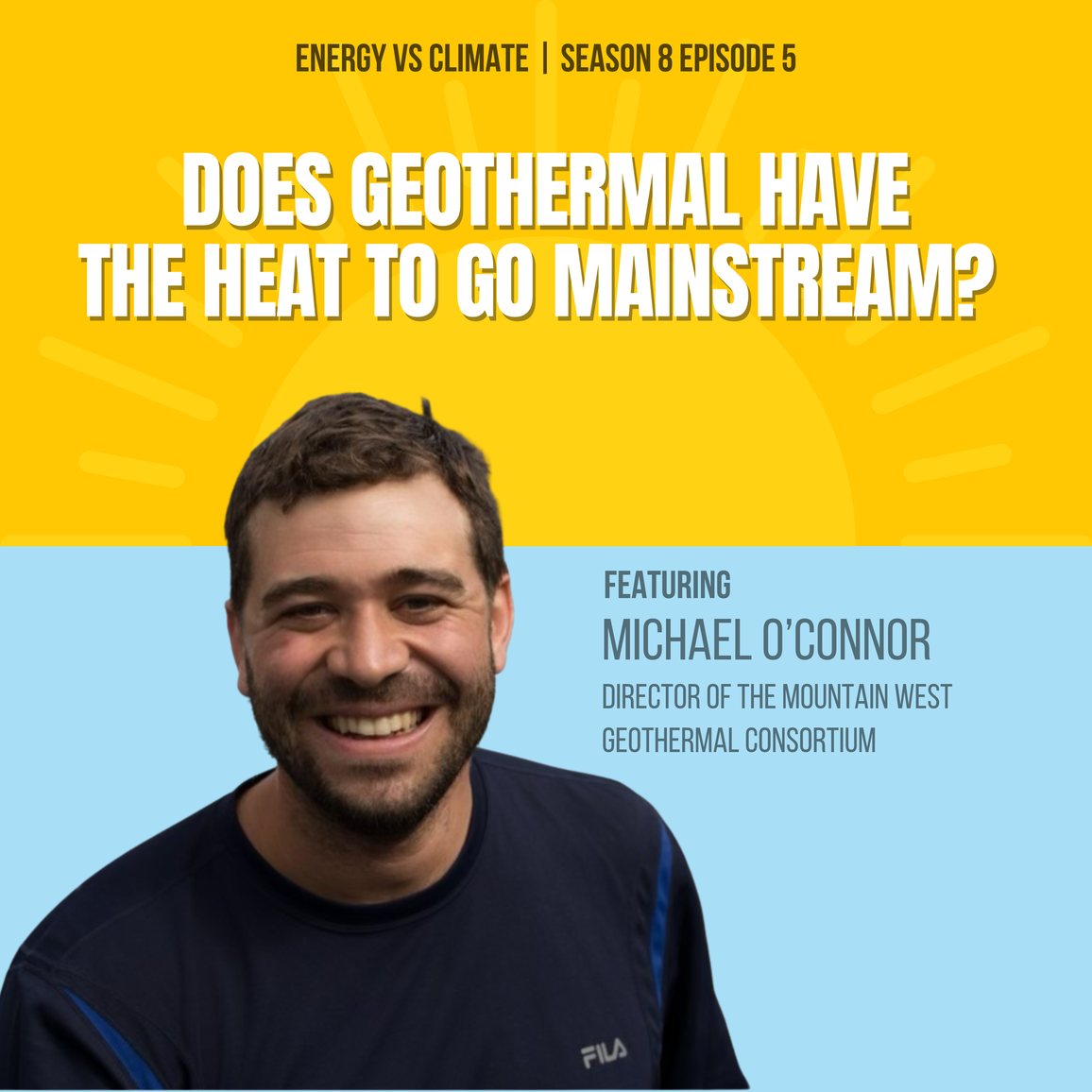
Does Geothermal Have the Heat to Go Mainstream? | With Michael O’Connor

Geothermal has the heat. So why isn't there more of it?
On November 17, Sara and Ed recorded a live webinar on geothermal with Michael O'Connor, Director of the Mountain West Geothermal Consortium. Michael worked at the US Department of Energy, where he co-led the Pathways to Commercial Liftoff report on next-generation geothermal power, and he now works with four western US states on getting projects financed and built.
Drilling techniques borrowed from oil and gas are changing what geothermal can do, and data centres want clean power that runs around the clock. So why has so little been built? Michael's answer centres on money, data, and utilities that have been slow to buy. They also look at where Alberta and Canada fit, and what would need to change here. And as always, audience questions.
Show Notes & References
[00:05:49] Government of Canada | What is Geothermal Energy?
- Geothermal electricity was first generated in 1904 at Larderello, in Tuscany, Italy.
[00:06:07] US Department of Energy | Geothermal Electricity Generation
[00:07:11] National Laboratory of the Rockies | Next-Generation Geothermal
- The US Department of Energy’s Office of Geothermal launched the #GeothermalEverywhere campaign to highlight key initiatives across its research and development efforts on enhanced geothermal systems (EGS).
[00:11:28] The Innovation Attorney | Geothermal Energy and Fracking Technology
[00:12:28] Alberta Geological Survey | Earthquakes and Induced Seismicity
[00:15:27] Center for Public Enterprise | The Dealer Always Wins
[00:20:27] US Department of Energy | Pathways to Commercial Liftoff: Geothermal Heating and Cooling
[00:21:17] RBC Capital Markets | Fervo Energy raises $2.2B in upsized IPO to scale next-generation geothermal
[00:24:13] EFI Foundation | Fervo and X-Energy: How Federal Support Powered Clean Firm IPO Successes
[00:34:56] PacifiCorp | IRP support and studies
[00:40:49] For more information on Alberta geothermal regulation:
- Alberta Energy Regulator | Geothermal Resource Development
- Government of Alberta | Geothermal Resource Development Act
- Government of Alberta | Geothermal Resource Development Rules
[00:45:38] Lazard | LCOE+
[00:52:27] US Department of Energy | Geothermal Energy Storage
Episode Transcript
[00:00:00] Michael O’Connor: In our world, if you take a big risk, you get a slow annuity over 30 years, and that is not the type of economics that lends itself to risk-takers.
[00:00:11] Ed Whittingham: Hi, I'm Ed Whittingham, and you're listening to Energy vs. Climate, the show where my co-hosts David Keith, Sara Hastings-Simon, and I debate today's climate and energy challenges.
On November 17th, Sara and I sat down with Michael O'Connor for a live recording on geothermal. Michael directs the Mountain West Geothermal Consortium, a bipartisan initiative of Arizona, Colorado, New Mexico, and Utah working to remove the barriers keeping geothermal from commercial scale. Before that, at the US Department of Energy, he designed strategy for $3 billion in clean energy investment and co-led the Pathways to Commercial Liftoff report on next-generation geothermal.
Geothermal has generated power for a century, yet in North America, it's still a sliver of the grid. Oil and gas drilling techniques are changing what's possible, and data centers want clean power around the clock. The hard part is money. Michael explains what's changed, what stands in the way, and what utilities need to do differently.
As always, we finish with questions from the live audience. So without any further ado, here's the show. I am happy to report that our long-awaited episode on the geothermal revolution, which has been a running joke here in EvC Land because it's long awaited, we were never quite able to put it off, pull it off.
But things, couple things changed recently. One, on a personal note, I was just in Iceland where geothermal isn't the energy of the future, it's how the lights stay on and how houses stay warm. And of course, Iceland sits on a plate boundary, and most of us don't, so that's been the problem with geothermal for decades is trying to...
It's great where nature hands you the reservoir, and it can be less great elsewhere. That's kinda one personal development. The other development is we met someone who has spent his career working out how to get geothermal built, who can speak to how drilling techniques borrowed from the oil and gas industry are being really accelerated by companies like Fervo, and we'll get to Fervo.
And this is letting, uh, developers and engineers, you know, go down into their own reservoirs and hot rocks almost everywhere at a time when we know data centers and load growth, they're creating new demand for clean power that runs around the clock. So let's get to that expert and the guy who has helped us to crack the nut on our long-awaited geothermal episode.
That expert is Michael O'Connor, who's the director of the Mountain West Geothermal Consortium, and that is a, uh, bipartisan, multi-state initiative that works with governors offices, state energy agencies, utilities, developers, and investors to remove barriers from geothermal projects, barriers to them reaching commercial scale, and particularly around finance and data and utility offtake.
Before that, Mike had several roles at the US Department of Energy, and most l- recently he's leading the strategic program for geothermal and carbon capture at the Office of Clean Energy Demonstrations And, uh, there he designed a strategy for 3 billion in investment and, and co-led, uh, we'll talk about the Department of Energy's Pathway for Commercial Liftoff report on next gen geothermal power.
And he holds a PhD in geosciences from the University of Texas at Austin, and he is joining us from a hotel room in a casino. And remind me, Mike, you've flown from Albuquerque. Remind me where you are at, which casino now for a conference?
[00:03:43] Michael O’Connor: I am at the MGM Grand Ferrari Plus.
[00:03:45] Ed Whittingham: Mike, thanks so much for joining us.
We're really grateful, and especially working around you being at a conference. Let's dive in, or I guess given the topic today, I should say let's drill down. This might be, like, full of puns, this episode. So Mike, start us at the very beginning. So when people say geothermal, they, like, seemingly, uh, can mean a heat pump in a basement.
It can mean district heating in, like, Reykjavik, or these days it can mean a power plant in Nevada. So tell us about the, the, the family tree of these- Yeah ... geothermal applications.
[00:04:26] Michael O’Connor: Yeah. Uh, so that is, I think, a strength and also a challenge of this industry is that that word means so many different things to so many different people.
Geothermal, but they're all relying sort of on the same principle. Geothermal energy is the discipline of, of extracting or leveraging heat from the subsurface for, to do work for us, right? And that can be heat or it can be power. There's geothermal, lo- low temperature geothermal or geothermal heating and cooling, and that's the heat pump type technology that you're, you're describing where you're actually not mining heat out of the ground, but you're using the ground as an insulator.
You're, you're, you're storing extra, excess heat in the ground when you have it, and you're pulling it out when you need it, um, using, using a heat pump. Then you have applications where you're actually drilling several miles below ground, um, and you are pulling brine or fluid or whatever you're pulling out of that, uh, out of a reservoir that is at an elevated temperature, and then you extract the heat out of that fluid and you use that to generally spin a turbine.
Although some folks are doing that for, for direct industrial heat applications too. That's entirely possible. It's heat. It's, you can use it for whatever, um, need you wish. There has been geothermal power online for 100 years across the, across the world, there's just not that much of it. Um, you mentioned Nevada.
Nevada's got about two gigawatts of generation it's had it since about the '70s here in the US. Uh, the US is the global leader in, um, geothermal power, but it's winning at about 3.9 gigawatts. Uh, that's .04% of just the capacity of this, of this country. Um, Iceland you mentioned, tiny country, heavily le- re- leveraging geothermal, um, for conventional purposes.
The reason I think we're here and we're having this ta- conversation is because although however is the oil and gas industry. Oil and gas industry brought some massive technological evolution, uh, to drilling. They, they were able to, you know, directionally drill and they can simulate reservoirs and they can do all s- they can, they can s- sense things, um, below ground that we were never able to sense.
And from that, you're able to extract, uh, heat from places where you never thought possible. Where reservoirs that are, are tight or, or impermeable. You can, we can, we can go in there and we can create permeability where there wasn't permeability, and then because that reservoir now allows for flow you can put a fluid down into the reservoir and flow through it and get that fluid to heat up.
This enables w-what a lot of people say is geothermal anywhere. Um, and that is true. Geothermal anywhere is possible. We're now riding down, uh, the second question about any industry is wh- at what cost, right? And so there are some places where geothermal, this type of geothermal approach is already economic, um, places like Nevada and Utah.
This is an economic alternative in comparison to basically any other clean, firm resource. We could see a future where we have advances in drilling and power plant technology where you would be able to translate that to somewhere like the US's East Coast, right, the Appalachian Basin, where there's elevated temperatures that aren't as high as, as, um, in the West.
Um, that group of technologies we generally consider next generation. There's, there's closed loop approaches, um, that are not yet as technologically proven out, but have proof of concept. Uh, or they're not economically proven out, but there's proof of concept, um, in several locations. And then there's EGS, enhanced geothermal systems, and that base- that's based off of, um, hydraulic fracturing.
Those are the two sort of buckets of new power technologies that we're sort of seeing explode the market.
[00:08:14] Ed Whittingham: Hmm. And, and you've made that point that I find really useful, you know, with, with next generation geothermal, that the heat is guaranteed. You drill deep down enough and it's hot, so as you said, the real question would be how much does it cost and how much of that heat can you get out?
And going back to Iceland, you know, Iceland has, I guess, the deluxe version of geothermal because the reservoir comes pre-installed. For most of us and developers, you actually have to, you know, y- y- you have to assemble your own. And so you'd mentioned hydraulic fracturing, so that... Let's, let's do a fracking comparison.
You know, f- fracking for a lot of good environmental reasons, or reasons because it's often challenging for the environment, it's got a bad rap and when we talk about that, that could make some of our listeners and viewers nervous. It does. Yeah So how is geothermal fracturing different from oil and gas fracturing and, you know, should we be concerned about it?
[00:09:15] Michael O’Connor: It's a great question, and like I, I think that it's important to sort of address this at the outset because I don't think the answer is that scary. While the technology, uh, being used to break rock is the same, the implications of breaking that rock in oil and oil and gas reservoir versus a geothermal reservoir are vastly different.
Um, in an oil and gas reservoir when you crack a rock, you release hydrocarbons. That is the primary concern I think of, environmental concern for fracking, is that you are going to release things that you shouldn't release into drinking water supplies. Um, while we, we don't really have much evidence of that writ large, I think there's places in, in Pennsylvania where that's pretty clear that, clear that it's occurred.
The reservoirs that geothermal, um, energy producers are going towards do not have hydrocarbons in them. They are, they are ancient granitic formations that at a, that are a much lower temperature and much less permeable. So the volatization of those, of those chemicals can't happen because they're not there.
Um, the second piece I think that is, uh, concerning is around seismicity and earthquakes and, and there's a, a pretty simple answer for that one as well. I think hydraulic fracturing in the oil and gas industry has created induced seismicity. It's well documented across places like Oklahoma and North Texas.
Um, there's a good reason for that. It's because we're taking something out of the crust and we're not replacing it And if you take something out and you don't replace it, the thing that you had was buoyantly, it was buoyantly held by the gas, and now it's not, and so it's gonna shift. And in an EGS reservoir, we're actually not removing anything.
You're consistently circulating a fluid through the entire reservoir. So there's a, a very limited, um, role that earthquakes will play. Additionally, for all of these, we have the opportunity for seismicity. We have the opportunity to monitor it. We should be monitoring it. The Department of Energy requires that you monitor your reservoirs to make sure that you are not going to exceed some sort of threshold that could potentially cause, uh, seismicity.
Um, so I think that's the, the two most important things. You're not fracking for hydrocarbons, and you're not, you're not re- removing fluid.
[00:11:26] Sara Hastings-Simon: Just to jump in on that second one. So here in Alberta, we have a traffic light system, uh, quite well-developed for seismic activity, uh, from fracking obviously, 'cause we have a lot of that going on in the conventional...
Um, or sorry, unconventional. I think it's fair to say, right, like, one of my favorite lines on this show is that all forms of energy production have some kinds of impacts, right? And, and so, you know, we're not gonna have no impacts with something like geothermal. And there is a need to, as you said, to monitor them and, you know, part of this traffic light activity is, uh, when, when you get towards the red that means you stop and you, and you can't continue with drilling at that site.
So, um, yeah, so, so I think it's, it's, you know, some- something that exists and should be con- s- should be... It, it is a real concern, um, but it's not a reason to not move forward with, with, uh, enhanced geothermal.
[00:12:17] Michael O’Connor: Yeah. We use the same monitoring tool, um, basically a traffic light system. AI has made that even more refined.
However, again, the, the, the process is, is different in that you're not extracting something, so we see fewer in- incidents of, of yellows or, or reds in any of these cases.
[00:12:34] Ed Whittingham: So Mike, going back to what you said, and just in the US, like, so the US has had geothermal power since the 1950s. It's the world leader, to my understanding, but it's still such a small spi- slice of the American grid.
And you used, I think, a, you know, a, a fraction of a percent. So, and, and trying to understand. So it's like you're both the world leader and a footnote-
[00:13:01] Michael O’Connor: Yes ...
[00:13:01] Ed Whittingham: in terms of power generation. We're the world
[00:13:02] Michael O’Connor: leader in a competition that no one's trying in.
[00:13:05] Ed Whittingham: A world leader competition no one's trying in. I like that.
[00:13:08] Michael O’Connor: Yeah.
[00:13:08] Ed Whittingham: Yeah. And, and, and so l- tell us, like how do, how do you true that? At, the, uh, the system, is it gonna get to 1%? Is it gonna get to 10, to 20%? I know we're looking at this, but maybe put into context to date, why is it such a small sl- sm- slice of the American grid?
[00:13:28] Michael O’Connor: Happy to, yeah, this is, I think, a great question.
Why are we in such a, um, a dearth, I guess, right now? I think one of the, our first slide when we present anything sort of, you know, a big talk is that geothermal is the ch- fastest, cheapest way to, to have to clean baseload today if you're lucky enough to buy it, right? The, the, the market activity is minimal, and it really centers on the, the subsurface risk component of this technology.
Geothermal is the only source of energy that we, um That we have that you have to build the power plant where you find the fuel. And so you, in, in the act, in, in the act of finding the fuel, or in this case creating the reservoir, uh, where the fuel will exist, you have to do some extremely expensive things.
You have to drill a couple of production in- injection wells, um, that go, in our case, at least 8,000 feet, so like little, little under two miles below ground. They're probably going to be deviated. Um, they're probably going to be, uh, in some way fracked if you're doing EGS, and then you have to run flow between them for a period of time long enough for somebody to be confident that this reservoir that you have is viable.
That test in and of itself is like $30 million, right? That just right there. And when you do it, we don't have... Even though we know there's gonna be heat, we don't have certainty of the amount of heat you're going to get. You need to appraise it, right? And so this appraisal step that we see in the, um, development cycle for geothermal is where, like, 20 different developers in the United States sit right now.
They are trying to raise the money to do that test, and there are not natural pools of capital that are available for this kind of work. We have a paper out called, uh, The Dealer Always Wins, that talks about why even though oil and gas technology is the solution that we lean on for EGS, the oil and gas business model is the exact wrong thing to look at, right?
Oil and gas business model is you j- you, you are able to, uh, take a big risk because you get a huge return very quickly, and if you don't get a huge return, you can write it off and then you can go and recycle it somewhere else. In our world, if you take a big risk, you get a slow annuity over 30 years, and that is not the type of economics that lends itself to risk-takers.
So finding folks willing to fund an appraisal stage has been the major gap in this industry. Um, it's the reason that geothermal never took off earlier on, and it's the reason today that even though we have a lot of attention and, and some high-profile technical successes as well as a huge amount of market demand, we don't see a map of project development like we should expect to.
[00:16:24] Ed Whittingham: We do wanna get into that and, and the type of y- your return in using an annuity, great for a pension fund, but not great for a VC or, you know, the typical oil and gas vest- investors looking for that big payoff. Um, but Sara, uh, you've got a comment.
[00:16:40] Sara Hastings-Simon: Yeah, I, I just wanted to kinda add to maybe zoo- zoom out a little bit on that, like what that challenge is.
'Cause I think you said it well, Mike, in terms of what geothermal can bring, and if I think about, like, describing its sort of main properties, you have this, you know, very low greenhouse gas emission electricity opportunity, um, that is, you know, m- more expensive and considerably higher, higher on the risk side.
And, you know, then historically it has to compete against, you know, the, the historical coal and, coal and natural gas, uh, on the electricity grid, where, you know, clearly it, geothermal's beating that on the greenhouse gas emissions, but not yet so far on the, on the price or that risk piece. Um, and then it also has to compete if you're, you know, interested in low carbon technologies with things like wind and solar.
And so I think one of the things, uh, I'm s- sure, sure we'll get into it more, but one of the things for me that's like really interesting or I think is helpful for me in thinking about, you know, where, where these pieces come in is in a way geothermal and something like wind and solar are not actually direct competitors for, you know, the full share of the pie of decarbonizing the electricity system.
And why geothermal has been slower to come in is because, you know, it is so cheap and so relatively easy when you're talking about the first, um, you know, it depends where you are, whether it's 50% or 60% or, you know, whatever number that is, but that first chunk that you can decarbonize by going straight to wind and solar without having to worry much about the seasonality or the kind of, you know, the, the non-dispatchability, uh, of that type of power.
And so it's a little bit like geother- in my mind it's like geothermal has been waiting its turn to be able to be ready to, to go in and, and take those risks and figure out how to unlock it, and it's kind of, it's almost like unfair to say why, why hasn't that happened t- to date or over, say, the last couple of decades where we saw so much wind and solar because those would be sort of the obvious first resource to pick.
And now we're at this point where you're starting to see, uh, e- enough adoption of, of wind and solar that you do wanna think about these, you know, dispatchable sources and, and obviously, you know, this 24/7 renewables that, um, at least until recently some of the tech companies were, uh, were actually really targeting.
Um, I'm sure we'll get into that too as well. But I just wanted to, I think, put some of that framing, and I don't know if it's fair to call it completely a misconception, but I think I often hear this, like, false narrative of like well, you know, wind and solar is better than geothermal, and it's not really...
Like, that's, to me that's comparing apples to oranges.
[00:19:19] Michael O’Connor: I think there's a great, there's a great report, uh, that C- Clean Air Task Force did with the State of California showing what the grid looks like in California with and without geothermal power, and it's a $44 billion more expensive grid with geoth- without geothermal power because of the overbuild on wind and solar.
They are different things for different markets and different... They, they serve different uses and both, I think, a full-scale grid, right, in the US, the one we modeled, uh, for the liftoff report had somewhere between 15 to 20% of its powers coming from geothermal
[00:19:50] Ed Whittingham: So Mike, I wanna talk a little bit about what has changed, and on this show on EvC, we like to try to tease apart sort of what's genuine and then what's part of hype cycles around new tech.
Yeah. Yeah, but I think geothermal- Totally ... I'm
[00:20:04] Michael O’Connor: seeing.
[00:20:05] Ed Whittingham: Yeah, it, you know, Joe, can we talk about nuclear? You know, we could be in another hype cycle. Personally I hope not, but, uh, we're certainly going through the third renaissance of my career, and maybe this is the second renaissance of, of geothermal in the past 15 years.
But I go back to your DOE, Department of Energy, Liftoff report, and you're looking at the FORGE site in Utah, and you said drilling speeds increased more than, I think, fivefold in three years. You look at between the two first big commercial projects, you know, uh, well cost fell from 13 million down to 5 million, and then we...
So, and that, that gets to what you said, the big upfront capital cost barrier is assessment, and this risk of going in and having to spend all that money on assess- assessing the resource, only to find out after your, your millions and millions in that the resource isn't good. But let's, let's talk about one of the things that's changed is Fervo.
So Fervo, you know, a lot of people now in clean tech, I find if, if they're familiar with geothermal, they know Fervo and the success story, and it just had an IPO, and I know it raised, like, almost 2 billion as part of this- Little over ... uh, IPO.
[00:21:18] Michael O’Connor: Yeah.
[00:21:19] Ed Whittingham: Yeah. It was a-
[00:21:20] Michael O’Connor: 2.1.
[00:21:21] Ed Whittingham: Mm-hmm. 2.1, yeah. Yeah, neat. And so to talk about knock it out of the park, and at a time when it's still relatively difficult, and especially in the US with waning climate policy, to raise big sums for companies or, or climate tech.
So Fervo right now, all those things with drilling costs and drilling speeds, is, is that now a proof point that the model works, or is it just one hot, well-capitalized company with a really good site?
[00:21:51] Michael O’Connor: It's a great question. It's definitely not a, a company with one really good site, because Milford wasn't even that great a site.
When we decided on where the Department of Energy was going to spend its dollars in investing in the FORGE demonstration, it was a competitive solicitation. There were five locations that were proposed. Um, FORGE was the one closest to transmission. That's why that's there. It's not, it's not because... It, it won a competitive solicitation for factors that really didn't have to do as much with the reservoir.
Um, so the good new- the site being good definitely had to do with the Department of Energy investing right next door and giving us all the information that needed to be known in order for a company to go out and, um, and take it to commerciality. Uh, that was value of the site. But no, I think the, the model in some ways is proven from the tech standpoint that if you are able to get the capital to validate and appraise a resource, that there is capital to follow it That will develop the resource, um, put on the top side equipment, try to build the interconnection and build out the field.
I do think that the, the path that Fervo took was an extremely challenging one, uh, and one that we at the Mountain West Geothermal Consortium don't necessarily imagine every company repeating. They had to take an huge amount of venture dollars that are not well suited for this type of work, very expensive capital, to work in the appraisal stage, and then find a way for those venture dollars to make their high, high return, and that was through, through the IPO process.
There is a need for a type of capital that doesn't demand such high returns so quickly, um, to help these developers that follow Fervo and for Fervo's next project, right? What's the next project look like and how do you get that financed? There is the need for a pool of capital that is able to accept that type of uncertainty, um, in exchange for a reward that's a little bit longer term.
We see that as a right role for government.
[00:23:54] Sara Hastings-Simon: Yeah, I just wanna, I just wanna give a shout-out and underscore what you said about the role of DOE there, right? And that, uh, I... This is my, another one of my favorite horses to beat on Energy vs. Climate, but that, that key role of government investment and making that first, uh, investment in something that is seen as very risky and proving that out and the way that, um, you know, Fervo is, uh, kind of being built on the back of that or, you know, being helped along by that, uh, investment, so, so critical to recognize that that's there.
[00:24:25] Ed Whittingham: Yeah, and Mike, I've heard you, so I wanna talk about the missing middle, 'cause I've heard you on another interview- Yeah ... refer to that. And so what I'm taking first from, from this part of the conversation is we can get the policy, but a big thing standing in the way r- right now is money. So a s- a developer has the surface data, they still need to spend upwards of tens of million dollars, sometimes 100 million, to prove up that resource, to determine how much heat they can get out, and at what cost they can get that heat out.
And until they do that, no one s- serious is gonna finance the project. And as we said before with the economics, the project economics, the reward at the end is a solid utility asset that, say, earns maybe 18 to 20% over 15 to 20 years, which, as I mentioned, is great for your pension, but it's not enough for venture capital-style risk.
So this is the missing middle. How do we fill in the missing middle?
[00:25:29] Michael O’Connor: I think we find pools of capital that are wi- a- able to, to tolerate long payback periods. Uh, that's one answer. Um, another answer, uh, that we're, we're sort of debating is, is, is blending stacks. And so we have a concept that we're working on, um, in several Mountain West states that would, that would effectively be a, a revolving fund for appraisal de-risking, uh, in which, um, states and pri- states and private sector actors come in together to fund the appraisal stage of something.
If the appraisal succeeds, the state is paid back through, uh, either a takeout, right, the, the, the state loan is sort of taken out by the next phase of capital or project returns, um, if, if it can tolerate such a long wait and, and, you know, five more years or something like that, but we pr- we prefer a takeout.
And if it fails, the project developers are, are made whole. We are not the only people talking about this. Uh, today Project Interspace released a very similar model describing this, uh, sort of m- uh, mechanism for the state of Texas, uh, capitalized at about $400 million, uh, where there's some pr- public sector entity that's providing some risk assurance basically for you to go out and, and demonstrate this.
There's also different flavor... The- these are, these are all different flavors of concepts that have been tried all over the world. Um, you know, Kenya's had a, a very successful de-risking program funded by the World Bank, as did Turkey. Germany and France actively have these, these insurance funds. Uh, the Department of Energy at, in the US didn't do it via insurance, but it did 50/50 cost share for dril- geothermal drilling from like 1985 through till the Obama administration, and most of the Nevada projects that we have came out of that, that work.
So I don't think we're inventing anything new here. I think the, the, the, the shift is that we've now We've got a technology that isn't a, um, dry hole risk, right? Will it, won't it? It's, it's a how much. A- and there are engineering approaches that allow for a project developer to take what would've been a failure in the past and turn it into a success.
So we believe that these funds can be more successful than they were in the past due to those engineering solutions.
[00:27:42] Ed Whittingham: And before we move off technical risk, 'cause I do wanna get us more on, on sort of the financial side, but then really get to policy and regulatory before, as we are want to do, we bring it back here to Canada and then Alberta, which is this great hotbed, again, pardon the pun, of geothermal in Canada.
Before we get, move on from technical risk, give me a... Like, what's a technical risk that people don't like to talk about?
[00:28:05] Michael O’Connor: The, the, the hard conversation is around the longevity, the longevity of these reservoirs. And the hard- it's a hard conversation because the only way that we're actually gonna be able to prove it to you is by running a reservoir for 30 years, right?
And so I don't have 30 years to waste. That's the primary challenge about answering that question. We have a lot of good scientific answers as to why we think these reservoirs can be maintained over long periods of time. If you have many wells in a field, that means you can turn some on higher and turn off others, you know, when one s- part of the field is getting colder than you'd like it to be, and then you can mine somewhere else.
And you can be able to sort of balance out your reservoir dynamics with lots of different wells in, in an acreage. We also know that the opport- we- EGS has been used in the past to elongate the life of reservoirs. The Geysers, which is the world's largest geothermal plant in, uh, northern California, was experiencing steep temperature, temperature decline in the early 2000s, prompting one of the first trials of EGS, which successfully rebounded its flow.
So we have... I have arguments. We've got examples. But can, is that tolerable for, you know, the, the, the most risk-averse s- o- otherwise solar and storage asset investors? That's a question that still remains to be answered
[00:29:32] Ed Whittingham: Mm-hmm. Let's, let's talk about data and, uh, buyers as barriers. So this is when we can get into integrated resource planning.
So utilities plan years in advance, decades in advance, but still we've got this problem of most of them aren't even considering geothermal. And part of that on the data side is they, they rely, say in the US, on US government figures, and then part of it is they're still unfamiliar. And so I wanna... I, I looked at Arizona and as a great example.
It's surrounded by geothermal resources and projects, yet it doesn't have a single megawatt yet, it doesn't have a regulatory framework, and no utilities, regulated utilities are planning for it. So WTF? Like that Like,
[00:30:20] Michael O’Connor: yeah. I, I think the first piece of the-- I think the last piece of what you said is finally changing.
I believe that there are some electric utilities in Arizona, particularly SRP and Tu- uh, Tucson, revisiting their assumptions on the value of geothermal power in the state, and where we should see geothermal show up in those IRPs for the, for the next midyear assessment. Um, that, that's likely. But an IRP is not a binding contract, right?
Uh, only in California, uh, do you have to do what the IRP says. This is, this is one of the gaps that our consortium is extremely, um, concerned about, and I think working, working hard on, is how do you build a procurement mechanism, a procurement system that enables a utility to sort of- Milestone based their, their purchasing of geothermal increase their ability to make the deal serious, but, but support it and, and consider it in its modeling, um, w- as the de- as the project's development furthers along.
Right now we're in a situation with because they... because these regulated utilities are generally governed by, uh, by regulation, um, they are really unable to look at a specific geothermal project until it's already fully completed megawatts on the grid, and by that point it's far too late. In this... I- in the old world, it means you'll never get there because you'll never get your dedicated offtake.
In this world, it means the data center's bought all the power and you've missed out, right? So the data centers do have the flexibility that regulated utilities don't have, and so they are coming in as early buyers of some of this stuff. But we don't believe that is the solution that will unlock this market.
Um, w- it's, it's important for the regulated utilities that are looking to serve load growth in their own, in their own areas are able to, uh, to do so by understanding... I mean, it could be as simple as hiring a resource geologist as part of your IOP team, but understanding what these resources look like at different levels of seriousness.
[00:32:25] Sara Hastings-Simon: Yeah, I think that's such a interesting, your last comment about, you know, hiring someone really gets at, I think, some of the challenges. And as you're talking I'm, I'm again sort of in my head sorting the, you know, in what way is this like wind and solar, in what way is this like nuclear? And it does seem like you have things you can borrow from the solution for both, right?
I mean, I do look, as you say, when we look at kind of a lot of the early capital that flowed into building out wind and solar, certainly a lot of that came from not utilities, but from the- Mm-hmm ... tech companies or others that were, um, maybe a little bit more flexible. But there's, there's something about the geothermal that's like, I don't know if it's to say something embarrassing, that it's like it, it has a vibe that's similar to nuclear.
Not in a bad way, but in a, like, maybe regulated utilities can wrap their heads around it more kind of way just because it's, like, more of a, a hard tech or something than, uh, than they see the renewables. Or, or frankly maybe it's for more fair to say because it has that potential dispatch ability that is not necessarily easier to manage, but just, like, more like what a traditional utility is sort of used to.
Like, it, it kind of fits a little bit more into that box. So all that to say, I think it's, I think it's really interesting the point that you're making around that it's not... it may not really be the case that the answer here is to kind of follow the wind and solar path and try to do this all via power purchase agreements outside of the utility space, but actually to do the, you know, very hard work of getting the utilities who on the one hand do have- You know, some of that slow capital.
But on the other end of the scale are, you know, some of the most risk adverse, uh, entities and, and that's a real challenge. Um, and understanding where that comes from, right? I mean, if your job- Yeah ... is keeping the lights on, you, you better be risk adverse. So, um- Oh, yeah ... all of our utility listeners, don't take that as a, as a dis to, to you guys, but, uh, the, rather a recognition of that, of that challenge.
So it's, it's interesting to think about how, how you're able to approach this and try to kind of pull a bit from column A and column B, uh, rather than saying, "Look, we're just gonna go and try to replay the blueprint that we had for technology X previously."
[00:34:32] Michael O’Connor: There's a shift that we're seeing in several utilities that are looking to include this resource because their backs are a little bit up against the wall, but those, those utilities generally have to adhere to some sort of legislation around clean, clean e- electricity standards, or they're seeing, uh, just spiking demand and no other alternative for, for slowing it.
But, I mean, one example is PacifiCorp over the last couple of weeks. That's the, uh, utility in... They cover several states in the Pacific Northwest, including Oregon and Utah. Just, uh, using updated cost data that w- we helped provide them for what geothermal was developing in, in Utah, was able to revise upwards their IRP from, uh, zero for geothermal to 1.8 gigawatts that was coming off of gas.
Um, and so that is, and that, and that is likely because Oregon has a clean firm standard, or Oregon has a clean electricity standard, and Utah has cheap geothermal. So they have re- they have the ability to, to buy one and s- satisfy the other. Those are the places where we're starting to see that kind of creativity exist, is if there is some combination of, of a market play that's real, and Utah geothermal is a market play that's real, plus a policy lever that is driving folks to be able to look beyond combined cycle gas.
[00:35:49] Sara Hastings-Simon: If only we had- Yeah ... some kind of clean electricity regulation, uh, in Canada that, you know, covered the country and required clean electricity. Uh, yeah.
[00:35:58] Ed Whittingham: Yeah. And yes, if, if only, and a government that would, you know, sometimes hold the line on it with certain provinces. And other- Yeah So let's bring it home to Canada and Alberta.
Yeah. Like the US, electricity is a provincial matter. The federal government has some leverage, but not total leverage, and we've got a patchwork of regulatory frameworks. When you look at the US, you know, it's, it's a spectrum of geothermal development. Nevada, which could scale tomorrow, to Arizona. Let's look at Alberta and, and for what you understand, and Sara, feel free to jump in as well, where are we in terms of a geothermal regulatory framework here that is off the shelf and applicable?
Where are we with projects? My keyhole view in the geothermal industry is through a friend and colleague, Paul McKendrick, who is the CEO of a startup, uh, Eonic, and is going guns a-blazing, and they've got all sorts of interesting people on his advisory board, the former head of Capital Power, uh, Steve MacDonald, uh, former head of, uh, Emissions Reductions Alberta, Janet Annesley, former chief of staff to an energy minister, longtime oil and gas executive.
And it's interesting to see, and he wants, uh, Eonic to become the next Fervo in Alberta. So when you put Alberta on that spectrum, as in ready, about to go off, or gee, hurry up and wait for five years, where would you place it, Mike?
[00:37:31] Michael O’Connor: There's a lot. I, I, I don't know a whole lot, first, I'm gonna say, about the Canadian, uh, geothermal market.
I just want to be, uh, f- fully upfront about this. I've been really focusing on the US Mountain West. But Alberta does come up a lot, and that's because Calgary is Ca- Canada's Houston, right? Calgary is the center of drilling expertise and knowledge, and, uh, in, in the, i- i- for, for Canada, and one of those locuses of the whole world, right?
It's, it's an enormous opportunity for technical resources and know-how around how to deliver this, these, these reservoirs. To that degree, also like Houston, Alberta doesn't have a Nevada-quality resource, right? Houston does- Houston doesn't either. Houston takes its people and its, and its skills, and it brings them to the Mountain West where the, the resources is the cheapest.
But that doesn't always necessarily govern a market. There are geothermal leases being signed in West Virginia in the United States because it is close to the PJM interconnection and the pow- and the cost per megawatt will be enormous. And so if you can make it work in, uh, West Virginia, you'll make a, a lot of money.
So there's that. I ... The market is ... Same for Texas. Texas is developing geothermal even though there's not that much of, of ... the resource isn't fantastic because the market allows for easy development. Um- My knowledge of Alberta is that it is home to a lot of geothermal startups, companies that have that knowledge, that expertise, that skillset, and I am not as clear on which of those pro- startups are actually investing in geothermal in Alberta.
I wouldn't be surprised if Alberta be- although having a resource that is, I would say, mid-tier, definitely worth looking at, but not high tier. Um, I would not be surprised if it ends up get- if development ends up there faster than somewhere else because of two things. One, the, the workforce, and two, there is so much already known about Alberta, the, the subsurface in Alberta, um, that is not as well understood in, in the rest of Canada.
Canada has the better, um, subsurface data, um, practice than the United States. Its data's more open in Canada than it is in the US. Uh, that being said, it's only open where you've drilled, and you have the opportunity in, in Alberta to, um, skip a lot of steps on your assessments and create really refined, uh, subsurface models cheaply or for free.
That could be worth something to developers, and I wouldn't be surprised if that's being acted on right now with absolutely no knowledge of the situation from an actual specific project's perspective.
[00:40:12] Ed Whittingham: Yeah, and I think of, you know, who has all that knowledge of the subsurface. It's, it's the oil and gas industry.
But this is- Mm-hmm ... where I sometimes hear it and, and Sara, I'd love for you to try to fact check it. You know, can, uh, the, they've got the knowledge, they know how to drill, you know, we have the technical know-how. Could... Are, are there examples of geothermal and ESG in particular becoming, like, a meaningful new, meaningful, uh, new line of business for oil and gas companies?
Or is that just kind of the latest tired, hackneyed cliche of what we're going to do in terms of lateral moves for the industry?
[00:40:47] Sara Hastings-Simon: Yeah, I'll... I, I can definitely opine on that a bit. I mean, so I've looked into this specifically in Alberta and this kind of complementarity, um, in some work quite a few years ago now with, um, Brendan Haley, uh, and his student, Aletta Latish.
And, you know, obviously there, there's a huge amount of overlap, as you said, you know, the knowledge of the subsurface, the people, the companies. I think there is a challenge when you think about a, an oil and gas company trying to get into geothermal, going back, Mike, to what you said originally around the just totally different, uh, structure of the risk and rewards and what investors are looking for when they, when they're thinking about the types of, um, return on investments that a company is gonna be making.
And so I think, you know, you've had examples, I think more, more promising, at least, not to over-index on Fervo, but examples like there where you have individuals who come from the oil and gas sector and start a company that is in geothermal and bring their knowledge. But going kind of directly, I think, is, is more challenging.
Um, we've also had, um, this challenge of when you have... It's almost like you have too much overlap, and then you have a challenge of the boom-bust cycles coming in. So, you know, when things are good in the oil and gas sector, um, there's really no appetite for doing much within geothermal because you would much rather have your, uh, employees, your capital, your drilling machines deployed to get more oil and gas out of the ground and make more money.
When things are bad in the oil and gas sector, well, you don't have that money to, you know, put towards anything else. So there's a little bit of a, like, heads you win, tails you lose, uh-
[00:42:23] Michael O’Connor: Yeah ...
[00:42:23] Sara Hastings-Simon: I did that wrong. Uh, but- Yeah. ... kind of dynamic going on, uh, that, that particularly in a, in a smaller place like Alberta has played out.
You know, looking forwards, I think- If I look at y- what's the opportunity in Alberta now, you know, I think there's, without some more significant action on the, on the greenhouse gas emissions side for the electricity sector, I think it's gonna be hard to make the case, right? So, you know, I was joking, but, like, in a world where you have the clean electricity rigs in place and you are preventing new gas plants from being built, um, you know, there's a, there- there's a clear path for geothermal to come in and say, "We can be the solution for, you know, dealing with the, the seasonality that we have with things like solar here in Alberta," which is, you know, much more extreme than, um, obviously anywhere south of us.
In, in the absence of that, you know, what do we see? There's, there's just been a huge rush to, uh, get new gas plants, um, to pair with all this new data center demand that's coming onto the grid, or at least onto the queue in Alberta. And so I think that it's hard, you know, if, if you have the opportunity to develop this geothermal or to just go straight and develop the gas and, you know, with the support of the province be doing the drilling on the gas side and, and just burning that directly, I think it's gonna be hard for geothermal to compete, uh, with that, um, without some kind of more, you know, targeted...
N- n- and I'm not saying that's how it should be, but, you know, in lieu of, of some ki- something forcing you to move away from that more highly emitting gas generation, um, I think it's a lot harder for geothermal.
[00:44:03] Ed Whittingham: Yeah, and you're right. I mean, Alberta is, is chasing data centers, so I wonder if a Nevada-style tariff where you've got the big loads paying for firm, clean power, if that's, that's something that could work up here.
But what, uh, uh, I'm, I'm looking at the clock, and I do wanna get us to audience questions. And we have a live questioner joining us. Her name is Sandra McDougal. So we're gonna unmute Sandra's mic so she can ask the question. So over to you, Sandra.
[00:44:32] Question: Thank you. So I live in the Arctic- Thank you ... and firm capacity dispatchable energy matters greatly, particularly for heat, because heat's about life and limb there.
So we need electricity, but we also need heat. Um, so the, uh, levelized cost of energy always surfaces solar, and that just
doesn't work in the Arctic. We're, we're dark. When we need our biggest heat, we're dark. So, um, another measure that we could use that could represent, um, like our needs better in the Arctic-
[00:45:08] Michael O’Connor: That's a great question.
[00:45:09] Ed Whittingham: Yeah. Yeah, and Sandra, I have to ask, though, b- just Mike, before, so hopefully longtime listener, definitely first-time caller from the Arctic. Where specifically are you?
[00:45:18] Question: Oh, uh, north of Alberta. I live in the Yukon.
[00:45:23] Ed Whittingham: Cool. Cool. Right on. That's, uh... So Mike, sorry, back to you.
[00:45:26] Michael O’Connor: Oh, I was just gonna say, uh, there's, there's, um, there have been a lot of stats that- measures other than LCOE.
I think, uh, the, the folks that created LCOE, Lazard, have come out with a metric called LCOE Plus, where, uh, geothermal, they're, they're trying to take into account sort of capacity factor a little bit more firmness. I do not quite understand how they make those metrics, but there's about an 80-page paper that describes it.
I know that geothermal plots quite well as an LCO- LCOE Plus metric. Um, also, I know that the Department of Energy in the US is funding research efforts around literally metric and standard development, um, to help utilities assess their portfolio cost, uh, sy- the system costs for these things. Generally, that's the broader concern for, for American, um, grid systems, is that you have to consider the whole system cost.
So if you choose solar and storage, that means you need to choose enough storage to cover long outage periods. Um, I'm not sure how electricity is priced in the Yukon, um, but I c- I would encourage you to take a look at some of that DOE research, look at LCOE Plus, look at some of those other, other metrics that, that sort of consider, uh, firmness.
[00:46:40] Sara Hastings-Simon: Yeah, and I think that a- as much as I was sort of saying a little bit downer on the opportunity in Alberta, uh, where you have a lot of cheap natural gas, I think places like the Yukon and, and others, um, where, you know, getting fuel to burn, uh, for winter heat is so expensive, it is easier to make that, um, case for geothermal work.
So I think there is a, you know ... Especially going back to what I was sort of trying to explain at the beginning, this idea that, uh, geothermal becomes more and more attractive the more wind and solar you put on your grid, the, the same is true the further north you go, basically. It's, it's the more you need this power to deal with the, you know, seasonality of the, of the solar, as you were saying.
So I think a lot of opportunity there.
[00:47:24] Ed Whittingham: Yay, Yukon. Uh, such a gorgeous place. And now we've got Gavin McKenna, the pride of Whitehorse, trying to take the Maple Leafs and lead them out of the basement. Um, thanks. Thanks so much, Sandra. Uh, we're gonna get to another question. Avril Kim-Campbell, "How sophisticated are geological models for identifying promising areas for finding geothermal sources?
I assume that areas near vo- volcanic activity would be promising. I live in Tuscany and read recently that Tuscany sits on such a resource." Presumably Avril is talking about Tuscany, Italy, and not the neighborhood in Calgary. Sara sitting on a volcanic resource. But yeah, um, maybe Mike, you could field that
[00:48:09] Michael O’Connor: Uh, it's a, it's a, that's a, that's a fun question.
And yeah, I think the answer is at a broad scale, like at a, at a zoomed out scale, we have a very good idea of where heat is. Um, but at a specific local scale, we have a very bad idea of where heat is. There's, there's a lot of uns- there, there's a lot of heterogeneity, you know, variability in the subsurface.
Um, and so this is, this is a challenge in communicating. I can promise you, you know, you, you men- you mentioned Tuscany. Tuscany sits on a plate boundary, right? There's basically the, the Eurasian plate is butting up against the African plate, and so there's gonna be heat, uh, coming out in the sort of Mediterranean re- region where there is actually quite good resource.
Where specifically I should put my well is the question that everyone is trying to answer, and you do need a lot more specific data to answer that question. So where in Tuscany would I go? I would need to do a lot more research to figure that out. Um, AI has made these models a whole lot better by being able to sort of predict out the likelihood of different variable, variability in the subsurface.
There's a company in the US called Zanskar Geothermal that has built their entire business case off the idea that they have better tools, uh, for identifying these specific locations than anyone else, and they've proven it out a couple of times. Um, so I think there's, there's a, a lot of opportunity for this to grow, but generally speaking, we, we have a really good idea of where in the world we should be drilling, and we have a very poor idea of where in the town we should be drilling.
[00:49:42] Ed Whittingham: Hmm. And just thinking, so coming back here to Canada, Mike, you know, geothermal, do you think its opportunity to reach commercial scale, is that gonna be through electricity? Is that gonna be through district heat? Is that gonna be through industrial heat, like produce a lot of things that require heat in Alberta, so it's a terrific source for that, or is it gonna be something else?
Like, what's, what's gonna be the first winner here?
[00:50:09] Michael O’Connor: In Alberta?
[00:50:10] Ed Whittingham: Well, take Canada. Take Canada broadly and, sir, I know we're asking, so you've, you've already- Well- ... claimed up front that, you know, you're not an expert, but-
[00:50:17] Michael O’Connor: Yeah. I mean, I'll do, I'll do my best, but the reason that power's gonna be the winner in the US, I'll say, um, is because our natural gas price is extremely cheap, right?
That's the, the, the, the plain, the plain and simple of it, is that we heat our homes with natural gas generally, and natural gas prices don't necessarily justify the investment in, um, expanding geothermal heat pumps into your homes. The retrofitting costs are, are quite high and, um, and we have a challenge on getting construction companies to integrate the systems, um, in that first construction.
When they do, it's cheap. When you integrate geothermal into a full system build, when you start to build the entire building, then it is, it, it is affordable. However, uh, that's not a practice that's pretty well adopted. My assumption is that, um, uh, uh, barring massive change to the electricity grid system demand picture that I can't necessarily picture, power will win in this case because you guys have also relatively cheap natural gas in comparison, and a relatively w- a huge country with a lot of opportunity for resource.
I think that's, that, that, that would be my, my assumption. Now, if we could, if, if we continue the trade war with you guys and just, you know, um, force you to make all your own stuff, then your Industrial Re- Revolution can be powered through geothermal p- heating. That would, that might be that might be a path.
Um, I, I, one I don't root for, but one that's possible.
[00:51:47] Ed Whittingham: Yeah. Or, you know, we just have some sort of trade deal and put in high-voltage DC lines connected all the way to Iceland, you know, and, uh-
[00:51:53] Michael O’Connor: Right. Yeah,
[00:51:54] Ed Whittingham: sure ... yeah, just use their, uh, abundant- Mm-hmm ... resource. Uh- Mm-hmm ... Mike Milton Tam asked, "Does geothermal offer a viable option to use periods of excess solar to inject heat to geothermal wells for reuse later?"
And we kinda touched upon it a little bit with storage, but Mike, what do you think?
[00:52:14] Michael O’Connor: No, that's, that's a great question, and there's a project that the department was funding when I was there around sort of subsurface, uh, reservoir thermal energy storage, RTES is what they called it. Um, yeah, where you do take, uh, excess energy, and it could be solar, it could be any form of excess energy, but use it to heat a medium below ground, and then that heat, because it's below ground, is insul- in- insulated and remains warm until you can pull it out later.
Implications for diurnal or week-long storage. I don't think it's necessarily implications for, like s- like, um, seasonal, but that's being tested. It's a, i- it's one of the many uses of geothermal that I would say is not necessarily, uh, incentivized by our market struct- our electricity market structure right now, and maybe isn't getting as much attention as it could, because really the thing that the markets, uh, are, are incentivizing right now is additional capacity.
[00:53:06] Ed Whittingham: Got you. Mike, I'm gonna close on a bit of a fun question. I notice that you have, uh, your BA included music-
[00:53:16] Michael O’Connor: Mm-hmm ...
[00:53:16] Ed Whittingham: in addition to geology. Yeah. Any overlap between geology- Rock music ... geothermal and music? Yeah. Rock music. Rock music, of course. Yeah. Uh,
[00:53:27] Michael O’Connor: I've, I've been asked before.
[00:53:29] Ed Whittingham: Yeah.
[00:53:30] Sara Hastings-Simon: Touché.
[00:53:31] Ed Whittingham: Yeah.
[00:53:31] Michael O’Connor: Yeah. Yeah.
Uh, no, not really. Uh, the, the, the music degree was, um, a, a... I went to a, you know, liberal arts college where you could pretty easily double major, and the music degree was a fun one, and the geology was the serious one.
[00:53:44] Ed Whittingham: Yeah. Yeah. Well, I hope you're able to pursue music on the side at the very least, and rock out.
Mm-hmm. So, uh, thank you. We've been able to rock out on this show, so I wanna just- Yes ... thank Mike for joining us, and once again, the pun, keeping us grounded in what it actually takes to build geothermal. You've been terrific, and as I say, kind of threaded the needle in terms of the articulate geothermal expert they were looking to bring on to finally complete this, called the tantric episode, the tantric episode.
You know, we never get quite close to summiting, and now we have. We've summited. So, uh-
[00:54:20] Michael O’Connor: The geothermal revolution, it's coming.
[00:54:23] Ed Whittingham: It is coming. So yeah, Mike O'Connor, thanks so much.
Thanks for listening to Energy vs. Climate. The show is created by David Keith, Sara Hastings-Simon, and me, Ed Whittingham, and produced by Amit Tandon.
Our title and show music is The Wind Up by Brian Lips. This season of Energy vs. Climate is produced with the support of The North Family Foundation, The Consecon Foundation, The University of Calgary, and you, our generous listeners. Sign up for updates and exclusive webinar access at energyvsclimate.com, and review and rate us on your favorite podcast platform. This helps new listeners to find the show. We'll be back with a new show on the pros and cons of data centers in a couple weeks' time. See you then.
About Michael O'Connor:
Michael O'Connor is the Director of the Mountain West Geothermal Consortium, a bipartisan, multi-state initiative that designs and implements targeted state-level interventions to accelerate geothermal energy development. He works closely with governors' offices, state energy agencies, utilities, developers, and investors to identify and remove the barriers keeping geothermal projects from reaching commercial scale, particularly around finance, data modernization, and utility offtake. Before starting the Consortium, Michael held several roles within the U.S. Department of Energy (DOE). Most recently, he led strategic program design for geothermal energy and carbon capture for the Office of Clean Energy Demonstrations (OCED), designing strategy for $3 billion in investment and authoring the Pathways to Commercial Liftoff: Next-Generation Geothermal Power report.
Michael received his M.S. and Ph.D. in Geosciences from The University of Texas at Austin, and earned his B.A. in Music and Geology from Amherst College. He resides in San Francisco, California.
About Your Energy vs Climate Co-Hosts:
David Keith is Professor and Founding Faculty Director, Climate Systems Engineering Initiative at the University of Chicago. He is the founder of Carbon Engineering and was formerly a professor at Harvard University and the University of Calgary. He splits his time between Canmore and Chicago.
Sara Hastings-Simon is an Energy Systems scientist studying energy transitions at the intersection of policy, business, and technology. She’s a policy wonk with a love of data. With a PhD in physics from the University of Geneva she has worked at both McKinsey & Company as a management consultant, and the Pembina Institute where she founded Business Renewable Centre Canada. Dr. Hasting-Simon is now a professor at the University of Calgary where she co-leads the Electricity Centre. She has a particular interest in the dynamics of the mid-transition, a concept she co-developed.
Ed Whittingham is a Canadian climate and energy leader with more than 25 years of experience across public policy, clean technology, corporate strategy, and the non-profit sector. He is the former Executive Director of the Pembina Institute and has worked with governments, companies, universities, and civil society organizations in Canada and internationally on complex climate and energy issues. Today, his work focuses on helping build and scale climate stabilizing solutions. He serves as Founding Director of the Advance Carbon Removal Coalition.
Produced by Amit Tandon & Bespoke Podcasts
Energy vs Climate: How climate is changing our energy systems
www.energyvsclimate.com