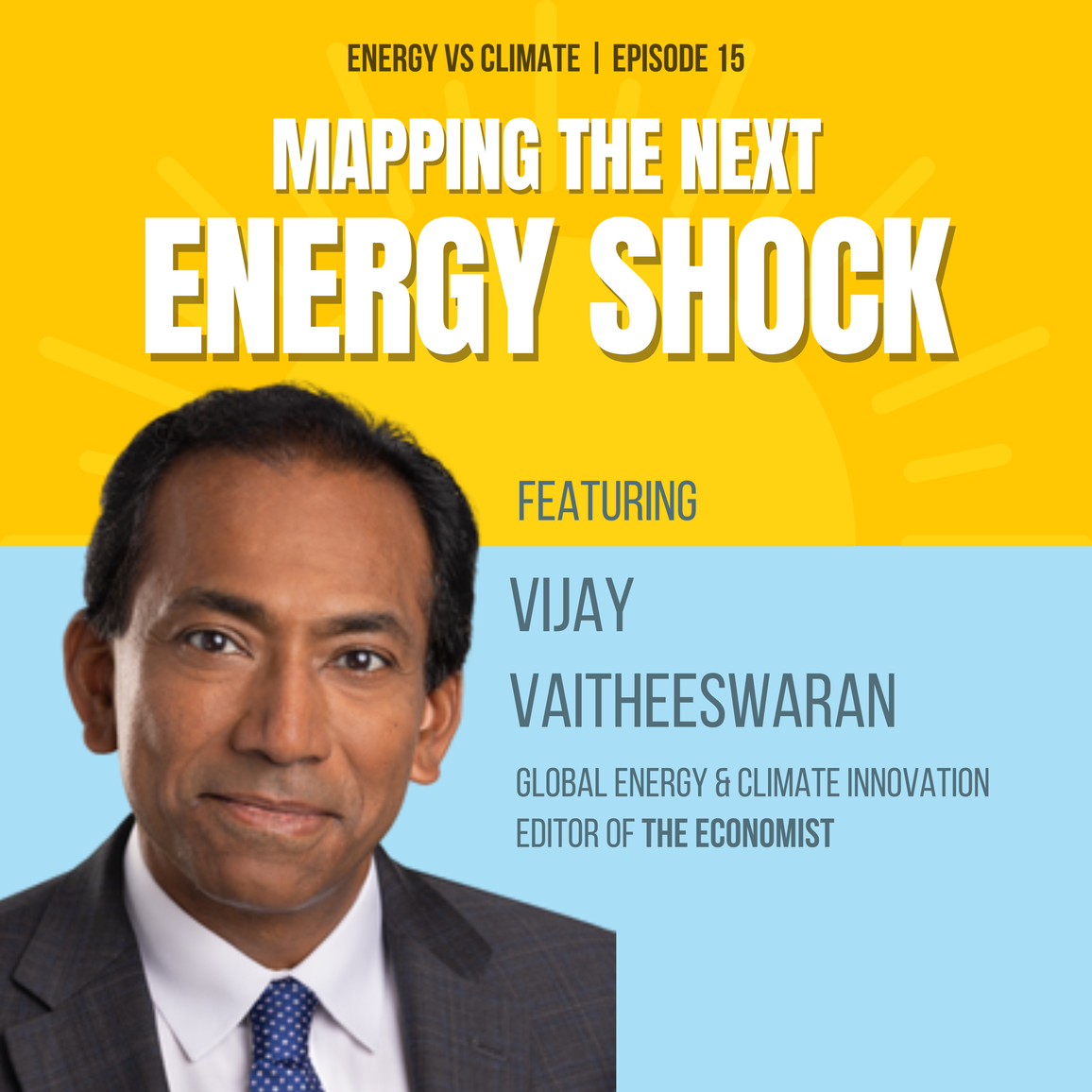
Mapping the Next Energy Shock with The Economist's Vijay Vaitheeswaran

The aftershocks of the Iran war are reshaping energy markets, investment decisions, and climate politics in very different ways around the world.
David, Sara, and Ed sat down with Vijay Vitheeswaran, Global Energy and Climate Innovation Editor at The Economist and 2025 Energy Writer of the Year, to discuss the shock rippling through energy markets since the war in Iran began.
On one side are forces accelerating the energy transition like electrification, EV adoption, solar deployment, and rapidly scaling clean tech. On the other are forces pushing toward deeper fossil fuel lock in: energy security fears, coal expansion, oil investment surges, and persistent fossil fuel subsidies. Which force is actually winning?
The conversation covered a lot of ground — from samosa vendors in Delhi packing up because cooking fuel tripled in price, to what a potential OPEC collapse could mean for the oil sands.
This show's a great listen, especially if you're trying to make sense of a world where the energy transition and fossil fuel lock-in are happening simultaneously.
Show Notes:
(12:45) Electric Autonomy Canada, Canada opens permit process for 24,500 Chinese EV imports (March 2026)
(16:30) The future of electricity is wind and solar, new report says. Canada is lagging behind
(16:45) Ember, Chinese solar exports double in a month to hit record high amid energy crisis (April 2026)
(18:50) Recent analysis shows that renewable power paired with battery storage can now rival or undercut new fossil-fuel generation costs.
(36:08) CBC, U.A.E. leaving OPEC amid Middle East energy supply crunch (April 2026)
(39:20) Oil Sands Alliance, The time is now to make Canada an energy superpower (May 2026)
(44:31) Carbon pricing has expanded to cover around 28% of global emissions.
World Bank Group, State and Trends of Carbon Pricing 2025
(47:15) Los Angeles Times, India is electrifying faster than China using cheap green tech (January 2026)
(51:05) According to recent studies from Lawrence Berkeley National Laboratory and Energy and Environmental Economics, states with higher electricity demand growth tend to experience smaller retail price increases. Surplus revenue generated by large customers like data centers help to fund grid upgrades without raising residential rates.
Reason, The Data Center Price Myth (December 2025)
(55:15) Renewables Now, UK blocks GBP-1.5bn Chinese wind turbine factory over security fears (October 2025)
(1:04:14) IMF Blog, Fossil Fuel Subsidies Surged to Record $7 Trillion (August 2023)
Episode Transcript
Vijay V.: Literally the samosa vendors are packing up and going back to their villages. And if you know anything about India, when the samosa vendors leave and you can't get your samosas, it's a national tragedy, but at a human level, it really is absolutely devastating.
Ed W.: Hi, I'm Ed Whittingham and you're listening to Energy Versus Climate.
The show where my co-host, David Keith, Sara Hastings-Simon and I debate today's climate and energy challenges. On May 5th, the three of us recorded a live webinar with Vijay Vaitheeswaran, Global Energy and Climate Innovation Editor at The Economist. We built this episode around a central tension. The aftershocks of the around war are reshaping energy markets, investment decisions, and climate politics in very different ways around the world.
On one side, our forces accelerating the energy transition like electrification, EV adoption, solar deployment, and rapidly scaling clean tech. On the other, our forces pushing toward deeper fossil fuel, lock-in energy, security, fears, coal expansion, oil investment surges, and persistent fossil fuel subsidies.
Which force is actually winning. Well have a listen and you be the judge. Now here's the show. We're joined by Vijay Vaitheeswaran, who is, uh, global Energy and Climate Innovation Editor at The Economist. He's also winner of the 2025 Energy Writer of the Year Award. He's one of the most closely read voices on Global Energy and you know, the Economist and his readership around the world.
He's got multiple, uh, books and cover stories to his name. And as the Financial Times Once put it, uh, the J is a writer to whom it is worth paying attention. So that's what we need, a writer to whom it's worth paying attention and a thinker. So welcome to Energy versus Climate Vij.
Vijay V.: Ed, thank you. Thank you for that introduction.
Only a mother could love. It's, it's a great honour to be on with you and, uh, look forward to the, uh, no doubt, uh, sparky and feisty conversation we'll have.
Ed W.: I like that. Sparky and feisty. We start early. We start a minute early, and we're gonna be sparky and feisty. Let's, uh, start, Vijay, just right off the top, can you characterise like, what, what exactly is this latest energy shock and what's really driving it?
And I say that, is it 90% geopolitical in that the straits of hormones have been clogged up, or are there structural and policy elements to it as well? And hopefully I'm not leading the witness with that. The second part of that question,
Vijay V.: you know, there's a, there's different ways of, of answering this and a lot depends on one's, um, proclivities, right?
If you see the world. With green tinted glasses, you'll see this as, uh, sort of something that will accelerate the energy transition inevitable. Even if you see the world, uh, from a filter of geopolitics, you'll see this, uh, with a slightly different analysis, right? So I think multiple things are happening.
One thing I would say from my perspective is that, uh, this was an entirely unnecessary crisis. This was a, a, a war of choice, uh, at a, at a moment that was chosen, uh, by, uh, the United States and Israel. Um, the challenge that it poses to the energy system and. Hopefully we'll talk about the climate system.
Relatedly, um, is one that, uh, was predicted, not just could have been predicted, was predicted. That is, uh, Horus is one of the most studied, uh, straits in the world, right? Uh, even more than Malaka. And, uh, so energy thinkers, uh, geopolitical thinkers have thought about this for a long time, what would happen.
And now we are, uh, pushing the boundaries and we're finding out that some assumptions were true, uh, or at least were, were facile. The idea used to be multiple scenarios have been done in depth by the Pentagon and, and others, that somehow this, it wouldn't make sense for Iran to, to hold out as long, or, you know, you one could easily, you know, demine this place within a couple of weeks.
And so in sometimes these nicely held theories by the best military strategists can only be put to put to practise. And then you find out exactly what, um, is the ground truth. So there's some dimensions of this that lead to lessons on the geopolitical front and the sort of real politic front for maybe for our.
Audience and for our own perspectives, what does this mean for energy? How is this coming in the arc of, let's remember five decades ago, we had, uh, the Arab oil embargo and the knock on effects the later, uh, shocks emanating from the Iranian revolution. We've had a couple of major crises more recently, uh, the gas cutoff in the wake of, uh, Russia's invasion of, of Ukraine.
So we've had warning signs that have shaken the foundations of the dominant. Fossil fuel infrastructure that is powered more than a century of economic growth. And I think that what we're finding now is this shock. And the question right question for us to grapple with is, will this too pass? You know, will this also somehow be absorbed by an incredibly resilient set of market and political and legacy infrastructures?
Um, or could this be coming at a time when there's something new under the sun? Literally the sun, the alternatives of, for example, pv, uh, and the low cost alternatives of battery and PV combined of electric vehicles, the broader electrification supercycle, that is the tools to think about something else that's meaningful as an alternative system.
Were simply not available in the 1970s, or even in, uh, four years ago when LNG came to the rescue, to Europe, that was still really reinforcing the existing paradigm. And now you have a number of countries saying, well, actually there's another horse I can jump onto in the middle of the stream. So I think that's the interesting question, is that what will happen and what are the reasons that might mitigate against that, or what are the.
Lingering powers of incumbency, the resilience of the incumbent should not be forgotten. It has been an incredibly powerful set of technologies involving internal combustion, fossil infrastructure. Um, you know, the old joke is, you know, I'm an engineer by background. Uh, I was taught as a mechanical engineer.
The best substitute for gasoline is gasoline. It is energy dense. It's long-term storage. You could use it anywhere you get the point, right? So there's, uh, I would explore and kick the tyres on what might be the reasons that the green dreams of a rapid transition might have some bumps in the road or might not even happen.
There might even be forces going the other direction as a result of the shock. And, and that's, that's how I, I would frame the analysis.
Ed W.: Yeah. And, and I liked your analogy of different actors are jumping on different horses, uh, depending on how they're reacting to the shock. And, and also just the question of are we now in a state going forward?
You know, you mentioned the 2022 shock, you know, at what point does shock just become the baseline, you know, are if are, are we in a series of shocks or going forward, does it look like we might be in a permanent volatility regime? But I, I'd want to spend a little bit of time just looking at the impacts that are happening in different regions.
So perhaps, and, and, and when we did this, this, this bonus show at the, the, uh, the middle of March, we talked about a bit, and we talked about Europe and Asia and North America, but I'd love to get your take. So starting like what's happening in Asia, what do we know so far, and is there any sort of clear outlines of what horses, you know, Asian countries are jumping on?
Vijay V.: Sure. I, I've just spent a week, uh, in India and before that in Kenya as well. So I have a perspective from the emerging markets, uh, which are hardest ticked as I think obviously our audience will know for a couple of reasons. Uh, one, lots of countries are poor and lots of poor people in poor countries are historically the very first ones that are affected by, uh, shocks of all kinds.
And, and the governments are least able to respond in terms of providing the subsidies that Europeans enjoy at a moment of crisis like this. However, distorting, however imperfect, that's what happens, which countries are buffeted. The United States, of course, the richest country in the world, and the originator of this crisis in many ways, uh, is self-sufficient in energy, broadly speaking.
So it's quite buffered in North America more generally. So these countries are highly vulnerable. They, they import a lot. Their poorest people often, um, are, are the ones that will suffer the first shock. And I saw this on the ground in Deli, uh, you know, just a week ago, uh, liquified Petroleum gas LPG is used for cooking.
It was seen as a great success by Modi being able to get rid of, you know, biofuels and cow d and like really providing a cleaner alternative. Well, guess what? It's important. And, and literally the samosa vendors are packing up and going back to their villages. And if you know anything about India, when the samosa vendors leave and you can't get your samosas, it's a national tragedy.
But at a human level, it really is absolutely devastating. The prices have tripled and may go higher in terms of cooking fuels. Um, that's a small example, but they're bigger examples of course, with LNG. Imported by multiple countries, um, at the bottom end of the spectrum, getting priced out by rich countries competing for it.
Taiwan, uh, rich country, uh, relies heavily on LNG and, and as do Korea, Japan, and so on. And they will outbid the poor countries, Bangladesh, uh, Pakistan, uh, and countries of East Africa. And we're already beginning to see rationing, uh, happen in a number of these countries. And so I think this is, um, uh, a kind of pain.
And in particular with product markets, that's another differentiation, right? The oil price that we see in the news for Brent, uh, or WTI, it doesn't reflect the acute pain in, in specific product markets, down market like diesel or jet fuel, where we're beginning to see, uh, the stocks run very low indeed, in, in particularly in Asia, but also other places outside of North America.
So I think we're gonna see those markets, um, feel the pain first and those sub sub-sectors, not just those geographies.
Ed W.: Yeah, it, uh, when we spoke in mid-March, we, we talked about Japan as an example, and, you know, it's difficult. Uh, you don't mothball nuclear plants for 15 years and then try to dust 'em off, like patio furniture, but it seemed like Japan was doing exactly that as a way of trying to ease its dependence on l and g, which had become very, uh, expensive while it's sitting on these, uh, nuclear assets.
Um, can, can you talk a bit about China? 'cause China's this interesting player in all of this. On one hand, China's also dependent on, on imported oil and is affected by it and has obviously played this. Relatively new for China, this sort of soft broker role. On the other hand, for those countries that are jumping and actors are jumping on a different horse, like you said, everything under the sun and literally that like solar panels, they of course the breadbasket for solar manufacturing in the world.
What's, do you have any anecdotes of what's happening on the ground there?
Vijay V.: Sure. You know, I was bureau chief in China for many years. I opened our Shanghai Bureau and um, I covered, um, the country including its energy policies for quite some time. And that's a country that has for a very, very long time been concerned about energy security.
Right? I mean, if there's a pivot in global economy and global thinking, it is really a pivot from, uh, the climate minded focus of the last 15 years, uh, what I call the age of big climate. It's over, uh, to a security focus. And that was already rising in the wake of the European gas shock, but it's much more so and will be, I argue, the dominant theme, uh, going forward in, in energy thinking, and.
China has been thinking that way from the beginning. Most of their actions, including lots of investments in renewables, were not done because of climate. They might have done, to some degree, to local pollution, which was a politically salient issue in China. But they have been absolutely paranoid about a cutoff of oil from the Middle East, uh, oil and gas.
And so they've embarked on multiple strategies to diversify their economy, diversify this as much as possible, um, and uh, as a result. They're hit not so badly compared to many other, uh, Asian economies. Uh, they're, uh, relatively well diversified. They also don't mind politically getting gas from Russia, for example, which, uh, is rebo for some countries.
And so they've, they've managed to hedge their risks and the increasing share of renewables generation on their grid. Of course, it helps 'em with domestic energy. And let's remember, they're the world's biggest consumer of coal as well. They have that in their back pocket. They're trying to use it in a different, more thoughtful way than in the past.
But nevertheless, they've always seen that as an energy security play, and that's what we're seeing now as well. And so, uh, I would say China, uh, in energy terms as is surviving quite nicely, uh, and uh, relative to peers in a, a time of global energy shock. And in terms of political terms, is one of the big winners.
Uh, as we've argued on the pages of the economist, China is perhaps the big winner from the global energy shock.
Ed W.: I'd like to now bring in David and Sara and open it up to this question. Let's talk about the underlying forces and let's talk about winners and losers. On one hand, you've got, and vi Jay, you, you've been talking about sort of some areas of increased solar deployment.
The high price of gas drives higher EV adoption. I just read in the newspaper today that we're getting the first imported Chinese EVs into Canada. It's driving electrification. Uh, but on the other hand, in a lot of places it's driving, uh, countries back to coal expansion, including in India. Uh, there's a surge in oil investment, including here in the Canadian oil sands and fossil subsidies are sort of, uh, du jour for some policymakers again.
So, which side is actually gaining ground or both simultaneously? True. And maybe to, I'll turn to you, Sara.
Sara HS.: Great. Yeah, I, I liked your comment, Vijay, about the tinted glasses, uh, listeners of energy versus climate will be unsurprised to know that Lauren, that mine are mostly green tinted, although with a, with a strong appreciation of that incumbent pushback and incumbent desire to kind of keep things going.
I would separate it a little bit into, and I think you sort of did in the asking of the question, ed separated a little bit into the coal versus natural gas and, uh, oil questions. I think there's no question that, especially in the near term, um, coal emerges as a sort of winner or beneficiary of this crisis in terms of, you know, countries turning back towards coal, more towards coal as an option.
But I still have some optimism that over the midterm, the, um. Kind of just the, the competitiveness in terms of pricing as well as things like that localised pollution mean that, um, it will be possible to kind of go back to this, uh, world in which we had coal being displaced by other sources of, of fossil fuels.
I think that, um. Continues to make the case for LNG much harder. Exactly. Again, as you were mentioning today, the fact that uh, many countries that were sort of, you know, sold on this idea of LNG as a low cost, low pollution, reliable. Source are then, you know, sort of almost, I would argue for a second time now, the first being after the Ukraine invasion being faced with this kind of, well, yes, it's, it's reliable and low cost except for when someone else who's willing to pay more than it for it than you are needs it.
And so I think that, you know, once, maybe people might've been more, more able to get over, but twice, I think there's a, there's a very strong memory then of the energy security risks there. They did a little back of the envelope calculation. Um, just to kind of, actually for myself too, to wrap my head around like, what is the scale of the growth in solar we're seeing and how much, you know, road transportation oil that we're talking about replacing.
Because indeed the, the last times we've seen these shocks, whether it's back to, you know, the seventies where of course one of the things that came out of it was the na, the precursor to the Natural National Renewable Energy Lab in the us. We have more ability to actually deploy a meaningful amount of, uh, solar or other forms of energy.
So with that long preamble, I'll say, I found numbers on the range of around 10,000 terawatt hours would be needed. Say if you wanted to dis replace all of the road transportation, uh, oil today, so around around 10,000 terawatt hours to do that, that's comparable. Just as a, as another metric to the total global electricity demand, which is somewhere around, um.
16,000, 17,000 terawatt hours. So actually kind of similar numbers, so what I'm gonna say about solar sort of applies to the, the two somewhat equally reaching that 10,000 terawatt hours. If we look at Solar's growth, for example, in uh, 2025, there was the equivalent of about 635 terawatt hours. Um. New solar installed.
So I'm talking, this is all per year. So, uh, the, it, it would generate the equivalent of 600 and and 35 terawatt hours. And in May, in March, apparently China exported about double its 2025 number of panels. Now this is very all rough in back of the envelope. So, you know, and I'm not saying that like this means that, you know, X is gonna happen within our energy model, but I think it does mean that the scales that we're talking about of things like solar production, so new solar panel production today is of the order that, you know, if that stayed Fletch and you were to.
Roll that out globally with all the, you know, challenges of that you could over the next decade replace all of the oil used in transport with solar power. Again, with a big caveat. I'm not saying that's what's going to happen. Uh, you know, obviously the world's way more complicated than that, but I do think it's interesting that for the first time we are entering into one of these crises where we have a scale of solar that is really material on the global scale of energy.
So I think that is something new and it means that this time really can, and maybe different than times before.
Vijay V.: So, uh, you know, I am, um. Very enthusiastic about the prospects of electrified transport, uh, of the rise of solar. I would even double down on, uh, Sara wearing my, uh, greener than thou glasses.
That it's not just solar, it is the astonishing advance of storage. Uh, more progress has been made in scaling up and reducing the cost and extending the lifetimes of storage in the last five years than in, uh, than in solar in the last 15 years. And the combination of the two, it's pretty clear that I've seen some recent analysis that'll be published fairly soon by very reputable, uh, source that suggests in, in many parts of the world now, uh, the combination of.
Solar plus storage at scale, uh, is providing round the clock firm power, uh, at cost lower than incumbent fossils, whether it be coal or gas. And that's always been the achilles heel of solar. Um, and, and as we see that combination price point, not just the levelized cost analysis from Lazar that are often cited and then quickly rebutted by the grownups in the room who say, well, we all know we need gas on, uh, or coal.
And then, uh, and then the conversation falls apart proper. Properly, uh, done around the clock pricing, uh, is gonna be increasingly competitive. And we see this in India in some ways at the Vanguard on this. They have around the clock auctions, um, uh, and they've actually got very good prices and they're driving down the cost of that combination, which provides grid sway services and so on.
So I think when we really think about meaningful advances, I'm, I'm a hundred percent with you. However, I would say that, you know, the impact of this crisis is going to have some knock on effects. And, you know, I don't know if this is the moment to talk about it, but I do think there, uh. In the world of Fossil, you had mentioned LNG.
Um, you know, there's a winner, a loser, and a wild card from my point of view on, on the fossil front. And then, and maybe at some point, uh, in our time together, we can talk about what are the, the headwinds to the green greener than thou transition. But I think, you know, in the short term, I think coal is a winner.
Uh, one has to acknowledge that, uh, let's see how long lived it is and when, you know, how quickly the solar plus storage phenomena comes on. But undoubtedly, in countries that have coal, we're gonna see more coal. We saw this in, in, in Europe as well four years ago. But in emerging markets, I worry about, you know, the Colossus, uh, you know, the Indonesia, the India, the China, uh, the Vietnam countries that have lots of stocks and they have not yet made progress, sufficient progress in the transition, or have vast assets that are paid down and can be run cheaply that that lock in will last much longer.
And the carbon footprint and the carbon shadow is so worrisome. It's, it really the number one thing I worry about when it comes to climate is, is the carbon shadow. If that call is burned, uh, that's a, a short term winner and might reinforce bad habits. The loser, I think is LNG gas more generally. The idea of a golden age of gas, a bridge to a greener future, I think has taken a serious knock and not.
Just because of questions about methane and supply chain, which can be managed, we know the methane issue can be managed if done thoughtfully. And, and honestly, it's in fact because of the reliability. Uh, and we've seen the volatility, the price, the security issues, European Commission saying, uh, in January, we don't wanna replace, uh, one dependency for another code for don't just get off Russian pipe gas and take American gas.
America being seen as unreliable is one of the legacies of, of the current policy out of Washington. And so I think LNG will be called into question as that very reliable bridge, just as there's a tidal wave of LNG coming from the US particularly. Qatar, less so because of the war having attacked the Qatar facilities, but there is, we were expecting in the next two, three years, monstrous amounts of LNG.
Many of these projects are done. They're certainly gonna come. What will happen? What will be the price that they'll get? You know, the, I think it's an open question. Before it would've been a, a very different scenario of a golden Age, but wild card, and it put this out to Speculatively oil May, if the departure of the United Emirates from o uh, leads to the collapse of opec, um, then you have a very.
Crazy period of time, uh, in the next five to 10 years. I'm not saying it will happen, but it's now a, a re reasonable speculation. Uh, as a second most important player in opec, the only one that has any significant spare capacity, one that has invested dramatically to expand their operations. One that's actually a world class operator ad noc, the oil companies actually excellent, uh, on technology, on the use of AI and so on.
You are going to suddenly find a big player on the world stage and a weakened OPEC if we see the taps thrown open or inability to control prices and a collapse in oil prices for an extended period of time. This is very bad news for clean energy. Uh, this has historically been a important marker or benchmark for how clean energy investment, venture capital, scaling up capital, all of this.
And so, uh, it's not gonna be good news for a period of time. And so, uh, I may reinforce the oil economy for longer than it might have been around otherwise. So I just put that on the table as a winner, loser and well card as I see it.
David K.: Perfect segue into actually where I was gonna go. So, obviously agree with you that this whole crisis highlights security, um, no question.
And agreed with the idea that particularly for LNG, given the competitors that security, um, uh, equation really makes LNGA user a loser. But I wanna think a little bit about what it really means to the well market from two perspectives. So if I'm the head of a state, then. I think I want to diversify. I want to build up domestic storage.
I look at how big the Chinese, whatever strategic reserve, whatever they call their strategic reserve was. I want to look at domestic supply. All those things really make sense. If I'm a state that's threatened. But if I'm an oil executive, on the one hand, I'm super excited about these high prices nowadays, and I'm certainly talking a bunch and exploring and nosing around.
But when it really comes down to a boardroom decision where I'm kind of inching towards FID on some big oil project, that hypothetically is gonna happen in response to these higher prices and shortage. I think I'm gonna be thinking about the fact that it's taking a long time for my project to come online.
Now, obviously it's different if I'm US Shale compared to some ultra deep thing that may be slower. And I'm gonna worry that by the time it comes online, all this will have passed. Maybe OPEC will have collapsed and prices will be pretty low and are really not do well. And so that's where I wonder about how much private investment will really happen given expectations and what the kind of trade off is between the legitimate view of governments that might want to encourage domestic supply or storage.
And the firms that might, uh, you know, they wanna make money and they want to, uh, uh, and they have reasonable expectations that oil prices might come down. How do you see that playing out? Sure. Let, let's
Vijay V.: take it in buckets, uh, um, governments and by governments. I, I, I, I. No, you mean, uh, oil importing or oil consuming governments as opposed to, you know, Saudi Arabia or something.
It was always an excellent idea what happened in the wake of the Arab oil embargo. That is the, uh, the creation of the, uh, international energy agency whose, uh, principle requirement is that it's member countries have 90 days worth of stock cover, uh, stock and product cover. Um, either the way the US does salt domes in Louisiana and so on, or, or commercial stocks.
So some way of having that buffer and more and more countries should do it indeed, all countries that, that should do it. What does this do though? It, it's, it's insurance, right? So you have to pay for it. It doesn't come for free, but we are in a riskier world where there'll be some additional expense involved and dealing with or coping with the volatility and the risk of cutoff.
And I think the sooner countries wake up to that and do it, including poor countries who might need to be helped in some way to do it, the better regional buffers could. Perhaps help, for example, so that that's gonna happen. Uh, and should I think this is the, this, this has been a pretty salutary lesson, um, and you hear more and more developing countries lining up with the IEA, which had really been a club of OECD rich countries.
Um, now you're seeing Brazil and India and others. Uh, I I I, I hope it'll be the poorer countries as well. Uh, but in terms of the companies, which is in some ways a more interesting question, you know, Levi, side ad knock and, and Aramco, there are, um, uh, much of the world's oil is pumped by national oil companies.
It is not pumped by Exxon. Exxon is not one of the world's top 10, you know, one of the biggest producers, uh, the, the, the private sector companies. And so we have to remember that their incentives are gonna be different. And if you are a, uh, one of the countries in Africa, Latin America, or Asia, that is a Midling producer, you're high cost, you're probably not highly competent the way that Aramco and and ADNOC are with your own technical capacity.
And you probably have relatively smallish reserves. And so your incentive might be to. Pump, baby pump that is, uh, you know, get out as much as you can, um, uh, in a world in which you're seeing, uh, the fortunes turn against oil producers. And so that's gonna affect the dynamic. And I say this as a setup to say then what happens in the boardrooms of Exxon, Chevron Shell and, and their, and, you know, uh, their big oil peers.
Uh, that's a real dilemma. You have several countervailing factors, and I've been in touch with, you know, the companies and following their earnings, which have just happened recently, as well as those of the drillers, the Schlumberger and the Halliburtons, who are a little bit of a early indicator sign of what direction of travel is going.
And what I'm hearing at the moment is that the, the shareholder discipline that had, um, taken hold in the wake of the shale boom and bust where perhaps $300 billion was, was ultimately lost. Investor capital was lost in that a boom and bust. Society benefited. You can argue innovation flourished. Uh, but you know, those guys lost their money for sure.
And so you have winding down of investment in the, in the big oil sector in the last five years. Under investment, uh, the boosters of the industry would say, I think we're gonna see a reversal of that trend. I think we're gonna see more investment in CapEx. Um, all of the shale drillers actually pointed out, other than some short-term discontinuity in the Middle East where their operations have been bombed or, and so on, the rebuilding of the Middle East, but especially their clients of big oil are all rushing to lockdown prospects in Africa, in Asia, uh, in, in and and, and in, in the Americas that are not in the Middle East.
So there, there's a differentiation of where they're gonna go because the Mose problem is seen as a MOUs problem. They don't see an oil problem. Uh, they say we want other provinces. And so I think you're gonna see a slight. Reflex in that direction. I don't think that's the long-term end game for the oil companies, but I do think we're gonna see these mixed signals.
And as an example, the, um, you know, uh, one of the top three drillers said, uh, they're booked out on shale through most of the rest of the year, for example, when that was not true before Horus. So they're seeing uptick even in the shale patch, which was supposedly in America reaching a peak. We people were talking about peak Permian.
Um, I think we're gonna see more application of energy and resources to non Middle Eastern oil in the short to medium term. And we can talk about the end game as a separate, uh, conversation. But that's why I see immediately
David K.: quick follow up on, on the impact of electric vehicles. So I asked my AI how much, um, this war has changed the forecast for quite soon, for 2027, where the kind of before the war forecast was that global sales would be sort of 34% or so of total vehicles.
And uh, the AI thinks it's now 35%. So it's not forecasting be difference, which makes sense to me because. The 2027 is pretty short. What I'd love to hear is what you are hearing from the well business kind of looking five years out, where with plausible growth of EVs over five years, obviously I'm quoting sales what they care about.
What the well market care's about is what fraction of the fleet is EVs. 'cause that's what starts. To actually alter demand and you know, kind of doing the integrals casually. My sense is kind of five years out, certainly less than 10 years out, EVs begin to take a real bite outta demand. And I'm wondering how, if you agree with that's true, and to the extent that you do or don't, how, how the oil companies think about that in terms of long run prices.
I mean, we've seen a
Vijay V.: radical evolution in thinking even at Exxon, which had held the, you know, the line on, uh, electrification not being a significant factor. You know, 20 years ago, I can remember sitting with their chief economist and they're absolutely adamant is not gonna be a significant factor. They have changed their perspective on this, even as in their latest sets of scenarios.
They don't call them scenarios, but they're, you know, when they look at the future, they see a world in which we use more oil than we do today. They, they don't see peak oil, uh, imminent, but they also allow for more electrification of fleets in their own thinking. Um, so I think. There are a couple of factors that will determine the pace at which this advances.
One of them has to be, um, will Chinese EVs, which let's be honest, they're making the, the best, the cheapest, the most innovative, um, uh, electric vehicles. They will be the source and supplier of most of the EVs going forward. If there is an anti-China backlash as there is in significant number of markets, us and India as an example, you are going to see a slower pace of adoption, even if it might have made sense.
So I want to know what are the non-economic factors like security policy or tariffs that are imposed it? Could we see meaningful supplies coming from other countries in the next 10 years? If you give you 10 years, you might see, uh. Nice EVs coming up from India or other countries that have capacity.
Right. Uh, but they probably won't reach the volumes. It won't be as good. Uh, we've seen the US struggle to make EVs that people wanna buy. Right? And so, uh, and this is relatedly to battery technology, right? The Koreans have decent battery technology, sort of the Japanese, but they're expensive. They're not on par.
At all near, um, cattle or the Jap or the Chinese innovators. And so there's a couple of ancillary factors. One has to answer what is the pace of pro uh, progress in, in developing EVs that are not Chinese? What is the backlash or tariff or security premia that are applied to Chinese goods? Um, that's gonna be a factor as well.
And the third is what set of incentives or policies are introduced? And this is country by country. Um, are you gonna have, for example, a clunker policies meaning, uh, you know, a fleet turnover, your assumptions, cars on the road for 20 or five or 10 or t You know, that makes a huge difference in how quickly we adopt new technology.
And so if there's a clunker tax or a a, a fee rebate system that's introduced, I could see a lot faster penetration of EVs, um, uh, without explicit subsidy, even though it's a defacto subsidy because you're getting the old clicker off the road and if the road it is actually scrapped rather than sent to a poor country, then you, the climate actually benefits, right?
So I would love to see more policies like that, uh, and that would really change the analysis much more so than I think, um, you know, uh, a's allowed for in a lot of the scenario planning.
Ed W.: Jay, um, you, you'd mentioned that in, you know, these volatile times, and it's interesting that maybe volatility is a structural feature.
It's not a temporary disruption. And with prices whip sawing, which means very difficult to plan energy systems, whether you're a policy maker or an operator of an independent or an operator of an NOC. And I do want to get to energy security as a driver because we've talked about it a long time and it's only been heightened, but I can't resist the urge to bring it back to Canada.
And, uh, especially given the basis, uh, the base of our, our, our, our listeners, the majority of them here in Canada and many of them here in Alberta. So we've got a federal government that's working with a provincial government kind of hand in glove now, seemingly after years of sort of fractious relations to plot out and.
Help the Canadian oil and gas sector, both the oil sands, but also conventional and other unconventional forms of oil and gas. You struck me and, and I want to better understand the tail of the tail risk of a potential OPEC fracture because if the UAE does break from OPEC and its sort of harms irreparably, irreparably, opec, and then we get these sort of low, uh, prolonged low price environment for a while, you know, not north of a hundred bucks, but maybe we get a prolonged $20 oil, uh, environment.
What is that going to do for some of the more expensive players, uh, in places like Canada? And I say this, you know, the markets are kind of speaking here because we've got Suncor Cenovus, Imperial, who for a long time have been operating sort of almost like income trusts and that they haven't been growing.
They're like, we're taking our existing assets. We don't think growth in the oil sands is possible. And so we're just gonna optimise and squeeze as much cash flow as we can out of them. And the oil sands being a very high cash flow generating asset. And now suddenly they're talking about growth again.
And then that puts on the radar screen, talks, some new pipelines and market access and, and some of the, the folks here locally get very excited. So it's kind of a long rambling question to ask you. Wither Canada, what happens to Canada? And especially in this OPEC breakup scenario you outlined?
Vijay V.: I mean, I, I don't wanna over egg that scenario, right?
We have to see what happens. Again, running with the question, and since I raised it in the first place, if it happens that we do see a collapse in oil prices for a prolonged period of time, this will be bad news for people who make oil in an expensive way. I mean, it's, it's, it's not rocket science, right?
Uh, if you're gonna have the, we, we've, and we've lived through this before, you know, in the eighties when the Saudis plunged the price in order to bankrupt the guys, uh, in America, you know, uh, we've seen extended periods of time when prices collapse. Uh, and that is not good for high cost producers or fossil fuels.
It's also not good for clean energy, generally speaking, unless. Solar could be the great exception because the flywheel effect is advanced so far, and the excess capacity in China on some metrics, they might have 10 years worth of global demand worth of, you know, panels and soon batteries ready to go.
Then that hangover effect might keep prices low, even in the teeth of, of relatively low oil prices. That's possible. So I don't want to, uh, preclude that option, uh, being available. Uh, but I do think, you know, as long as uh, this is a high cost region, it's gonna be a challenge to compete against the oil prices.
Um, and some of it is by design, right? Sometimes the Saudis do this on purpose to punish competitors. In this case, clearly it's not by design. Uh, the, the rift with the UA is, is quite. Genuine and, and powerful is being done for other reasons. And the UAE will maximise production. That's part of why they're doing this, not to be held back by, um, Saudi, by the Saudis who, who Bri, who had previously tried to restrict their output.
There has been a point of contention for several years now. So that's what I would say. Then you'd have to see, you know, what are the knock on effects? What are, what are possible responses in Canada, right? So, uh, can you dramatically reduce your cost base? Uh, you know, I leave it to our, your Canadian expertise here amongst my fellow, uh, uh, panellists today.
But, um, uh, I think you have to look to what are your lower cost alternatives.
Ed W.: Yes. And, and I think it comes down to the legacy operators versus some of the ones who have brought projects online more recently. And some of the legacy operators shell before it, uh, divested to CNRL, uh, syn crude Suncor, they've been up there a while.
They've optimised, been able to get there, but they say their price of production down to levels where it'd be competitive, even in a low price environment. I think everyone else, including all the SAG D operators would not be competitive. But Sara, I know you have lots to say on this topic.
Sara HS.: Yeah. But before I get to the Canada of it all, maybe just one comment on the global picture and kind of the supply to demand balance and EVs.
I mean, I think it's also worth reflecting on the fact that, you know, much like the, what matters for the EV demand, destruction is the fleet, uh, size. What matters for the price is really a lot at the margins around oil demands. Right. And so you don't have to, I mean, I'm sort of saying something that's somewhat obvious, but I think it's important enough to remember that you don't have to talk about, you know, haling the demand for oil before you make a big change to what's going to happen in the supply demand markets for oil.
And I think that's interesting also, actually in the context of how, uh, countries might choose to respond. Because there is, you know, there's certainly the like. Hard tech version of you build up your storage and local supply of, of oil. And that's a, you know, good step to ensure, um, energy security. But there is a world in which, especially if everybody else is doing it, electrification also provides both the, like, near term, uh, relief to price volatility for those who adopt the electric option.
But of course, also if you're able to, you know, eat into the, the supply demand, um, balance sufficiently, uh, even, you know, lack of security from one region or from certain countries or things like that, becomes much less meaningful as well too. So there's a, there's a world where that, that. Happens, um, coming back to the Canada of it, I mean, you know, we just saw over the last week there was an op-ed arguing that um, it's not the right time from a former pathways employee leader, leader, that's the word I'm looking for, that it's now is not the right time for, for CCS in Canada.
Um, and then we had actually pathways themselves come out, uh, with a media release, I think it was yesterday from when we were recording this, um, that base it, it said a number of things, but among things it said is, you know, this is a sign that's the world needs more Canada oil right now and now, so we should, um, remove the carbon tax and we will, you know, then build CCS and uh, increase our production and.
I, I find it very hard to take those claims at their face value now. Right. I think they, I, I would say at this point, they almost logically have to be understood more as like negotiation tactics in the Alberta, uh, federal MOU, because you know, first of all, if there's no carbon tax, it's totally illogical that you would do CCS because, you know, why would you?
Spend more money to, to capture carbon if you aren't being paid for it. And second of all, this volatility that we're talking about, you know, I don't see a world in which that volatility goes away, whether it's because of the, you know, what's happening in the global order, you know, and what's happening with the energy transition.
Both of those are going to be pushing for more, for more volatility. And it's very hard to see investors wanting to put, you know, 30 year plus capital in the ground around then. So, um, I guess I'll, I'll say I'm, I'm highly sceptical of, uh, a lot of what the oil and gas industry is saying now about what they're willing to do, um, when it comes to new production.
And, you know, even more so about these, these plans for carbon capture and storage, which are. You know, just continuously being kicked down the road.
Ed W.: Yes. And always further down the list to plan new production. But Sara, you'd mentioned this former Pathways executive. I think you're referring to Martha Hall Finley are you not?
Who is former VP at Suncor, head of the Candle West Foundation, but now finds herself as a colleague of yours at University of Calgary. If memory serves, you seem to disassociate yourself from her comments.
Sara HS.: Well, I think that that shows just how much academic freedom and independence there is, uh, which is, which is I think, a good thing.
Right. Uh, and, and you know, my, my reading of the markets, I would be interested vij, you know, your perspective from energy reporting on what you think about sort of Canada's whole. It's a little bit in the weeds and it may be our bun fight that nobody cares about out. Side of Canada, but maybe you can comment a bit about, uh, you know, what's happening with carbon capture and storage or not, or, you know, do you see that as ever coming to, to fruition in the Canadian oil sands?
Well, listen,
Vijay V.: I, I will not get drawn into a Canadian bond fight, but I'll make some first principles comments. Um, Canada is incredibly interesting as a, because you do encapsulate this dilemma of, uh, liberal politics, generally speaking with a, you know, a Texan style red state trapped within, trying to get out.
As far as I understand with the, uh, with the recent move towards, uh, referendum for independence, uh, in Alberta, making some progress. Apparently this tension, uh, is very interesting and it is a, uh, is a, a crucible that the world is watching. Um, again, the first principles that I work on, we will not deal with the carbon problem unless we deal with externalities in some manner.
Um, and I think you hit the note exactly right. Why would anybody pay for CCS unless you had to, or there was some reason to do it. Either some incentive, like the IRA tried in the US the IRA law. Unsuccessfully, by and large, and, and having been reversed in part or, uh, there is, uh, some sort of carbon pricing or other mechanism.
Um, so, uh, but if we look to the, you know, the, the a hundred year view of climate change, uh, we have to remove, we have to have negative emissions. We have to remove in the second half of the century, uh, at the very latest greenhouse gases from the atmosphere. We'd better start working on ways to do it now.
And it's gonna be expensive now, otherwise it won't get cheaper later. Uh, it's not gonna magically appear, although we hope people in labs are working on this. I know David, uh, I think David and I met, um, it was almost 20 years ago when you were in, uh, uh, when I came to university and, you know, in, in effect you drew on the back of a napkin what would later become carbon engineering.
Uh, I came to see at no Trees with the launch of it, uh, under Occidental's, uh, flag at that point. Um, and so, you know, these technologies take a long time to just stay. That was, you know, the better. Half of two decades, I would hope Canada could be a great incubator because you have both, again, a certain, uh, a kind of willingness to think about the environment in a almost European way of, uh, thinking about long term, thinking about historical obligations, thinking about, uh, the need to, you know, sort of step up on the world stage and also being an important fossil fuel producer.
So having the legacy, the. Assets, but also the skills of geology, of engineering, of, you know, the hard-nosed, uh, way that the world actually runs with the, you know, 80% of primary fuels still fossil fuels, right? So you have both. So I, we look to you, and it was a bit disheartening to see, uh, a global, uh, you know, climate champion as a first move, a remove part of a carbon tax that was not, uh, you know, encouraging for the rest of the world.
Uh, I've got the scars on my back of, uh, 20 years of writing leaders in the economists advocating carbon pricing. And, um, you know, a quarter of the world, roughly 27% of global GDP now is covered by some kind of carbon tax or carbon pricing. Too low in many countries, but we're moving in the right direction.
We should, when we get to something approximating a hundred percent, I think we'll have much better policies and outcomes coming from the bottom up in investment decisions. So that, that's kind of how I see it from, from first principles. Uh, like I say, you know, the, the BUN fights, I'll leave to you three.
David K.: I was really struck by your comment about the differential impact on, um, LNG compared to oil. I've been thinking more about it. So just to step back, I think I'm the old one in the room and I actually do have a childhood memory of driving down the US and it would've been 73 when there were lines for gasoline and there was, uh, even an odd, uh, number licence plates got to fill on even on even an odd days.
And I think it's really interesting, of course, to reflect on all the profound social and technological changes that that oil shop created. And thinking about your comment about the difference between oil and analogy, I want to sort of distil it down and see if I've, I've got it right. I guess the way I would say this oil is, at least for some use, is just kind of fundamental and close to priceless.
You know, you wanna run an aeroplane, it's just very hard to imagine any other way to do it. And it's not that expensive to, to store oil. We could co countries that are vulnerable could build out more storage comparatively, cheaply and quickly. Whereas for L-N-G-L-N-G is mostly, first of all, it's still growing.
There isn't a giant LNG infrastructure. The way there is a giant existing oil infrastructure. LNG is in its growth phase and it mostly competes other than chemicals against electricity, uh, which is, you know, solar and nuclear or whatever on the margin, uh, um, or heat. And for those competitive measures, there is, there is a competitor then you'd say if, if this has highlighted the importance of, um, security and, um, volatility for both.
For, for, for oil, it may not make that much difference because we still need oil so much and we can store. Whereas for LNG it may make a big difference because there really is a choice. And so that's why LNG really is worse off. Is that your argument? I
Vijay V.: think in broad brush. That's correct. The only footnote I'd put to that, or, or sort of, you know, a possible modification to that is for that subset of countries that have gone down the electrification path already in a significant way.
There is evidence the elector state is advancing in, in the developing countries. I'm actually working on a, a cover briefing for the Economist on this. And the rates of electrification, for example in India are higher now than they were at a comparable stage of development in China. Um, it's more electrified.
Than in, than China was, in part because the tools of electrification, like two wheelers that are battery swapped and, uh, you know, EVs and, and electrified heat, even in, in, in industry to some degree, are made by China at an affordable price Already, China itself didn't have that. They had to invent the tools of their own future.
They're readily available at a subsidised price for the world now. So I would just say the countries that are doubling down on this and, and are willing to see that as an option to oil because it's at hand, oil may still have a challenge, but there are many countries that are not in that position or they, you know, they have other domestic reasons or legacy reasons, or they have a domestic car maker, uh, that's not IC engines, and they're not, they're not interested.
The lobbies play a role in all of this. So if you, this is a chance to leapfrog ahead, uh, off of oil, but it's not necessarily one that every country will take.
Ed W.: Jay, I, I'm wondering, I want to pivot and we're, we're gonna get to a question or two, but, uh, I wanna talk about sort of looking ahead for the future.
And at this point, if we're having this conversation in, let's say, two to three years from now, and we, again, we, we've been unpacking this question of which road are we going down to, or are we going down them simultaneously? Are we going down the energy transition road? Are we going down the fossil fuel lock-in road?
And so energy security is sort justification for, uh, countries and Iowa CS and OCS to really locking fossil fuels. But if we're, we're having this conversation two to three years, what are the indicators that we would pay attention to to tell us which of those roads going down? Is that oil demand growth versus plateau?
Um, emissions EV adoption in India, uh, coal build out traject trajectory. In your position, what are you watching for?
Vijay V.: I, I see the road ahead. Um, the world faces twin challenges. Um, one is, in my view, certain that is the energy challenge. That is, we're gonna use a lot more energy going forward, and this is gonna happen, driven primarily by the developing world, air conditioning load, demographic dividend in India and Africa.
A billion people each, uh, as well as of course, the electrification of transport. Globally, we're gonna use a lot and AI in rich countries, particularly the US in certain nodes. But let's not over egg that omelette. There's gonna be a lot more energy consumed in future concomitantly. There's a second crisis and challenge, which is the climate challenge.
Uh, and I think, uh, I'm confident that the first challenge will be met by us using more energy, dirty or clean, especially in developing countries. They're going to grow. They're going to use the energy that's available and affordable for their people. Um, I hope. Pray and I advocate for action on the second challenge.
And my, uh, belief is that there are forces that can lead to something of a, um, a positive flywheel effect where the two can be met, can, and we haven't. I'm so pleased to be part of a conversation on energy that does, hasn't mentioned AI yet, thank goodness. Uh, but there are, uh, we don't need to go off on that side trail, but I would pause it that, um, the electrification trend globally, the, uh, astonishing decline in prices of clean firm power, uh, which is related but not the same.
As well as what I would say, AI emerging as a climate superpower, not the way it's built in American politics is driving costs up for granny and so on. That's been roundly debunked by, you know, the, the, uh, Livermore, uh, by the Berkeley study, I should say the launch Berkeley study and others. Uh, but if we used and done properly as, as a tool for transformation of the power grid as well as multiple other tools, uh, for climate, I think we can see an outcome where there is more energy and it's a lot cleaner going forward, but that is a world in which there will also be more fossil fuels used.
That's why, again, we didn't get into a long debate about peak versus not peak and which day and month there's gonna be peak and what. But I think that's how I see the world, that there's gonna be a lot more energy use and I'm gonna work as hard as I can to make sure that most of it is as clean as possible, especially at the point of use as electricity.
Ed W.: We're gonna bring in, uh, number one EVC fan and former host of Energy versus Climate, Rob Trombley.
Rob T.: Um, so just a question, I guess just, um, going back to I think, uh, you all were talking about, um, LNG imports and just, um, solar's ability to kind of replace some of that gas. So I think, you know, usually when we're thinking about replacing gas on the electricity system, I think we're often thinking about, um, replacing gas units.
And in that kind of frame, you know, a cleaning firm really matters. Um, and, you know, lots of folks know I'm probably, I'm a pretty big fan of storage, but I guess in this specific context, isn't storage really a. Only important in so far is it allows more kilowatt hours of solar to make it to end consumers.
You know, when we're thinking about the shocks from, you know, LLNG price spikes, um, isn't solar really more important just about displacing how much gas is burned on the grid as opposed to, you know, replacing gas units? And does that kind of lead to almost a, a different role for solar in this kind of specific context than we usually think about on the grid?
Sara HS.: Take a stab at that. So I, I think, Rob, if I understand what you're saying is that, especially now, the solar that's coming in doesn't necessarily need to be so firm because we're still talking about more like peak shaving and, and things like that. And, and I guess what I would say to that is. I think pretty quickly because of the pace that we're, it's possible to instal solar.
You pretty quickly can get to the point where you have so much solar that you do need to start time shifting it. Um, but as Vijay said, the storage piece is becoming so, or has become so cheap that that's not really a, a problem. Um, I will say, I think one of the other things that's interesting about solar in this kind of like response to the crisis that that didn't come up so much so far is like when we think about the response to price shocks, there are act actions that the governments can take in this very like, centralised way.
But there's also sets of actions that individuals can take in a very disaggregated way. And in previous price shocks that second group, those disaggregated actions were much more limited to things like conservation and, uh, which, you know. Can, you can do something but can only go so far. And I think what's also interesting, what I'll be watching kind of coming out of this is that this is really, I, I would argue the first energy crisis that we're facing in that way where there's more of these individual clean levers for people to pull, namely putting solar on their own rooftops.
Um, and particularly in, in countries that may not have, you know, great grids. And so I think there could be a bit of a, um, you know, leapfrog effect coming there, whether that's paired with storage or not.
Ed W.: To what degree, uh, VJA has China now positioned itself as, you know, not just having strategic oil reserves, but it's got strategic reserves of, uh, the clean tech that the world is going to need.
I mean, some have written about the, the problem that it had over capacity, and especially with any kind of global downturn that over overcapacity is really done China a favour. Well, now that the, you know, we go through the shock and, and people are looking at lessening demand and solar panels are flying off the shelves.
Is, is China an outright winner given this price shock?
Vijay V.: I mean, they're well hedged, right? So this was done as an energy security play was done as a market list play, right? They China wanted to sell to the world and they've certainly positioned themselves well for that. Don't ask what the price was, right?
That subsidies are, are hidden in, in multiple ways, but it's part of their economic system now. Yeah, I wouldn't go so far as to declare this as a, a complete outright winner because how aggressively they played their card cards, uh, we're seeing the back. Backlash. I mean, I was very disheartened to see in Britain just recently, um, uh, plans for, uh, investment by one of the leading Chinese, uh, wind players at 1.5 billion pound sterling, I believe, to invest in making, uh, wind components and supplying a project with octopus, the leading UK utility, very innovative company.
They wanted to use wind and really develop it, uh, uh, based on security grounds. The company's been blocked. We saw this earlier in Germany where an offshore, uh, the same company, Ming Yang, one of the world's leaders, uh, was blocked from a project. They were booted out. And, um, the local champion, Siemens was given the, the turbine contract.
Um, and on, you know, a very unspecified, vague, uh, security concerns that are, um, uh, in my view, uh, should be investigated. You know, there, there are ways to be smart about security and see which areas of security are legitimate and should be. Domesticated or indigenized, what areas can be ring-fenced and what are general areas of concern?
Cyber hacking can come from non-state actors, not just Chinese. So you, or, or human error. You should do the same things to make your wind farms safe, uh, and secure and not being able to take down the grid whether or not they're Chinese components. So, uh, I think there's a, uh, a kind of a sloppiness to the jingoism and, and xenophobia that actually China has some responsibility in that the way it's overplayed its cards.
So I don't know that they're a complete winner. And if there's a massive backlash, then it'll be a handful of countries that don't mind. Maybe there's, you know, developing countries that are, or they're already in the Chinese camp or they, they don't really see a threat. Uh, the, it's a gift to the world, uh, uh, and I think, you know, the countries that accept the Chinese technology with appropriate safeguards will be great winners, not just China as the winner.
Ed W.: Great. You know what, uh, it, it's been a great conversation. I've managed it poorly because we're bumping up against the clock. So with questions, we're gonna be one and done, but we do have enough time to do a closing round of, of, uh, thoughts and I will turn to David first.
David K.: I'm gonna step back again to this idea of how things change with O Oil shocks and think about what it means for decarbonization and, and kind of come down on Sara's side that I think this really is different from previous shocks because we're really almost there for competitive, uh, uh, renewables.
And I think about the following way next year, just sort of no big forecast. The world will produce about two terawatt hours of battery capacity and about one terawatt of pv. So what that means is within just a few years or three years, you make three, four terawatts of PV easily. That's not even counting growth.
And that means you're producing, making enough ev to pro enough PV to produce a terawatt or so of average power. And again, in just a few years of that kind of, um, storage capacity, you could make 24 terawatt hours of storage. And that means really in just a few years, the world is positioned to make something of order of a terawatt of, of firm solar capacity, which is just.
Kind of stunning. And you know, that's in a world where total electricity demand is like three and a half, 3.7 or so terawatts as of today. So that doesn't mean it's easy. There's all sorts of ways. It's hard and that's only a third of it. And we have to, you know, convert, uh, EVs. But it means that, that these things can really be material in a way they couldn't before.
And I feel like the fact that they're material and competitive and stable at the same time as there's a shock, is gonna tend to drive them faster in ways that will matter in the long run, even though it's gonna be true that people will also build up oil and gas in some ways.
Sara HS.: Yeah. Well, I mean, as you said, I think I, I agree with a lot of that and I, you know, looking back it feels like we've been talking for, you know, five, 10 years about this is coming and now it's like this is really coming within, you know, the next five to 10 years.
So, so I think, uh, I still worry, you know, putting on my Alberta hat, I still worry that we're not really, um, aware to the, the magnitude of changes. Yeah. I wanna come back to kind of the energy security and, and what that looks like and. The, the points that you made, Vijay, about the, um, you know, how much power you give to a given country and all those things I think are, are really well taken.
I, it goes back almost, I think five, six years ago now, he was on a webinar, uh, with the IEA, uh, with, uh, Nico, uh, SAOs, who was at the time with the csis. Um, and he made the comment that, you know, energy security when it comes to oil and gas is of course very much supported by this, you know, intense global order and global, you know, security.
Um, that, that exists as well too. And so I think we are entering a time where. It's not that electricity, you know, is inherently requires less security, maybe a little bit less because it can be a little bit more localised once you have the, uh, different technologies in place and you're not having to continuously buy, there is a sort of somewhat shorter timescale 'cause you don't actually burn the the fuel.
Um, but that said that it's not that, you know, we completely get rid of our energy security concerns, but rather that they just change form and that's going to require a whole new set of thinking. I think this, this conversation has really, uh, kind of crystallised that for me. But, but nonetheless, I think as you know, as David says, I come out optimistic here that, uh, that, you know, the last kind of big shock that we had and big push from the US got us a pretty good jump on a, uh, towards decarbonization.
And, and this next one may now come at a time where we're really pushing across that, you know, fin materiality line if you want.
Ed W.: I'll make a couple comments and then we'll give last word to Vijay. It, it really feels to me I'm, I'm not sure I'm as optimistic as Sara and as David it, you know, we're, we're making 2050 climate decisions or decisions that will impact the climate and the problem in 2050 based on a 2026 security lens.
And, uh, it really feels, thanks to Trump once again, security trumps long-term climate and decarbonization as the dominant force, and it's only when you can actually merge security with decarbonization and costs that you get this magic mix where we get a solution that works for the climate, works for security and, uh, is implementable.
So, you know. Goals haven't changed. I, I really look forward, like I said, in, in sort of two years from now, it's kind of a tale of two cities or, or to mix metaphors, uh, two roads. And I'd love to, uh, put it out there, Vijay, to have you back in a couple years to see which of those roads we've gone further down.
I remain, I should say, well, I'm not quite pessimistic, I'm not as optimistic as my, my colleagues here over the long term. I still remain optimistic that I think we are getting a handle on the climate problem. It's just the next 30 years that have me deeply worried. Alright, Vijay, over to you. Last word.
Vijay V.: Great. So, um, I listen, I, I. I think this is the most optimistic time, most hopeful time for the advance of, uh, clean energy and related trends of electrification, of empowerment or distributed energy. We didn't talk much about that. Um, and certainly in contrast with the shocks of, of 50 years ago, the tools are available, the costs are, are declining, fast to reliability is increasing, uh, and the security benefits.
Uh, to go slightly against your point that I think actually renewables and clean energy benefit from a security shock because the imports of fossil fuels have shown themselves to be unreliable, volatile, highly priced, in contrast to homegrown energy, which is overwhelmingly will be clean except for a handful of countries that have coal.
Having said that, um, I'm very much in this camp. I wanna put down a marker for six, what I call, uh, the, the, the dirty half dt, dirty half dozen of, of, uh, challenges that I'm gonna watch for so that when we get together in a couple of years, I will be watching for progress the world makes in overcoming these challenges so that the flywheel of clean energy takes off even faster.
First, um, does OPEC collapse and will cheap oil? Really kill renewables. We're gonna be watching for that. Or what policies can be implemented on that. Second, whether it's drought or donta, when you have outages of clean energy or, uh, you often find a reversion to coal. For example, we saw this in Brazil, we saw this in China, we saw this in Scandinavia.
So be aware there can be a swing in the pendulum. There's not a march towards, you know, peak anything. Third renewables are CapEx heavy. Even though the OPEX is free or nearly free. And so that is difficult in a world of, let's say longer for higher interest rates that affects CapEx heavy projects, that's a headwind to watch out for in the global environment.
Um, the world is getting riskier in part because of damage brought by climate change itself and other reasons. So more volatile security conscious world and developing countries. Broadly speaking, where most of this revolution needs to happen, they already have. A risk premia that's too high applied for projects like clean energy projects.
And that could make it worse to get the investment that one needs in these markets in very sensible technologies of clean energy. Fifth, the supply chains are a real problem, and especially as the world moves on an anti-China kind of backlash on these very affordable, clean, and, uh, proven technologies.
The, uh, and let's say you get them from India or you get them from domestic sources, they're gonna be more expensive. Supply chains are gonna get bonged up. That raises the cost of clean energy, could bung up the transition. And finally, and, uh, top thumbing Gly, the 7 trillion plus in direct and indirect subsidies provided to fossil fuels, that the IMF is documented.
If you wanna be rigorous about it at trillion plus in direct subsidies, that governments need to phase out with enthusiasm and aggression. That G seven promised to do it in Pittsburgh hasn't happened. It's only gonna get worse with this global energy shock. We're gonna put more subsidies and perverse distortions in place.
Uh, I think that's a single most powerful thing we could do is eliminate the harm and then think about externalities pricing of some kind. I'm gonna watch for. Progress on those dirty half dozen so that I can join the enthusiasm of my, my colleagues on this. Uh. Webcast.
Ed W.: Yes. Uh, the perennial fossil fuel subsidies question.
That is a terrific dirty half dozen list, and we'll be watching for them as well, Vijay. Uh, very well said. Um, thank you so much for the time. Uh, we started early. Now I've let us run overtime, but that's because we had such a rich conversation. We're very grateful for you, uh, coming on Energy versus Climate.
It's been great. Thanks for having me. Thanks for listening to Energy Versus Climate. If you enjoyed this episode, check out our earlier conversations. With International Energy Agency Chief Energy Economist Tim Gould on the I a's Annual World Energy Outlook reports. The first is season four, episode four, IEA Energy scenarios, and the second is Season five, episode six.
Energy versus IEA. Oil and Gas Scenarios both tackle many of the same questions around energy security, fossil fuel demand, and the forces shaping the global energy transition. The show is created by David Keith, Sara Hastings-Simon and me, Ed Whittingham, and produced by Amit Tandon with help from Michael Edmonds.
Our title in Show Music is The Windup by Brian Lips. This season of Energy versus Climate is produced with the support of the North Family Foundation, the Consecon Foundation, the Trottier Family Foundation, and you our generous listeners. Sign up for updates and exclusive webinar access at energyvsclimate.com and review and rate us on your favourite podcast platform.
This is our last scheduled show of the season, but trust us, we'll be back with bonus content in the weeks to come.
About Our Guest:
Vijay Vaitheeswaran is the Global Energy & Climate Innovation Editor of The Economist. He has produced numerous cover stories and won awards for his reporting. He is an accomplished public speaker and his three books have created a stir, with accolades ranging from lengthy reviews in The New Yorker to shortlisting for the FT/McKinsey Business Book of the Year prize. The Financial Times has declared him to be “a writer to whom it is worth paying attention.”
Vijay is a Life Member of the Council on Foreign Relations. He serves as an advisor on innovation to the World Economic Forum/Davos, and has taught at NYU Stern Business School and Northwestern University. Vijay is an alumnus of Harvard Business School and the Massachusetts Institute of Technology.
About Your Energy vs Climate Co-Hosts:
David Keith is Professor and Founding Faculty Director, Climate Systems Engineering Initiative at the University of Chicago. He is the founder of Carbon Engineering and was formerly a professor at Harvard University and the University of Calgary. He splits his time between Canmore and Chicago.
Sara Hastings-Simon studies energy transitions at the intersection of policy, business, and technology. She’s a policy wonk, a physicist turned management consultant, and a professor at the University of Calgary where she teaches in the Energy Science program, and co-leads the Net Zero Electricity Research Initiative. She has a particular interest in the mid-transition.
Ed Whittingham isn’t a physicist but is a passionate environmental professional. He is the founder of Advance Carbon Removal, a coalition advancing demand side solutions for carbon removal in Canada. He is also the former CEO of the Pembina Institute, Canada’s widely respected energy/environment NGO. His op-eds have been published in newspapers and magazines across Canada and internationally.
Produced by Amit Tandon & Bespoke Podcasts
Energy vs Climate: How climate is changing our energy systems
www.energyvsclimate.com