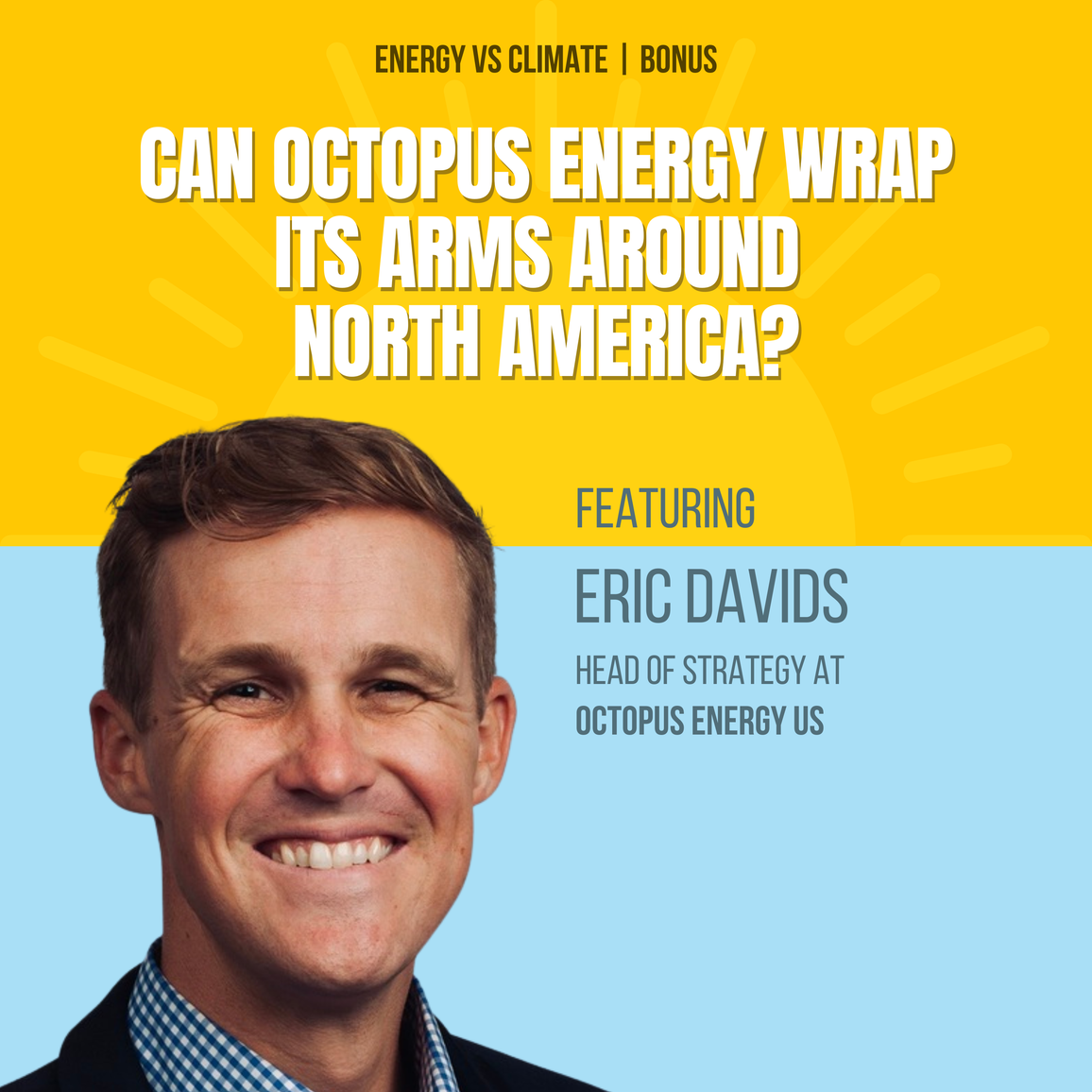
Can Octopus Energy Wrap Its Arms Around North America? | Demand Flexibility & More With Eric Davids

The company trying to transform the relationship between utilities and their customers.
During a recent heat wave in the UK, one utility paid its customers collectively over £100,000 to turn things down for a few hours, not through some grand new infrastructure, just a text message and a price signal. That company is Octopus Energy, and it caught our attention.
In this episode, Ed and Sara (David sits this one out) talk with Eric Davids, Head of Strategy for Octopus Energy's US business, about redefining utility-customer relationships, how approaches in the UK stack up against North American utilities' much blunter "please conserve" grid alerts, and what happens when consumers get real price exposure and it doesn't go well.
(Note that while EvC has a strict no corporate sponsorship policy, that restriction doesn't extend to plushie toys.)
Episode Transcript
[00:00:00] Eric Davids: In the heat wave, for instance, one of the things that we did was we had saving sessions where we sent a small notification out to customers to say, Hey, if you turn down your electricity during this period, you'll be credited for sort of the savings that you delivered.
[00:00:17] Ed Whittingham: Hi, I'm Ed Whittingham and you're listening to Energy Versus Climate, the show where my co-host, David Keith, Sara Hastings-Simon and I debate today's climate and energy challenges.
Recently during the heat wave that roasted the UK, one utility paid out to its customers over a hundred thousand pounds to turn things down for a few hours, not through some grand new infrastructure, just a text message and a price signal. That company is Octopus Energy. And our guest today is Eric Davids Strategy Manager for Octopus's US Arm.
We talk about what it actually takes to get people to shift their electricity use, how that compares to Alberta's much blunder. Please conserve grid alerts. What happens when you hand consumers real price exposure and it goes wrong. Know David for this one, it's just myself and Sara, and as you know, we rarely have folks from the private sector on the pod.
In this case, we're making exception because we wanted to find out more about Octopus and its model. So without further ado, here's the show. Eric Davids, welcome to Energy Versus Climate.
[00:01:21] Eric Davids: Thanks, Ed. Thanks, Sara. Glad to be aboard.
[00:01:23] Ed Whittingham: Well, we're glad to have you here. So you are the strategy manager for Octopus Energy Group, and so would love maybe right off the top if you could provide just a little bit of background on yourself, how you came to be the strategy manager for Octopus Energy Group, but then we'd love the A, b, C 1, 2, 3 on Octopus itself.
[00:01:44] Eric Davids: Yeah, absolutely. So I, I actually started my career in the Marine Corps and when I was thinking about transitioning outta the Corps, I was thinking about what industry I wanted to move into, and energy just struck me as a place where I could continue mission oriented work with sort of a, a collaborative space and just, just really sort of drew me in.
And I joined a company called Uplight, which provided utility customer engagement, demand side management services in North America for my first five years. And then about a year and a half ago, I, um, transitioned and joined Octopus Energy after having my eye on them for a long time. And Octopus, frankly, it's a, it's a pretty beautiful company.
It, it started in 2016 and, and the original sort of founding intent was that the founders believed there was a ability to reimagine how utilities interacted with their customers. And, and it's sort of no surprise that most people don't, don't have great relationships with their utilities, or at least don't think of them as a, as sort of more than a commodity provider.
And Octopus wanted to reimagine that and say, a utility can be fundamentally different in terms of how it serves its customers. And then over time as sort of the, the, the system has changed and as consumers are playing a more meaningful role, which we'll get into in the conversation, Octopus had a recognition that by creating a really strong relationship with our customers, they're better positioned to maximise the value of customer side of flexibility on creating a more.
Optimally managed system. So I've been following Octopus for a little bit of time. It has a major presence in, in the UK and other parts of Europe and Japan. Um, and it had a very small presence in North America when I joined, but I joined and really tried to figure out how we might grow in this market, which is very, very different than the liberalised retail markets that we had scaled in globally.
[00:03:27] Ed Whittingham: Hmm. I'd love to dig into all that, but just as a bit of a side note, and it's because for 10 years in sort of the early two thousands, through to the early 2010s, I helped run, uh, it was an internship programme with the Virginia Military Institute in that we would get VMI cadets up to where I live in the Canadian Rockies, place, some locally, sometimes local government, local businesses, NGOs, have them do, uh, research, writing internships, and then go back and having spent, uh, uh, hopefully a wonderful summer in Banff and having had their horizons broadened.
So for someone coming outta the Naval Academy in the Marines, how has that experience informed what you're doing now?
[00:04:06] Eric Davids: Totally. I, I think there's an element of. Sort of mission focus that I mentioned, and that's what drew me in. I think there's also, um, when I was in the Marine Corps, so much of the military is sort of revolves around energy and, and I had a sniper platoon and the, the limitation of the time I could keep my team out in the field was the life lifespan of the batteries and how much batteries they could carry on their backs.
I, I think it's, it's very well known that a lot of American deaths from the previous conflicts have been sort of caused in IEDs and convoys and many of those being fuel convoys. So I think there's this integral link between energy and, and sort of deployed operational military forces. And then clearly what we're seeing now is, is this sort of link between energy security and, and military and sort of the intersection of how energy can play a role in determining the strategic outcome of a conflict.
Even if you can have a tactical success, Iran's ability to have control of Straight of Hormuz clearly having a major impact on our ability to sort of free ourselves from, from this, this war of choice that we're in right now.
[00:05:11] Ed Whittingham: Yeah. Yep. And yeah, unfortunately I do know the reality of injuries that come out from IEDs as we had one of our band programme graduates, uh, suffer an IED explosion, uh, in Afghanistan.
But, uh, let's say that's neither here nor there for now. Tell me like what is Yeah. How would you define demand flexibility is, that's what, you know, Octopus Energy's business. You're in the business of demand flexibility.
[00:05:35] Eric Davids: Absolutely. So I, I, when I look at it, I think there's the what and the why and the how, and the what is that each of us as individuals in our homes has a demand shape, um, that our home sort of takes and that the utility can see.
And it's linked to our, our daily life patterns of when we wake up, when we turn our coffee makers on, when we turn our lights on, when we get home from work. And if you have an electric vehicle, you plug your electric vehicle in when you run your washer dryer, all of the patterns of how we live creates a demand profile in the home.
And the same is true for, for businesses. The same is true for data centres, which is, uh, a big piece of the conversation in North America. And demand flexibility is the ability to influence the shape of that demand curve in some way, shape or form. And, and the reason to do that is because energy is, has different prices at different times of day and it has different carbon intensities at different times of day.
So the ability to shift sort of usage to places where energy might be cheaper or cleaner is, is powerful. And then also on really hot days there's, or cold days in Canada, I know a number of provinces in candidates are, it's a winter peak. There, there's constraints in the system where, where there's, there's risks of instability if demand outpaces supply.
So the ability to go in and intervene and reduce demand during those sort of hot days or really cold days can be significant too.
[00:07:05] Ed Whittingham: Yeah, maybe And and sir, because it's timely and a practical application. Yeah. Chatting with your colleague Grace, who's in London, she has a fan running in the background because it's so hot.
So, you know, England has been, and, and much of Europe's been going through this really prolonged heat wave. So what specifically is Octopus doing say, to help the, reduce the pressure on the grid during this, the present heat wave.
[00:07:32] Eric Davids: Octopus integrates its flexibility into its customer centric retail programme.
And as I mentioned at the outset, we focus first and foremost on developing a strong relationship with the end customer. And then what we've done on top of that is roll on innovative tariff and sort of incentive re remuneration structures for end customers. So in the heatwave for instance, one of the things that we did was we had saving sessions where we sent a small notification out to customers to say, Hey, if you turn down your electricity during this period, you will be, um, you'll be credited for sort of the savings that you delivered.
And just in the past week, we were able to derive, um, 250 megawatt hours of flexibility, um, from customers who basically just responded to a small signal to say, Hey, I'll turn down, I know there's not sort of widespread AC usage, but maybe it's shifting someone's washer dryer out of a certain period. And we paid out over a hundred, a hundred thousand pounds to our customers by basically allowing them to participate in a very, very small way to reduce the strain on the grid during the heat wave.
And I think it's just indicative of the ability to, when you, when you have the, the sort of smart metres to allow for those types of programmes, you have the market design that allows for a dollar to basically be distributed to an end customer for participating in a value stream that a few years ago they wouldn't have had access to.
You can drive pretty meaningful participation and have a pretty meaningful effect. And, uh, that was just one example of what we did in the heatwave last week.
[00:09:06] Ed Whittingham: Got you. So you're figuring out a way to mega, uh, to monetize not the megawatt, but to, to use the phrase the megawatt, is that
[00:09:13] Eric Davids: right? The megawatt, yeah.
Yeah, yeah, exactly.
[00:09:16] Sara Hastings-Simon: And maybe I'll just jump in with a, with a comparison here, uh, in Alberta, um, I'm losing track of the years, so forgive me if I've gotten this wrong. I think it was a year ago in the winter when we all got these text messages, uh, on our phone via various, you know, alerts saying, please turn down your energy usage.
Been a couple times that we've gotten them. Mm-hmm. Um, and in this case it was really the system operator basically saying, you know, we, we have an issue with, uh, having enough power available, and so we need folks to take action to, you know, exactly as Eric was saying, maybe, um, don't start that dishwasher washing machine right now.
Something like that. And, uh, it was, you know, the good news is, is it was successful and, and Albertans responded, uh, but it was all based on kind of a, you know, collective good and do your part. Um, so, so the difference, one of the big differences there is, uh, it, it was missing that payout part. So anybody who turned down their, you know, didn't start their dishwasher, didn't get any kind of reward for doing that.
And, you know, people that, that didn't do it weren't of course weren't penalised, but they, but it all relied on this, you know, doing the right thing kind of spirit.
[00:10:27] Eric Davids: Totally. And what we've seen is it doesn't take a very high incentive to get someone to take an action. And obviously different communities behave differently, but even in, even in Texas where there's a little bit of a don't, don't touch by thermostat type of culture, if you will, we still see pretty good adoption when we have these saving sessions there.
And even if the incentive is one to two to $3, um, if we're able to communicate really crisply to end customers, um, we see pretty high adoption of people who are able to say, Hey, yep, I'll, I'll do that. Um, both for small benefit, but also for the community. Good.
[00:11:00] Ed Whittingham: Yeah, I, so when you say a few bucks, I'm actually surprised to see that people would be moved by that.
'cause I've often thought that we've had the technology to talk to our dishwashers to talk even to our fridges, thermostats for a while. But at the household level, people seem, you know, it's, it's a whiz bag thing. And look, I can turn my temperature through my smartphone when I'm away from the, from my home.
But very few people are actually using it to save money in any kind of way. Now, if the utility takes that over them and makes it a little bit thoughtless, then people are much more inclined. But you'd mentioned, you know, if you communicate with the end customer in effective way, you can help them to see the light, you know, of a savings of a few bucks.
So we've obviously, you said off the top, you've figured out how to do that in the UK, other parts of Europe, even Japan. But you say you've got a very small base in the us So is that for lack of trying to date, or is that for lack of effectiveness, or is that there are some other barriers in place for the American end user that aren't in place for European ones?
[00:12:06] Eric Davids: Yeah. Well, maybe I'll start by sharing sort of Octopus's approach to flexibility and what's worked in the UK particularly quite well, and then move into sort of what of that can translate to the US and what of that we have trouble translating. And, and one of the sort of things that I, I, I think about when I think about flexibility is someone, someone who, um, has an energy bill, um, and they might have an ev, they might have a, a thermostat for that person.
All of these things are related to their energy. However, in the US right now, someone pays their energy bill to their regulated utility. They might receive a incentive for being part of a thermostat and response programme, and they might have a separate programme where they have their EV enrolled in a managed charging programme and they receive a gift card every year for being part of that programme.
I think what Octopus has been able to do brilliantly in the UK, and a lot of it's around market design, but a lot of it's around the, the thought that went into the customer value proposition development was integrating all of these into a single customer decision where, where Octopus is able to sell an outcome to a customer and to say, do you want 50% charging at night or 70% off your, your charging at night compared to what it would be sort of in a normal tariff structure.
And a customer says, yeah, that sounds great. I'd love to have 70% off my EV charging at or free EV charging at night. And then that person is enrolled in the Octopus EV tariff. And then over the course of the night when the person comes home, they plug their EV in Octopus is able to determine when that vehicle charges and um, when it's not charging.
And then there's an outcome where in the morning when the person goes to go off to work and take their charger out, we, we ensure that the vehicle reaches the set point that the user or the owner had established previously. And I think it's selling that outcome that's integrated into the energy plan where then when the customer receives their energy bill, they see a credit of for all of your EV costs, they were discounted by 70% off what they were sort of in normal hours.
And we take all of the complexity around sort of trading the flexibility of that asset away from the end customer and they're just sold an outcome that is frankly is too good to refuse. It's like that, that's a great deal. And then we sort of articulate it in a way that is very consumer friendly and in integrally linked to the energy plan.
[00:14:33] Ed Whittingham: Sorry, Sara. Uh, it would be useful, uh, um, maybe if you could explain it using the Canadian context or maybe specifically the Alberta context because as in, in our province here, Eric, you know, we, we don't have any time of day incentives for when we charge. So Sara and I both have EVs, whether we charge it in the middle of the day during peak hours, middle of the night, there's zero difference in the price and therefore zero incentive.
So what do you do is you come back and, you know, you're getting in at supper hour, you're doing what everyone else is doing, just charging it right away because you're there. That's when you think of it. But there is an incentive for the utility itself based on the pool price. And, and, uh, Sara, maybe you could explain the mechanics of that, because what happens behind the switch is still a bit of a mystery for a lot of, uh, consumers.
[00:15:20] Sara Hastings-Simon: Yeah. Um, you know, I think we're, we're sort of like in between this, you know, kind of utopia that Eric, uh, describes where you have kind of someone managing this all for you and the world where, um, you, you have none of it being done in the sense that the way that, uh, consumers in Alberta see pricing, as you say, ed, we don't get a price, we don't get charged different amounts for electricity at different times of the day when you use it.
But the way that electricity is generated and sold on the market at a whole, as a whole within the province does have this variation down to right now the, the hourly level. So what that means is that every hour the system operator, um, is essentially, you know, making, making the markets, uh, come together and clear.
And so there's a certain amount of electricity that's needed and, and different generators offer to sell that electricity at different prices. And then you essentially, you know, you get a clearing price where the supply and demand, uh, meet and that is the hourly price for power in the market. And that price can vary actually wildly.
Right? So there are, and, and in fact in Alberta where we have an increasing amount, as many places, increasing amount of renewables, we also have a very large co-generation base. There are an increasing number of hours where the price of power is actually zero. So it's, uh, it's kind of. Almost, I think sounds unbelievable when you tell people like, how could that possibly be be the case?
But there are an increasing number of hours where it is free to purchase power in Alberta, and then you have the other side of the other end where you have, you know, hours where it costs, uh, you know, thousand dollars, uh, per megawatt hour to, to buy power. And what you and I see as a consumer at the end of the day, or sorry, at the end of the month, I should say, is an average over this sort of average shape.
So there, there's a kind of shape defined for the average profile of residential electricity use in the province of Alberta, and we see a price that is, you know, somehow related to the, the weighted average across those hours. And I say somehow because then moreover, right now we have a, um, we do have a competitive retail market in Alberta, so that's why you, you know, if you live in Alberta, you get all these like cards in the mail, switch to so and so energy and you'll get, uh, this much savings.
Uh, but, but the offers are relatively limited. So right now you have the offer of having a so-called floating rate. So you basically end up paying, you know, that average market price or you can have a fixed rate, which is, um, a companies gonna offer you a guarantee based on their forward projections. So you get some, you know, security there.
So that's kind of, there's a little bit of choice there. By the way, if you follow Blake Shaffer on, on uh, X or Blue Sky, he often tells people when it makes sense to switch from one to the other. So there's a little plug for my electricity centre, uh, co-director, uh, with his trading experience. But, but that's about it.
There's no ability, you know, gi, given what I just told you, that there's these hours where power is free, of course it would be great if, you know, you and I could charge our EVs then, or we could, uh, start our dishwashers then and, you know, not charge our EVs when it costs a thousand dollars an hour and that's where, um, Octopus or, and, and this kind of demand flexibility type of offerings comes in that, that we don't yet have to date, um, in, in Alberta.
[00:18:49] Eric Davids: Yeah, it, it's interesting and, and I'm not an expert at Alberta, but I, I do wonder. A lot of the dynamics are pretty similar to Texas and, and fairly similar to the UK and competitive retail and advanced metering. I, I forget, what is the penetration of advanced metering in Alberta? Do you, you know, off the top of your head?
[00:19:09] Sara Hastings-Simon: I don't know. I always forget the number be because in, in Calgary it's basically zero. So in my very provincial, mine is zero, of course not in, uh, in Edmonton we have, there's a lot more. So it's, it is, you know,
[00:19:21] Eric Davids: yeah,
[00:19:21] Sara Hastings-Simon: close to 50% or something, but we, but we don't yet have the ability to, um, you know, reregulate on a regulatory level to look at the hourly power use and use that to do, uh, billing in Alberta.
Yeah,
[00:19:35] Eric Davids: because in the UK I mean, what we kind of saw is after half hourly settlement existed, after there was deep smart metre penetration and the combination of sort of innovative retail, you were able to start to create these offers that, again, they were offers that were too good for customers to refuse.
And that's what sort of turbocharge flexibility in the UK and really beyond sort of the levels of penetration that we've seen across North America, because it's just sort of fundamentally a different customer value proposition. But it was sort of those, those were the fundamental factors that were necessary to be in place first.
And it sounds like Alberta, similar to maybe. Texas and Texas might be a little bit more advanced, but it's on its way. It's just, it, it's, it's a sort of, there's a little bit of like preconditions to creating sort of the, the type of business model and type of customer offers that Octopus have been able to do in the UK.
[00:20:23] Sara Hastings-Simon: Oh, ed, just to, just to follow up on that, I mean, I would say that the key thing is that, and maybe just to explain for the, the listeners Yeah. This, you know, this hourly piece. So like, you know, if you go look at your electricity metre, uh, it'll ha you know, the, a sort of dumb metre has this little spinning circle, or maybe it even has a digital readout, but it's not looking at that hour, a power use within an hour.
It's really just like the total counting up. And so obviously if we're talking about being able to, you know, use power in the hour when it's cheap and not use it when it's expensive, um, you need that ability to know how much power you're actually using in that one specific hour. So you have some infrastructure constraints that, that you need to unlock this in a, in a place like Alberta as well as others.
And then you have the, the ability, you know, the rules that the regulator sets that says, you know, you are allowed to make an offering to a consumer that has this kind of, uh, like structure to it where, you know, you're, you're letting them pay less at some hours versus others, um, is sort of, you know, which I think it's fair and Ed not to, not to take over, but maybe we can talk a little bit about that, that next is like, okay, so, you know, why not just throw the regulations out?
Let just let companies do whatever they, whatever they wanna do. Uh, and so maybe you, Eric, you could talk a little bit about, I mean, I think there's been examples of some utilities that have tried to do that where it's like, well, we'll give you full exposure to, you know, hourly pricing and that sounds really great when you get to pay the zeros, but sometimes that can go really wrong.
So like, what are the guardrails in place? Or like how does this get approached in a way that, you know, accesses those savings but doesn't leave someone, oh my God, I need to charge my ev and it costs a thousand dollars for this hour. Like, I've now lost, you know, all my savings.
[00:22:11] Eric Davids: I think we saw some of the pitfalls of sort of raw price exposure in winter storm Uri, and there were a couple of retailers who had full price exposure and, and all of a sudden their customers were met with incredibly high bills and, and led to a bit of a catastrophic problem.
Um, so, so I think we, we have sort of. Tended to be on the, sort of the retailer, the, the, the utility, if you will, is, is better positioned to take risk than the individual end customer and to sort of aggregate that risk across individuals. So I think what we have tried to do is to create a system where customers have the ability to participate in these new value streams.
They also always retain control of the devices in their homes. For instance, in our electric vehicle product, when someone plugs their electric vehicle in, and we have our algorithm of saying that won't charge until midnight, but if that person needs it charged earlier for one reason or the other, they can press a, um, I forget the terminology, this is in our UK product, but it's some boost.
It's a boost charge and they can, they can basically have it charged automatically. The same is true for thermostats. If, if there's a demand response programme where there's a sort of a turn, turn down or turn up of, of thermostats, but someone has an elderly person visiting their home, there's always the ability to override that sort of turned out signal from the utility.
I think what we've seen though across both EVs and thermostats is that on average the amount of people, if you sort of execute your algorithms effectively, you execute your communications effectively. The amount of people who opt out is between two and 3% of these programmes. So it's indicative of done right.
Generally you get pretty good participation and then you also aren't sort of passing on a tonne of the, the risk, the market risk, the end customer who's just not positioned to take that risk or think about it and it's just not part of their mind share. So, so, um, it's better to create something relatively simple and easy to understand and sort of not necessarily make them have to be checking half hourly energy prices throughout their workday.
[00:24:17] Ed Whittingham: You talked about preconditions that need to exist for, you know, a successful market entry for Octopus energy and I'd imagine so one I don't know about and have a question, the other, maybe it'd be clear like you, you'd need to have some sense of how meaningful the opportunity is, and that is based on the overall load.
Is consumer demand a significant part of the portion or is it an insignificant part of the portion relative to industrial and commercial demand? And then the second one I'd love to hear about is microgeneration. Are you more likely to enter a market that has a significant number of micro generating consumers or does that not factor in?
[00:24:59] Eric Davids: That's a good question. I mean. I'd say, I'd say we're at this inflexion point as Octopus Energy Group where most of our market entry has been in places where we've gone in as a liberalised retailer. So we have a large business in the UK. Obviously we have large businesses in Spain, France, Germany, Italy, and, and Japan.
And when I joined Octopus a year and a half ago, we had a, a business in Texas as well, a retail business. And I think our sort of next horizon is saying, where can we enter in, in support of regulated utilities where an end customer, so sort of, I think everyone in Canada except for Alberta, doesn't get to pick who they get their energy from.
And I think in those instances, the question is, um. Is customer service a priority? Is there, is there a incentive and a desire for the utility to be more customer-centric in its approach to end customers? Because some utilities, there's actually no incentive to, to be more customer-centric. And then secondly, is flexibility a regulatory requirement or is it a strategic imperative?
And a lot of sort of thermostat demand response programmes in the US sort of when I first came outta the Marine Corps and joined the industry were, I'd say more of regulatory requirements. And it was smaller and this industry has evolved quite quickly, but um, it was more of saying, Hey, we need to have 10,000 thermostats in this land response programme, but that's not going to be at all sort of integrated into our planning or our operations.
Octopus is interested in entering is utilities who are starting to view flexibility as a key value driver in this sort of new era where a lot of renewables are coming online and a particularly a way to unlock value for end customers. And Octopus sort of has this theory that the energy transition, it, it must be good for the end customer, it must sort of have ways of tangibly bringing down prices.
Electra tech must be better than fossil fuel alternatives. And sort of we are bullishly on the side of sort of advancing strategies aligning to those sort of tho those missions, if you will. And to, to your point about sort of microgeneration, I think it's, I think it's really interesting and, and to try to figure out sort of are there areas where we can sort of better maximally use sort of prosumer activity and whether that's sort of having a whole fleet of, of solar and saying could we add batteries to that fleet and could that create sort of more optimal system effects?
I think there's a lot around, um, sort of balcony solar and, and sort of small micro batteries that we're exploring right now. And really what it comes down to, maybe to put a period on it is it's trying to find ways to empower end consumers to save money and take part in value streams that previously were unavailable to them.
And wherever we can do that, I think we're keen to, keen to dig in.
[00:27:46] Sara Hastings-Simon: Just picking up on, on what you were saying there about kind of, well two, maybe two questions and one, one is like yeah, how would you explain why now is different, right? Because I think to be critical, one could say, okay, we've heard about this like prosumer and consumer involvement and all these things and you know, that is a little bit of a hype cycle like data really deliver.
Why, why is now different? And then maybe in addition to that, in cases where you are working with consumers sort of at at large scale, how does it, you mentioned like a changing relationship with the utility. Do you think it changes their relationship with energy as well too? Or is it so hands off that it's kind of still like outside of their, you know, it doesn't quite change the way they think about energy, I guess.
Is that
[00:28:31] Eric Davids: Yeah.
[00:28:31] Sara Hastings-Simon: Question for you
[00:28:32] Eric Davids: to, to your first question and I mean these themes are well documented, but on your show too, but I think the story of demand growth, the sort of imperative of affordability and how that's sort of a top. Ballot election issue in a lot of US states right now. And then also just, um, sort of, it's a, it's a what got us here isn't gonna get us there moment.
I, I think in the sort of us utility industry and, and continuing to sort of have a sort of CapEx heavy business model and, and not necessarily focus on utilisation is going to continue to lead to higher rates, which is increasingly untenable. So how do we sort of get out of this spiral that we're in and think differently?
And, and I said the word utilisation, I think a lot of it's around how do you better utilise the resources you have today? And sort of as one, as as one sort of specific example in there too, that sort of is, is thematically aligned to what I just said. I think a lot of this data centre, low growth, I mean, it's well documented too that it's being slowed down by communities that are pushing back and saying, Hey, I, I, I don't want that in my community.
I think it might raise electricity rates. And, and I think there's a lot of perception about that and is, is there a way to sort of use this inflexion point in the US energy system, which, which is in a fundamentally different place than it was a couple of years ago to, to say, Hey, let's accelerate the deployment of electrified technology into homes.
Let's optimise those assets in new ways. And a lot of this is around batteries too. And I, I think this, I think VJ in the podcast a couple weeks ago was talking about battery cost declining so rapidly and fundamentally, like could you pair sort of all of these trends together to create a lot more electrified tech in homes, have these optimised in such a way that increases system utilisation and ultimately brings down costs for and customers.
I think, I think that's kind of the moment that we're in and we see sort of consumers as a part of the solution in a way that a few years ago, I, I think it was sort of, you're just, you're, you're paying a bill and you're sort of more of a taker that a participant. And, and maybe that gets to your second question.
I think it's, it's how well sort of your and my relationship with electricity change over the next five to 10 years. I think it's, it's gonna be interesting to see can utilities provide the type of customer-centric value propositions that Octopus is able to do in the UK and other markets globally. And, and Octopus has had a lot of enabling factors to enable, enable that type of relationship with an end customer.
But, um, let me just give an example of my home utility where I, I, um, I get a home energy report every month that says you use this much energy in comparison to your neighbour. Um, unfortunately it's higher than my neighbour, but that report doesn't acknowledge that I have an electric vehicle and I'm participating in that electric vehicle in a separate.
Utility ev managed charging programme. And separately, there's a, a smart thermostat programme which I can participate in, but that's, again, communicated in a separate channel to me. And I think it's, is there a way to essentially sort of say, Hey, we've had a lot of learnings about the value of demand flexability, we've had a lot of proof points and a lot of these programmes are quite scaled, but to sort of bring all those together so that when a utility interacts with an end customer, they're able to share sort of a more coherent customer experience of saying, Hey, you've used this much energy last month, here's what you've used it on.
Here are a couple of ways that you have eligible to you to save money that might be switching onto a time of use rate or participating in a, uh, in a home energy efficiency programme. And then here are a few ways to participate in new value streams that previously might have not been available to you.
And can you provide that customer-centric sort of interface that allows for someone to fundamentally start to view their utility differently and, and to have these programmes that utility has and has proven in a more streamlined way. And I think that's where, where we, we hope to get to. And I think the question is, does the utility on that or does Tesla have that type of experience for their end customers or Renew home, have that type of experience for their end customers.
And it's a, it's a complex ecosystem and it's sort of. I think it's sort of where do customers mind shares go when they think about sort of their energy management of their home?
[00:32:34] Ed Whittingham: Well, I've got, I've got an anecdote about, uh, great customer experience, but just before that, just to
[00:32:39] Eric Davids: Yeah.
[00:32:39] Ed Whittingham: Date stamp. Uh, this recording just today meta announced, uh, it's going to spend 13 billion to develop a one gig data centre, uh, for power AI here in Sturgeon County in Alberta.
Wow. Yeah, we had our premier, we're in the midst of, uh, the Calgary Stampede and make the announcement with a nice cowboy hat on and everyone's super excited. But the customer experience I wanted to refer to, and this is going back decades to the mid nineties when I was a student in Japan, living in an international exchange student's dormitory and per room, you would need to go down to the lobby, feed a thousand yen notes into a machine that would then buy you electricity credits that you could see next to your thermostat in your room.
And so during a hot Japanese summer, if you're running the air conditioning, you could see that balance rapidly dwindling and was this great constant visual reminder of the impact financially of you using electricity. And so much so that when the dorm room next to me came open in the summer and we're connected by the same balcony and the sliding door was left open and when someone left, they would just reset it to near infinity, the electricity 'cause no one was in there.
I would sneak into the room next door, turn the air conditioning on and sleep there so that I could use that free electricity instead of paying for my electricity in my own room, showing that people will hopelessly game the system if they're able to do so. But that does lead to a serious question. It, your Octopus energy you said is in Japan and Japanese have this interesting relationship with electricity and especially post FUKushima, and they seem to have measures that give that direct sort of message, that direct signal more to consumers there.
At the same time, it is a very Byzantine system that they have with electricity generators and retailers and whatnot. So I'd be curious to know what specifically have you learned from your foray into the Japanese market, and are any of those lessons transferable to other jurisdictions?
[00:34:47] Eric Davids: You know, ed, that your anecdote was awesome to hear.
I, I haven't worked closely with that piece of our business, so I'm not in the position to sort of share specifically, um, like, like our de detailed learnings from our, our, our business in Japan. It's a, it's a joint venture with Tokyo Gas and yeah, there's not in a position to share sort of more deeply about that.
I'm sorry.
[00:35:09] Ed Whittingham: Yeah, yeah, no problem.
[00:35:10] Sara Hastings-Simon: As we're talking about energy transition writ large, I think there's always this thread of equity that runs through it all, right? In terms of, are the ways that we're changing our, our energy systems going to improve equity, you know, maintain a, a system that's that's already not equitable or, you know, make things worse and, and, uh, make things less equitable.
How does demand flexibility come in and kind of, again, is it like, are there pitfalls to look out for? Like, we talked a little bit around, you know, that there being risks of going to a full price, uh, exposure system. Uh, is it inherently more equitable? What, you know, what's, what's your view on that or what needs to be done to, to ensure equity?
[00:35:55] Eric Davids: I think one of the risks as we branch out of. Sort of smart thermostat based flexibility, value is, is that just the resource types that people would have to buy to participate? Uh, electric vehicle a, a battery, uh, heat pump are, are pretty expensive upfront. And, and I think one of the focuses is on how those can, the, the upfront price of those can be brought down, leveraging the tail value of flexibility.
And I, is there a way to have a, a lease for one of these assets and maybe batteries or, or sort of heat thumbs, which I think can be seen as a thermal battery, um, or maybe easier to think about in this respect than EVs. But is there a way to, uh, a way to think about it where as part of the financing package, you can leverage the long tail value of the flexibility to bring down the cost.
So for someone, it's actually a very affordable thing to instal in their home. And, and also there's a, a time of use rate, as we were talking about earlier, whereby installing a battery, they are actually probably saving more money than they're paying for in the lease cost by participating at a time of use sort of arbitrage.
And I think that that's the type of innovation that we're, we're leaning into. 'cause we have a very strong view that we want sort of, again, it's green energy, good for people's bills and it's, it's for everyone's bills. And I think it's, it's sort of parti people who are directly participating in the programme by having these assets on their homes.
And then ultimately it's are you, are you bringing down the system costs too? But I think, I think that's, that's kind of the key is, is can you, can you bring down the upfront costs? Costs and can you sort of spread the benefits to, to everyone participating Is, is the objective. Maybe the one other thing that I'll add there, Sara is, and I, I don't think it's legal in Canada right now, but there's a lot of movement right now in sort of balcony solar and small batteries and homes in the us.
And I think is, is there a pathway to creating more opportunities for people with sort of smaller prosumer type systems to, to participate And then also time of use rates, behavioural demand and response there. There's ways to sort of provide these value streams to people without the need for sort of big upfront costs.
And I think trying to lean into those two along with sort of bigger battery programmes and whatnot.
[00:38:13] Ed Whittingham: Yeah. And, and if, if you're go in and ask a policy maker for any of those incentives, the first question is going to be because we're still in an affordability crisis, is this going to create increased costs for any end user, any consumer, or is this going to lower costs?
And it's not enough if that, you know, well we're, we're gonna have a financing mechanism which is gonna spread the pain over several months or several years. It really is, there's no appetite right now for anything that's going to increase costs. And it seems like Octopus has figured out a good way to come up with something that benefits both the climate, but also really benefits the consumer at, at a time when the, the climate isn't an afterthought, but it's certainly, you know, lowered down the list of, of priorities right now in the face of this affordability crisis.
[00:38:58] Eric Davids: Yeah, no ab absolutely. Yeah.
[00:39:00] Ed Whittingham: Well, Eric, thanks so much. Listen, I, I will say on energy versus climate, it's rare that we have someone from a company come, you know, and appear on the show. We're, we're very careful just about there not being any kind of conflict of interest. Unlike certain prominent politicians these days, like the president you have, uh, in your country and is 2.2 billion, most of that from crypto, or even as we were talking to your colleague, Nigel Farage, who seemed to have no problem getting paid whatever it was, 5 million pounds from a, uh, a crypto investor prior to entering public life.
But now, of course, uh, he is set to face in this selection as a result, count bin face. And, uh, we'll all be watching that and we'll be very curious to see if utility costs feature into that local election. But, you know, while we don't, we don't take any, you know, payment that's not pay to play. We're certainly not opposed to getting swag.
So, you know, if there's some nice Octopus energy mug or a hat or something like that, you know, that doesn't, uh, breach our conflict of interest. Guidelines just wanna be clear. And I,
[00:40:03] Sara Hastings-Simon: I have been like for years wanting one of those little Octopus stuffies. So, you know, when you, when you were saying that we don't, we don't accept any payment.
I was about to say, speak for yourself 'cause I'm still hoping to get my hands on one of those. Uh,
[00:40:15] Eric Davids: we, we could arrange that. Yeah. Her name is Constantine. We'll, we'll ship a couple of your away. No, thanks for having me. Um, love what you guys do and really appreciate the conversation.
[00:40:25] Ed Whittingham: Thanks for listening to the special summer bonus edition of Energy Versus Climate.
Subscribe to our YouTube channel for video versions, clips, and add a comment or question while there. And if you have ideas for show topics, send them along to info@energyvsclimate.com. That's info@energyvsclimate.com. We'll be back in September with a brand new season of shows. In the meantime, keep an eye on the EvC feed.
We might be dropping some more bonus content this summer. And as always, thanks for listening.
About Our Guest:
Eric Davids is Head of Strategy at Octopus Energy US. He leads the company's strategic growth initiatives, partnerships, and corporate development efforts. Before joining Octopus Energy US, Eric served as Senior Director of Advisory at Uplight. In that role, he worked with utilities and energy providers to advance customer energy programs and grid modernization initiatives.
Eric began his career as a U.S. Marine Corps intelligence officer after graduating from the U.S. Naval Academy with a degree in Ocean Engineering. He later earned a master's degree from Durham University and an MBA from Duke University's Fuqua School of Business. His experience spans military service, business strategy, and climate technology, offering a unique perspective on the evolving energy industry.
About Your Energy vs Climate Co-Hosts:
David Keith is Professor and Founding Faculty Director, Climate Systems Engineering Initiative at the University of Chicago. He is the founder of Carbon Engineering and was formerly a professor at Harvard University and the University of Calgary. He splits his time between Canmore and Chicago.
Sara Hastings-Simon studies energy transitions at the intersection of policy, business, and technology. She’s a policy wonk, a physicist turned management consultant, and a professor at the University of Calgary where she teaches in the Energy Science program, and co-leads the Net Zero Electricity Research Initiative. She has a particular interest in the mid-transition.
Ed Whittingham isn’t a physicist but is a passionate environmental professional. He is the founder of Advance Carbon Removal, a coalition advancing demand side solutions for carbon removal in Canada. He is also the former CEO of the Pembina Institute, Canada’s widely respected energy/environment NGO. His op-eds have been published in newspapers and magazines across Canada and internationally.
Produced by Amit Tandon & Bespoke Podcasts
Energy vs Climate: How climate is changing our energy systems
www.energyvsclimate.com