Stuck in the Middle: The Mid-Transition Crisis & the Energy System's Awkward Middle Age | With Emily Grubert

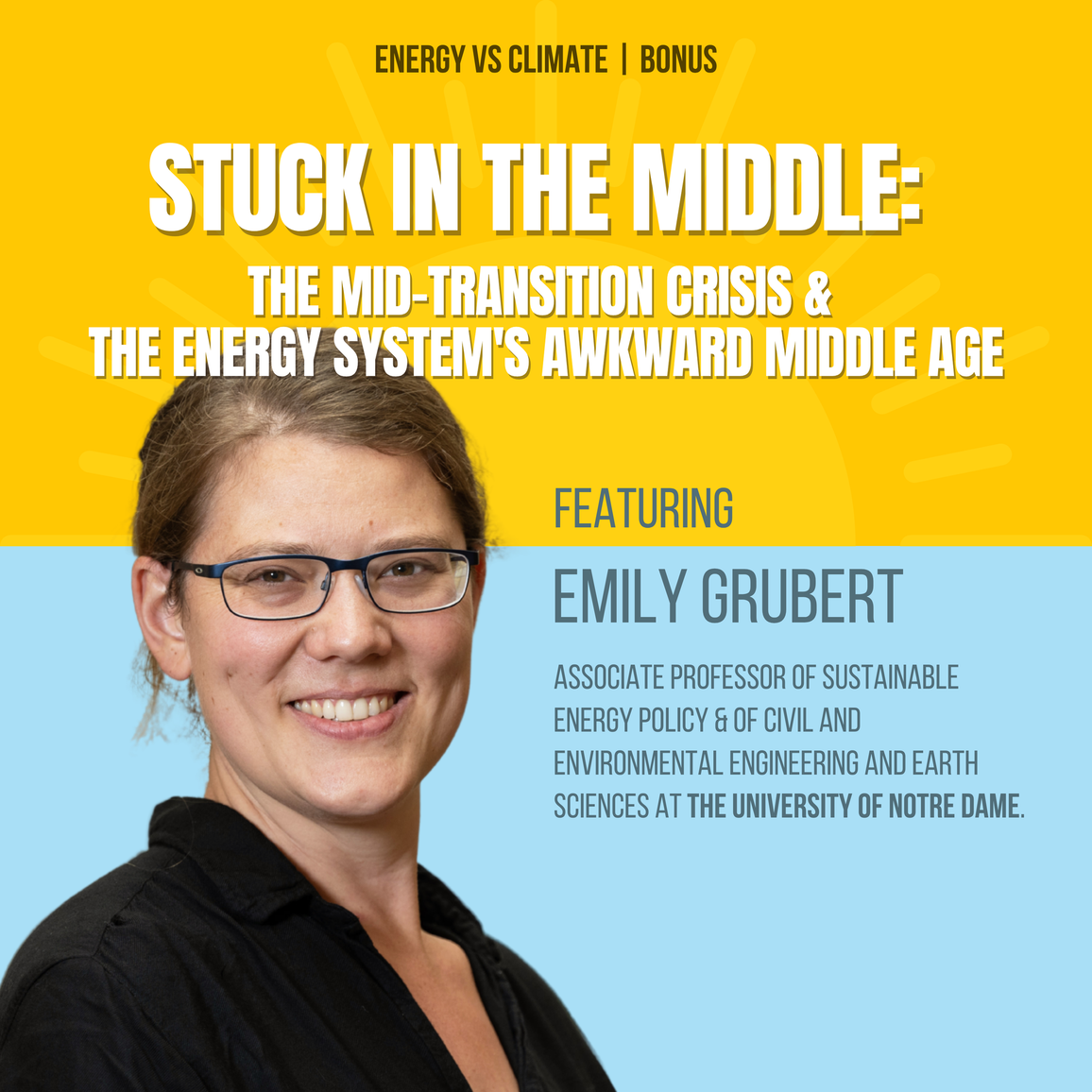
Decarbonization usually means addition: more wind, solar, EVs. But a real transition also means taking something away.
We talk about decarbonization like it's a shopping list: more wind, more solar, more EVs, stacked on top of whatever's already running. But a real transition means something also has to come off the list. Fossil systems have to shrink at the same time clean systems grow, and for a good stretch in the middle, both have to serve the same demand at once. Neither one can do the job alone, and each ends up constraining the other.
Civil engineer and environmental sociologist Emily Grubert (University of Notre Dame) calls this overlap the mid-transition, and it's the subject of a paper she co-wrote with Sara. Ed sits down with both of them to work through what the concept actually means once you get past the label.
Some of what's in this one:
- Why refineries and coal plants can't just wind down smoothly to zero, and where the "minimum viable scale" wall actually sits
- What Alberta's coal phase-out got right, what it missed, and why the coal companies got compensated a lot faster than the communities did
- Whether the oil sands could shrink one asset at a time, or whether losing one piece, a pipeline, an upgrader, takes more of the system down with it
- The uncomfortable question at the centre of it all: is a slow, managed phase-out actually the safer path, or just a longer runway for incumbents to extract concessions on the way out.
Episode Transcript
[00:00:00] Emily Grubert: Ah, no, you don't want this to take a long time. You want to move through this as fast as you possibly can with the possible having the big asterisk of like without blowing stuff up basically, 'cause that's the risk in many of these cases
[00:00:13] Ed Whittingham: Hi, I'm Ed Whittingham, and you're listening to Energy vs. Climate, the show where my co-host David Keith, Sara Hastings-Simon, and I debate today's climate and energy challenges.
Today, we're digging into a paper that Sara helped write alongside our guest, Emily Grubert, a civil engineer and environmental sociologist and associate professor of Sustainable Energy Policy at the University of Notre Dame. Emily and Sara co-authored a paper called Designing the Mid-Transition, the framework for today's conversation.
Decarbonization usually means addition, more wind, more solar, more EVs. But a real transition also means taking something away. We get into what that looks like on the ground, why a refinery can't wind down to zero, what happens in coal towns when plants close early, [00:01:00] and whether Alberta's oil sands could shrink piece by piece, or if losing one part takes the system down with it.
No David for this one, so just myself and Sara. Here's our conversation with Emily Grubert. So Emily, before we get into infrastructure and models, can you give us the plain language version of what is mid-transition, and how would an ordinary person know that we're living through it?
[00:01:25] Emily Grubert: It's a great question.
I think Sara's had this experience too, but a lot of people that have, uh, sort of gloriously picked up on this concept, I think will call things mid-transition issues that I don't think they actually are. Um, but basically, I think the way that I think about it is that there is fundamentally, like mathematically must be a period when you're going from something big to something small and something small to something big, where there's a lot of dynamism about what's-- how big.
This is not very articulate, but I, I think the point that I kind of wanna make is that a mid-transition where you have one system that's shrinking, one system that's getting [00:02:00] bigger, they're both trying to serve the basic same things, you fundamentally have to go through a period where there is some complicated constraints that each is imposing on the other.
I think sometimes people ask like, "Oh, could we avoid this?" Like, no, not really. Like to go from big to small, you actually have to go through all of the other sizes, and similarly, to go from small to big, you have to go through all the other sizes. So when you're doing that at the same time, you end up in this situation where you have one declining system, one growing system, and a lot of uncertainty about who's doing what at any given time.
[00:02:31] Ed Whittingham: So it's not necessarily a period on a calendar, it's you're talking it's a percentage. Like how do you mark it? Is it a percentage of technology adoption, or is it a condition a system enters?
[00:02:42] Emily Grubert: Yeah. So I think qualitatively, the way that I think about it is when you have a situation where both systems are constrained by the other, and also neither system can provide all of the services that you need from, like the energy system in this case, that's when you're in the mid-transition.
I [00:03:00] think Sara and I spent a lot of time trying to figure out whether we could put up some quantitative heuristics, and we're sort of amused and also annoyed to come up with like, maybe this is about eighty/twenty. But looking at what we've seen from some of the systems that are Out there, we do start to see those instabilities associated with the big system basically not being able to just muscle through it around twenty percent penetration by an alternative that's sort of technologically different.
So, you know, example, if you have a lot of inverter-based resources on an electricity system that wasn't initially designed for that, you start to see things like curtailments or super rapid ramp rates for gas turbines or things like that around that twenty percent mark. We're not probably in the mid transition for a lot of other energy systems besides electricity, I would argue.
And so it's a little hard to tell whether that's gonna be similar. I think it probably is. There's a reason people use the eighty/twenty heuristic. But roughly, I think qualitatively, it's when you start to see the dominant system really getting constrained by the other one, I think is [00:04:00] probably the easiest way to spot it.
[00:04:01] Ed Whittingham: Sure. And that's good to know. I, I was wondering, are we actually in it? You say probably for electricity, not for buildings and transportation yet. But can you apply the eighty/twenty or the inverse, the twenty/eighty example specifically to electricity? So what is that shorthand for?
[00:04:16] Emily Grubert: Yeah. That's shorthand for when you have about twenty percent penetration by the new system and eighty percent maintenance of the old system, that's where you probably start to see this entry.
It can look a little bit different depending on what your resource stack is. So some clean energy resources are more like the old fossil thermal-based electricity system than others. The, I think the typical example, and I generally agree with this take, is that nuclear tends to read like a fossil asset in these contexts.
So a situation where you have big central station thermal nuclear plants is not really going to put you in this challenging period where you're really having to think about what your institutional capacities are and how you regulate this, what kinds of KPIs you use to tell whether you're hitting your reliability [00:05:00] targets.
Whereas something like wind, where you don't really have that same, like I'm making spinning AC, I'm synchronized to all these other generators, like that is actually technologically fundamentally different. So I think the, the twenty percent of what we would probably typically refer to as modern renewables is kind of where we're starting to see it on the electricity side.
[00:05:20] Ed Whittingham: Gotcha. I mean, so it's not simple substitution. You know, you've got fossil, you've got zero carbon systems. Neither can provide all the services that we need alone, and each changes the, the, the conditions of the other. And maybe Sara, to bring you in, so when we think of transition, we're also thinking of just adding clean energy What do we miss when we treat decarbonization as just a problem of addition rather than decarbonization as simultaneous phase in and phase out?
And that can create problems.
[00:05:56] Sara Hastings-Simon: Yeah, so o- obviously you've been doing your homework, Ed. I think you've- [00:06:00] you read the, the paper as well, um, because that is the other kind of big thing that comes up in, in the transition. And this is interestingly, like, for, for all the annoyance that I have with people who've said, "Oh, you know, there's no way we can transition because we've never really, like, phased things out before," um, I think there, there's a nugget of truth in that, which is exactly, you know, a transition, a true transition when we're talking about addressing climate change does mean a phasing out of fossil fuel systems.
And there is, I think, politically, and, and we see that here in Canada, you know, I would describe it as sort of the all-of-the-above solution, where people have been for, you know, frankly, decades now talking about this idea of like, "Well, we can all just be happy and get along. We won't talk about, you know, phasing out or shutting down anything.
We're just, we're just adding more and adding new." And so what I think is also, uh, a big part of the concept of, of mid-transition [00:07:00] is this idea that not only do you have to think about what you're adding, but you actually, at some point, especially, you know, somewhat later on than probably that, that, uh, 80/20 point, uh, the end side of it is thinking about what you're taking out.
And that has, obviously, impacts to, to labor and, and to the economy, but it also has structural impacts as well, too. And so the other piece around the mid-transition that comes out is, you know, what happens as you start to scale down these large infrastructures that have been built in a very... It's like a, as a physicist, I want to say it's sort of like related to the idea that time is, you know, moves only in one direction.
It's not, you can't necessarily just reverse things and take them apart and expect things to continue to work as they have, uh, before. And so, you know, that's where Emily and her co-author, uh, Josh, uh, have this new work that looks at, you know, what is kind of this minimum viable scale [00:08:00] of different types of energy technologies and how those might evolve, and that's an area that I'm really interested in as well, too, doing some work looking at, you know, what happens from the gas station perspective of, you know, when do you stop being able to, say, refuel a vehicle or something like that, too.
[00:08:15] Ed Whittingham: Thanks. That's, that's helpful. And Emily, going back to one of the core arguments is that- Neither system, the new system or the old fossil-based system, is optimized in the middle. But Sara alluded to it, like with gas stations. What are some of the compromises or the concrete compromises that the old and new systems force on each other?
So, you know, just thinking of one, you've got gasoline infrastructure, refueling infrastructure. It loses customers, but it retains all those fixed costs- Right ... or not so sunk costs. And the other one is, say, renewables, which you said this is where we're actually in the mid-transition phase, but a lot of renewables is now relying on low utilization gas-fired electricity [00:09:00] backup.
And it's low utilization, so it's suboptimal. Can m- maybe unpack a couple of those, those compromises.
[00:09:06] Emily Grubert: Yeah, and in those cases, I think that's examples where the new system is constraining the old one. I actually... I think when the media specifically has pieces on this, it tends to be like, "Oh, all these terrible things are happening to the energy system because of renewables."
I would argue that the fossil systems are not being as nimble as they claim they can be, and so this is not really, like, the fault of solar or whatever. But, like, similarly, we see a huge amount of complexity, especially in the United States, where we have production tax credits that depend on a facility actually producing electricity, where curtailments in order to accommodate the fact that big steam generators can't turn on and off easily are actually pretty meaningful for wind in particular.
In the US, we have, um, investment tax credits for solar, and so they tend to be a bit less concerned about curtailments than wind because the, the tax credit they get is based on how much they spent, not how much they make. But those kinds of things, I think we're starting to see. One of the ones that I'm actually more [00:10:00] worried about, Alison Gocke has written about this a bit in the legal setting.
She has a paper in a law review called the, um, it's The Legal Mid-Transition, I think is the title of the article. But really interesting points about how some of the law and some of the regulatory structures we put in place are really designed around the way that certain kinds of assets function. So particularly, one of the things we see is something like a capacity factor or a requirement for certain types of availability from kinds of generators.
When you're fuel-based, you can basically create a pretty clear assumption of when you're going to be able to turn on and off that we can predict for, uh, non-fuel-based resources like wind and solar, but we don't necessarily have quite that same certainty. And so when you have legal settings that basically decide who gets to run, who gets to connect, who gets to exist based on whether they're able to fulfill this particular structure, like, uh, for those of you that have read, like, is it a poem or a book where basically the fish, uh, learns that it is not an elephant or [00:11:00] something?
I'm getting this completely wrong. But, like, you can be really good at being a fish even if you're not that good at being an elephant, and we have a lot of regulatory institutional infrastructure that sort of presumes you're an elephant and hasn't thought about how we could think about this differently if you're mostly planning for fish.
If you have this period of maybe a couple decades where the fish are being forced to prove that they can proximately resemble an elephant, maybe you don't go back on that at the end. So when you do get to that point where the clean system is 80% of things, but you're still using institutional designs and just expectations of how things work that come from before that, you've optimized into a system that could be running much differently if you had thought more about what it needs to do.
I think one of the really interesting examples of this is when people start talking about DC power lines. What that means when you have largely DC-producing electricity systems is, you know, like, we could think about this differently than we do rather than forcing everything to take the two or three percent hit to become, like, excellent [00:12:00] AC.
So those kinds of things I think we're starting to see.
[00:12:03] Ed Whittingham: Gotcha. I'd love to, and maybe punt it for a little later in the interview, get to, you know, do you actually want a long mid transition? Do you want a short mid transition? And you talk about, like, a well-managed Fossil phase out and we need to carefully manage it.
And a lot of people will hear that and it's like, "Oh, the oil and gas industry," some might say that, and that's just an argument for delay, delay, delay and lock in. But before we get there, that's just a, you know, a foreshadowing of where, where I'd like to go. What... I mean, I'd love to get an example, and maybe taking a refinery as an example of a minimum viable scale.
And you say, like, why would ramping down the last 20 to 30% be harder than ramping down the first, you know, 70 to 80%? Why is that last chunk hard to retire?
[00:12:54] Emily Grubert: I would say, actually, that break point probably comes bigger than we expect. So we might be talking [00:13:00] about the, the last 60 or 70% is, uh, sudden rather than the first 20 or 30% or so.
What's interesting, I think, is with a refinery in particular, you're talking about a single facility that, a- again, very US perspective, I think this is approximately true in Canada, Europe, Australia, and maybe Japan as well, the sort of long-term industrialized economies. Our refineries are very old. And so you have a lot of stuff that's been sort of accretively added.
So, you know, we need a slightly different move here, so we're gonna add a piece of equipment. But a lot of the site has really been there for maybe 100 years in many of these cases. So the point one about minimum viable scale here, and I get this comment a lot from people that have worked in facilities, is like, once you turn a valve off, you might not ever be able to turn that valve back on.
We don't really know. We've never had to try and no one's touched it since 1972. Like, that's a pretty normal condition. So just the fact of, like, if you're trying to turn something down, you just physically might not be able to. I think with refineries, the, the minimum viable scale [00:14:00] thing that is more interesting to me is fuel product mix.
So we design all of the equipment on a refinery site to basically do a combination of making molecules bigger and smaller. If you end up in a situation where the fuels that you still need, like maybe jet fuel is something that you anticipate needing for longer than you need gasoline or something like that, the mix of your ability to take a particular input, and refineries are generally tuned towards specific crudes, that's why we end up in these complicated conversations geopolitically every time we start to see differences in who's producing and who's not.
But that combination of what you make bigger and smaller is actually quite hard to shift without putting a few hundred million dollars into a system. And so the notion that you actually might not be able to produce a small amount of jet fuel because you have to also be producing a large amount of gasoline in order to enable you to do that, or whatever that looks like at your specific facility, is sort of where we start hitting minimum scale issues.
But even just, like, keeping things hot enough, those kinds of things. The industry [00:15:00] itself says that most refineries have a, a turndown capacity of around 65 to 70%, which basically means that they can't go lower than that from an output perspective and with a pretty stable product mix.
[00:15:11] Ed Whittingham: Sara, so, uh, thinking here locally of Alberta- And I wanna get into coal now.
So you've got coal-fired electricity plants that are dependent on coal mines. They're inextricably linked, but they make closure decisions separately And so you've got a few plant closures can destabilize a mine, and then a mine can potentially strand plants that are designed for specific coal and, and, and transportation routes, getting the coal to the plant.
So maybe looking at Alberta, what do we do about that? Is that an engineering problem? Is that an ownership problem? Is that a governance problem?
[00:15:52] Sara Hastings-Simon: Yeah, I mean, I think what's interesting about the, the mid transition and in particular this diseconomies of scale, is that I think s- the [00:16:00] answer is sort of all of the above.
Like, all of these things can show up. As Emily was saying, sometimes it's, like, a technical problem either of, you know, the age of the plant or something like that, or it's about the, you know, specific details of the services that are being provided. Sometimes it's, it's not actually physically a problem, but it, the problem is how you're, you know, how you've kind of designed the rules of your system and the challenge of changing those rules because you have to go through a long governance process and because, you know, you have incumbent players who are, typically have a lot of power over the way that those rules get changed, that want to keep the rules in their favor.
So there's, there's, like, many layers of challenges here and, and that's not something new, right? Like, what I'm describing there is, is a very well-known phenomenon that, you know, g- goes by the n- one of the names at least of, of lock-in, right? So the idea that you have all these ways in which you have a so-called path dependency.
So a system, you know, starts on a path, and it tends to [00:17:00] continue down that path because, you know, that's just sort of what it's always done. And so the infrastructure around it is designed in that way, and the rules are designed in that way, and people's habits are designed in that way. But it becomes particularly challenging when you're trying, you know, in a transition, y- you're, you're explicitly trying to get onto a different path, and that is very, uh, very difficult.
So I think what's interesting when it comes to Alberta and the coal is I would argue the coal phaseout that we had, you know, not, not perfect, right? And I think hindsight is 2020 in terms of definitely blind spots in some of the ways that, you know, transition support was provided to workers, in some of the ways that we thought about, um, you know, what would happen to the electricity market after the coal left.
You know, not the problems that we thought of, I think that's quite interesting, right? So we've, uh... I, I guess I should pause and, and introduce this for people that aren't familiar with the fact that in [00:18:00] Alberta we have phased out all of our coal plants actually. So there was a federal date, uh, that was further in the future, then there was a provincial date that was brought in for 2030, and in fact, the last coal plant closed ahead of time.
As part of that provincial sort of forced phaseout date, there were payments that were made to the companies that owned the coal plants, and there was, uh, support set up for workers in affected commun- communities 'cause we have, of course, these communities with, say, a mine mouth plant where, you know, the, the coal industry is a large part of the economic driver of the community.
So reflecting on, you know, what happened, I think this kind of- Challenges that popped up that were maybe not totally foreseen, right? The way that the increased flexibility of the natural gas repowered plants that replaced the coal plants allowed electricity companies to exert more market power over the...
And I [00:19:00] should say f- you know, fairly, they weren't doing anything illegal. They were following the laws, but the laws had been written, uh, with a different type of flexibility in mind. And so I started by saying, you know, it went really well, and then I dove right into where it didn't. But I think where it, where it went well was this pl- you know, somewhat of planning of like, okay, here's in principle the dates that this is going to happen.
We know that there's going to be labor impacts, and so government needs to come in really proactively and plan for this phase-out rather than letting it just, you know, happen, and in particular, also thinking about, you know, what happens with the remediation. Although I don't, I don't actually know how well that has gone, but I think that's another, uh, area where, you know, kinda unmanaged, leaving companies to sort of run some of these, you know, quote, "into the ground" and leave behind big liabilities is sort of the, the exact wrong way to do this.
But politically, it's challenging, right? Because even if you know that we [00:20:00] have to do this or you know that in some cases it's going to happen anyway economically, the government has to wear it in a different way if they're managing that phase-down. I think Emily has done some interesting work also on what, uh, proposals for how this might happen in the US, so may- maybe you can speak a bit about that.
[00:20:17] Emily Grubert: Yeah, and I think it's been really interesting watching how other people have managed coal phase-out, I think specifically, especially when it's been on purpose. 'Cause US coal production's down by about 50% from peak, and I think one of the things that we've been looking at a lot is whether there are opportunities to really step into a situation that is really not going well, like a lot of these extraordinarily chaotic transitions that have been happening and have been very visibly enormously damaging, and think about, how would you do this differently, and how could you kind of prove to people that if you were managing this, it could look different?
So this is a bunch of work that I've done with Mijin Cha, who's at the University of California, Santa Cruz, specifically on the Powder River Basin in Wyoming, [00:21:00] where other context here, the US is extraordinarily unusual, possibly unique in the world, in that we have very, very little public ownership of resources and kind of critical energy industries.
The Powder River Basin is an unusual exception to this sort of. So the coal is federally owned but then leased out to private companies for mining. And so we've basically been looking at this semi-isolated system that is one that was developed after environmental laws developed and trying to say Is this a case where we could actually build some capacity and essentially do a governance demonstration of a managed transition in a setting where workers have already been laid off, in some cases multiple times?
We've seen massive ownership succession or lease succession, I suppose, where the bigger companies that you've heard of basically sell off their permission to do things to companies that you haven't heard of who probably can't handle some of the reclamation bonds and stuff like this. Basically trying to say, if the feds reclaimed these leases, basically canceled the leases, and [00:22:00] then managed the basin down, what does that look like?
The kinda conditions here that I think are different from some of the other ways that you could conceive of a managed transition that make this easier, and to be clear, we were looking for an easy case 'cause I think when you haven't demonstrated that people should trust you, you should give yourself the benefit of going somewhere where it's very unlikely that you're not going to make something better.
Like this case, what's going on is so bad that it is really, really unlikely that you would make it worse, and that's, I think, ethically a really important thing to think about. But also, in this situation, you have a case where the electricity system can handle in the U.S. the coal plants going away. There may be a couple of situations where you'd have some voltage issues, but we have so many gas plants with excess capacity that you basically could just retire this.
The other thing that's different about coal than oil and gas, I think, is that because it's a solid fuel, you can stockpile it And so kind of managing the fact that there are probably different minimum scales for the rail system, the mines, the power plants, these kinds of things, you could [00:23:00] conceive of a situation where you just decide how much are those coal plants going to burn before they close.
Declare it, like, this is gonna be two years or three years or whatever that looks like. Mine that much coal in a go, let it be a rock basically that then you can kind of manage. Because one of the issues with the Powder River Basin is that these mines in some cases are, you know, six, 10 miles across. You can't just mine a little bit at a time.
So we've been thinking a lot about what it would look like for a federal manager probably to step in and say, "We're going to think about what timing, order, and services look like from these assets before shutting them down."
[00:23:36] Ed Whittingham: Mm-hmm. I'd like to just probe a little further about the coal, coal phase out and where it's analogous versus disanalogous or would be disanalogous to what we might do with, with oil and gas.
But first, the Alberta experience here, and, and Sara will remember this well, is that the coal companies with the announcement of phase out were immediately compensated. And by immediately, you know, what Sara, it took a, a year [00:24:00] or so to figure out the billions the, the companies got for shutting down some of their plans before end of life, before scheduled end of life.
And then if we... A few years ago, we had a woman named Doray Veno from, uh, the town of Hanna on to talk about reskilling. But also, you know, a big point of that was the companies were compensated quickly. The communities, that was a much longer, bumpier road, and of course, any kind of compensation was a fraction of what ultimately went to the shareholders of these private companies who had their stranded assets.
And I worry that it might be dangerously analogous because if you're a refinery and you say that whatever the number is, 20 or 30%, that's my minimal viable capacity, and if you want me then to get down, you have to compensate me, and they're gonna use that to go and, and seek exorbitant rents from the government of the day if they're, you know, getting down to that entirely from market dynamics.
But [00:25:00] going back to coal and where it might be disanalogous is, you know, you think electricity user, users didn't need to change out a furnace They didn't need to change their cars. They didn't need to change their daily routine. It was just another generator came in, used the same wires. And so maybe go a little bit further.
Is that the right example? Or what would be different when we're talking about a ramp down of, say, oil and gas infrastructure?
[00:25:26] Emily Grubert: Yeah, I mean, like you're saying, the end use versus inputs thing is different for oil and gas because exactly, like the end use equipment does need to change. We have more precedence for that and arguably more authority for that.
Um, also, Alison Gocke, who is like a, a great person on the law side if people are interested in doing this to go check out, has written a bit about the town gas to natural gas transition in New York City, where essentially the city said, "We're switching you all over from this sort of carbon monoxide and hydrogen mixture that we used to make to natural gas methane, and so we are gonna go basically door by [00:26:00] door and switch out the burners in your equipment."
Obviously, that's a little bit different from what we're talking about when you actually need to go from burning a fuel to using electricity or something, but there is precedent and authority for being able to do those types of things. Politically, like yeah, we can have that conversation, but politics can change.
I think that you're right though that the coal example is easier, both because we're already in a situation where you don't need the coal anymore, and we, again, being like heavily industrialized countries that have a lot of capacity to make electricity out of other things. But coal is much easier to manage here.
Also, I think really importantly, and this is part of the reason why I prefer to talk about moves that kind of do everything at once, both for the rent-seeking issues that you were talking about, but also just because for coalition reasons, coal is easier to talk about from a phase out perspective because it also produces a lot more obvious air pollution issues.
And so the kinds of different reasons you might want to do this are more obvious and have been sort of [00:27:00] longer explored. So yeah, it's not a great example if you're trying to say, "I wanna do the hardest thing first." But I think this is one of these cases where doing the easiest thing first to prove that you can and to build some capacity and to really demonstrate that this is something you could learn how to do and people should trust you on this journey.
I'd much rather start on the easy thing than start on the hard thing, immediately fail, and then not get to try again.
[00:27:23] Ed Whittingham: Mm-hmm. But Sara, let's go to a hard thing that is local. Let's talk about the oil sands, which is a type of resource that we've covered a lot on this show. So first, if you're a, a public policy planner, and you applied a minimal viable scale lens to the oil sands, and you look at the whole supply chain, like where do you start first?
Are you looking at individual mines or in situ projects? Are you looking at upgraders? Are you looking at diluent supply and recycling? And then- As an add-on to that, could oil sands production decline smoothly asset by [00:28:00] asset? And so let's say Suncor closes its base mine or Syncrude, and then the Scotford Upgrader comes off.
Or given the supply chain, if you lose something like the Scotford Upgrader, if that goes down, is that likely in the oil sands industry to create like a cascading effect? One sort of critical piece of infrastructure goes down, or even a pipeline. And by the way, I should note that we're talking about this at the same time when our federal government and the provincial government and some in the industry are expressing all sorts of irrational exuberance about ramping up oil sands production.
We'll see what happens, but the private capital for pipelines at least is staying on the sidelines because they seem to know something that governments don't know. But yeah, going back, if you lose, like, say, one pipeline or one upgrader, is that gonna create cascading effects? And then we have very messy mid transition.
[00:28:58] Sara Hastings-Simon: Yeah. I mean, going from, I think, [00:29:00] like Emily was saying, like starting with the easier, jumping to the oil industry, I think it's hard for me to think of a, of a sector that's harder, right, in the sense that it is, I believe this is correct, I'm gonna say, like, it's by far the most globalized and most intricately kind of many-fingered webbed, uh, traded commodity that we have, right?
So like you talk about the challenge of a single refinery and how that's been added on to, you know, over the last 100 years or something, like the oil, the global oil industry is, you know, just orders of magnitude, like more, more complex. And so again, like I don't-- I'm gonna sort of l- like talk off the top of my head for how I think the mid transition starts to play out and where, where it starts to bite first in the oil sector in Alberta and there's, there's kinda two things that come to mind for me in big ways.
And one, I think that is more [00:30:00] than necessarily like the local dynamics of, oh, you can't run sort of this industrial cluster if you start to lose, you know, one plant. I think there we have a fair amount of like robustness to what I would call pruning. You know, you could take off like one specific plant and still have, you know, the others that have their community that's, that's working there or, or living in Fort McMurray.
I think where you, you may see some of those mid-transition dynamics start to arrive earlier is actually in the demand side for the fuels and the refineries, right? And so one of the things that you hear often in downtown Calgary is, you know, it doesn't matter how much oil, you know, Saudi is producing at what price because we are competing with other heavy oil producers.
And so it matters, you know, how expensive our heavy oil is compared to their heavy oil because that heavy oil is m- what's needed for the [00:31:00] given refinery slate, uh, input slate that's been designed around there. And that is a completely true statement in a sort of equilibrium position. But as soon as you start to open up these refineries at scale, because as Emily mentioned, you know, you start to enter into a world where, say, gasoline demand declines dramatically, but you still have significant demand for jet fuel, and now you're needing to not just work at the margins, but significantly retool your refinery so that you can produce a lot of jet fuel without producing so much gasoline.
Once you're, you know, into the retooling for that output slate point, well, that's a moment you, you know, at least my chemical engineer, petroleum engineer friends tell me, you can retool your refinery from an input slate as well, too, right? Like, that you... You know, there's no reason a priori that you need to take this heavy oil input.
It's sort of, again, a historical that's what was, you know, what made the most sense for the market at that time, and you've kind of [00:32:00] been locked, as we talked about in this path dependency, you've been locked into that by the infrastructure. But now you have a moment to choose again. And so at that point then, Alberta's heavy crude is no longer competing just with, say, Venezuela's heavy crude.
It enters a, you know, broader competition, um, against any other types of crude that are available at given costs and given reliability and given, you know, pollution and, and all these other things. And so I think where the mid-transition kind of dynamics may start to bite early on in Alberta is exactly around this how does the demand for heavy oil shift globally if there are large portions of the refinery sector that are starting to be retooled.
And that's not really something that, you know, our energy system models, even the very big intricate ones, really look at, right? They kind of They will assume ramp up and ramp down of, of [00:33:00] refineries, but they don't kind of have this, like, complete blank slate redesign opportunity in them. So I think that's, that's kind of a big one that, again, is sort of almost by definition a lot of these mid transition issues are things that we haven't faced before, right?
Because we've never been trying to go this direction, and so it's a, it's something that I think is very, very new that we're gonna have to deal with. The other one that I'll point out is, is more along the rule setting, and we had, um, Martin Olszynski back maybe last season or the season before- That's all.
Yeah ... losing track of time. Yeah. Uh, talking about, you know, some of the challenges and, and particularly, you know, there's, there's a lot of focus obviously in Alberta on the challenges around reclamation and liabil- unfunded liabilities in the conventional oil and gas side. But when you look at the oil sand side, kind of the big issue is that the way the rules are written, these mine sites, these oil sand mines don't need to start funding [00:34:00] their reclamation until they're reaching sort of the end of their defined, uh, lifespan, where that lifespan is defined not by the demand for their products, but by the, you know, sort of theoretical potential of, you know, how long they could continue.
And so you, you add that into this story that I just told about the way that, um, you know, demand could change, and I think you see another pretty big blind spot when it comes to the way that we're planning end of life liabilities that, you know, don't take into account these transition dynamics that, that are, you know, likely to, to occur.
[00:34:38] Ed Whittingham: And that's as a, as a, you know, public policy planner. You need to take into account those dynamics, and they're very far reaching. Back to Emily, I'm still unclear, do you want... Like, we're in a mid transition period for electricity, so we said off the top, not yet for transport and buildings, but that's coming shortly Do [00:35:00] you want a long mid-transition?
Is that a long mid-transition gives us time, or is that dangerous because during that long mid-transition, you're going to have problems with duplication, lock-in, declining system costs? And it just-- maybe the analogy is like, you know, the Band-Aid. You know, you've, you've got this hurt. Do you wanna rip off the Band-Aid, or do you wanna take it off gradually?
And, and going back to that question I'd mentioned, if you say we wanna manage fossil fuel phase-out carefully, a lot of people, and especially who care about climate, are just going to take that as an argument for slowing climate action.
[00:35:42] Emily Grubert: I'm really glad you asked that question directly. I even have a slide on this in a lot of the talks that I give.
Uh, no, you don't want this to take a long time. You want to move through this as fast as you possibly can, with the possible having the big asterisk of, like, without blowing stuff up, basically, 'cause that's the risk in many of these cases. But no, a long [00:36:00] mid-transition, I think, is extraordinarily risky for a number of reasons.
One, and I think, like, the worst case scenario actually is that you just sort of stay in that period forever. I think especially... I make the action movie analogy here a lot. Like, we're very used to stories wrapping up, and so it's like, "Oh, we're in the mid-transition. We'll get to the end of it eventually."
You might not. You might just stay in this period where you have two systems that aren't designed to work together just having to be forced to work together forever. That would be bad for a number of reasons. But I think one big, big reason why you want this to move forward as quickly as you can is precisely like you say, you're paying for both systems the whole time.
And by the way, the one that is getting smaller also has immense political power and also has immense destructive capacity potentially. If you are in a system where nobody's investing in maintenance, you're losing workforce that really understands how these things work, and you're dealing with basically advancing climate change the whole time as well.
So you're now in a situation where you have this [00:37:00] system that's super old, is operating outside of its design capabilities, and is also being basically run by people that are sort of definitionally less experienced as you get farther and farther away from sort of the, the peak of expertise here, and young people aren't really excited to go into an industry that they know is going away.
And you've got climate making this all harder at the same time. Like, that's a really, really dangerous situation, and I think that the point about not wanting to pay for it but also not wanting to leave it there to be a big problem is actually a really, really important one. Obviously, I think the other really good reason to move through the mid-transition as quickly as you can is because we do genuinely, at least I do, think that what's on the other side is better.
You're in a situation where you're not making climate worse. You're in a situation where your air pollution burden is much less. You're in a situation where your water burden is much less. Like, all these kinds of reasons why you would want to move away from fossil are things that you would like to deliver as quickly as you can, I think.
And so that [00:38:00] combined with the fact that, like, a lot of the electricity-based end uses that we consider are quite a bit more efficient have, yeah, even indoor air quality health benefits that can be quite significant. Like, there's a lot of reasons why you would want to do that. And so moving through it quickly such that you basically take advantage of while you still do have a relatively functional, relatively well-maintained fossil system with a relatively competent and relatively large enough workforce and move to a place where you can be done without having to sort of trickle through as you're losing all of those things in a high-hazard industry set is, I think, really important.
But yeah, let me be super clear. Like, making the mid-transition longer is a bad outcome, and you do not want to be doing that.
[00:38:42] Sara Hastings-Simon: I'll, I'll just jump in and say you, you had the Band-Aid analogy. I think I like, especially 'cause it's summertime, I'll say the, like, swimming pool analogy, right? Like, spending more time in the mid-transition is like when you're sort of standing in the pool, you know, halfway up to your belly button or something and, like, inching in the, the cold water.
And, [00:39:00] you know, like Emily said, you know that on- once you get all the way in, it's actually gonna be much better, and that's kind of the worst place you can possibly be. And I think one of the other sort of reasons that that's important to, to realize and ig- and acknowledge the costs of being in the middle is that there are some cases where, uh, or probably most cases where, you know, you're going to have to spend something to speed up that transition, or you'll be presented with opportunities to spend something to speed up that transition.
And it's very likely that that will be worthwhile because of what you will save by not having to exist in this middle where you're supporting the, the two systems. And that's, I think, again, with the way that we evaluate often policy options or, or, you know, government intervention, we have to be really careful that we're able to account for those costs in the middle so that when we're asking, you know, "Is it worthwhile to spend X to, you know- buy out [00:40:00] all the old gas heaters, say, in a region and, and go fully electric, you know, that's a cost.
But not having to maintain the two systems, you know, are we properly accounting for the savings there? And also importantly, are we all... You know, there's a whole bunch of equity elements that come up there as well too, because, you know, the people that are most often left on the slower side are, are sort of on the, in the pre-transition phase are those with the least ability to kind of pay and the least ability to manage the challenges of, of being there.
[00:40:32] Ed Whittingham: Yeah, and I, I would think that if we're 20 years out from today and we're looking back and we say that, "Well, we really had a well-managed mid transition. We handled that well," the metrics by which you're judging that, and Emily, to your point, speed, you know, we moved through it fairly quickly. Obviously emissions have dropped, but we had unin- uninterrupted energy services, but also we were able to, you know, tackle the energy [00:41:00] cost affordability crisis that we're still living through.
You might have some other metrics that we would say, "Yes, that defined, uh, having a, a good mid transition." But I also wonder how we get there, again, looking 20 years hence. You know, one idea is was there some public institution that we created sort of a mid transition operator specifically to work on this?
Because what we're talking about, and no offense to anyone working in Canada's federal or provincial energy departments, I don't think they're thinking about this And I'm not sure that they or the energy tribunals or regulators out there are particularly well-equipped right now to look at something like minimum viable capacity when looking at an upgrade or a refinery or even a mine.
So again, 20 years hence, we've managed it well, sort of what did we have to build or create that doesn't exist today?
[00:41:56] Emily Grubert: Yeah, a coordinating function. And I think like, again, this is gonna be [00:42:00] super US-focused just because we have a really different institutional structure in terms of who has control over things.
So I don't wanna say that public control and a public coordinator is sufficient for this transition, and I think a lot of people are like, you know, every other country basically already does have this capacity other than you guys so like, why are you talking so much about this? But it is, I think, a necessary precondition that you have some centralized actor that is actually able to make declarations about who's on, who's off, and what they're doing.
And at least within the US system, I think the hardest thing to sort of approximate from a regulatory perspective that doesn't involve public control, whether via ownership or some other means, is the ability to compel something to stay on. That I think actually is going to turn out to be pretty important.
And especially as we're talking about minimum scale issues, one of the things that I bring up a lot, especially in the refining context, is that if you do agree that an individual asset can't really go below about 70% output, and if you agree that you maybe have a small [00:43:00] amount of demand that you need to be able to serve for a while, you might actually prefer for your probably less efficient, smaller refinery to be the one that closes last, rather than your very, very efficient, highly profitable big refinery.
So if you don't have the ability to say to someone, "Hey, you're losing money, but I need you to stay on anyway," you end up in this situation where you have a lot of maladaptations. And so I think what we need to build is the permission structure, but the authority to actually control, again, what's on, what's off, and what's it actually providing with a way to actually enforce that in a number of ways.
The issue about what it's actually providing, I think, is also sort of, uh, close to my heart because in a lot of the deep decarbonization models that I look at, there's sort of a presumption that the natural gas system is going to be there to catch you, whether it's on the heating side or on the power side, but there's a lot of modeling that suggests that you might just have a bunch of natural gas generators that are sort of there just in case.
I'm a civil engineer. I think the analogy that I use here a lot is that I took a buildings [00:44:00] class one time where they were like, "Don't trust fire water systems." Like, no one's ever tested them, and if you need them once every 40 years, like, there's no way that thing works. Similar here, like, I don't think you can trust a system to show up for you for a couple of hours in the most aggressive, most difficult context that you can consider because those are the times when you need the backup.
And so this coordinating function that's actually able to say I don't believe this thing is going to be there, but I am going to require that you have this other path to mitigate a risk that I know is coming, and this is where it gets starts to get really interesting when you think about what that means from demand-side interventions, for example.
Like, what does it look like to actually think about heat refuges and cold refuges? What does it look like to actually think about insulating somebody's house as an alternative to some of the supply side build out or whatever? If you don't have an authority that is able to think across both of those systems and is able to do things like use tax revenue to fund it rather than relying on a shrinking rate base that is burdening the poorest people, like, [00:45:00] those kinds of capacities are things we need to make.
I have not come up with a solution that doesn't involve government involvement here. There might be one, but that's kind of where I'm sitting at this point.
[00:45:09] Ed Whittingham: And we also have to think about what does it mean the right to be cold and for- Right ... say, indigenous peoples in, in Canada's north, and that's- Yeah
you know, shout out to Sheila Watt-Cloutier and the great book that she wrote. Well, and, uh, when we get to there, I would imagine one of the, uh, midpoint indicators of the mid transition is we'll see a lot of rent-seeking behavior from the incumbents. Uh, you know, there'll be a starter's pistol, and suddenly when you see all sorts of corporate hand, uh, hands out wanting a some sort of bailout, then I think we'll know.
[00:45:39] Emily Grubert: We are there. I think this is actually, if I may, just really quickly, this is another thing that my group has been working on quite a bit over the last year in the California refining context 'cause they are kind of there. They've got a moderately isolated system, sort of less than 10 refineries with a lot of rent-seeking behavior, and it is one of the reasons why we talk about, like, a shift to public control can't be one at a time at the point of bankruptcy.
You actually [00:46:00] need to be able to control the relatively healthier assets so that you can control who goes offline rather than just accepting the order that's given. But, yeah, the rent-seeking behavior has been extraordinarily evident, and you're exactly right. Like, as you get to the point where you're closer and closer and closer to actually just losing the capacity to do something, the chance that that asset can play chicken with you to basically whatever level it wants to is super high.
We just saw this with the UK renationalizing its steel industry. Like, there's all sorts of examples of this. But yeah, super, super high risk and maybe actually precedes sort of a, a technical mid transition because people can see this coming.
[00:46:36] Ed Whittingham: That's a good cautionary note to end on. Emily, thanks so much for your time today.
[00:46:40] Emily Grubert: Thank you.
[00:46:41] Ed Whittingham: Thanks for listening to the special summer bonus edition of Energy Versus Climate. You can find video clips on TikTok, YouTube, and Reels. And if you have ideas for show topics, send them along to info@energyvsclimate.com. That's [00:47:00] info@energyvsclimate.com. We'll be back in September with a brand-new season of shows.
In the meantime, keep an eye on the EvC feed for bonus content, and as always, thanks for listening
About Our Guest:
Dr. Emily Grubert is Associate Professor of Sustainable Energy Policy, and concurrently, of Civil and Environmental Engineering and Earth Sciences at the University of Notre Dame. Her research focuses on justice-oriented deep decarbonization and decision support tools for large infrastructure systems. Grubert holds a Ph.D. in Environment and Resources from Stanford.
About Your Energy vs Climate Co-Hosts:
David Keith is Professor and Founding Faculty Director, Climate Systems Engineering Initiative at the University of Chicago. He is the founder of Carbon Engineering and was formerly a professor at Harvard University and the University of Calgary. He splits his time between Canmore and Chicago.
Sara Hastings-Simon is an Energy Systems scientist studying energy transitions at the intersection of policy, business, and technology. She’s a policy wonk with a love of data. With a PhD in physics from the University of Geneva she has worked at both McKinsey & Company as a management consultant, and the Pembina Institute where she founded Business Renewable Centre Canada. Dr. Hasting-Simon is now a professor at the University of Calgary where she co-leads the Electricity Centre. She has a particular interest in the dynamics of the mid-transition, a concept she co-developed.
Ed Whittingham is a Canadian climate and energy leader with more than 25 years of experience across public policy, clean technology, corporate strategy, and the non-profit sector. He is the former Executive Director of the Pembina Institute and has worked with governments, companies, universities, and civil society organizations in Canada and internationally on complex climate and energy issues. Today, his work focuses on helping build and scale climate stabilizing solutions. He serves as Founding Director of the Advance Carbon Removal Coalition.
Produced by Amit Tandon & Bespoke Podcasts
Energy vs Climate: How climate is changing our energy systems
www.energyvsclimate.com